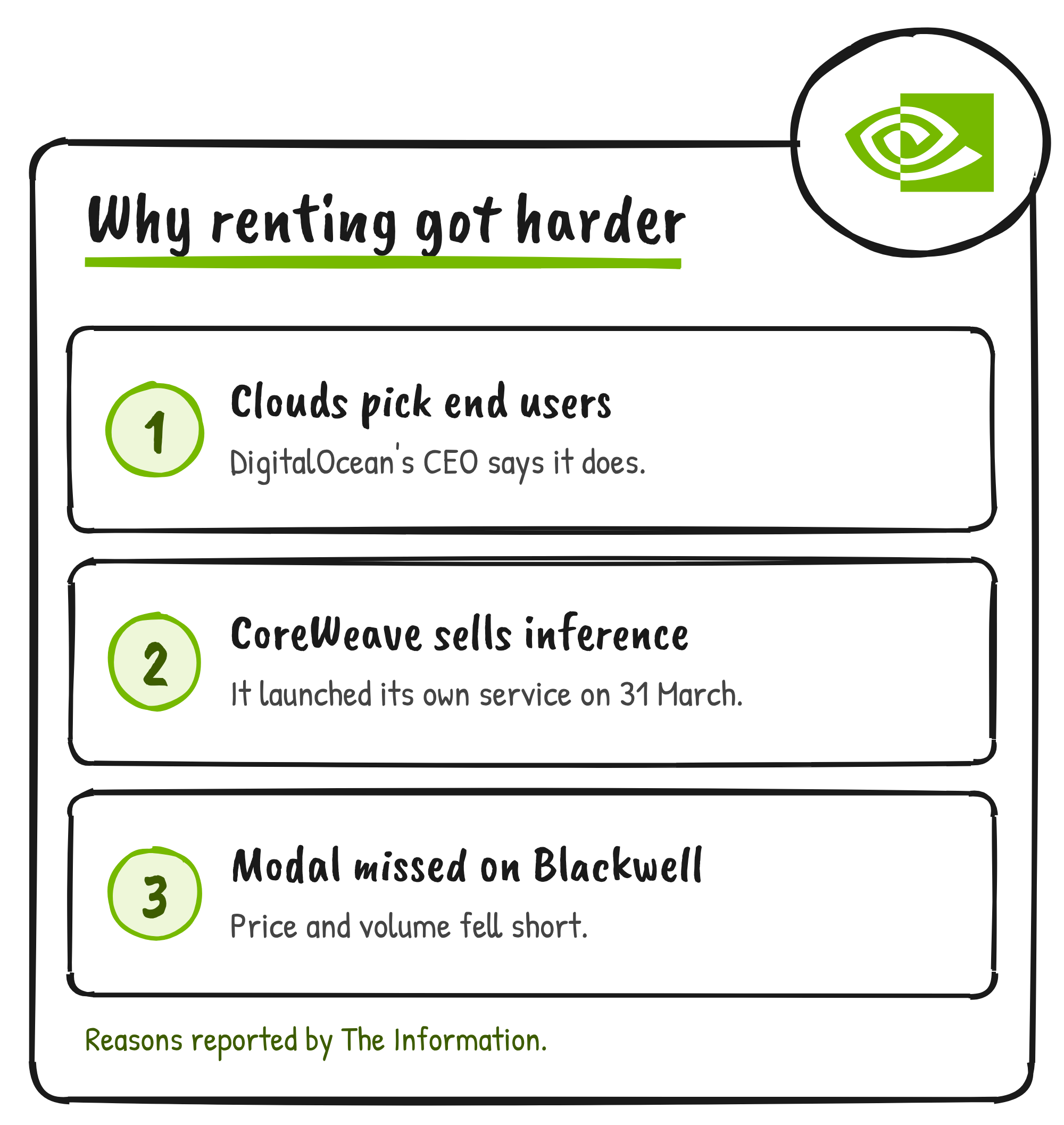
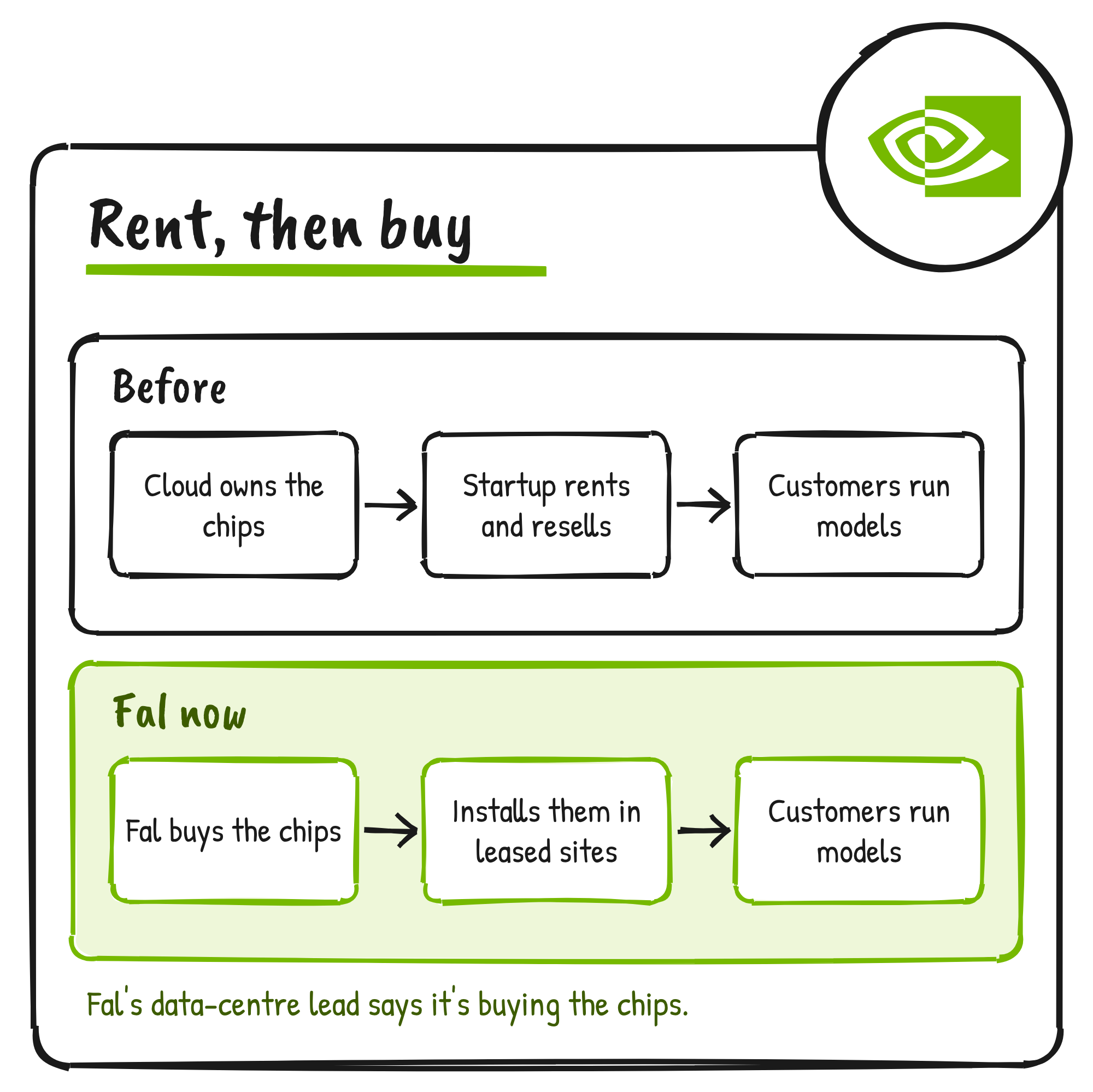
AI inference providers Fal, Together AI and Baseten are buying, or preparing to buy, their own Nvidia chips instead of relying only on cloud providers for capacity, The Information reports. Raghu Rao, Fal’s data-centre lead, told the outlet that Fal is buying Nvidia chips for the data centres it leases.
Catherine Perloff and Stephanie Palazzolo wrote the report, published on 11 November 2026 and shared again on X by the outlet. It’s behind a paywall, so the details here come from its public excerpt, summaries by Dealroom and Shopifreaks, and the companies’ own announcements.
AI inference startups are being forced to rethink their business models as access to computing power tightens. Fal, Together and Baseten are moving to buy their own Nvidia chips rather than rely entirely on cloud providers.
— The Information (@theinformation) November 11, 2026
Read more: https://t.co/TncGpO541i
Why they’re buying
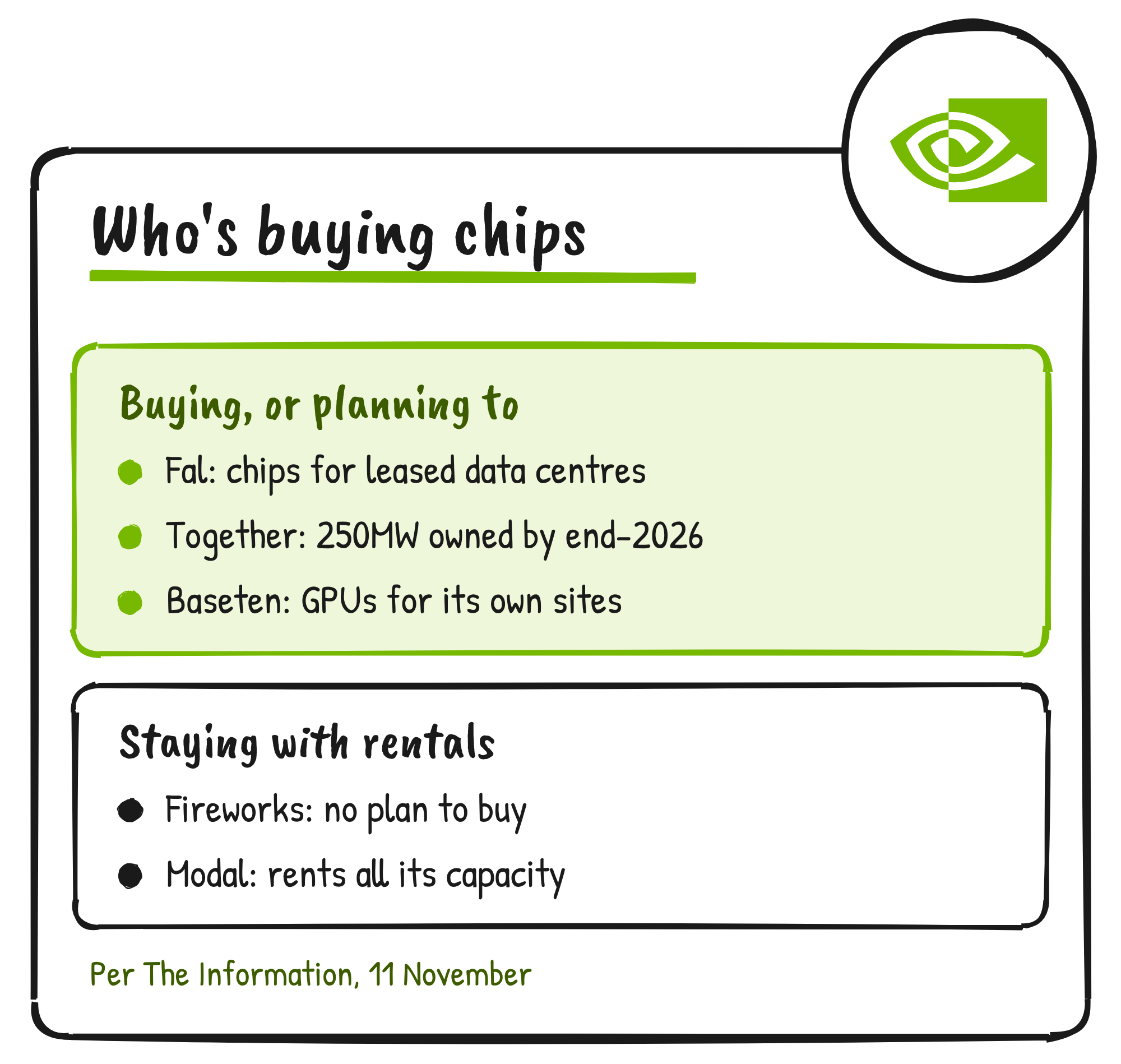
Inference is the step where a trained model answers a prompt. Providers such as Fal, Together, Baseten, Modal and Fireworks run that step for app makers, mostly on Nvidia GPUs, the specialised chips that run the models, rented from cloud providers. The Information reports that rented capacity has become harder to get. DigitalOcean CEO Paddy Srinivasan said his company prioritises customers with their own end users over companies that resell computing capacity. Modal added up to 30 neocloud partners, the newer GPU-focused clouds, after failing to get Nvidia’s Blackwell chips from larger providers at the prices and volumes it wanted.
The margins are thin too. TechCrunch reported on 3 November, citing several people familiar with inference companies’ financials, that their gross margins stay low because of the cost of buying or leasing compute.
What each company is doing
| Company | Move, per The Information | Backing and size |
|---|---|---|
| Fal | Buying Nvidia chips for leased data centres; has discussed debt financing | US$1.65 billion across Series E and F, announced 3 November |
| Together AI | Plans 250MW of owned capacity by the end of 2026 | Valued at US$8.3 billion in July, the New York Times reports |
| Baseten | Plans to buy Nvidia GPUs for facilities it operates | US$13 billion valuation after a US$1.5 billion Series F in June |
| Modal | Rents its capacity; added up to 30 neocloud partners | CEO says it owns no capacity so far |
| Fireworks | Told investors it has no current plan to buy hardware | US$17.5 billion valuation and over US$1 billion in annualised revenue, announced 15 July |
Fal: chips first, debt discussed
Fal runs image, video and audio models for developers. On 3 November it announced a Series E led by Sequoia Capital and a Series F led by Bessemer Venture Partners, with continued investment from Nvidia, for a combined US$1.65 billion. TechCrunch, citing Bloomberg, reports the US$1.3 billion Series F values Fal at US$16 billion, double its April valuation. Fal’s post says the rounds fund inference capacity and its team.
The Information reports that Fal is buying the chips with part of that money and has discussed borrowing to buy more. Rao declined to comment on debt.
Baseten and CoreWeave
Baseten plans to buy Nvidia GPUs for facilities it operates, The Information reports. The company was valued at US$13 billion after a US$1.5 billion Series F announced on 22 June, which it said would go toward talent, compute and enterprise sales. Bloomberg reported on 30 October, citing people familiar with the plans, that Baseten is set to raise new funding at a valuation of up to US$30 billion.
CoreWeave launched its own inference service on 31 March. A person familiar told The Information that CoreWeave then stopped selling compute to Baseten. Someone close to Baseten disputes that, and CoreWeave says its relationships with inference providers are good.
Together’s 250MW
The Information reports that Together plans to have 250MW of capacity in its own data centres by the end of 2026. Separately, Together announced on 31 August a partnership with Saudi Arabia’s Humain that includes a new 250MW data centre there. The New York Times reports that Humain supplies 120,000 chips and Together pays with a share of revenue. Humain expects to deliver the first 7,000 chips by November and reach the full allocation in 2027, the Times says.
Fireworks and Modal are staying with rentals
Fireworks told investors that hardware is a commodity and that it has no current plan to buy, The Information reports. Its Series D announcement on 15 July put it at US$17.5 billion with more than US$1 billion in annualised revenue. Its security bulletin says a third-party cloud provider hosting its research and development machines had a security incident on 23 October, which is covered in Fireworks says hack reached billing data and some model weights.
Modal CEO Erik Bernhardsson said on the Latent Space podcast on 22 October: “We don’t own capacity. We rent all the capacity so far.” He said Modal’s deals are typically three years and often need meaningful money upfront.
Together’s 250MW target runs to the end of 2026, and Humain’s full chip allocation for Together is due in 2027.
Discover more from Sulat AI & Tech News
Subscribe to get the latest posts sent to your email.