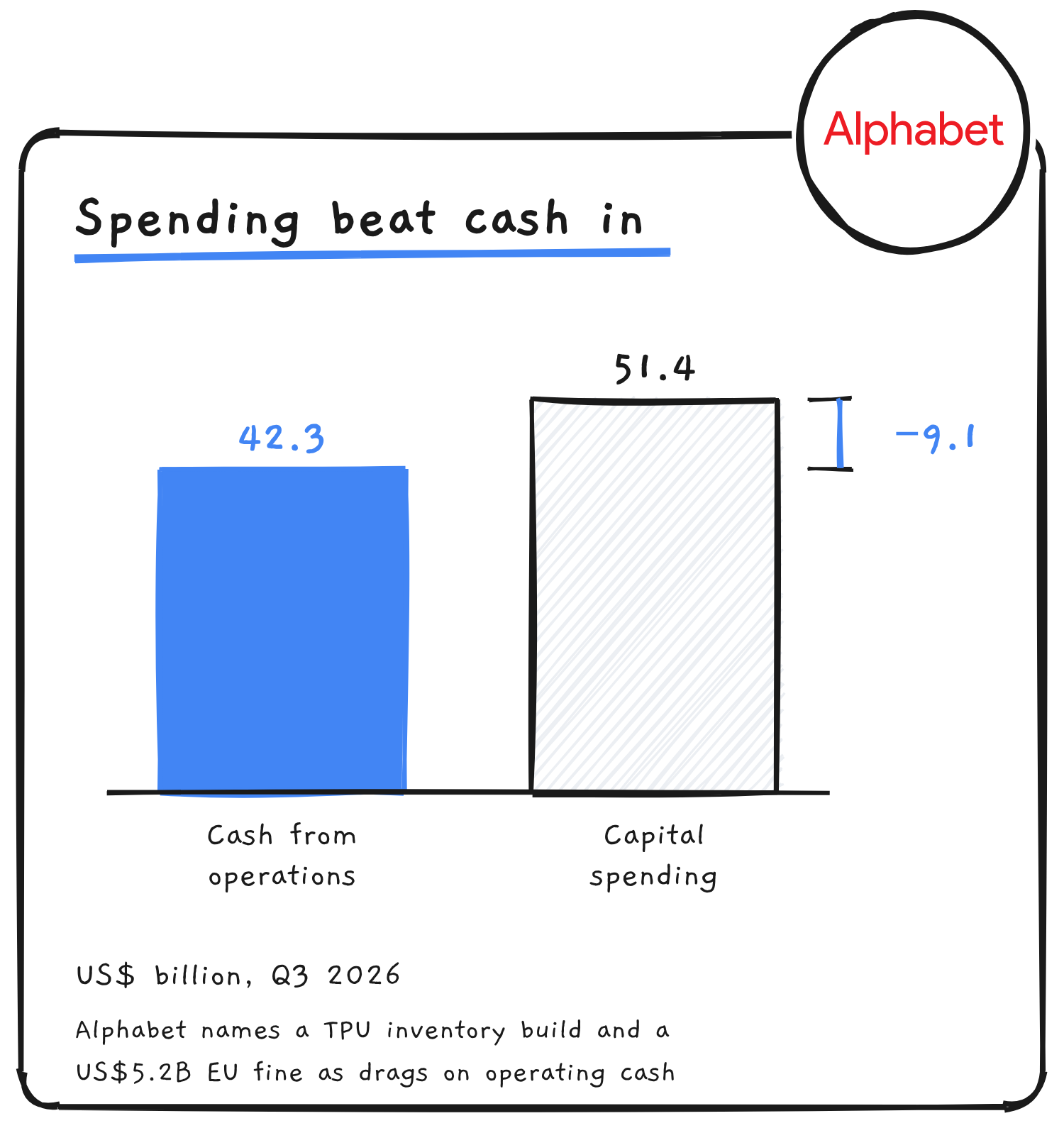
Alphabet’s free cash flow was negative US$9.1 billion in the September quarter, its second negative quarter in a row, according to its third-quarter results. Free cash flow is the cash a business generates from operations minus what it spends on capital equipment, and Alphabet uses that definition itself. It was negative US$5.9 billion in the June quarter and a positive US$24.6 billion in the December 2025 quarter.
Alphabet reported the figures on 28 October 2026 and filed its 10-Q the next day. Reuters reported that the June quarter was the first time Alphabet’s free cash flow had gone negative in its 22 years as a public company. Revenue still rose 25% to US$127.6 billion and operating income rose 30% to US$40.6 billion, so the swing comes from cash going out, not from profit disappearing.
Spending outran cash from operations
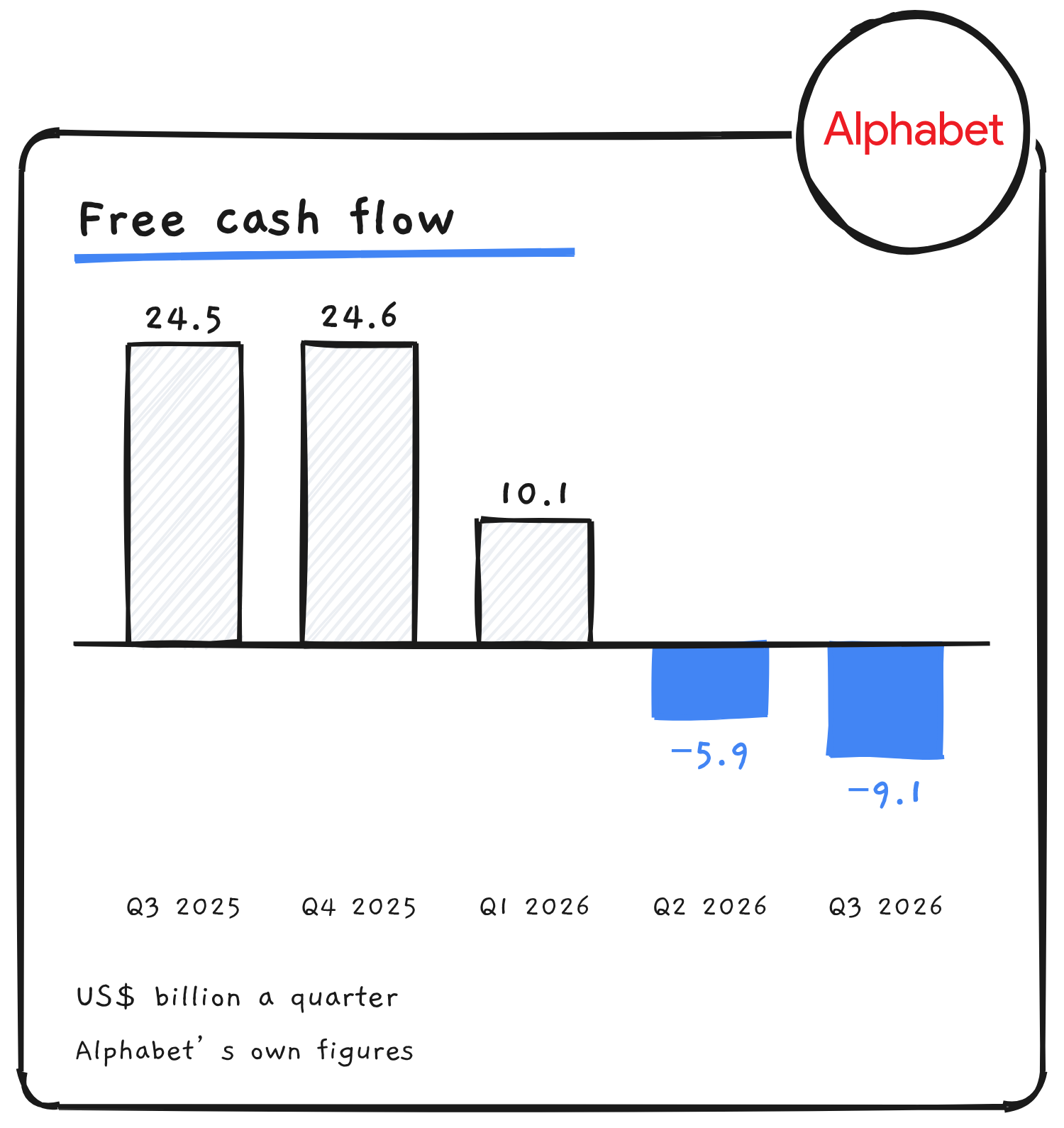
Alphabet’s purchases of property and equipment, its capital spending, were US$51.4 billion in the quarter, up 114% from US$24.0 billion a year earlier. Net cash from operations was US$42.3 billion, down from US$48.4 billion. Chief financial officer Anat Ashkenazi said on the earnings call that about 65% of the technical-infrastructure spending went on servers and networking equipment, and the rest on data centres.
Ashkenazi named two drags on operating cash: a build-up of inventory for sales of Alphabet’s TPU systems, the packages of Google’s own AI chips (tensor processing units) with storage, networking and software, and a US$5.2 billion cash payment of a 2018 European Commission fine after the appeal ended. She said the inventory is built before the customer is billed, so cash goes out first and comes back as the systems are delivered. She expects more of that revenue to arrive through 2027.
How Alphabet covered the gap
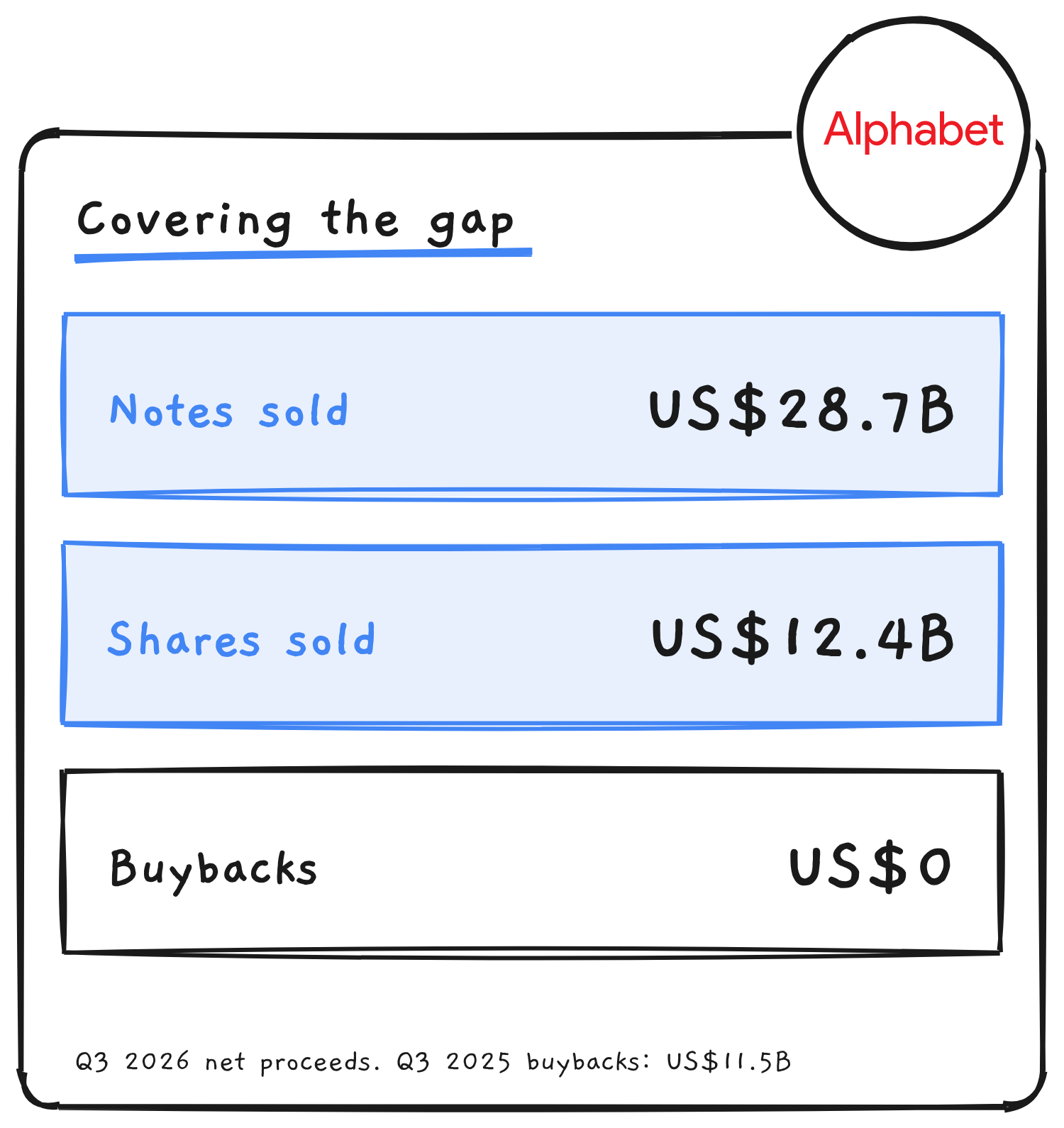
Alphabet’s release says it issued senior unsecured notes for net proceeds of US$28.7 billion in the quarter. It also sold shares under its at-the-market programme, which lets a company sell stock gradually at prevailing prices: 12 million Class A shares for US$4.3 billion and 24 million Class C shares for US$8.1 billion, US$12.4 billion in all. US$27.6 billion remained available under that programme at 30 September.
Alphabet bought back no stock in the quarter, against US$11.5 billion in the same quarter a year earlier. Long-term debt stood at US$125.1 billion and cash and marketable securities at US$265.1 billion, which includes US$90.4 billion of marketable equity securities, Ashkenazi said.
What the market made of it
CNBC reported that analysts had expected negative free cash flow of US$2.7 billion, and that Alphabet came in at negative US$9.07 billion. LSEG data cited by Reuters had analysts expecting the figure to come close to break-even. Alphabet’s shares fell nearly 13% on 29 October, their worst day ever, wiping about US$500 billion off its market value, CNBC reported. The previous record fall was 11.63% in March 2020.
Revenue missed too: Reuters reported US$127.6 billion against an estimate of US$128.2 billion from LSEG, with advertising revenue of US$82.0 billion short of US$83.4 billion. Google Cloud revenue more than doubled to US$30.7 billion.
What Alphabet says comes next
Alphabet kept its 2026 capital-spending guidance at US$195 billion to US$205 billion. It had spent US$132.0 billion by the end of September, so the fourth quarter has to carry roughly US$63 billion to US$73 billion to land inside that range; that range is arithmetic on the 10-Q’s nine-month figure, not an Alphabet forecast. Ashkenazi said capital spending will increase significantly in 2027 and that Alphabet will give details on its fourth-quarter call. Alphabet hasn’t given a 2027 figure.
On free cash flow, Ashkenazi said: “Our sizable investments in technical infrastructure and inventory build of TPU systems as we scale that business will put pressure on free cash flows.” She also said Alphabet expects a return on invested capital “meaningfully above our cost of capital” through the cycle. Jeremy Saltsburg, a senior investment officer at Check Capital, told Reuters that a US$300 billion capital-spending number for 2027 “could potentially scare the market because free cash flow now is finally negative.”
The primary documents are Alphabet’s third-quarter release, its 10-Q and its earnings call transcript. Reuters’ results report and CNBC’s coverage carry the analyst figures.
Discover more from Sulat AI & Tech News
Subscribe to get the latest posts sent to your email.