Google has filed a US patent application for training an AI chatbot to work ads into its answers, scoring the chatbot on both how satisfied raters are with the reply and how likely people are to interact with the ad. The US Patent and Trademark Office published the application, US 2026/0350464 A1, on 5 November 2026.
Bearly AI, which sells a chat app that bundles Claude, GPT, Gemini and Grok and says it carries “No ads. Ever.”, flagged the filing on X on 14 November NZ time. The patent-tracking site Patentlyze had published a plain-English breakdown of the application earlier.
Google recently filed a patent for training AI chatbots for working ads into the answers.
November 13, 2026
Details of training are interesting:
▫️Human raters score answers with ads already in them.
▫️Ads that are “seamlessly integrated” score higher.
▫️The chatbot is then trained on rater satisfaction plus “predicted… revenue or click-through rate.”
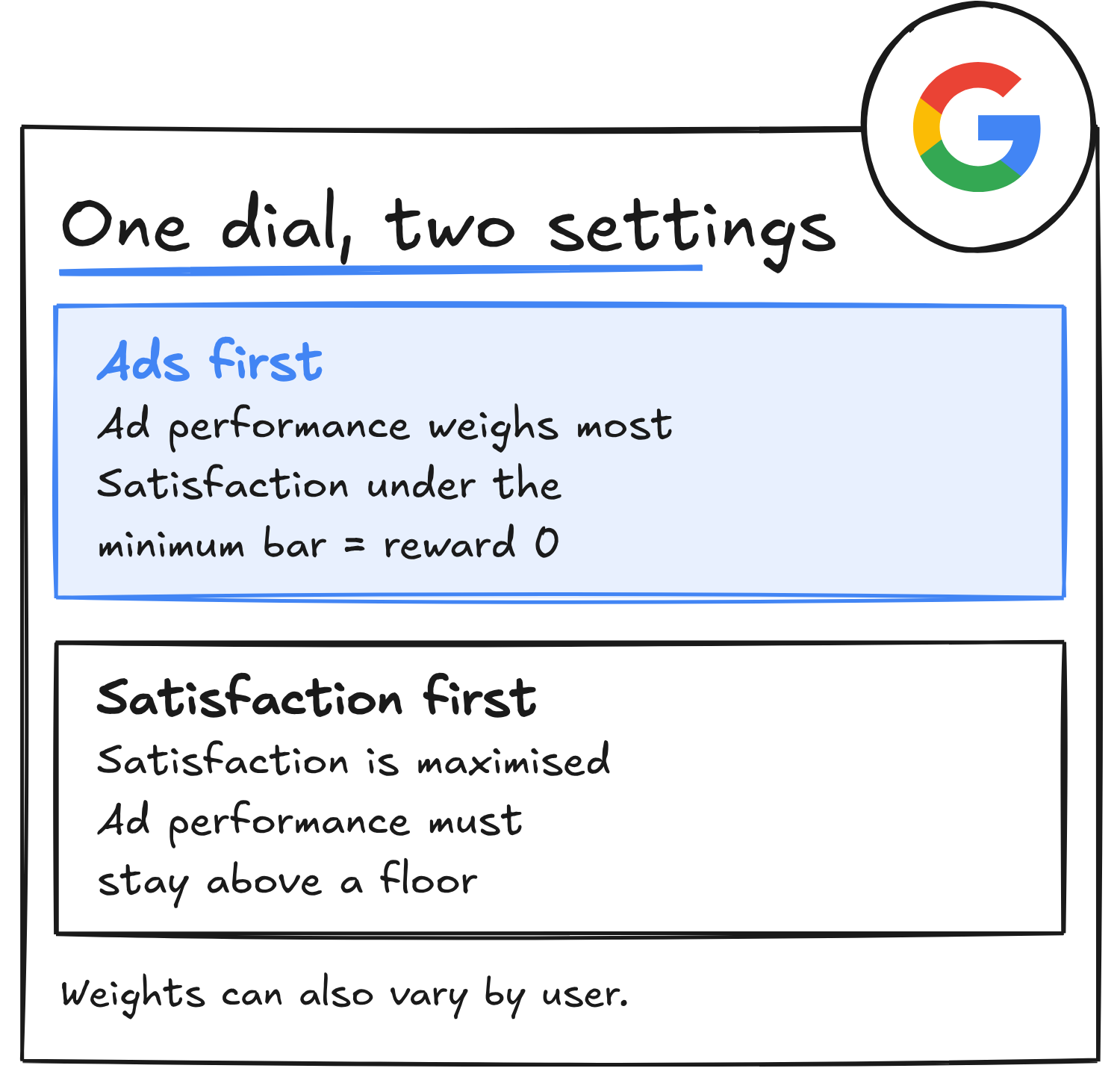
▫️In one setting, ads are weighted “the highest.” If users get too unhappy, the reward is 0.
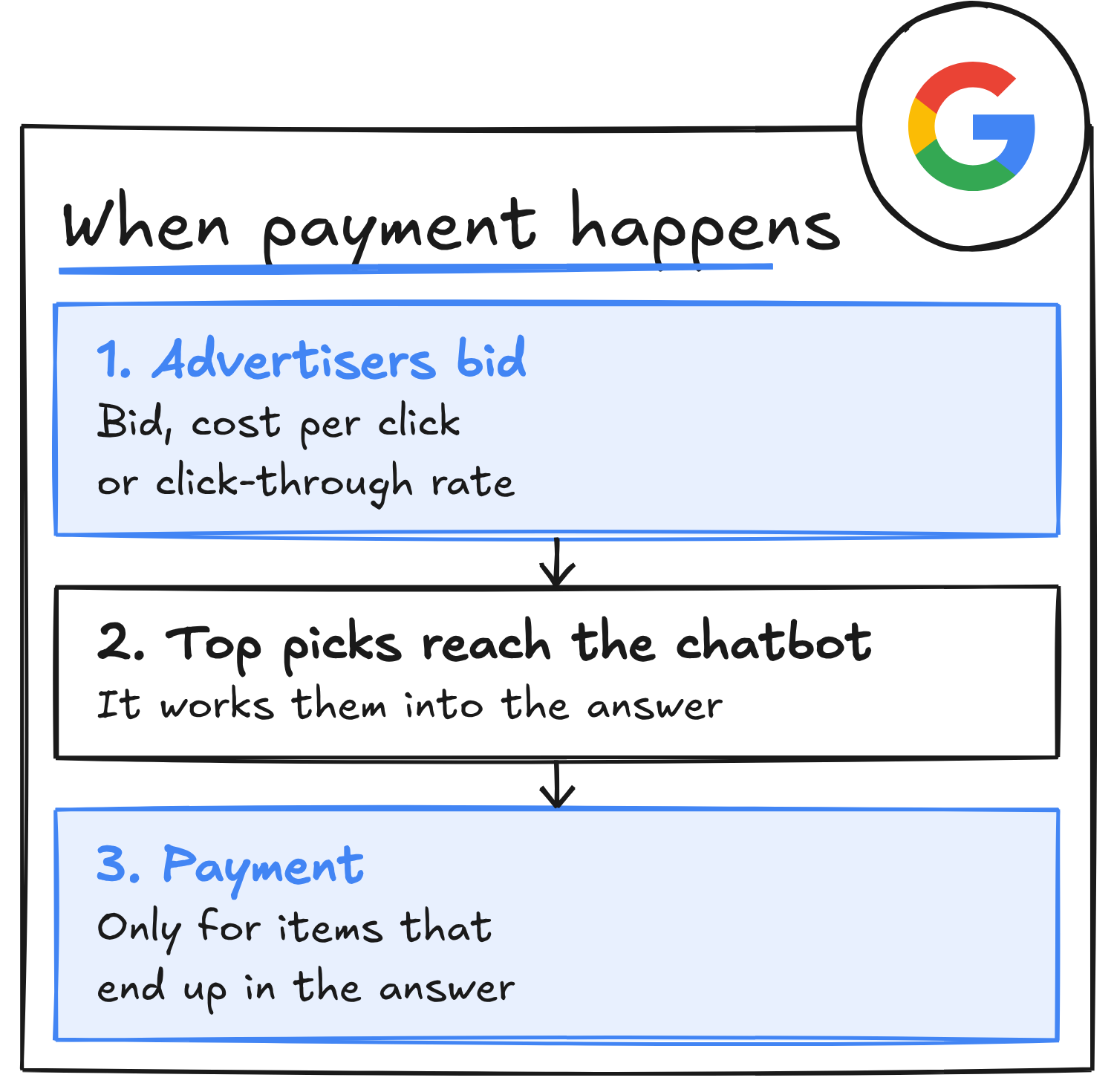
▫️Ads come from a live auction. Google gets paid only if the ad makes it into the answer.
What the filing covers
The application, titled “Multi-Stage Training Process for Sequence Models”, was filed on 1 May 2025 by Google LLC. Its inventors, Florian Nils Hartmann and Duc-Hieu Tran, are both based in Zurich. The document is an A1 publication, the USPTO code for an application that hasn’t been granted. It has 20 claims, all on the training method.
The filing calls the ads “third-party content items” and gives advertisements as an example of that content. Its abstract says the approach “can be used in AI assistants and search engines”.
How the two-stage training works
In stage one, Google trains a reward model, a scoring program that predicts how satisfied a user would be with an answer. The training uses reinforcement learning from human feedback (RLHF). Human raters score several answers to the same query, and each answer contains at least one third-party item. The answers are generated with temperature sampling, a setting that adds randomness to the model’s word choices. The reward model’s weights are adjusted until its predicted scores converge with the raters’ scores, according to claims 2 and 3.
The description says raters favour smooth placement: “a content item that is seamlessly integrated into the natural language response can receive a higher user preference ranking than one that simply inserts the content item in without a smooth transition”. It adds that an item judged relevant to the response is associated with higher satisfaction than one that appears irrelevant.
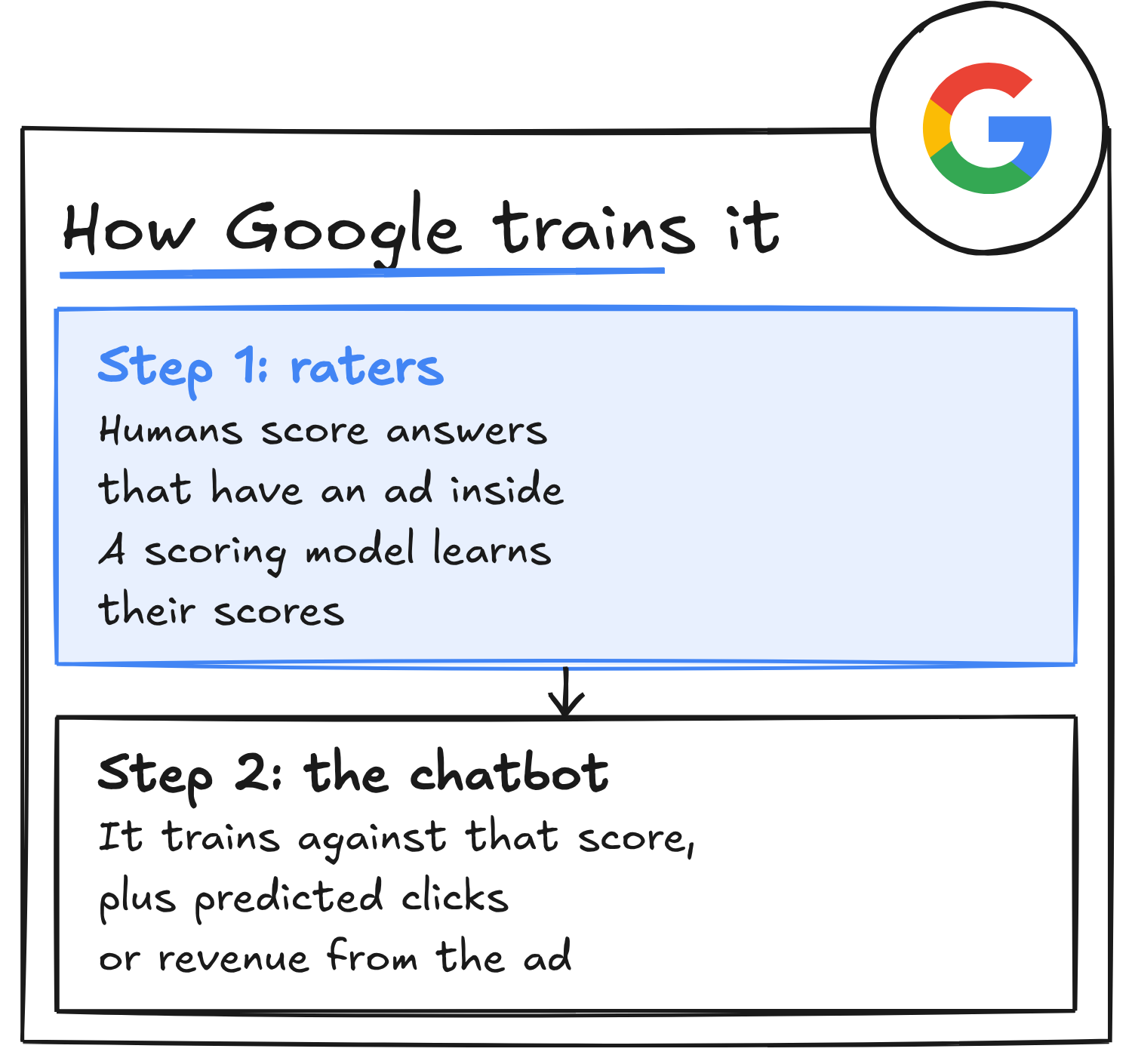
In stage two, the chatbot itself is trained with a loss function, a formula that measures how far the model’s output is from the target. Claim 1 says the loss combines the satisfaction metric from the trained reward model with “predicted interaction metrics” for a third-party item integrated into the chatbot’s answer. The description adds an optional third component, a score for whether the answer is factually correct. It says the components can be combined linearly, with a weight on each, and weighted differently by use case or by session.
The filing also names the failure it’s built to avoid. A model that chases immediate reward, it says, “might prioritize including as many third-party content items as possible, even if it degrades the quality or relevance of the response”.
Where the weight goes
The description gives two settings for the balance. In the first, a content item’s performance metric “can be weighed the highest while maintaining a minimum threshold that the user satisfaction metric should exceed”, and if that threshold isn’t reached the reward model generates a reward of 0. In the second, satisfaction is maximised while item performance is kept above a threshold. The filing adds that the two metrics can be weighted individually by user characteristics.
Training can continue after launch. The filing describes training on live feedback such as thumbs up, thumbs down or implicit signals, and says the training can run on the user’s device so feedback stays private. Instead of human raters, the reward model can be trained with AI feedback, or with a written set of principles known as constitutional AI, according to claims 10 and 11.
Where the ads come from
The filing says candidate items can be pre-selected for a query, or chosen in real time by calling a third-party content provider. That selection can include bidding: the top candidates are picked on a value the provider defines, such as a bid, cost per click or click-through rate. The filing then says “a payment will only be made for the content item(s) that are incorporated into” the chatbot’s output. Bearly’s post says Google gets paid under that rule; the filing doesn’t name who receives the payment.
Other Google ad filings
Ads inside chatbot conversations already exist outside this filing. TechCrunch reported on 1 May 2025, relaying Bloomberg, that Google’s AdSense network had started supporting ads inside chats with some third-party AI chatbots. Patentlyze also lists a separate Google application, US 2026/0186628 A1, published on 2 July 2026, that times ads to the pauses in a chatbot’s reply.
The 5 November application covers training only. Its 20 claims cover the two-stage method.
Discover more from Sulat AI & Tech News
Subscribe to get the latest posts sent to your email.