HubSpot replaced its chief executive on 12 November, eight days after it guided fourth-quarter revenue below the third quarter. Co-founder Brian Halligan is back in the job, and the company calls it a “refounding.” In the release and 8-K, HubSpot also reaffirmed its fourth-quarter and full-year guidance. The guidance is the problem the new CEO inherits.
The explanation HubSpot gave investors on its third-quarter call was that AI is changing how buyers find software. The numbers say that is only part of it. Fewer small customers are signing up, and HubSpot has spent the year changing how it prices to them.
What HubSpot reported
Third-quarter revenue rose 17% to $947.6 million, according to the results release. The guide for the fourth quarter is $945 million to $947 million, up 12%. That is below the quarter just reported. Full-year net new annual recurring revenue is now expected to fall year on year, and net revenue retention fell to 101%, with the company expecting it to finish the year about two points lower.
Net customer additions are the clearest signal. HubSpot has given no figure for the fourth quarter and says it expects it to be below 5,000.
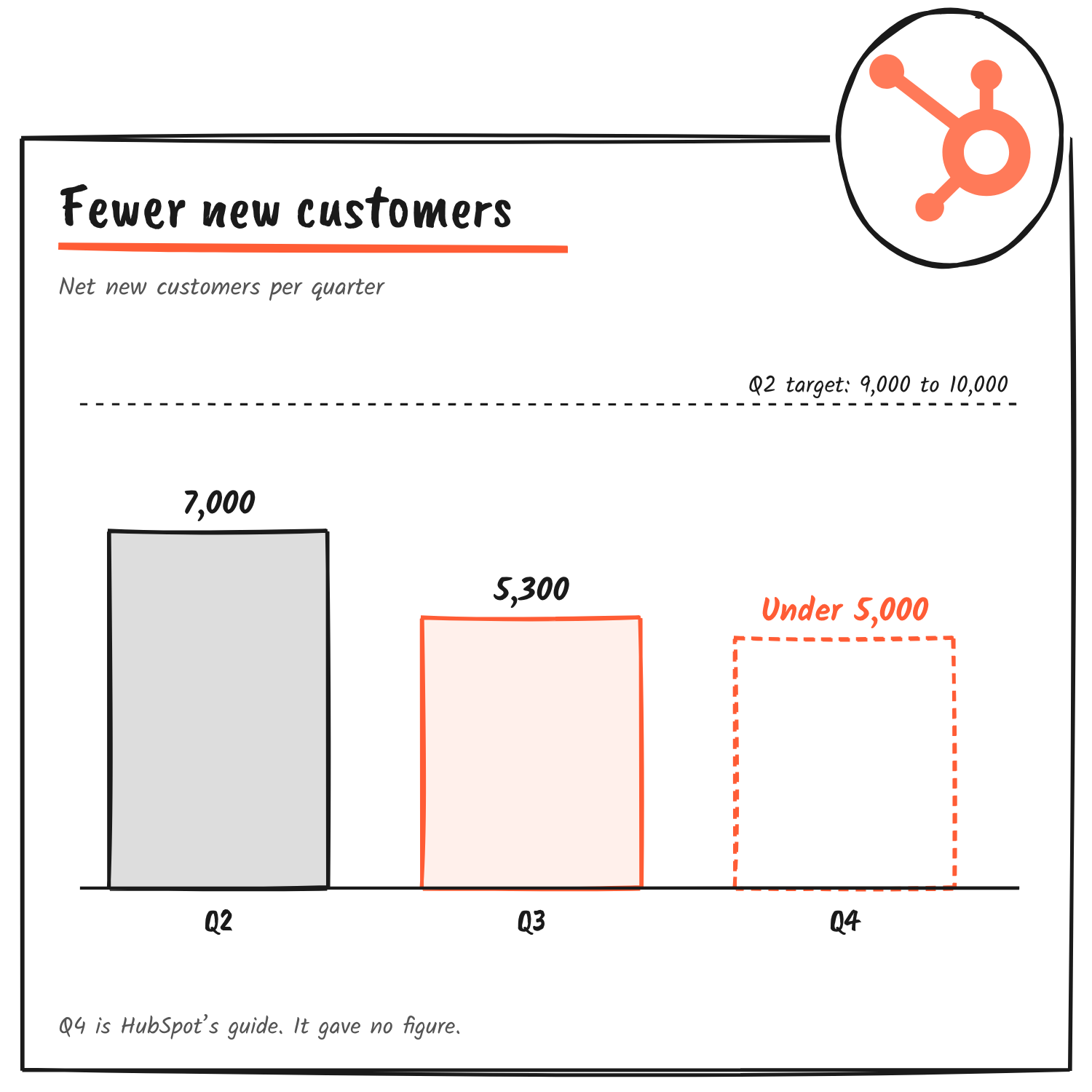
| Quarter | Net new customers | HubSpot’s own expectation |
|---|---|---|
| Q2 2026 | 7,000 | 9,000 to 10,000 |
| Q3 2026 | 5,300 | 5,000 to 6,000 |
| Q4 2026 | No figure given | Below 5,000 |
In August HubSpot also cut its full-year revenue guide to $3.678 billion to $3.686 billion in its second-quarter results. Investing.com reported the shares fell about 21% in after-hours trading. By the Bloomberg count carried by The Next Web, they have lost about half their value this year.
The AEO explanation
On the call, Yamini Rangan said “inbound demand remains under pressure” as AI changes how buyers discover software. HubSpot is answering with answer engine optimisation, connectors for ChatGPT and Claude, and intent-based marketing. She also said those new channels “are nascent, and they don’t really meet the changes in the inbound demand.”
HubSpot’s own marketing team tells a different story. A case study on its blog, updated on 10 November, six days after the results, says HubSpot is the most visible CRM in AI answers, with a 1,850% increase in qualified leads from AI and 3x the conversion rate of other sources. The post gives no starting figure for that 1,850%. If those numbers hold, discovery is working for HubSpot’s marketing team.
The shortfall sits somewhere else. In August the company blamed the miss on “weaker conversion rates and increased buyer hesitancy.” In November the CFO said net adds reflect “continued demand pressure and increased buyer hesitancy, particularly downmarket.” Those are problems after a buyer has found HubSpot. HubSpot also says its net add figure is driven disproportionately by Starter and Pro customers, which is where it has been changing price and packaging.
Pricing is the lever HubSpot is pulling
Since April, HubSpot has moved its Customer Agent and Prospecting Agent to outcome-based pricing, at $0.50 per resolved conversation and $1 per lead recommended. Credits sell at $10 per 1,000. In a pilot that began in the Nordics in April and the Benelux in June, and which it extended across EMEA for new customers in the fourth quarter, it removes separate hubs, narrows the jump from Starter to Pro, and puts usage-based features under one credit mechanism. HubSpot says the pilot lowers average selling prices, and it reports credit use two to three times higher than outside the pilot.
The company calls these changes deliberate and says it is putting long-term growth ahead of short-term net adds. That is a defensible bet. It also means HubSpot is accepting weaker customer numbers and lower prices now, and asking investors to wait for credits to make up the difference.
Eight days
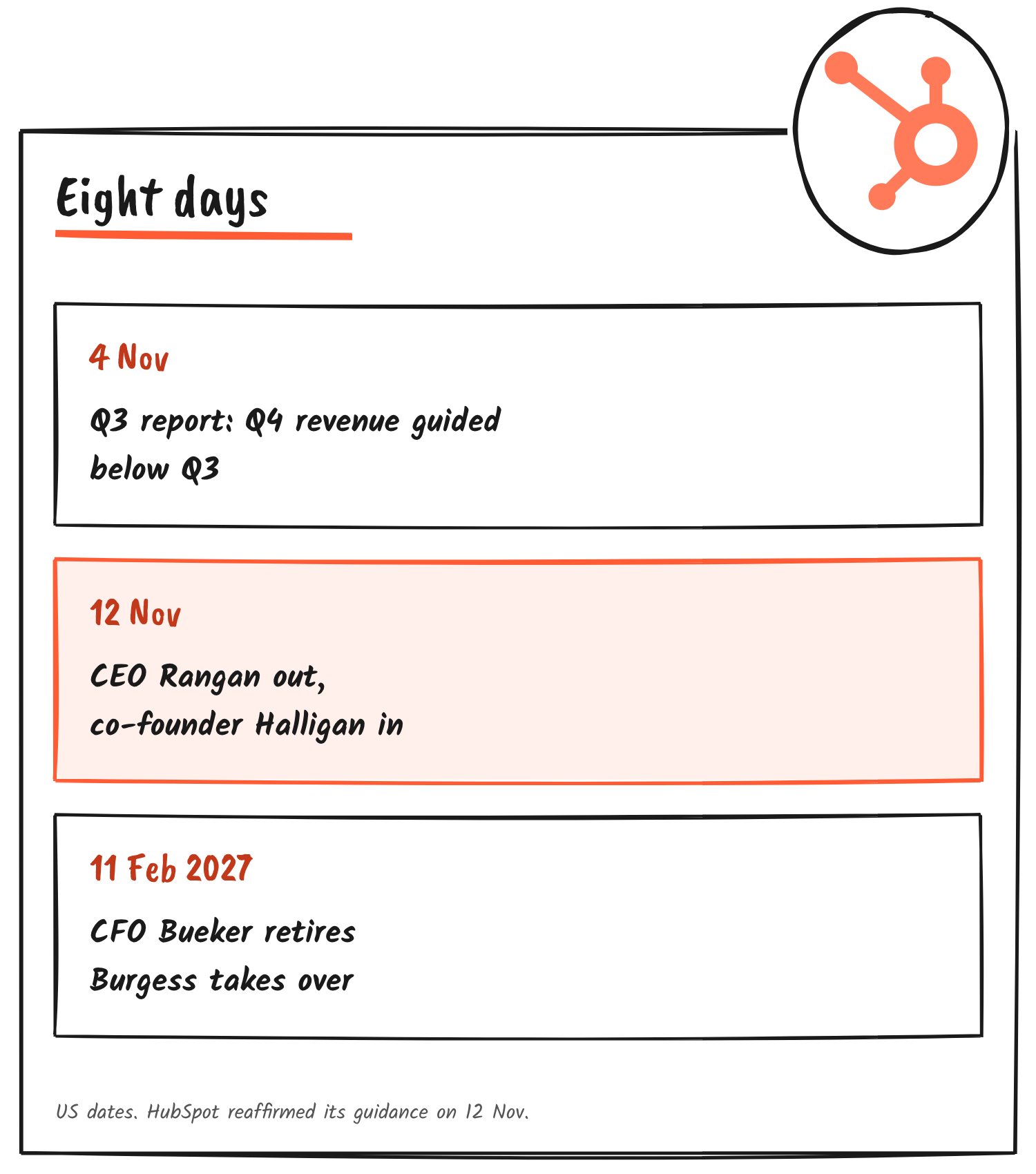
Halligan told Bloomberg that HubSpot may have focused too much on short-term financial targets, and added: “I don’t know if you looked at the last earnings, but the numbers aren’t great.” The board’s own wording, in a statement from chair Lorrie Norrington, is that it is “united in its support of his refounding.”
Halligan announced his return on X.
The announcement has few specifics. Halligan has said he will overhaul product, go-to-market and culture, and that he wants to avoid HubSpot being “swallowed up by a private equity firm.” Chief financial officer Kate Bueker retires on 11 February 2027, which HubSpot calls long planned, and Adobe’s Karen Burgess takes over. HubSpot says it will disclose Halligan’s pay as CEO by amending the 8-K. HubSpot’s shares rose more than 6% on the day, TechTarget reported.
Buybacks and layoffs
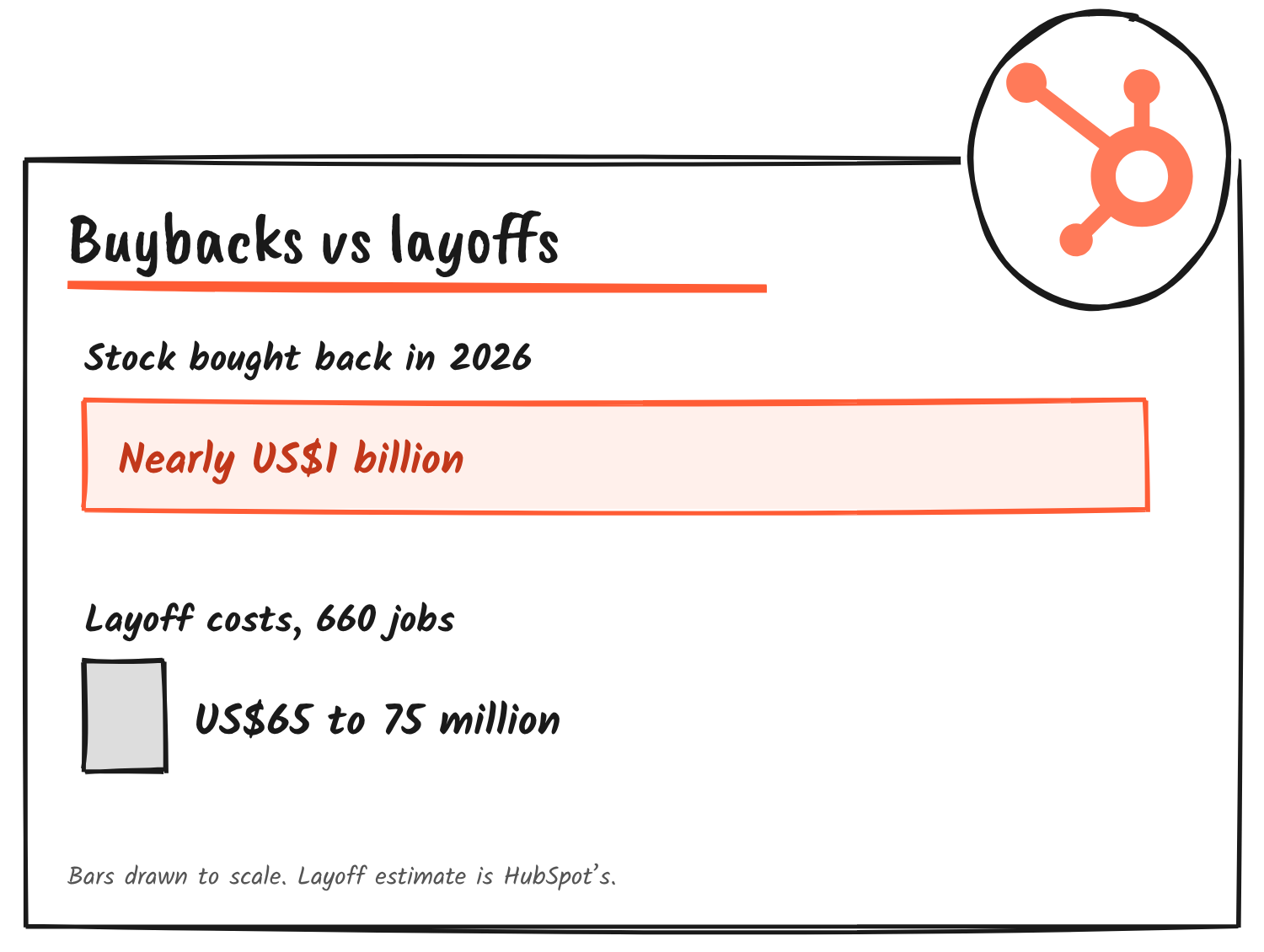
HubSpot cut nearly 660 jobs, about 7% of its staff, on 6 October. It estimated charges of $65 million to $75 million, mostly severance and related payments. Over the same year it has bought back nearly $1 billion of its own stock, including $237 million in the third quarter, according to the CFO.
Halligan is also a seller. A Form 4 shows 8,500 shares sold on 20 October at $239.57, about $2 million, under a 10b5-1 trading plan adopted on 12 March 2026. The shares were held by Wolf Investors, LLC, whose sole member is a trust Halligan set up. Filings show the same 8,500-share sale each month since June. The plan predates his return as CEO, and the sales are pre-arranged. They are still a matter of record for anyone weighing a founder’s “refounding.”
What HubSpot gets credit for
HubSpot is not in trouble on profit. Third-quarter non-GAAP operating margin was 23%, free cash flow was $188 million (20% of revenue), and it expects about $720 million of free cash flow for the year. Under Rangan, customers grew from 135,000 to more than 311,000 and revenue from $1.3 billion to an expected $3.7 billion. Analyst Predrag Jakovljevic of Technology Evaluation Centers told TechTarget the company remains profitable and cash generative, and that it must show its AI agents deliver measurable returns so customers pay for credits willingly.
TechTarget’s own verdict was blunter, calling the CEO change “just the latest HubSpot dumpster fire.” It also reported that CTO Dharmesh Shah apologised for a “curt and insensitive” LinkedIn post about the October layoffs.
What to watch
The fourth quarter is HubSpot’s most important, and the company has said it will report actual net adds in February. If credit use keeps climbing, the pricing bet will start to look like it is working. If net adds, retention and net new ARR keep falling, answer engines will not be the explanation.
Disclosure: I signed up for HubSpot’s startup programme and a trial in October 2025.
Discover more from Sulat AI & Tech News
Subscribe to get the latest posts sent to your email.