
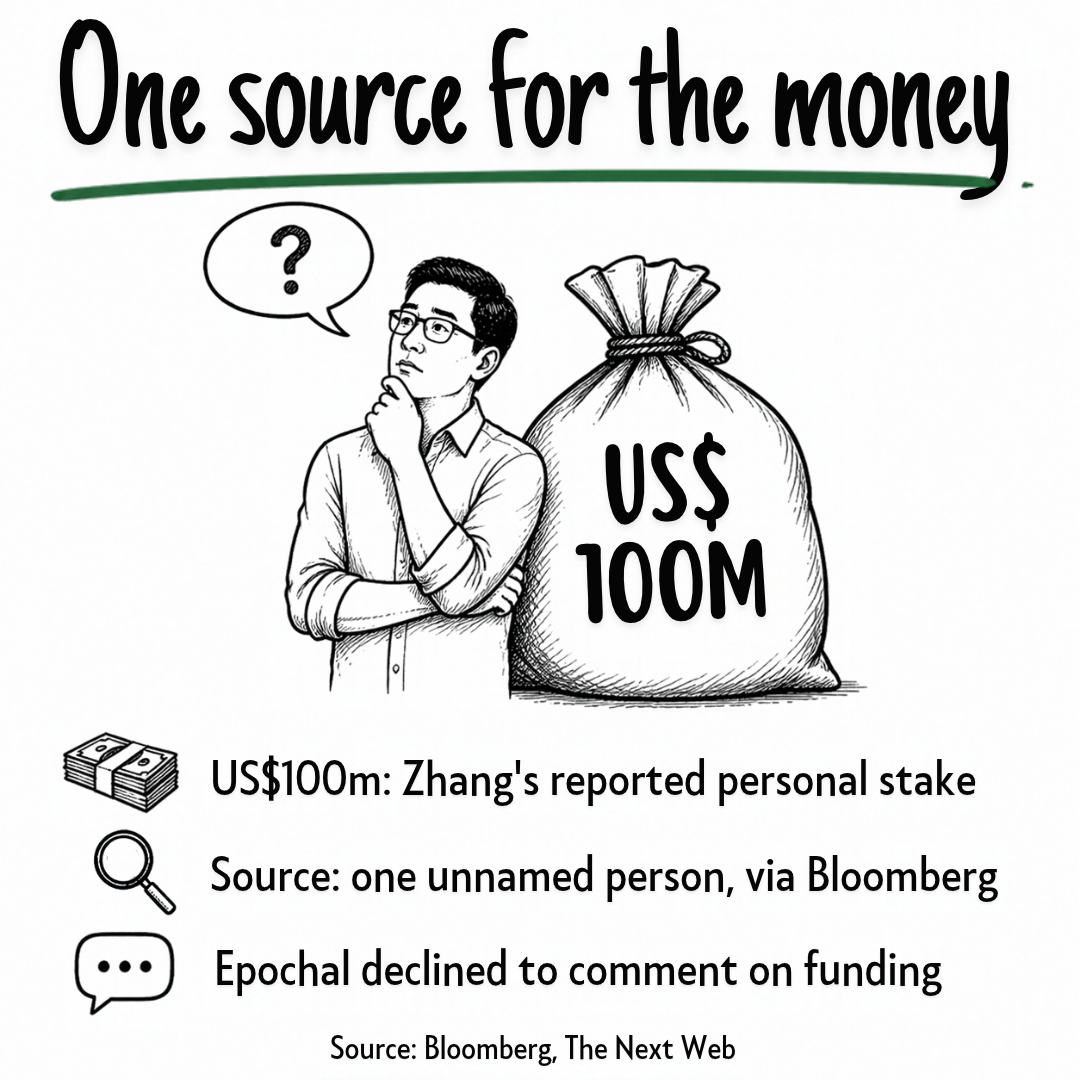
Three of xAI’s co-founders, Guodong Zhang, Zihang Dai and Manuel Kroiss, have launched Epochal, a startup that wants to teach AI to predict the future. Its first product, Time Portal, serves the web as it stood at any moment the user picks. Bloomberg reports that Zhang is putting in US$100 million of his own money, a figure that rests on one unnamed source.
Epochal announced the company and Time Portal on 24 November. Its post describes the gap it’s chasing in one line: “Today’s AI has read almost everything and lived through almost nothing.” The company says it’s building “a time machine for the internet to simulate the past and teach AI to predict the future.” It says it built the first product in 90 days, and it’s hiring in Palo Alto for engineering, post-training and business operations roles.
US$100m
Zhang’s reported personal stake, per one Bloomberg source
347
live questions in Epochal’s replay test
0.98
correlation of replay errors with the live originals
100
free search and fetch requests per organisation
Who is behind it
Bloomberg’s Natasha Mascarenhas and Carmen Arroyo report that Zhang, Dai and Kroiss left xAI after Elon Musk merged it with SpaceX in February. The Next Web reported on 28 March that all of xAI’s 11 other co-founders had gone by then, and that xAI was valued at US$250 billion when SpaceX acquired it. Kroiss led pretraining. Epochal’s team also includes Alex Bocharoff and Frank Luan, and Bloomberg says staff from xAI, OpenAI, Anthropic and Google DeepMind have joined. Other departed co-founders have started companies too: Igor Babuschkin’s River AI raised US$1.1 billion in August.
The money is the thin part. Bloomberg’s source says Zhang is investing US$100 million personally. An Epochal spokesperson declined to comment on funding, and The Next Web found no other investors named. Until Epochal confirms the figure, it’s one person’s account of the number.
How Time Portal works
Time Portal is three APIs, for search, fetch and sandbox, served from api.epochal.com. Every request carries an API key and an Accept-Datetime header, the as-of instant. The instant has to be in the past. Search and fetch go back to 1 January 1970, and the sandbox starts on 1 April 2023. A bare date resolves to 23:59:59 UTC that day.
Search ranks only pages published or updated at or before the instant. A time-aware reranker handles words whose meaning drifted, and Epochal’s example is “copilot” in June 2019 against July 2021. Pages that have since died are tombstoned.
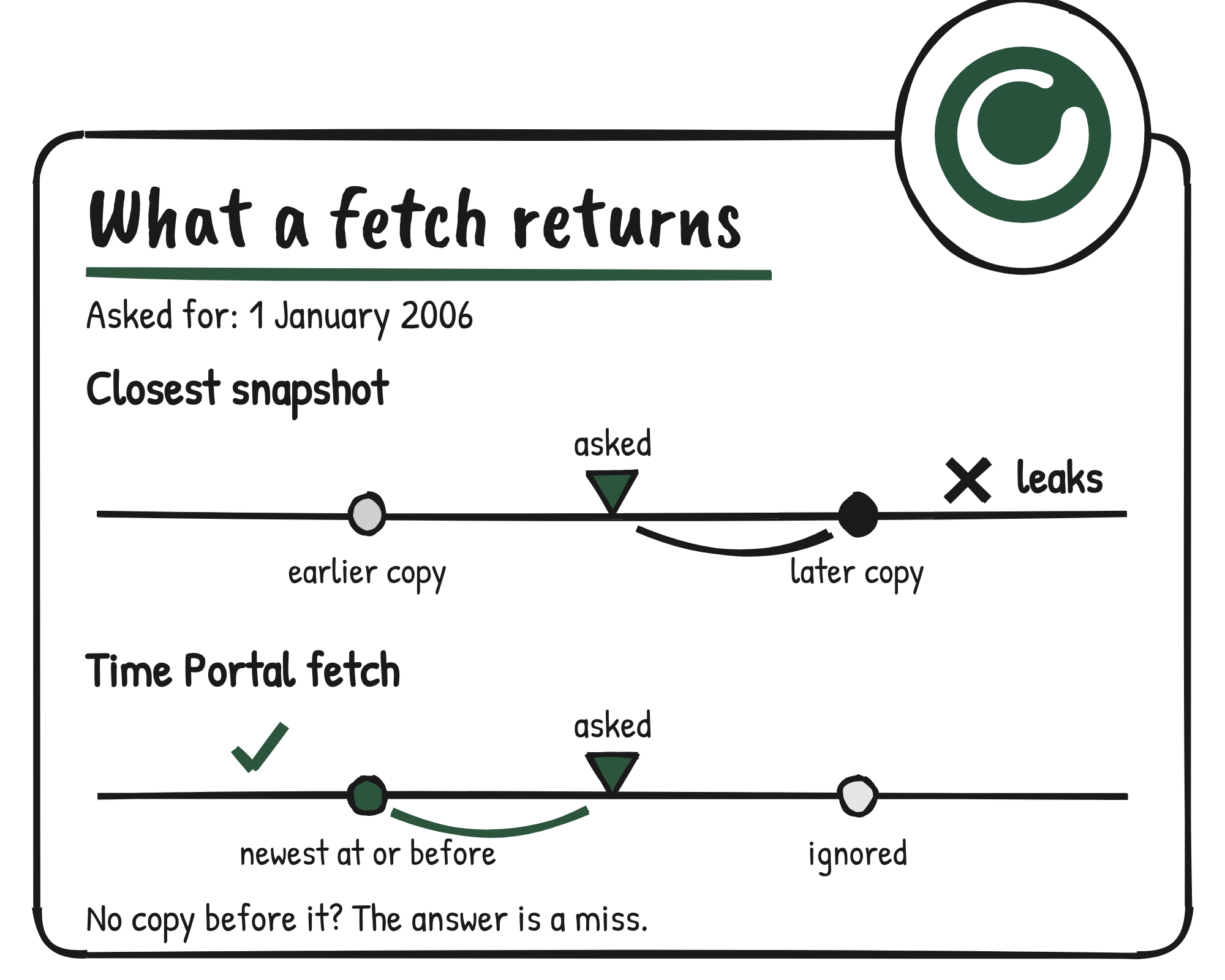
Fetch is strict. It returns the newest capture at or before the instant, and if there isn’t one it returns an error, never the nearest copy and never a later one. Epochal contrasts that with the Wayback Machine’s availability API, which returns the closest snapshot. In its example, a request for example.com on 1 January 2006 came back with a copy captured later that day. That’s Epochal’s test of a rival, and I haven’t repeated it. The Memento standard, RFC 7089, leaves it to servers whether to return the nearest copy or the nearest earlier one.
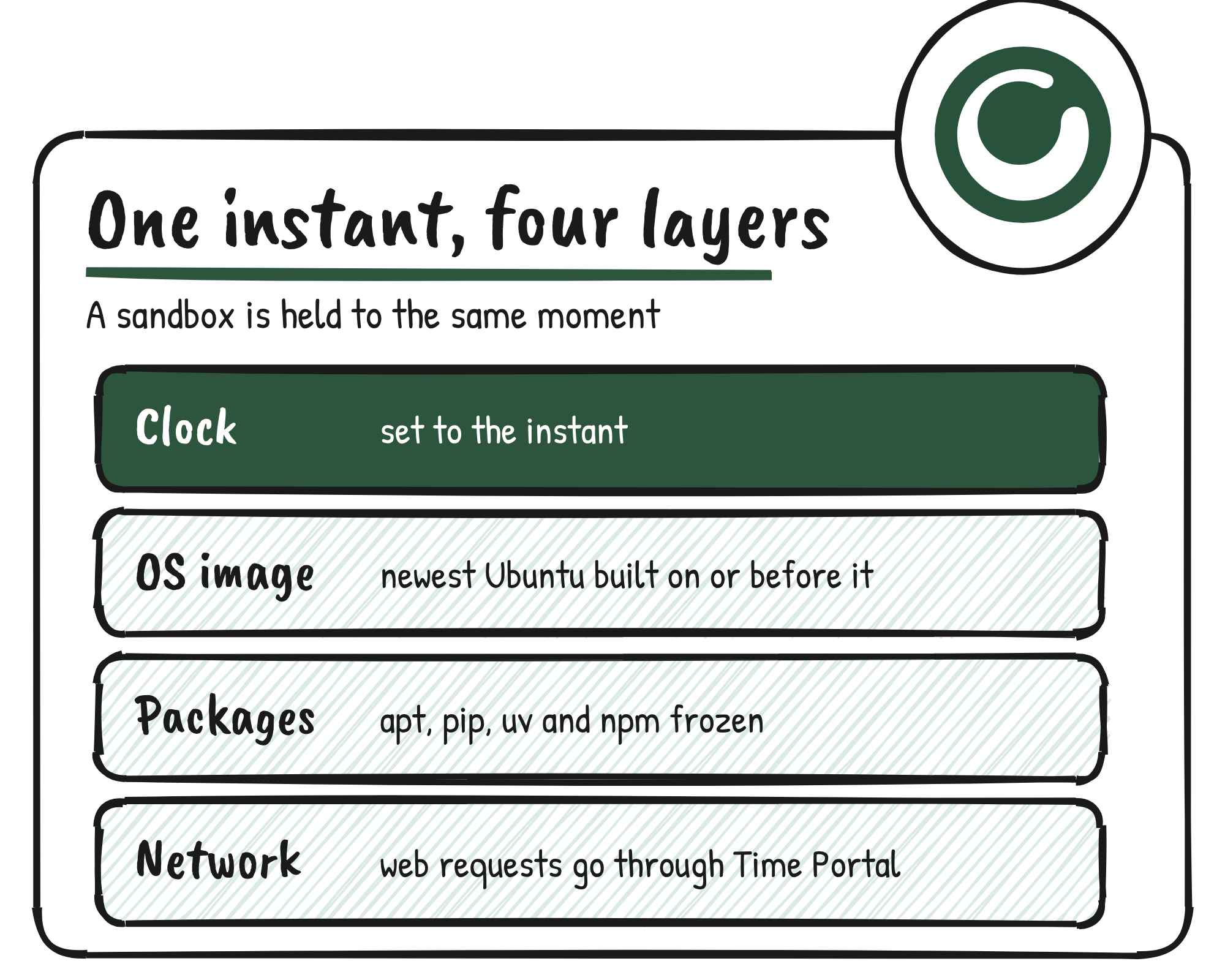
The sandbox applies the same rule to a whole machine. It’s a microVM whose clock is set at the kernel level. It boots the newest quarterly Ubuntu image built on or before the instant, with the apt, pip, uv and npm mirrors frozen at that date. All HTTP and HTTPS traffic, including curl and Python requests, goes through Time Portal.
What the engine holds
Epochal’s engine post gives the scale. The content store is built on Lance over S3-compatible storage, with MinHash deduplication and fingerprinting rewritten in Rust, which it says is about 10 times faster. On 13 November one URL was captured 2,082 times, a median 48 seconds apart, and it changed 690 times. About one page in 100 has five or more versions. Of every 100 pages offered for indexing in the week to 20 November, 56 became new versions, 25 were near-copies of another URL, 13 were exact copies and six repeated the page’s own content. Epochal says searches about the past ran three to four times slower than searches about today in its benchmarks.
The crawler fetches more than 10 billion pages a day, Epochal says, against “hundreds of millions” for the Wayback Machine, a figure it attributes to the Internet Archive. Those numbers are the company’s own.
Getting in
There are Python and Rust SDKs, a command-line tool, an MCP server, a console playground that needs no key, and a visualiser at visualizer.epochal.com. The PyPI packages epochal-api and epochal-sandbox went out on 24 November at version 0.1.2. The model key stays local, but prompts and replies pass through Epochal’s API. Every organisation gets 100 search and fetch requests and one hour of sandbox time free. Paid plans are by contact only.
The command-line example from Epochal’s docs
epochal time-portal run --model claude-sonnet-5-5 --as-of 2024-10-06 "Will AI research win a Nobel Prize this year?"Does it stop the future leaking in?
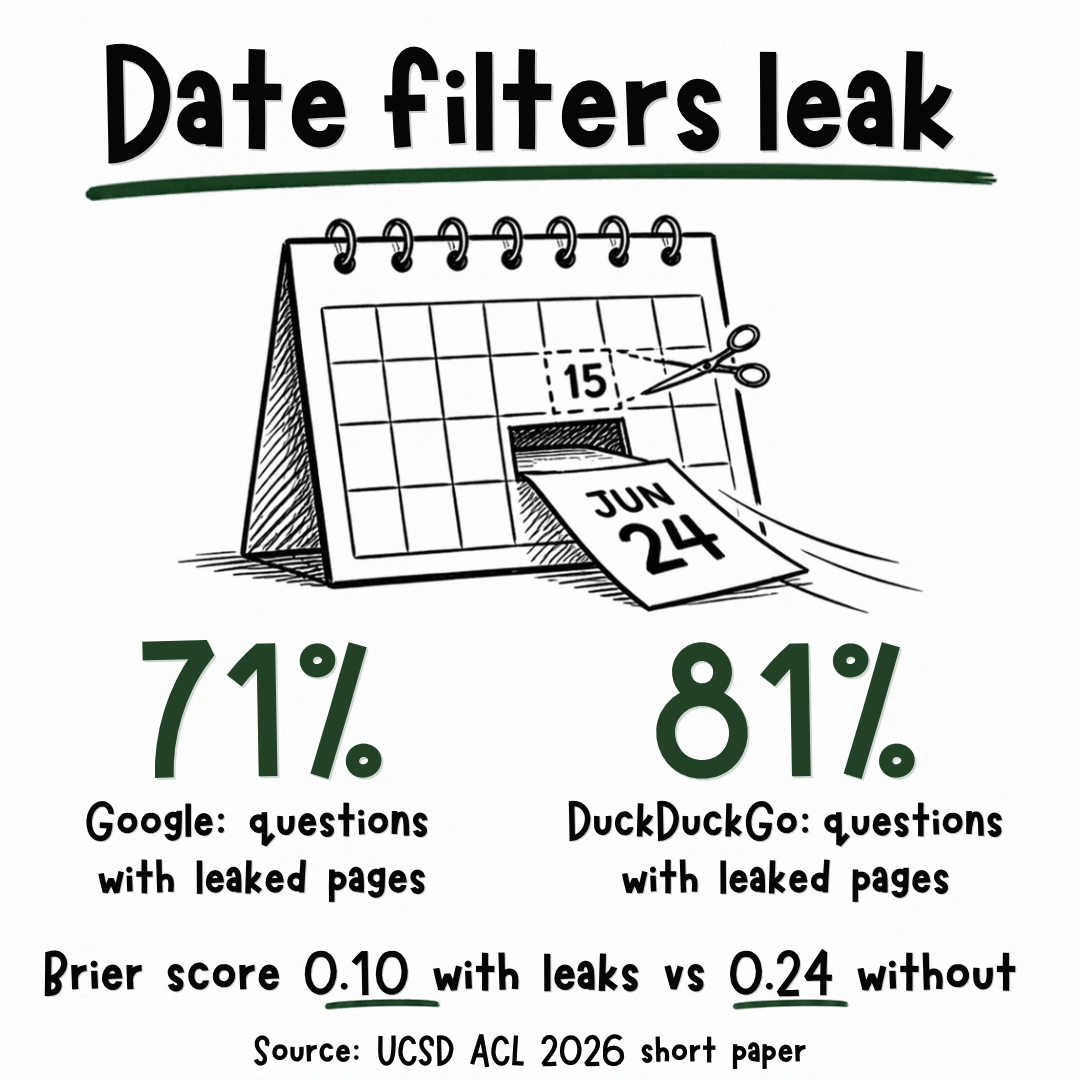
That’s the question the product exists to answer. Epochal points to the September 2025 SWE-bench Verified issue, where coding agents read future commits through git log --all. An ACL 2026 short paper from UCSD found the same problem in web search. Date-filtered Google and DuckDuckGo returned at least one page with major post-cutoff leakage for 71% and 81% of questions, and revealed the answer outright for 41% and 55%. With gpt-oss-120b the Brier score, where lower is better, was 0.10 with leaks against 0.24 without. The paper’s leaks came from page updates, related-content modules, unreliable metadata and absence-based signals, and it recommends frozen, time-stamped snapshots. That’s close to what Time Portal sells.
Epochal’s own test is a replay. It forecast 347 live Kalshi and Polymarket questions, then replayed them weeks later with the as-of set to each original forecast time, and compared the errors. Replay errors correlated with the original live errors at 0.98 for Time Portal, 0.49 with no web access and 0.16 with the live web after resolution. Epochal reports no significant deviations.
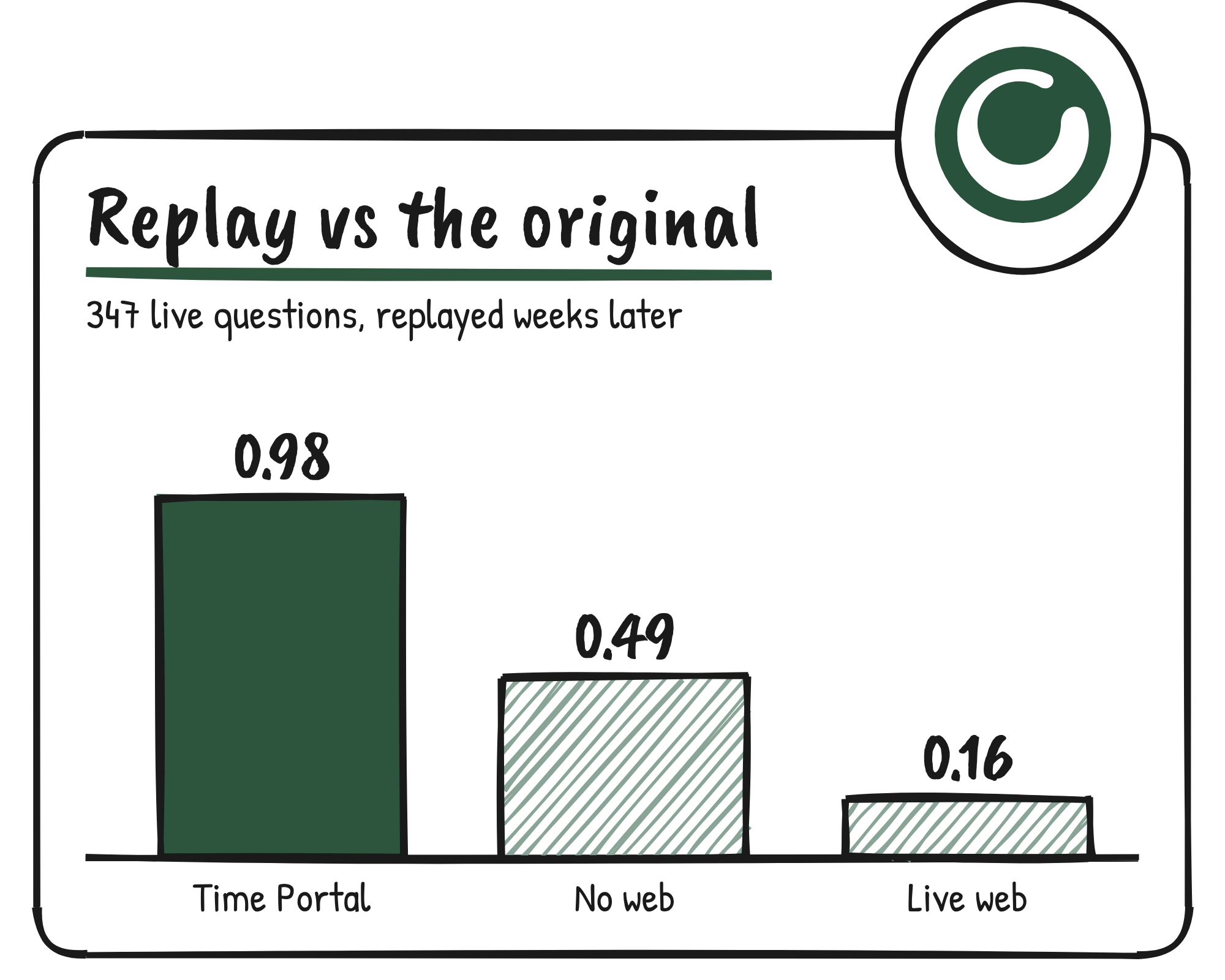
That’s a fidelity test, not an accuracy test. It shows a replay behaves like the original run. It doesn’t show Time Portal makes forecasts better. The post gives three correlations and no question list or error tables.
Epochal lists its own limits. The model’s weights aren’t gated, so a model trained after the cutoff can recall outcomes. Each run should use one Accept-Datetime and no live web requests. Not every URL has a snapshot at every time, and fetch errors rather than serving a newer copy. Apps mounted in a sandbox are current builds. The sandbox’s files and output are discarded when it stops.
Where it sits among forecasting efforts
Epochal isn’t a benchmark. It’s the plumbing for running historical tests without leakage, so it sits beside the benchmarks rather than against them. FutureSearch’s BTF-3 already runs pastcasting against a frozen web corpus. Prophet Arena’s Time-Gated Search Benchmark scores search engines for leakage and has an interface for adding engines. Epochal wasn’t on the list of engines I read.
| Effort | What it does | Latest figure |
|---|---|---|
| ForecastBench (FRI) | 500 questions every two weeks, half from markets, half from datasets; Brier Index | Top entry 69.4 against a superforecaster median of 68.1 on 17 Nov |
| Metaculus | Human Pros against bots over seasons of questions | Pros have beaten the best bots every season so far |
| Prophet Arena | Live sealed forecasts scored on prediction markets; time-gated search benchmark | Scores engines for leakage; accepts new engines |
| FutureSearch BTF-3 | Pastcasting against a frozen web corpus | 2,386 resolved questions (2,015 binary, 371 numeric) |
| FABench (arXiv 2610.40940) | 287 questions across nine domains, 29 Oct | Retrieval improved the Brier score of all eight models |
Read the ForecastBench line with care. Its organisers said on 16 July that models were statistically indistinguishable from superforecasters, but the human baseline dates from July 2024 and the confidence intervals overlap. On FABench, the best three models scored slightly above Polymarket consensus on 54 Polymarket-linked questions.
The yardstick everyone uses is prediction markets. Kalshi traded US$114.6 billion in contracts between 21 October and 19 November, 76% of prediction-market volume, according to DeFi Rate. That counts contracts at US$1 face value. The Block reports that more than a dozen US states have taken action over its sports contracts.
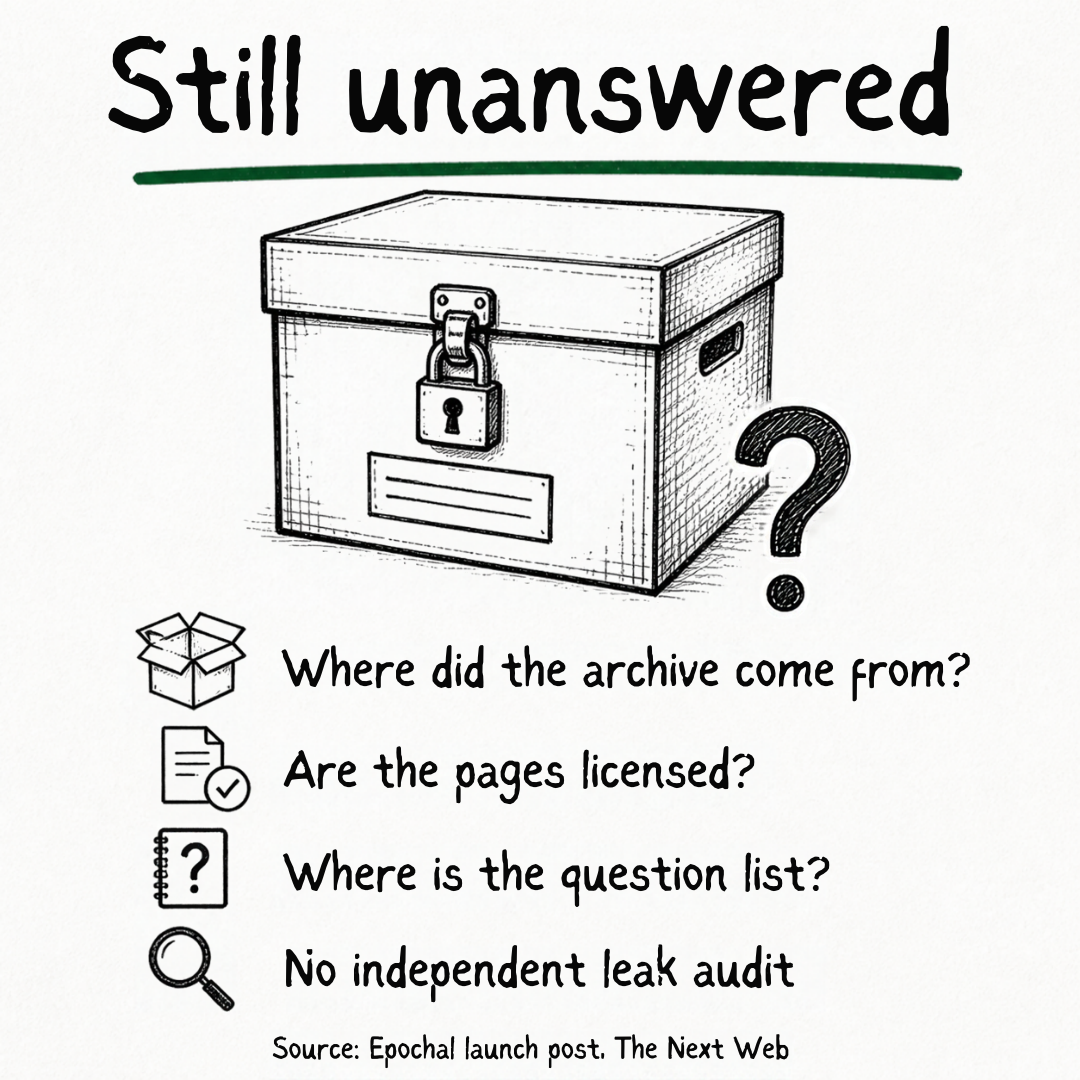
What Epochal hasn’t said
| Question | What’s on the record |
|---|---|
| Who funds it | One Bloomberg source says Zhang is investing US$100 million. Epochal declined to comment on funding, and no other investors are named. |
| Valuation or raise | None disclosed. |
| Where the archive came from | Epochal hasn’t said how it gathered the pages or whether they’re licensed. |
| Accuracy | Three fidelity correlations. No question list, no error tables. |
| Independent leak audit | None found. Not on the Prophet Arena engine list I read. |
| Pricing | 100 free requests and one sandbox hour, then contact sales. |
| A forecasting model | I found no published model of its own, or a date for one. |
Epochal says it will share experiments “in the coming days”. The number to watch is accuracy on questions that resolved after a model’s training cutoff, with the question list published. That would tell us whether a faithful replay also makes better forecasts.
Sources
- Epochal, Introducing Time Portal, 24 November 2026
- The Next Web, three xAI co-founders launch Epochal, 24 November 2026
- Bloomberg, “XAI Founders Unveil New AI Startup to Predict Future Events”, 24 November 2026
- FABench, arXiv 2610.40940, 29 October 2026
Discover more from Sulat AI & Tech News
Subscribe to get the latest posts sent to your email.