A data extortion group calling itself Inception has listed seven companies on a new leak site since 17 November, and two security firms say it’s running a phone-based campaign to steal single sign-on (SSO) logins. BleepingComputer reports that none of the seven has publicly confirmed a breach. Okta’s threat team says the people behind the campaign previously fed the ShinyHunters leak site. Inception says that’s wrong.
7
companies named on Inception’s leak site
21
confirmed SSO phishing domains, per ReversingLabs
41
more domains it attributes with high confidence
21 Oct
how far back ReversingLabs says to check your logs
What Inception claims
The leak site, titled “Inception, Chapter 1”, named five US companies on 17 November: Advanced Micro Devices (AMD), Cigna Healthcare, Henry Schein, Paychex and PepsiCo. AutoZone followed on 19 November and Lucid Motors on 21 November, per ReversingLabs. Each listing is marked “leaked” with an expired deadline. The Register reports that none of the seven has confirmed a breach and none answered its questions.
| Company | Listed | What’s been checked |
|---|---|---|
| AMD | 17 Nov | Claim only. Not examined by Ransomnews. |
| Cigna Healthcare | 17 Nov | Ransomnews examined the published file: 421,661 IT service desk tickets from a ServiceNow system, the newest dated 31 October. |
| Henry Schein | 17 Nov | Claim only. Not examined by Ransomnews. |
| Paychex | 17 Nov | Claim only. Not examined by Ransomnews. |
| PepsiCo | 17 Nov | Ransomnews examined the published file: 500,817 rows of names, job titles and work emails, with no passwords or phone numbers. |
| AutoZone | 19 Nov | Claim only. |
| Lucid Motors | 21 Nov | Claim only. ReversingLabs found a lure domain that sends visitors to a NetIQ sign-in path. |
Ransomnews says the Cigna and PepsiCo files match what the group described. It found callers’ names, callback numbers, internal IP addresses and device names in the Cigna tickets, and no passwords or phone numbers in the PepsiCo file. Names, job titles and ticket numbers are what a caller needs to sound like a real colleague to a help desk.
How the campaign works
ReversingLabs says the campaign has run since late October and uses phone calls, not email. None of the legal-themed lure domains has an MX, DKIM or DMARC record, so they can’t receive or send mail. They exist only to serve a login page to someone who’s already on the phone with the attacker.
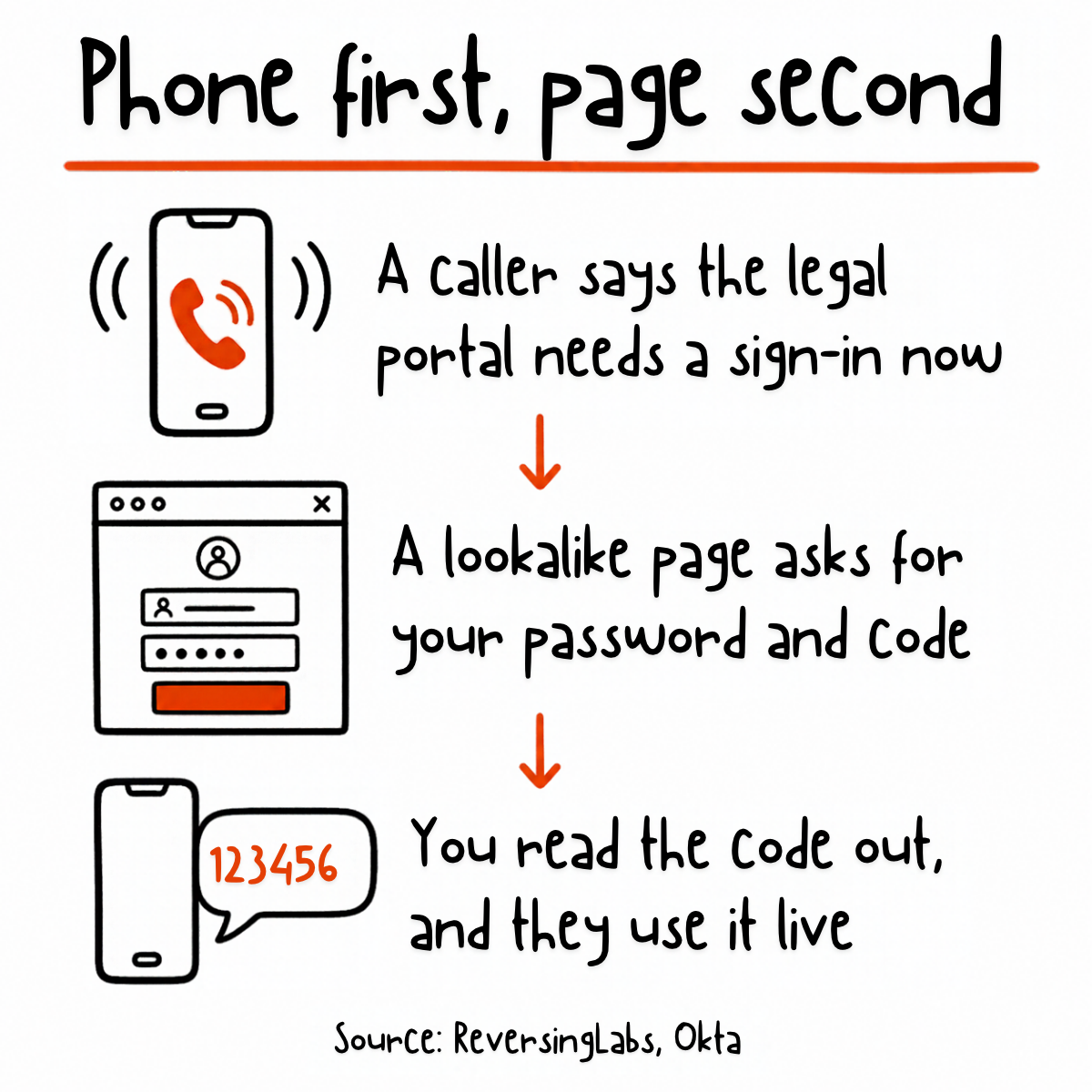
Okta’s advisory, published on 23 November, describes callers who pose as support staff and push a user to reset a password urgently. The phishing kit first collects the username and password, then asks for MFA factors. While the caller talks the user through it, the user reads out one-time passcodes or approves push notifications. With that, the operators reach the company’s SaaS apps and pull data to extort the victim. Okta says the crew changes its domain themes every four to six weeks.
The current “legal” theme started in late October. Okta lists the naming patterns:
legal-<target>[.]com
legaldept-<target>[.]com
<target>[.]legal
<target>-legal[.]com
ReversingLabs analysed the 21 confirmed domains and found a filtered kit. Visitors the kit isn’t set up to attack get forwarded to the target’s real Okta tenant, such as amd.okta[.]com or pepsico.okta[.]com, which makes a scanner or a curious employee see nothing odd. The kit matches each target’s identity provider: Lucid’s lure used a NetIQ and OpenText Access Manager path instead of Okta. Registrations landed in an evening window between 18:00 and 00:59 UTC, mostly through the registrar NICENIC, and the domains moved behind Cloudflare within minutes. Okta says Cloudflare challenges block scanners from the live domains, which has stopped it analysing the kit in depth.
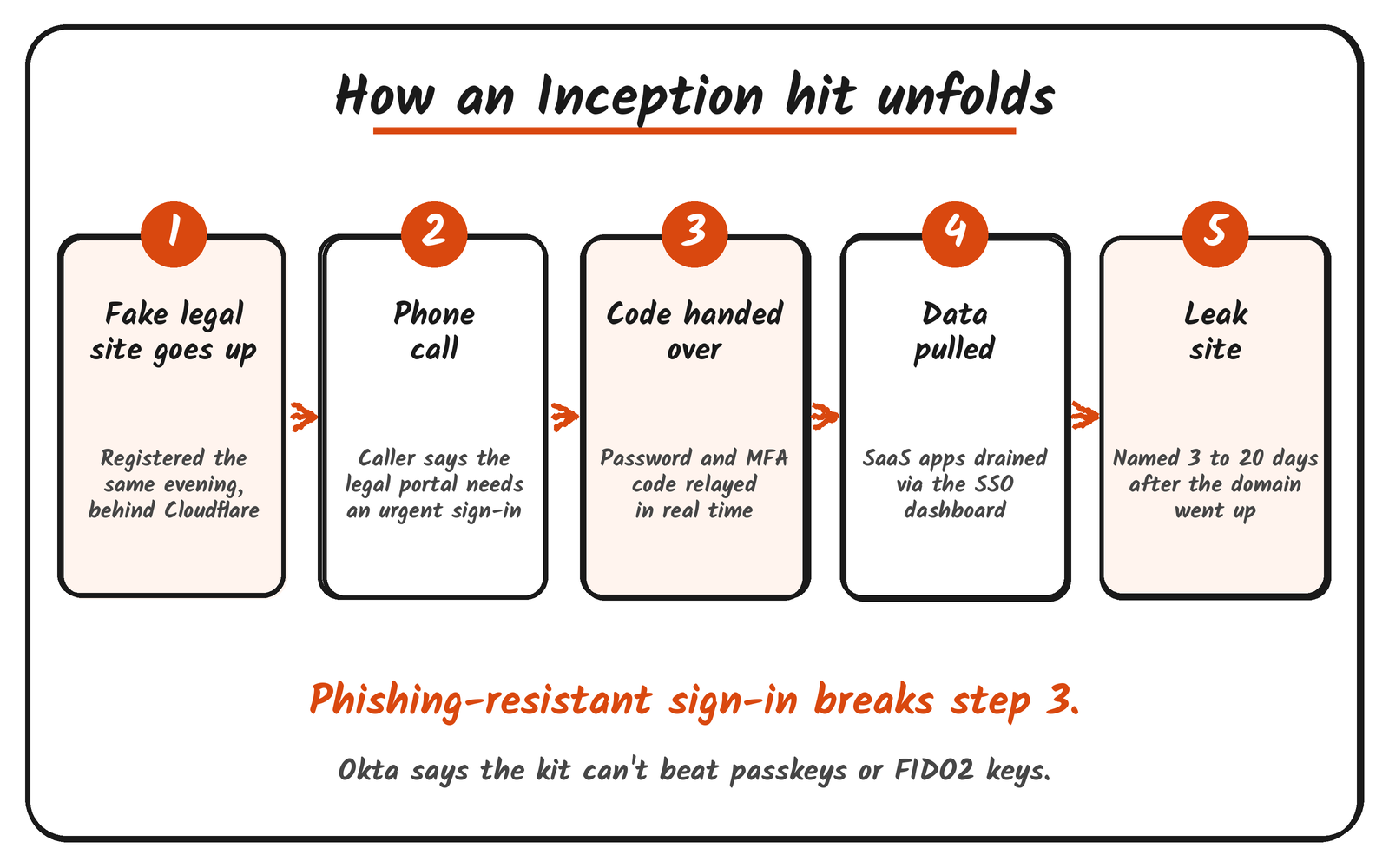
The lure domains went up three to 20 days before each victim appeared on the leak site, ReversingLabs says; Okta measures the gap at 6 to 19 days. On top of the seven named companies, ReversingLabs found 41 more domains it attributes to the campaign with high confidence and four at medium confidence. The brands in them include Dropbox, Duolingo, Western Union, Indeed, Activision Blizzard, Riot Games, Twitch, Reddit, Nestlé, Anthropic, Nintendo, Starbucks, McDonald’s, Paramount and NBCUniversal. BleepingComputer notes that a lookalike domain doesn’t show a company was breached or even targeted, and none of those companies has recently disclosed an attack.
Who’s behind it
Okta tracks the activity as O-UNC-053, a cluster it has watched since March 2026 across technology, healthcare, biotech, financial services, insurance, entertainment, gaming, retail, transport, hospitality and legal targets. Between March and September, companies that O-UNC-053 phished showed up on the ShinyHunters leak site one to 28 days after the phishing domains were registered. Then came two arrests of alleged ShinyHunters members, which Okta lists as Pepijn van der Stap on 15 September and Saif al-Din Khader, known as “Rey”, on 29 September. The ShinyHunters site went offline, and Okta saw no leak-site publications from the cluster through October and early November even as it kept registering domains.
Okta saw the Inception site appear on 16 November, with targets whose phishing domains it had already tracked. Its assessment:
Before and after the change in DLS publication, O-UNC-053 maintained consistent infrastructure and TTPs, leading us to assess that the cluster has very likely changed their brand affiliation.
Okta Threat Intelligence, 23 November 2026
Okta adds that it can’t say with high confidence whether O-UNC-053 runs the Inception site itself or partners with another extortion actor. It also says it can’t verify that the published data is genuine.
Inception rejects the link. Its leak site carries a statement calling the overlaps “shared use of commodity services” such as registrars and CDN providers, according to BreachNews, which reviewed it. BreachNews quotes the longer version: “We are not ShinyHunters. We were never ShinyHunters. We are Inception.” BleepingComputer adds that the group says private tooling circulates among independent actors and that using it doesn’t prove affiliation.
The ShinyHunters name has its own news this week. BleepingComputer reports that operators claiming to be ShinyHunters launched a new leak site on 23 November, signing posts with PGP keys from 2020. Those keys were revoked in March and have circulated among many people, so the signatures don’t show the same individuals are back. An earlier report on this site covers ShinyHunters’ claim to have taken FBI staff data:
Not a new trick
The method is the one Google’s Mandiant described in January 2026, when it tracked vishing-led SaaS data theft under the names UNC6661, UNC6671 and UNC6240 (ShinyHunters). Callers posed as IT staff, sent targets to company-branded phishing domains, relayed credentials and MFA codes in real time and enrolled their own MFA device. The SSO dashboard in Okta, Microsoft Entra or Google then gave them a path into Salesforce, Microsoft 365, SharePoint, DocuSign, Slack and other apps. One of its examples, matchinternal[.]com, was used in the Match Group breach.
| Cluster | Lure style | Registrar | Source |
|---|---|---|---|
| UNC6661 (Jan 2026) | <company>sso.com, <company>internal.com, posing as IT staff | NICENIC | Mandiant |
| UNC6671 (Jan 2026) | Similar vishing; extortion not sent under the ShinyHunters name, with harassment of staff | Tucows | Mandiant |
| O-UNC-053 / Inception (Oct to Nov 2026) | Legal-themed domains, web-only, filtered kit | Mostly NICENIC; also Spaceship, NameSilo, Tucows | Okta, ReversingLabs |
The help desk is the other recurring weak point. CISA’s advisory on Scattered Spider, AA23-320A, describes attackers posing as employees to get IT help desks to reset passwords and move MFA to a new device.
What defenders can do now
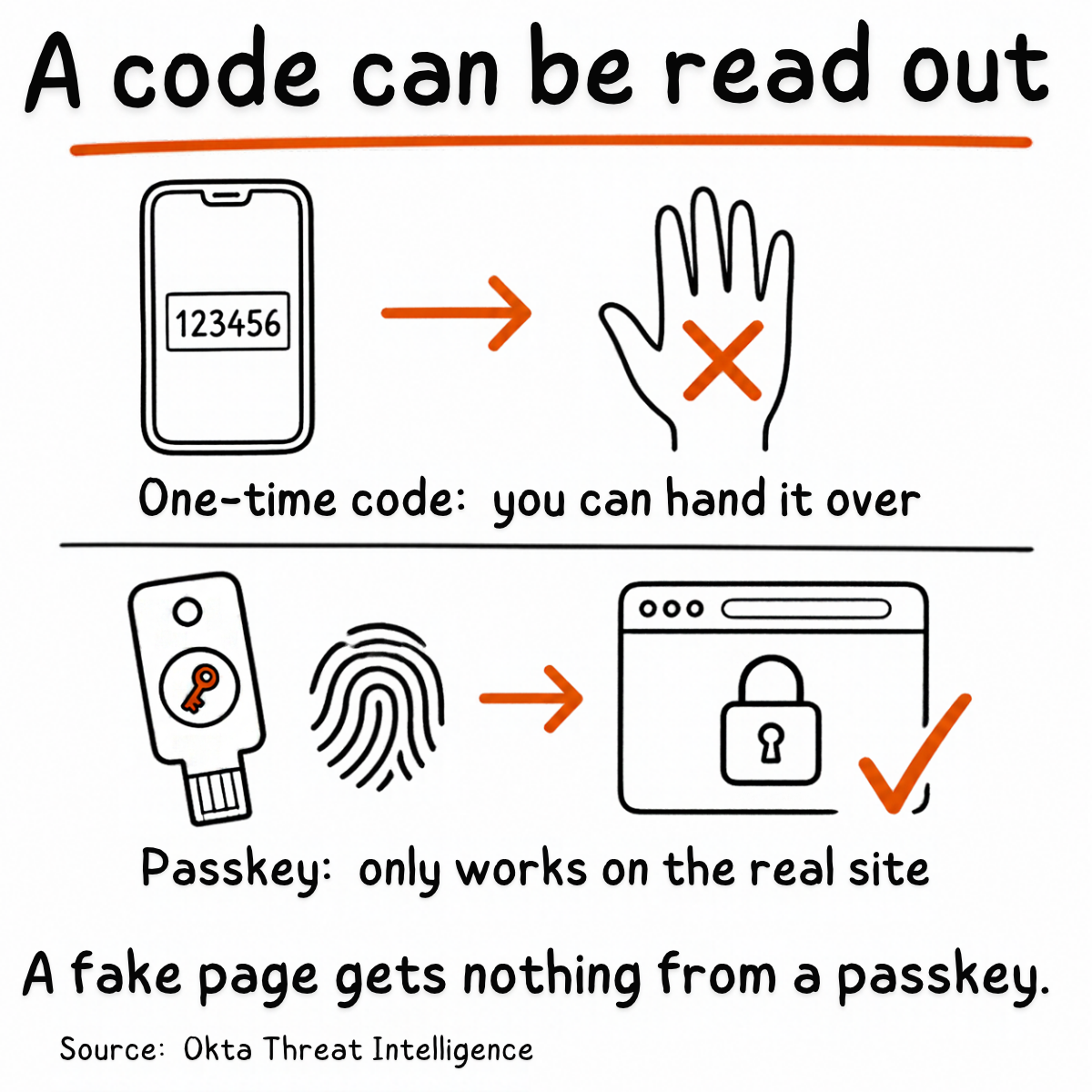
Okta says the kit can’t beat phishing-resistant methods such as Okta FastPass and FIDO2/WebAuthn passkeys, because those won’t sign in to a lookalike site. Both ReversingLabs and Okta point to the same first fix, and ReversingLabs and Mandiant add the rest.
- Enforce phishing-resistant sign-in (FIDO2 keys, passkeys or other origin-bound authenticators) and take one-time codes and push approvals out of high-value apps.
- Verify identity strictly before any password or MFA reset, and brief the help desk and staff to refuse urgent “legal” or compliance sign-in requests on unfamiliar domains.
- Restrict sensitive apps to managed devices, and deny or step up requests from rarely used networks, as Okta recommends.
- Watch newly registered domains and certificate transparency logs for your brand paired with legal terms, and block hits at DNS and the web proxy.
- Hunt through DNS, proxy and identity provider logs from 21 October 2026 for lookups to those domains, cross-origin SSO referrers and odd post-login activity. Revoke sessions and reset credentials if you find a hit.
- Alert on unexpected MFA changes. Mandiant’s January detections also cover rapid SaaS data downloads after an SSO compromise, PowerShell user agents hitting SharePoint or OneDrive, and the deletion of “security method enrolled” notification emails.
What’s still open
No victim has confirmed a breach, and the leaked-data claims rest on the group’s own listings plus Ransomnews’s look at two files. Okta hasn’t confirmed that Inception is ShinyHunters, only that the cluster behind the phishing very likely moved brands. ReversingLabs says the unlisted domains point to dozens more targets, but it doesn’t say any of them was breached.
Sources
- Okta Threat Intelligence: former ShinyHunters-affiliated cluster O-UNC-053 moves to new INCEPTION leak site, 23 November 2026
- ReversingLabs: SSO vishing campaign associated with Inception, 23 November 2026
- BleepingComputer: new Inception extortion gang launches large-scale vishing campaign, 24 November 2026
- The Register: Inception claims seven victims in a week, 23 November 2026
- Ransomnews: Inception leaks PepsiCo staff directory, lists AMD and Cigna
- BreachNews: Inception leak site claims AMD, PepsiCo and Cigna, 24 November 2026
- BleepingComputer: Mandiant details how ShinyHunters abuse SSO to steal cloud data, 31 January 2026
- BleepingComputer: ShinyHunters claims to return after FBI arrests, 24 November 2026
Discover more from Sulat AI & Tech News
Subscribe to get the latest posts sent to your email.