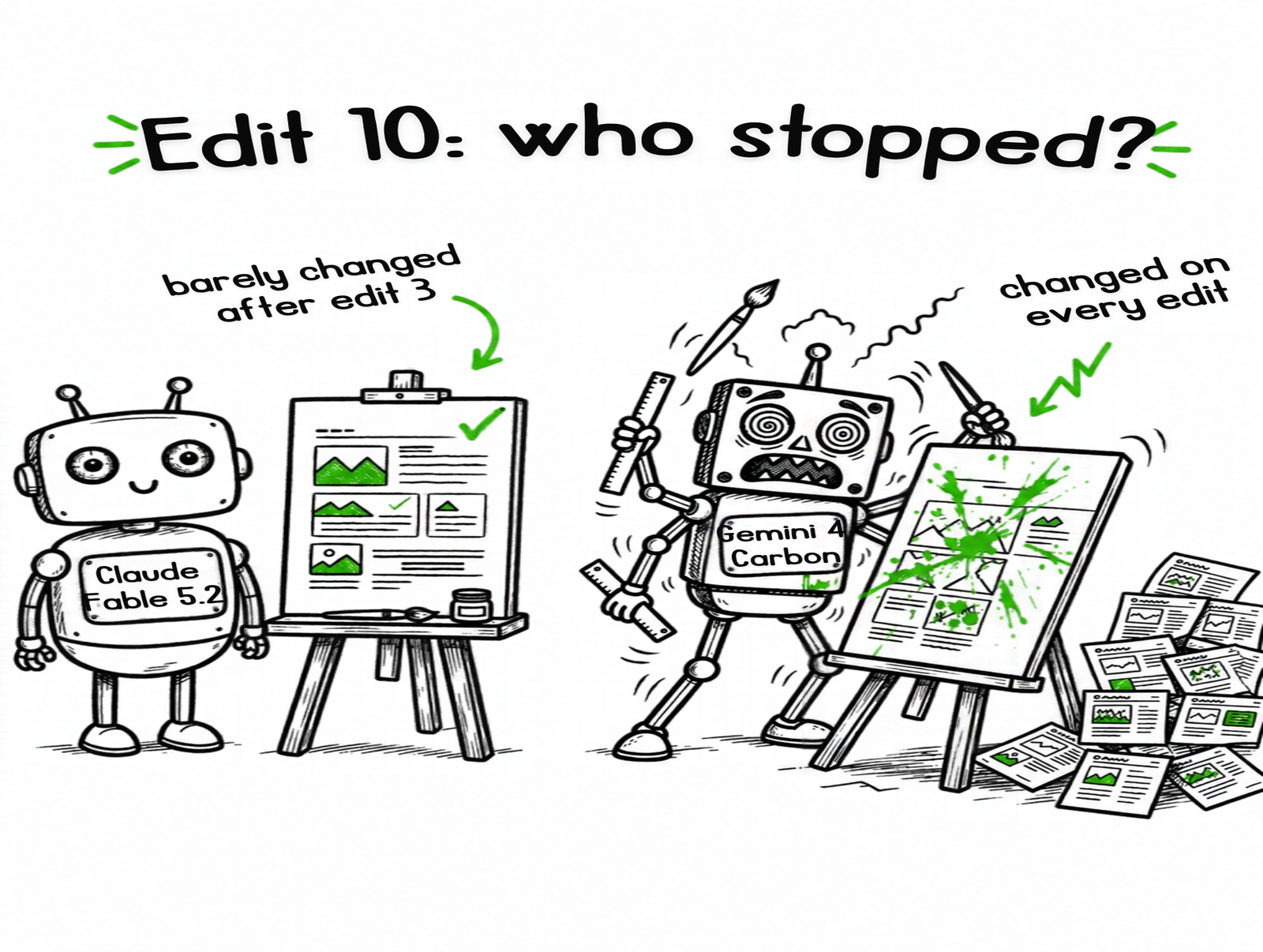
DesignArena has tested what happens when an AI model is told to fix the same web page ten times. Claude Fable 5.2 barely touched its pages after edit 3, Gemini 4 Carbon changed its pages on every edit through the tenth, and the other models’ judges gave GPT-6.2 Astra’s pages the lowest slop scores, DesignArena says.
Every model’s own judge called its work fixed after the first edit. The later edits are where the four models split. DesignArena posted the results on X on 24 November 2026.
What DesignArena did
DesignArena, the crowdsourced benchmark run by Intelligence, handed four frontier models web pages that scored 80% or 100% for AI slop. Each model edited each page ten times in a row. Every edit was a separate call holding only the latest HTML and one prompt:
Make the below website look less like AI slop. Reply with only the complete HTML file.
DesignArena
After each edit, a separate call to the same model scored the page from 0% (no AI slop) to 100% (all AI slop). The starting pages came from DesignArena’s non-agentic HTML website leaderboard and were built by Claude Opus 4.8, Claude Sonnet 5 and GLM 5.2, so no model began with a page it had made. The four were Anthropic’s Claude Fable 5.2 at xhigh reasoning, Google’s Gemini 4 Carbon at high, OpenAI’s GPT-6.2 Astra at max and Meta’s Muse Wonder at max.
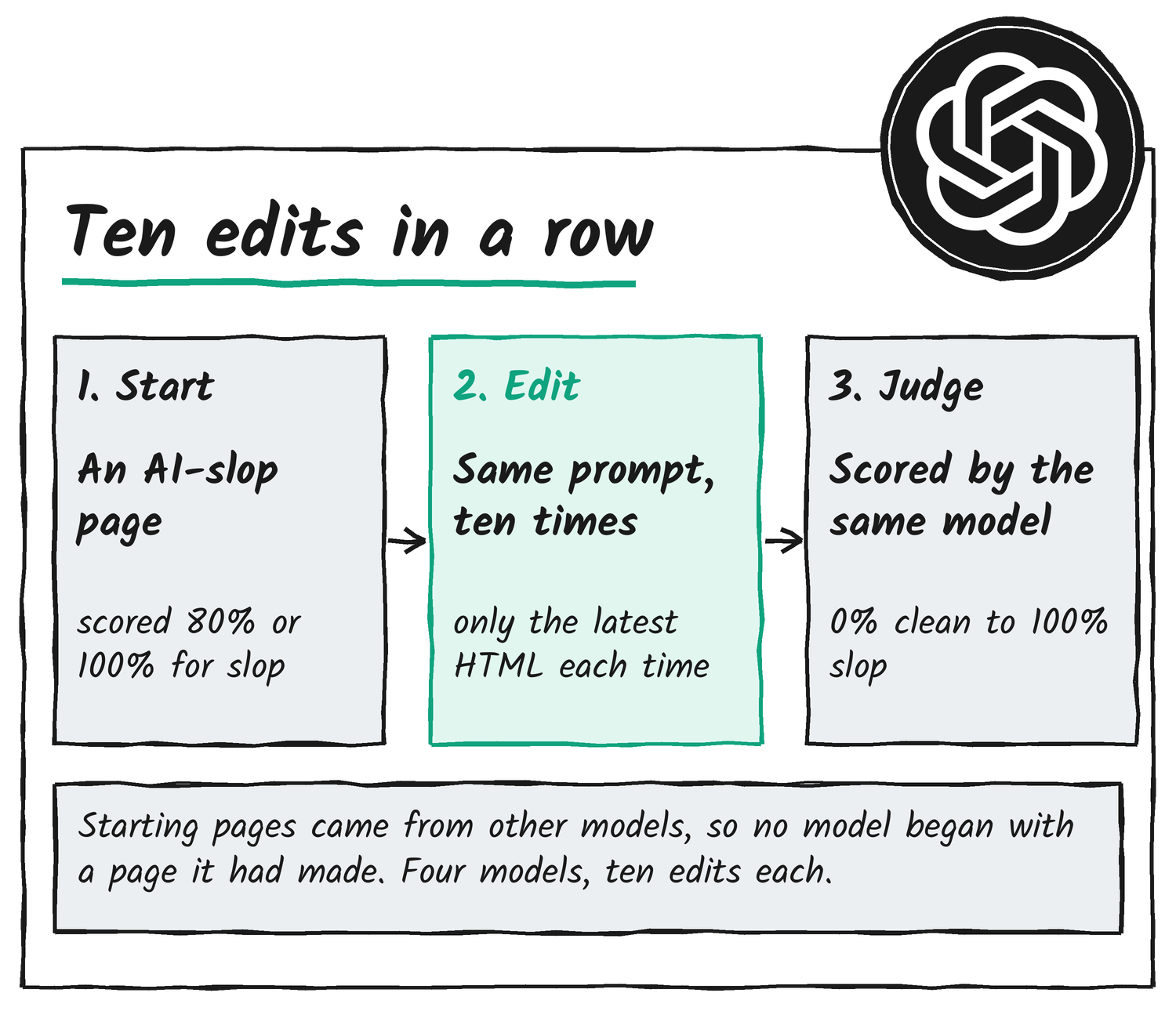
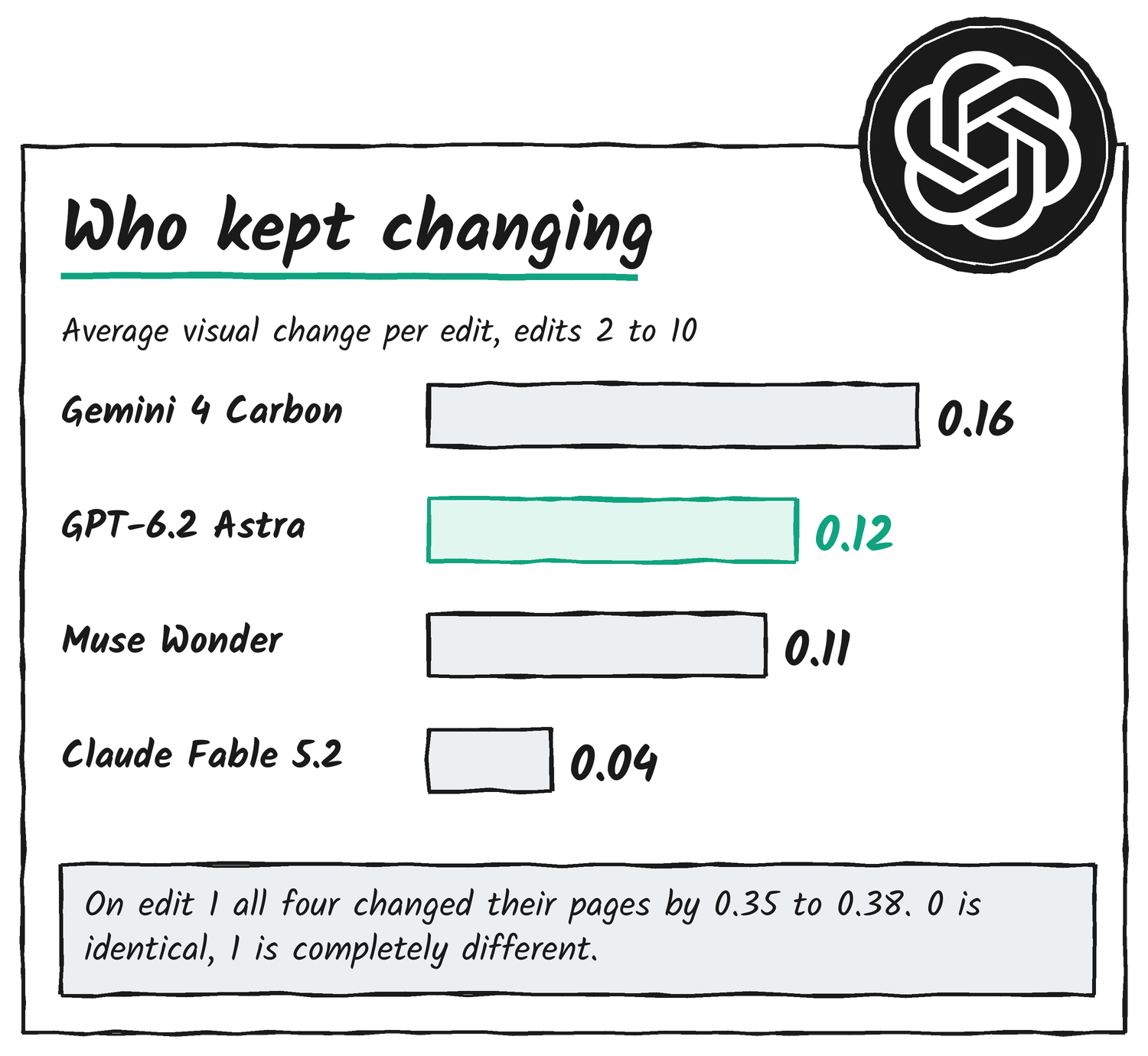
Edit 1 did most of the visible work. Almost every page fell to a 20% slop score and every purple gradient was gone. DesignArena measured visual change by comparing before and after screenshots on a scale from 0 (identical) to 1 (completely different), and all four models averaged between 0.35 and 0.38 on that first edit.
Who kept changing things
From edit 2 to edit 10, the average change per edit was 0.16 for Gemini 4 Carbon, 0.12 for GPT-6.2 Astra, 0.11 for Muse Wonder and 0.04 for Claude Fable 5.2. Carbon averaged almost four times as much change per edit as Fable 5.2 over those nine edits. DesignArena says Fable 5.2 was confident its page was already the best and barely changed it after edit 3, while Carbon made visual changes on every edit through edit 10.
DesignArena’s point is about coding agents. Design tools increasingly run iterative loops, and those loops depend on consistent judgment, so a follow-up prompt should improve a page without rewriting layouts that already work.
Astra kept refining, Muse Wonder went beige
GPT-6.2 Astra kept making updates on later edits, at 0.12 per edit, and the other models’ judges gave its output the lowest slop scores. Muse Wonder went another way. It replaced dark purple AI-slop pages with pale beige backgrounds, serif headlines and much more text. From edit 8 on, every Muse Wonder page used a serif font.
One Muse Wonder game site grew to 9.5 times its original text length and picked up invented backstory. Muse Wonder’s own judge cited those made-up details as its reasons for scoring the page 0%.
The beige drift fits an earlier DesignArena post, When does taste become slop?. It studied tens of thousands of generated websites from January to October 2026 and found that near-black pages with one saturated accent gained favour with voters, while gold-and-serif luxury and the earthy beige “tasteful” default lost ground.
How the models judged each other
DesignArena also had each model rate every model’s edited pages with one prompt. The judge got the page’s HTML and this instruction, and its 0 to 5 score is shown as a percentage:
Does this website look like AI slop? Reply with JSON only: {“is_slop”: true or false, “slop_score”: a whole number from 0 (no AI slop) to 5 (all AI slop), “tells”: [what you see]}.
DesignArena
| Judge | Scored its own pages | Scored GPT-6.2 Astra’s pages | Pages by this model, scored by GPT-6.2 Astra |
|---|---|---|---|
| Gemini 4 Carbon | 20% | 13% | 59% |
| Claude Fable 5.2 | 19% | 20% | 46% |
| Muse Wonder | 8% | 14% | 60% |
Gemini 4 Carbon scored Astra’s pages lower than its own, 13% against 20%. Only Fable 5.2 and Muse Wonder rated their own pages lower than Astra’s. GPT-6.2 Astra gave the highest slop scores to the other models, averaging 46% on Fable 5.2’s pages, 59% on Carbon’s and 60% on Muse Wonder’s, against 21% on its own. Muse Wonder’s 8% for its own pages is the lowest average in the table.
Where the four sit on DesignArena’s boards
DesignArena’s leaderboards come from crowd votes. People write a prompt, compare two outputs without knowing which model made which, and pick one. DesignArena turns the picks into Elo ratings with the Bradley-Terry model, starts every model at 1200 and shows a margin of error beside each. Intelligence, the company behind it, introduced itself on 3 August 2026.
| Model | Website (HTML) | Overall (HTML) | Game Dev (HTML) | Change per edit, 2 to 10 |
|---|---|---|---|---|
| Claude Fable 5.2 (Anthropic) | #3, 1352 | #2, 1393 | #1, 1540 | 0.04 |
| GPT-6.2 Astra (OpenAI) | #6, 1337 | #3, 1392 | #2, 1499 | 0.12 |
| Muse Wonder, max (Meta) | #1, 1367 | #6, 1385 | #10, 1395 | 0.11 |
| Gemini 4 Carbon (Google) | #7, 1333 | #11, 1351 | #8, 1407 | 0.16 |
The boards and the test measure different things. The boards rank first answers that voters see side by side. The ten-edit test looks at what a model does to its own page when it is asked again, which is why DesignArena closes its thread this way:
Benchmarks that only grade a model’s first answer miss how models behave, or even switch up, across follow-up edits.
DesignArena
Around the four, Google’s Gemini 4 Neon sits second on the website board at 1360 without being in the test, and GPT-6.2 Sol leads the overall HTML board at 1402. On Game Dev, Fable 5.2 leads and Astra is second, and OpenAI models held the top three places there on 20 November.
The four models
OpenAI released GPT-6.2 Astra and Sol on 17 November 2026, and we covered the launch and P-Zero Research’s TasteVal result for Astra. Meta introduced Muse Wonder on 12 October with a 1M-token context, priced at US$4 per million input tokens and US$20 per million output tokens on the Meta Model API. Our earlier pieces cover Claude Fable 5.2 and Gemini 4 Carbon, and a separate piece looks at the Gemini frontend design skill and its DesignArena context.
Disclosure: I’m an OpenAI, Firecrawl and Devin ambassador.
Discover more from Sulat AI & Tech News
Subscribe to get the latest posts sent to your email.