
Media Partners Asia (MPA) forecasts that microdramas will earn US$20 billion worldwide in 2026, up 24% on 2025, and US$32 billion by 2031. Bloomberg ran the figure on 26 November. It comes from MPA’s second annual study, The Microdrama Economy 2026, which Variety and Deadline both reported.
The headline number is the easy part. The same report says that outside China the business has not yet shown it can earn a durable profit, and that 56 cents of every dollar of revenue there goes on marketing. MPA sells the full report, and Bloomberg’s piece sits behind a paywall, so I’ve worked from the figures as Variety and Deadline reported them. What I attribute to Bloomberg is limited to what it published at the top of its piece.
US$20bn
MPA’s 2026 forecast, up 24%
US$32bn
Forecast for 2031, 9.8% a year
76%
China’s share, US$15.2bn
56¢
Of each dollar spent on marketing outside China
- What MPA counted
- Why MPA’s number is bigger than Omdia’s
- China is three-quarters of it
- Outside China: US$4.87 billion and thin margins
- AI is making the titles, not yet the money
- Who’s left standing
- Where AI Serye fits
What MPA counted
MPA measures what viewers, advertisers and brands spend, before app stores and payment processors take their fees. Outside China it counts dedicated microdrama apps and their web storefronts. Microdramas watched in general social media feeds fall outside the total.
Bloomberg’s summary puts 2026 growth at 24% and the 2031 figure at US$32 billion, citing MPA. MPA forecasts growth of 9.8% a year through 2031. By my arithmetic, 24% growth to US$20 billion puts MPA’s 2025 figure at about US$16 billion. Omdia put 2025 at US$11 billion.
Demand for micro drama is established in every major market, but outside China this is still an emerging business, and it has yet to show that it can earn a durable profit.
Vivek Couto, CEO and executive director, Media Partners Asia, quoted by Deadline
Why MPA’s number is bigger than Omdia’s
The gap is scope. Omdia counts all revenue and forecasts about US$14.1 billion for 2026, with China at 75%. Omdia’s October release rounds that to about US$14 billion and adds a forecast of nearly US$25 billion by 2031. MPA counts gross spend before fees, so its figure is higher for the same year.
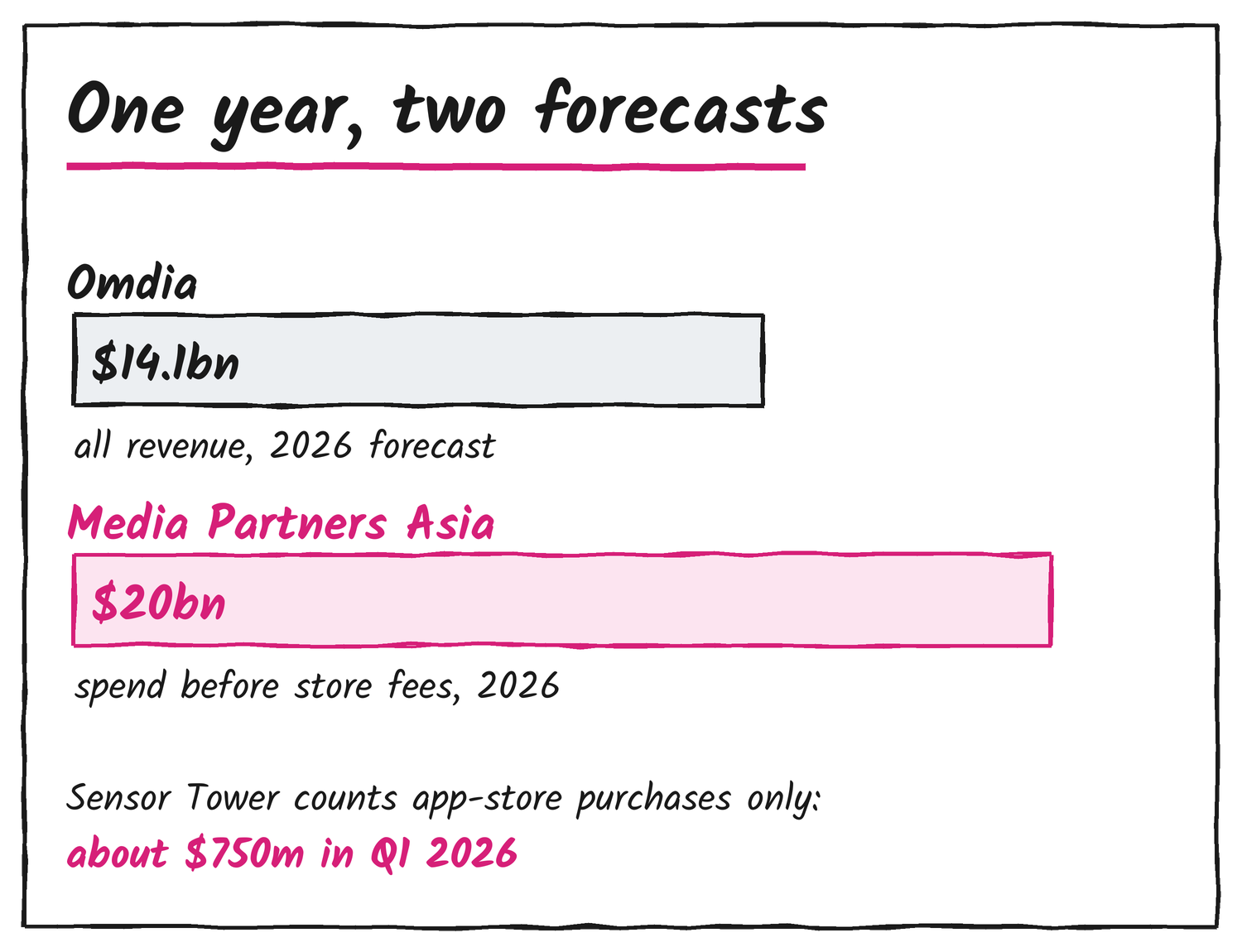
MPA’s own numbers moved, too. Its August report sized the market outside China at US$3.6 billion for 2026. Its November report says US$4.87 billion. Nothing I could read from MPA bridges the US$1.27 billion between the two.
| Who | 2026 figure | What it counts |
|---|---|---|
| MPA, November 2026 | US$20 billion worldwide | Viewer, advertiser and brand spend before app-store and processor fees |
| Omdia, October 2026 | About US$14.1 billion worldwide | All revenue, China 75% |
| MPA, August 2026 | US$3.6 billion outside China | The market outside China |
| MPA, November 2026 | US$4.87 billion outside China | Dedicated apps and web storefronts, before fees |
| DataEye | More than US$6 billion overseas | Overseas forecast, as China Daily reported it |
| Sensor Tower | About US$750 million in Q1 | Apple and Google in-app purchases only, with ads and web payments left out |
| China’s regulator (NRTA) | More than RMB100 billion (about US$15 billion) for 2025 | China’s market, official figure |
China is three-quarters of it
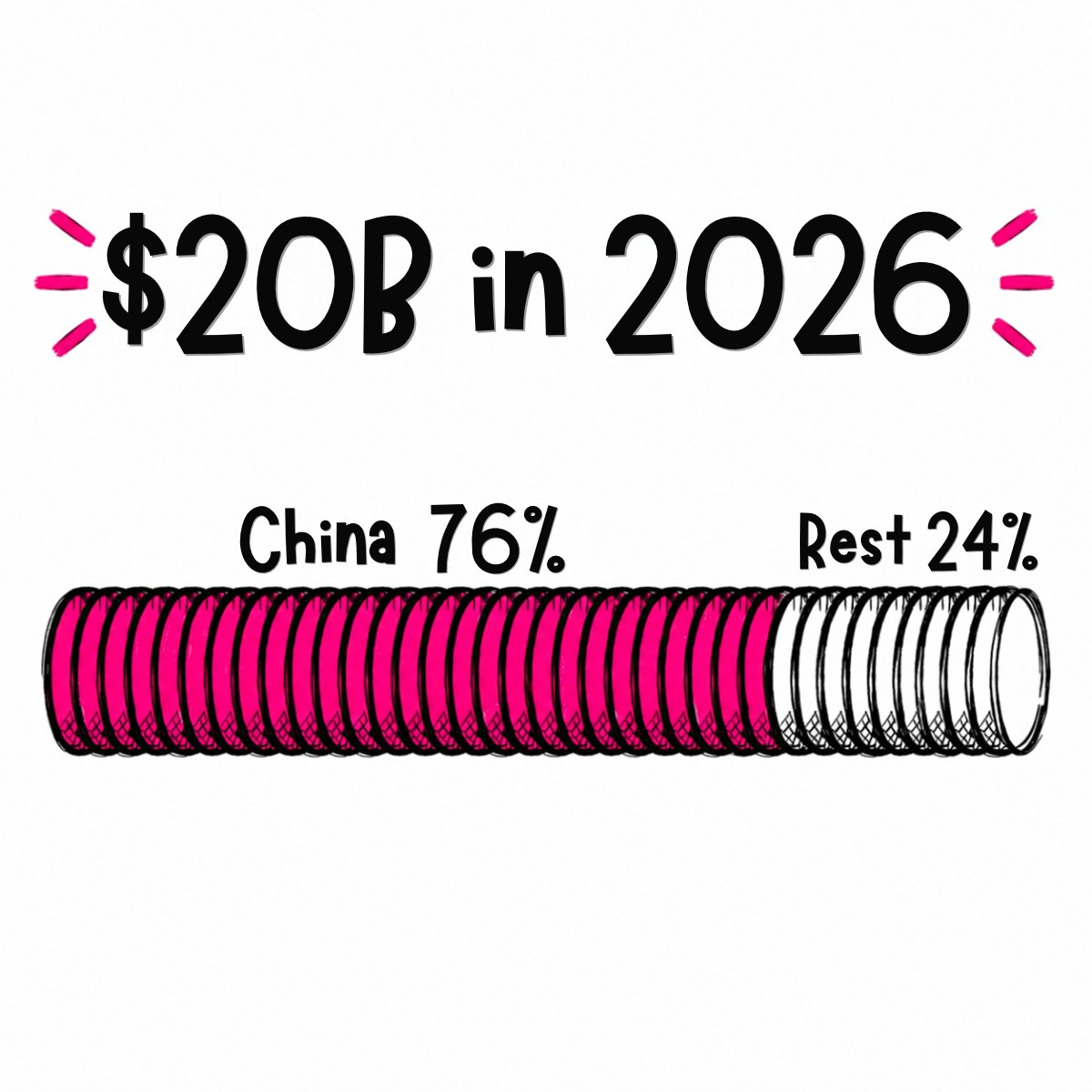
China is US$15.2 billion of MPA’s total after revenue grew 90% in 2025. MPA expects growth to slow to 6.7% a year as viewing levels off, bringing China to US$21 billion by 2031.
Free, ad-funded viewing passed paid viewing in China in 2025. Advertising will make up 69% of China’s microdrama revenue in 2026 and 79% by 2031. ByteDance, which runs Hongguo and Douyin, takes 56% of Chinese revenue, and ByteDance, Tencent and Kuaishou together take 82%.
China’s regulator uses a bigger number. The National Radio and Television Administration (NRTA) put the 2025 market above RMB100 billion, about US$15 billion. MPA calls its own estimate narrower because the regulator’s figure also includes producer spending on AI models and platform investment. NRTA also says more than 800 million people in China watch microdramas, and that 430,000 microdramas went online in the first eight months of 2026, 13 times the total for all of 2025, as China Daily reported.
MPA doesn’t estimate profit in China, because ByteDance, Tencent and Kuaishou don’t report microdramas as a separate line.
Outside China: US$4.87 billion and thin margins
MPA puts dedicated apps outside China at US$4.87 billion in 2026, a third more than in 2025, and at US$11 billion by 2031, growing 17.7% a year. Deadline reports that MPA finds marketing takes 56 cents of each dollar there, and app stores and payment providers another 18. By my arithmetic that leaves 26 cents for content, staff and profit.
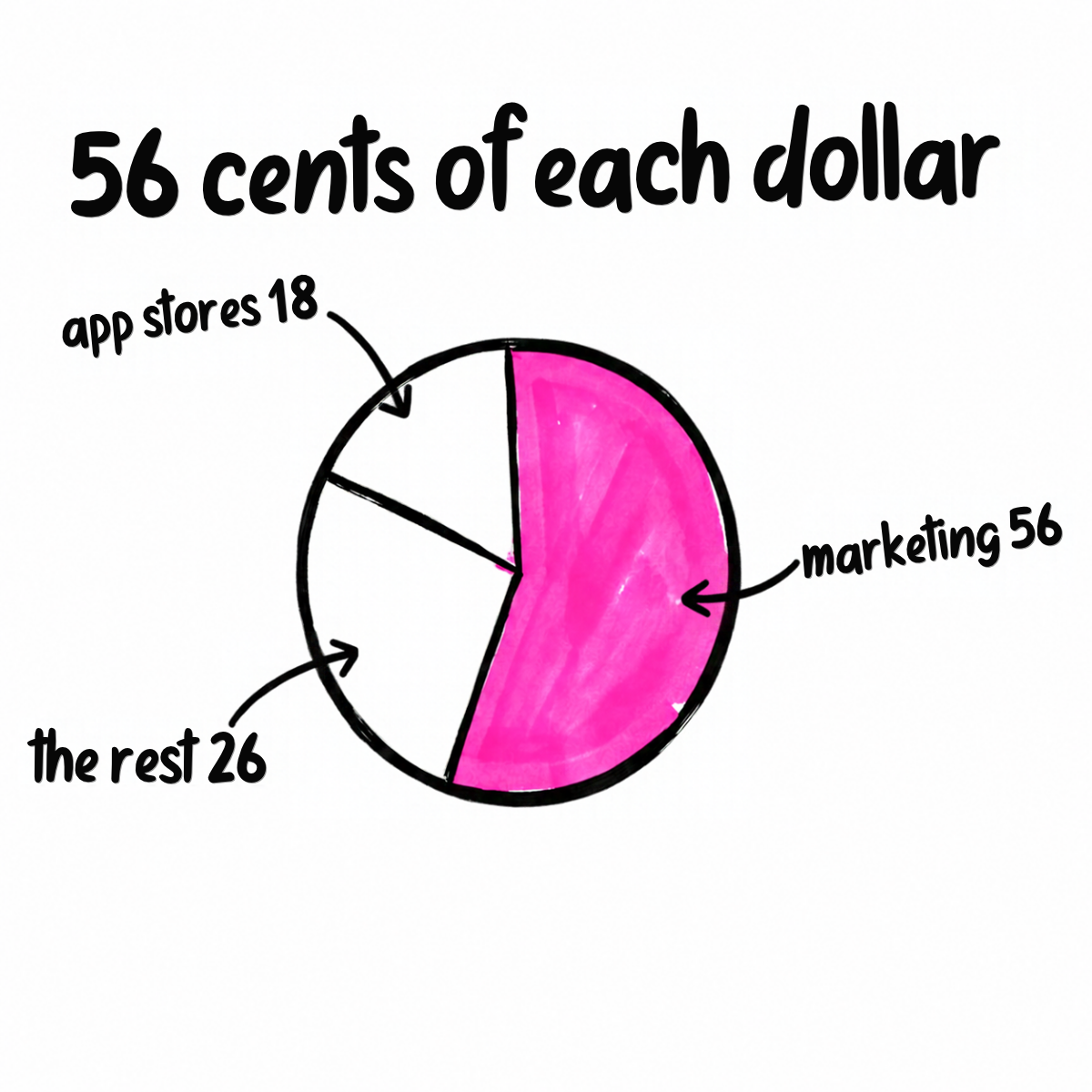
The company numbers match that squeeze. DramaBox recorded a 3.2% net margin in 2025. ReelShort lost US$12 million that year and made an US$8 million profit in the first quarter of 2026. The two largest groups each take in more than US$1 billion a year.
The Conversation reported two more data points on 25 November. Crazy Maple Studio, which runs ReelShort, nearly doubled its revenue to RMB5.72 billion in 2025, with a company-wide net loss of about RMB86 million. Mega Matrix, the parent of FlexTV, reported advertising expenses of 43% of revenue in the first half of 2026. Production is the cheap part: the streamer Mansa makes microdramas on budgets of US$100,000 to US$250,000 a series.
Sensor Tower’s numbers show the same split between audience and income. Short-drama apps passed 850 million downloads in the first quarter of 2026, up 140%, but in-app revenue was about US$750 million, up 20%. Southeast Asia, Latin America and India took more than three-quarters of the downloads, while the money still sits in mature markets such as the US.
Where the money sits
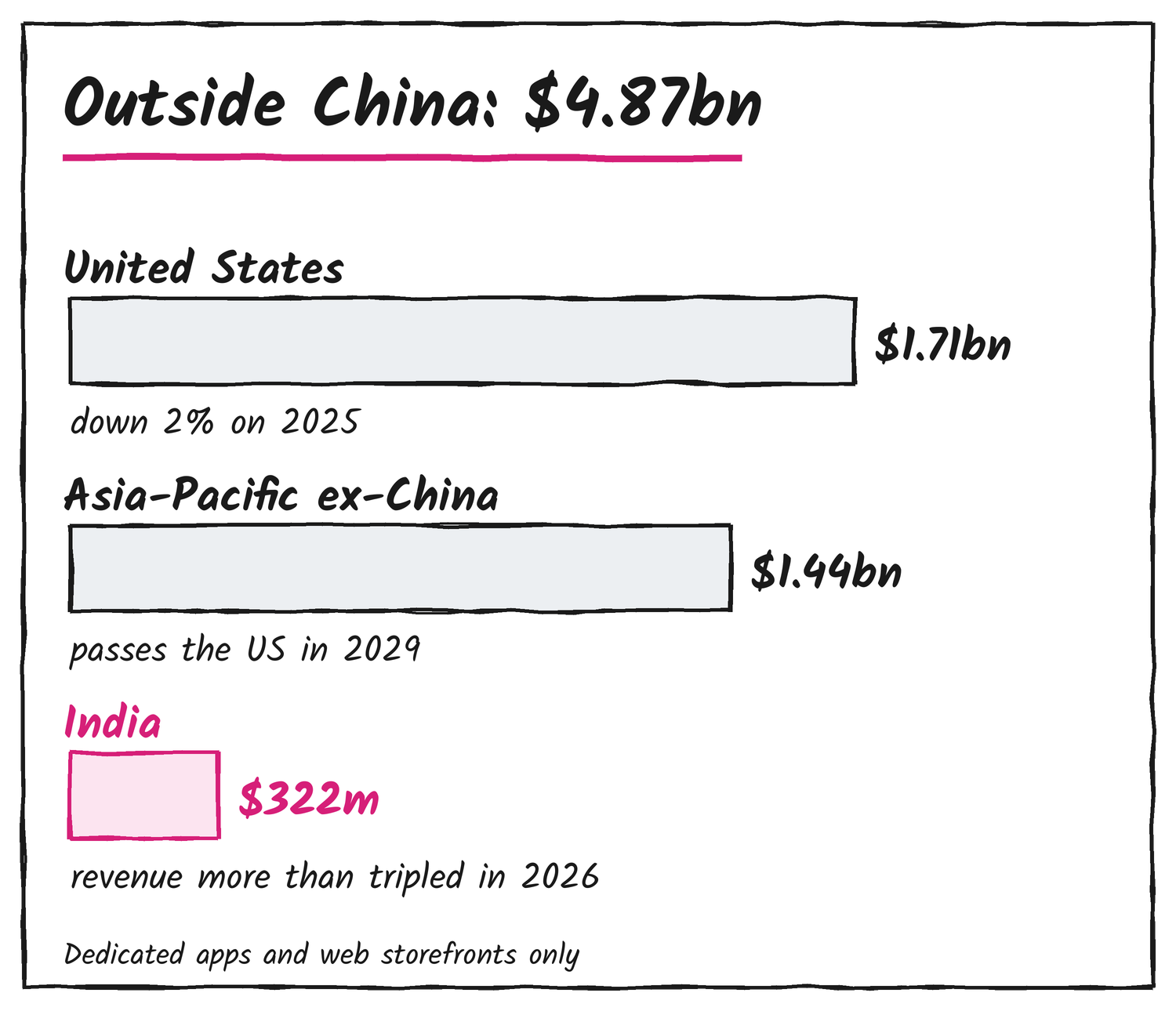
The US is the largest single market at US$1.71 billion, 2% below 2025. Asia-Pacific excluding China is at US$1.44 billion, and MPA expects it to overtake the US in 2029.
India, at US$322 million, is Asia’s largest microdrama market after China, ahead of Japan and Korea, and revenue more than tripled in 2026. Local services Kuku TV and Story TV each roughly tripled their takings, and JioStar launched Tadka on JioHotstar in April. India is the only major market where local platforms lead. They sell low-cost subscriptions that skip app-store billing, and JioStar’s existing streaming audience cuts what it pays to find new viewers.
In South Korea, Vigloo competes with Chinese-backed apps, and in Japan so does Fuji TV’s Fod Short. MPA doesn’t expect YouTube or Meta to make a major impression on the market. Meta has still put the format to work: I covered its government-backed scam-awareness microdrama for India, premiering on Instagram, on 20 November.

AI is making the titles, not yet the money
AI is changing the supply of titles faster than demand. MPA counts about 100,000 new titles listed on apps outside China in 2025 and forecasts 440,000 in 2026, with AI-generated titles rising from 15% of listings to 75%. Each listing is one title in one language on one app, so a series offered in several languages or on several apps is counted more than once. MPA puts the cost of an AI-made title at roughly 10% of a Los Angeles shoot.
Audiences have been slower to switch. Live-action series hold most of the top 50 places on five of the six platforms outside China that MPA tracks. In China about nine in ten titles released in 2026 are AI-made, and they bring in 20% of the year’s revenue.
Who’s left standing
DramaBox and GoodShort announced a merger at the end of October. With ReelShort, Kunlun and NetShort they take 65% of revenue outside China, and MPA says the leading apps are Chinese-owned or backed. In August MPA put ReelShort at 29% of the market outside China and DramaBox at 21%, and forecast ReelShort’s 2026 revenue at US$1.05 billion, up 34%.
The forecast says the format is big. MPA’s own numbers say the money is concentrated: 76% of it is in China, and outside China 74 cents of each dollar goes on marketing, app-store and payment fees before a studio pays for a script.
Where AI Serye fits
I own AI Serye, a free catalogue of series, films and minisodes made with generative AI. “Serye” is the Filipino word for a series. It has a micro-drama section, and it lists work that creators publish on their own YouTube or Vimeo channels, so the views, likes and comments stay with them. It also carries AI Serye Originals, made by the site itself, with the tools named on each page.
AI Serye doesn’t sit inside MPA’s US$20 billion. It doesn’t sell episodes or coins. It is the other end of the same shift MPA counts: the AI-made titles that MPA expects to make up 75% of listings outside China.
Terms used in this piece
- Microdrama
- A serialised drama shot for phones, usually vertical, in episodes of one to two minutes, often with a paywall at a cliffhanger.
- Outside China
- MPA’s count of dedicated microdrama apps and their web storefronts, without general social feeds.
- In-app purchase
- Money spent inside an app through Apple’s or Google’s store, which keeps a commission.
- Ad-funded
- Free viewing paid for by adverts, as opposed to coins or subscriptions.
Sources
- Bloomberg, “Microdramas Rake in $20 Billion as World Gloms On to Quick Hits”, 26 November 2026 (headline and summary)
- Variety, “Microdrama Revenue to Hit $20 Billion in 2026, Profits Thin”, 26 November 2026
- Deadline, “Microdrama Revenues Hit $20B, But Profits Outside China Still Weak”, 26 November 2026
- Media Partners Asia, ReelShort / Crazy Maple Studio: Inside the US$1B Micro-Drama Machine, August 2026, and Screen Daily’s report on it
- Omdia, 13 October 2026, and Prensario on Omdia at MIPCOM
- Sensor Tower, State of Short Drama Apps 2026, June 2026
- China Daily, “Bite-sized drama boom”, 3 October 2026
- The Conversation, “Microdramas are transforming streaming entertainment. But can the business model last?”, 25 November 2026
- About AI Serye, read 26 November 2026
Disclosure: I own AI Serye.
Discover more from Sulat AI & Tech News
Subscribe to get the latest posts sent to your email.