
Stripe has shown what came out of Stripe Residency, a pilot programme that put a curated group of indie and bootstrapped solo founders in a Bali villa from 15 to 21 November 2026. On 25 November, US time, its X account posted a thread of 16 “ships” from the week. I read that thread, the hosts’ announcements, the residents’ own posts and Stripe’s Atlas research. Stripe hasn’t published terms, a cost, a selection process or a second date. It has published a roster, and the roster tells you who Stripe is courting and what they build.
7 days
in Bali, 15 to 21 November 2026
16 ships
in Stripe’s thread, from 12 named residents plus one post I couldn’t match
1
of the 16 posts names a Stripe product, Connect
0
published terms, costs or next dates
- What Stripe announced, and when
- Who was in the villa
- The 16 ships
- Why solo founders: Stripe’s Atlas numbers
- Nine years of courting indie founders
- How it compares with other residencies
- What Stripe hasn’t published
- Sources
What Stripe announced, and when
The first public sign was on 29 October. Jess Lozano Schmitt, who describes herself on X as a member of staff at Stripe, wrote that “we’re making Stripe Residency happen”. She described “a curated group of indie hackers and bootstrapped solo founders to spend a week building in Bali with the stripe team (nov 15–21)”. Stripe users who wanted in were told to reply with why they were interested, or message her or Cait Bahari, who is listed as a host on the residency’s own site.
Bahari posted the same day, with a different pitch: a “small group of solo and indie founders to cowork in Bali”, with “plenty of unstructured time to exchange ideas, get feedback, and build alongside one another”, and “a few spots left”. Both posts carry a quoted post from the founder Marc Lou, dated 2 May, in which he said Stripe “should host a regular hackathon or residency where we build and monetize startups”. That’s the closest thing to a stated origin I found.
The week itself ran as announced. On 16 November the open-source developer known as Javi posted that he’d flown from Portugal to Bali for what Stripe was calling Stripe Residency and that, as far as he knew, the group were “the beta testers of the program because this is the first time they do it”. The kickoff dinner had been the night before. He described days of working at the villa, with badminton, bouldering and surfing around the edges.
Stripe’s own thread came four days after the week ended. Its opening post calls Residency “our pilot program for bootstrapped founders” and promises “a look into all the ships”. The rest of the thread is Stripe reposting what residents had already published.

Who was in the villa
The residency has a website, stripe.house, but Stripe didn’t build it. A resident, the founder of One who posts as kyzo, made it as a shared 3D island with a warung, a swimming cove and a padel court, and published the source on GitHub. The repository was created on 20 November, the week’s second-last day. The page lists 21 names, which its README calls “the 21 invited makers”, and that count includes the two Stripe hosts.
The names run from solo makers to small teams. Minh-Phuc Tran, who is listed as a Hacker Residency host, was there. So were the founders of Bannerbear, Tailscan, Plutio, Tutti, Slashspace and PoloFlow, a co-founder of Tutorbase, and the maker of DevUtils. It’s a group of people with audiences, which suits a programme whose public output is a thread of demo videos.
The 16 ships
The thread has 16 posts of resident material. I matched 15 of them to 12 named residents. The 16th, for a product called ReplyBrain, doesn’t show its author in the version I read, so I’ve left it unattributed. I read the text of each post, not the videos attached to them.
| Resident | What the post says they shipped |
|---|---|
| kyzo (One) | Persistent bots in One, which turn a Codex or Claude session into an agent at the side of the screen; also the stripe.house island |
| Minh-Phuc Tran | A summary video of what he shipped in the week |
| Tony Dinh (DevUtils) | A video of what he worked on during the programme, with no product named in the text |
| IndiJo | Moshi desktop running on top of rex, with a demo recorded in Bali |
| Fiki | tryibid.com and a new version of Chengyu Calendar shipped; a major update to zhiyin.dev due the following week |
| nim | An MCP server for aiagent.app so the product can be used from a preferred AI assistant |
| Josef Büttgen | A portfolio app for photographers and videographers, built with two collaborators; separately a feed for knowledge work that you set up by giving Claude Code the repository link |
| Tomás Stambulsky | Still Shipping, launched the same week GTA 6 came out |
| Ann Nguyen | A word game called Overthinking; a demo onboarding tour she hopes will bring in 30% more B2B customers |
| Sandro Kratz (Tutorbase) | Stripe Connect rolled out to all Tutorbase customers |
| Melanie Klenner (PoloFlow) | A preview of PoloFlow ahead of its beta |
| Praneeth Pike (Slashspace) | Smart tools, which let you prompt without setting up connectors to other tools |
| Unattributed | ReplyBrain, which runs customer support through an AI agent |
Two things show up. At least five of the 16 posts involve AI agents, MCP or Claude Code: One’s bots, nim’s MCP server, Josef’s Claude Code tool, ReplyBrain and Slashspace’s Smart tools. And in the text of those 16 posts, one names a Stripe product, which is Tutorbase’s Connect rollout. A programme run by a payments company produced a thread where AI tooling is the biggest single theme and payments barely appear.

kyzo’s post puts the work at “the last 2 weeks during the Stripe Residency”. The hosts’ announcements and Javi’s post give one week, 15 to 21 November, so some of what kyzo shipped was started before Bali.
Why solo founders: Stripe’s Atlas numbers
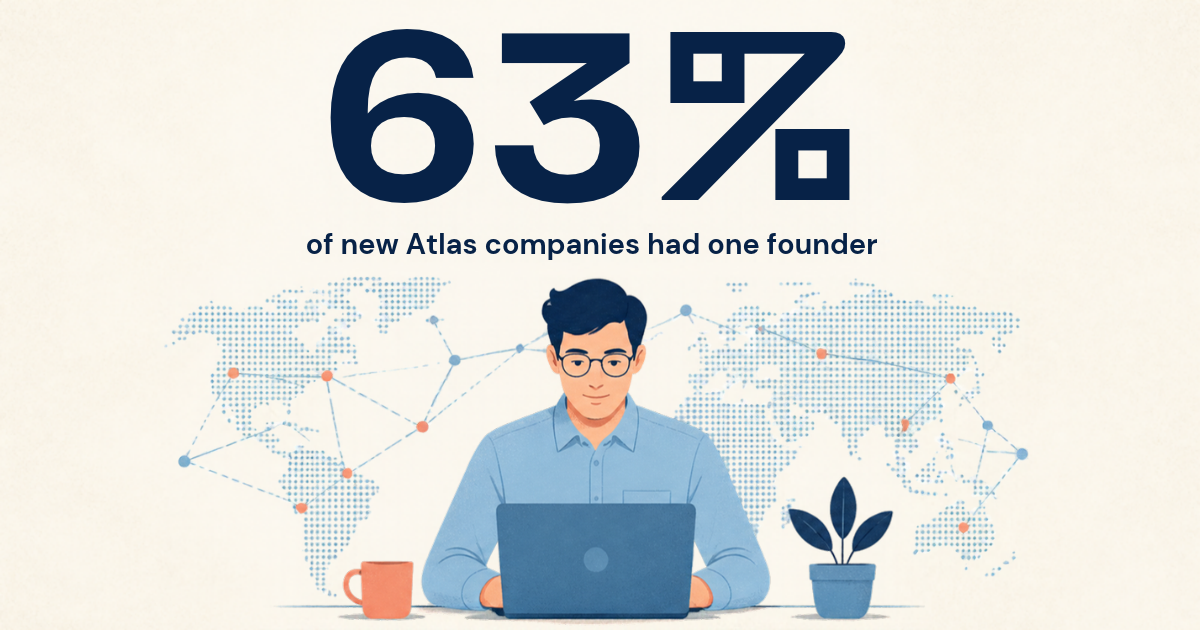
Stripe has its own research on this audience. On 28 May it published an analysis from its Atlas team, the service that incorporates companies for founders worldwide. It says solo founders, meaning people who launched through Atlas without cofounders, formed 63% of C corps formed so far in the second quarter of 2026, an all-time high. It adds that the gap between typical and top performers is widening: four years ago the top-decile solo founder made about 34 times the median in the first six months, and in 2025 it was 61 times.
The same piece describes what top-decile solo founders have in common. They were about twice as likely as median founders to build AI-native products, they sold abroad from the start, and they leaned towards B2B. Marc Lou, the founder who suggested in May that Stripe host a residency, is quoted in it as saying the next generation of solo founders “will be less defined by technical pedigree and more by speed”.
| Measure | Top-decile solo founders | Median solo founders |
|---|---|---|
| Countries sold into in month one | 10 | 3 |
| Non-US countries sold into by month 24 | 40 | 6 |
| International share of revenue | 51% | 2% |
| First-month customers who returned the next month | About 30% | 8% (middle decile) |
Read next to the Residency thread, the match is close. The people in Bali build AI-native products for businesses and sell them online from wherever they happen to live. That’s my inference, since Stripe hasn’t said how it picked the group, but it’s the profile its own data says wins.
Atlas is the bigger channel to this audience. Its Atlas page says more than 120,000 companies have incorporated through the service, that one in four new Delaware corporations choose it, and that Atlas startups have raised US$30 billion. This week it added US$500 in OpenRouter credits to the Atlas perks, which I covered separately, and OpenRouter itself became part of Stripe after a deal confirmed earlier this month.


Nine years of courting indie founders
This isn’t Stripe’s first move for the independent crowd. In April 2017 it acquired Indie Hackers, a site and community founded by Courtland Allen that put profitable, self-funded businesses in the spotlight. TechCrunch reported that Allen would carry on as normal, with the title “Indie Hacker at Stripe”. Co-founder Patrick Collison explained the logic on Hacker News: “The Stripe upside we’re hoping for is that more companies get started and that they’re more successful.”
Residency fits that line. It gathers people who are building companies and lets them publish what they make, and so far the thread is the programme’s only visible output. Whether Stripe sees it that way is a question only Stripe can answer, and it hasn’t.
How it compares with other residencies
Residency is a retreat with a thread at the end, and the other programmes in this space are investment vehicles with fixed terms, so the comparison is about what each one publishes. Here’s what I could confirm from each programme’s own pages.
| Programme | Length and place | What it publishes |
|---|---|---|
| Stripe Residency | One week, Bali, 15 to 21 November 2026 | Dates and the word “curated”. No terms, cost or selection process |
| Hacker Residency Group | One month, Da Nang, 1 to 31 May 2026 | Ten founders living and building in a villa for the month. No terms on the home page I read. A listed host, Minh-Phuc Tran, was at the Stripe villa |
| Antler Indonesia | Six weeks, in person in Jakarta | US$85,000 for 10% via a SAFE if you pass the six weeks, and up to US$250,000 matched at 50% of institutional money raised |
| Y Combinator | Winter 2027 batch, January to March, San Francisco | Says it invests in companies as soon as they’re accepted |
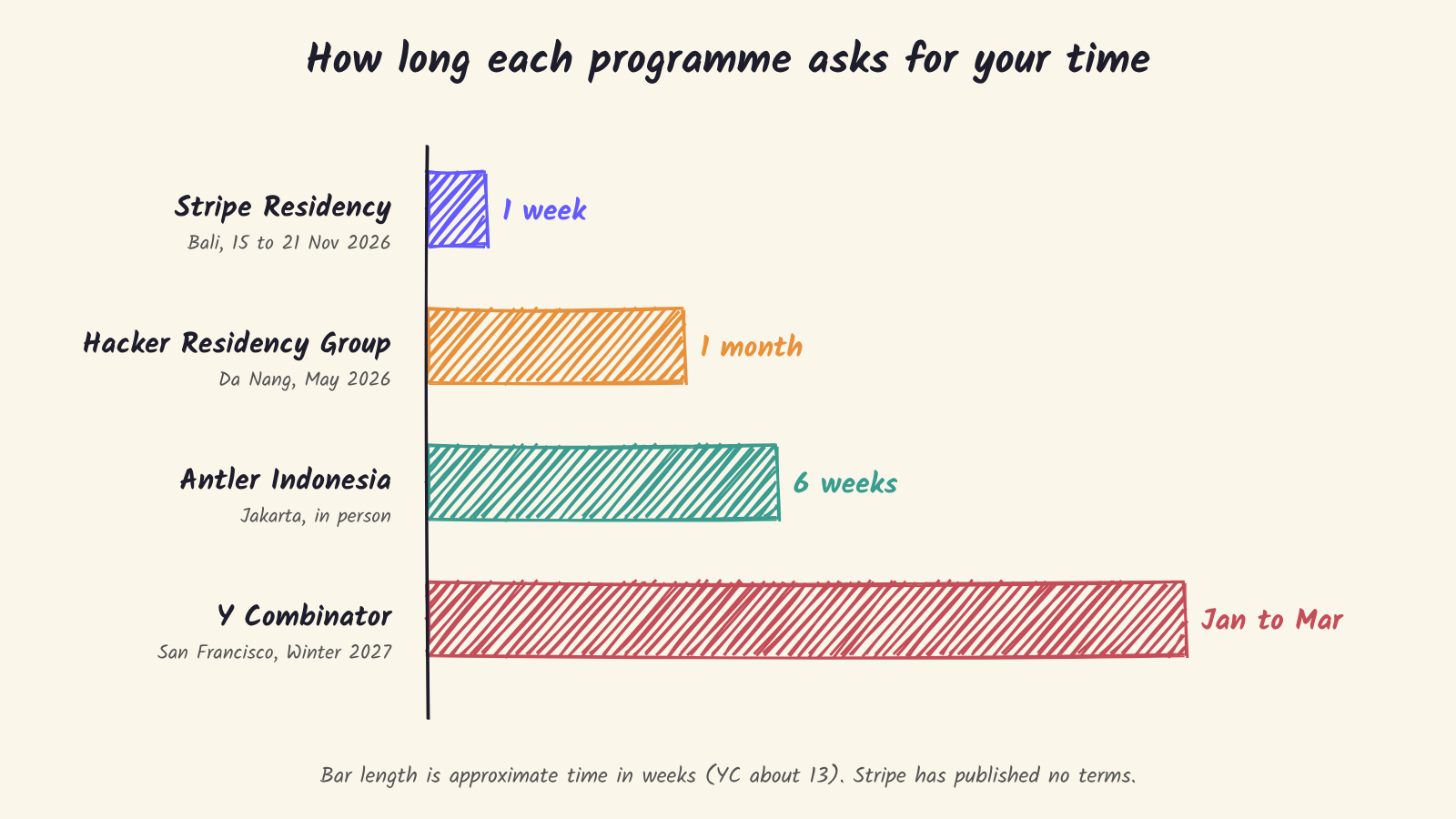
Stripe’s week is the shortest by a wide margin. Antler and Y Combinator say how they invest, and the pages I read for Stripe and Hacker Residency Group don’t say what a founder gives or gets. For Stripe that might be because there’s nothing to give. A free week in Bali would be consistent with every public word so far, and so would a programme with strings attached. The posts don’t say.
What Stripe hasn’t published
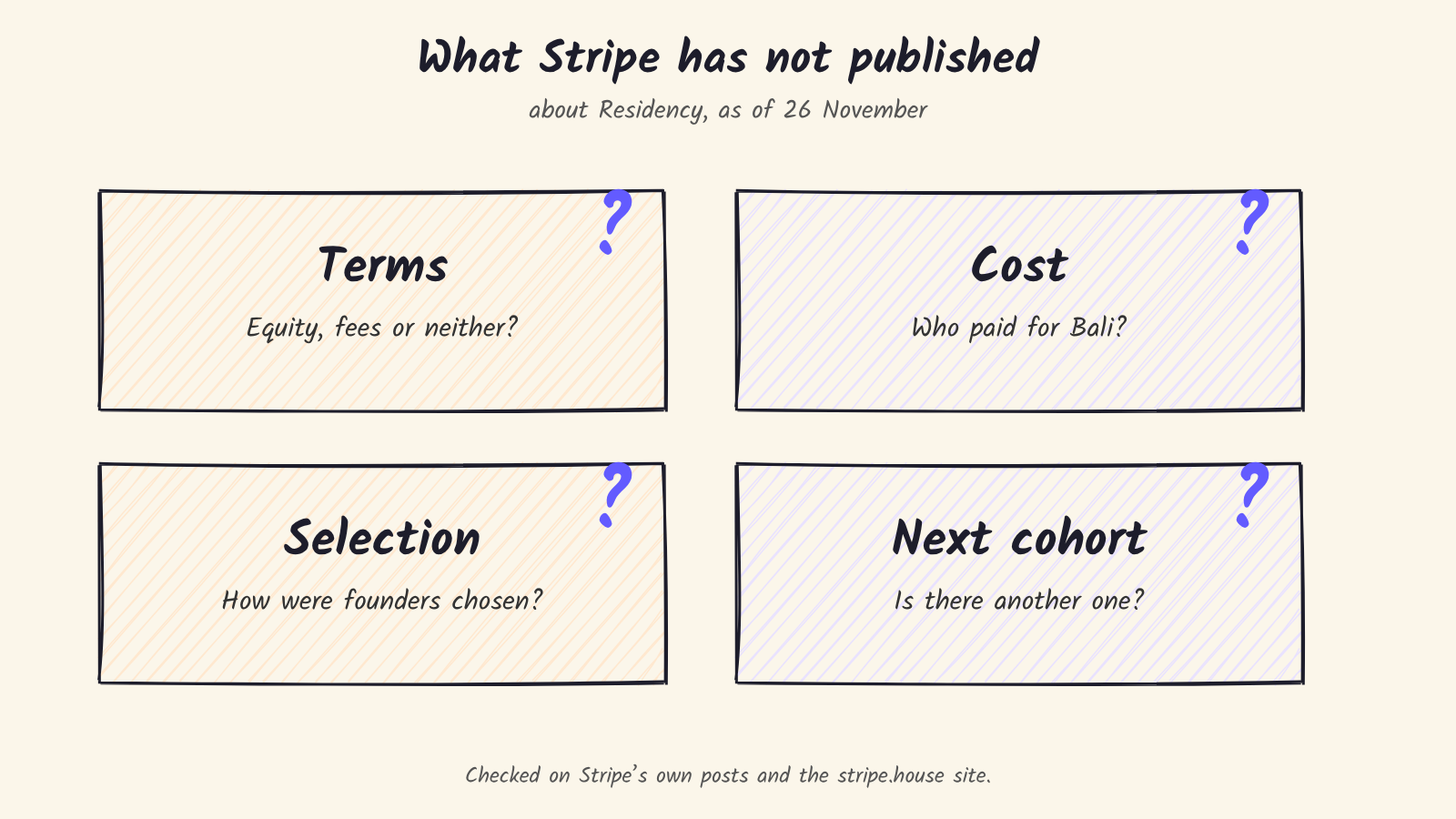
As of 26 November I found none of the following in Stripe’s thread, the hosts’ announcements, the residents’ posts or stripe.house:
- Terms. No mention of equity, a fee, a revenue share or any obligation for residents.
- Cost. Nothing on who paid for flights, the villa or the dinners.
- Selection. The hosts say the group was curated and that Stripe users could reply or message them. There’s no application page or criteria.
- A next cohort. Stripe calls this a pilot. No second date has been announced.
None of that is unusual for a pilot. It does matter for the solo founders who formed 63% of Atlas C corps this quarter, because a second cohort would be the first time they’d need to know what they were applying for. If Stripe runs one, the page to read first is the one that tells you the terms.
Terms used in this piece
- Residency
- Stripe’s name for its pilot programme that brought indie and bootstrapped founders to Bali for a week.
- Ship
- Founder slang for something finished and released, as in a product launch or feature.
- Bootstrapped
- Funded by customers or the founder’s own money rather than outside investors.
- Stripe Atlas
- Stripe’s service for incorporating a US company from anywhere.
- C corp
- The kind of US company that investors usually expect a startup to be.
- Top decile
- The best-performing tenth of a group, here measured by revenue.
- SAFE
- A simple agreement for future equity, a common way for early investors to buy a stake later.
- MCP
- Model Context Protocol, a standard for letting AI assistants use another product’s tools.
Stripe has shown a good week of building in Bali, and a roster that matches the founders its own data says do best. What it hasn’t shown is the deal. Until Stripe publishes terms, Residency is a well-run week with a good thread at the end.
Sources
- Stripe on X, thread of 25 November 2026: x.com/stripe/status/2125624231878918600
- Jess Lozano Schmitt on X, 29 October 2026: announcement
- Cait Bahari on X, 29 October 2026: announcement
- Javi on X, 16 November 2026: post from the week
- Marc Lou on X, 2 May: post quoted in both announcements
- stripe.house and its source on GitHub
- Stripe, Solo founding is at an all-time high, 28 May 2026
- Stripe, Stripe Atlas
- TechCrunch, Stripe acquires Indie Hackers, 11 April 2017
- Antler Indonesia, Hacker Residency Group and Y Combinator, read 26 November 2026
Discover more from Sulat AI & Tech News
Subscribe to get the latest posts sent to your email.