Arena says Microsoft’s MAI-Code-2.1 has debuted on Code Arena: WebDev at #13 overall with 1,717 points, which makes Microsoft the sixth-ranked lab on that board. The number is real, but it isn’t a vote count. Arena’s own table tags the row AutoEval, meaning a reward model trained on millions of human votes cast the day-one votes in place of people. The gap to the model above it, Meta’s Muse Wonder Full, is 7 points, which on Arena’s scale is close to a coin flip.
Arena posted the result on X on 25 November, US time. I read the post, the WebDev leaderboard, Arena’s AutoEval explainer, Microsoft’s MAI Code 2 launch post and its model card. This piece explains how the leaderboard works for anyone who has never opened it, what the score does and doesn’t tell you, who sits around it, and what Microsoft has and hasn’t said about version 2.1. Microsoft’s earlier launch claims are in our piece on MAI Code 2, and the wider launch is in our guide to the seven new MAI models.
1,717
points for MAI-Code-2.1 on Code Arena: WebDev, tagged AutoEval
#13
position Arena’s post gives it, and #6 among labs
7
points behind Meta’s Muse Wonder Full, the model above it
105
points behind the leader, Claude Fable 5.2, at 1,822
- What Arena announced
- How the Arena leaderboard works
- What AutoEval means for this score
- Who sits around 1,717
- The price argument
- MAI-Code-2.1 versus MAI Code 2
- Where you can use it
- How other day-one AutoEval scores looked
- What nobody has published yet
- What to do with this
What Arena announced
Arena’s post says MAI-Code-2.1 “has just debuted in Code Arena: WebDev at #13 overall with a score of 1717 pts, placing Microsoft AI #6 among frontier AI labs.” It adds that the model is 7 points behind Meta’s Muse Wonder Full and ahead of Gemini 4 Hydrogen (xHigh) and Kimi K3.1 Pro (Max). Across Code Arena’s sub-categories it lists MAI-Code-2.1 at #7 in Fullstack, #8 in Data and Analytics, #8 in Consumer Product and #11 in HTML.
Two details matter. The first is the “#6 among labs” line. Arena ranks a lab by its best model, so five labs have a higher-scoring model than Microsoft’s. The second is the spread across categories. The model does better in Fullstack work, which mixes interface, backend and data, than in plain HTML generation, where it sits at #11. That fits what Microsoft says it built the model for: multi-file changes, debugging and production code, not one-page demos.
How the Arena leaderboard works
Arena runs anonymous head-to-head contests. In Code Arena: WebDev a person types a request, such as a pricing page or a small game, and two unnamed models each build a working web app. The person looks at both, picks the better one or calls it a tie, and only then sees which model made which. Arena says the board holds about 1.05 million votes across 165 models in its 23 November snapshot, which is why a single week’s votes can still move the order.
A statistical model turns those pairwise votes into one number per model. Arena uses a Bradley-Terry fit, which treats each vote as evidence about how likely one model is to beat another, and then rescales the result to an Elo-style score. Higher means more wins against the field. Every score has a 95% confidence interval, a band around the number that is wide when a model has few votes and narrows as votes pile up.
Most people misread the size of a gap. On an Elo-style scale, the chance that the higher-scored model wins a single vote depends on the difference. By my calculation, 7 points is about 51%, and the 105 points between MAI-Code-2.1 and the leader is about 65%. A rank is a sorted list, and a sorted list hides how close the neighbours are.
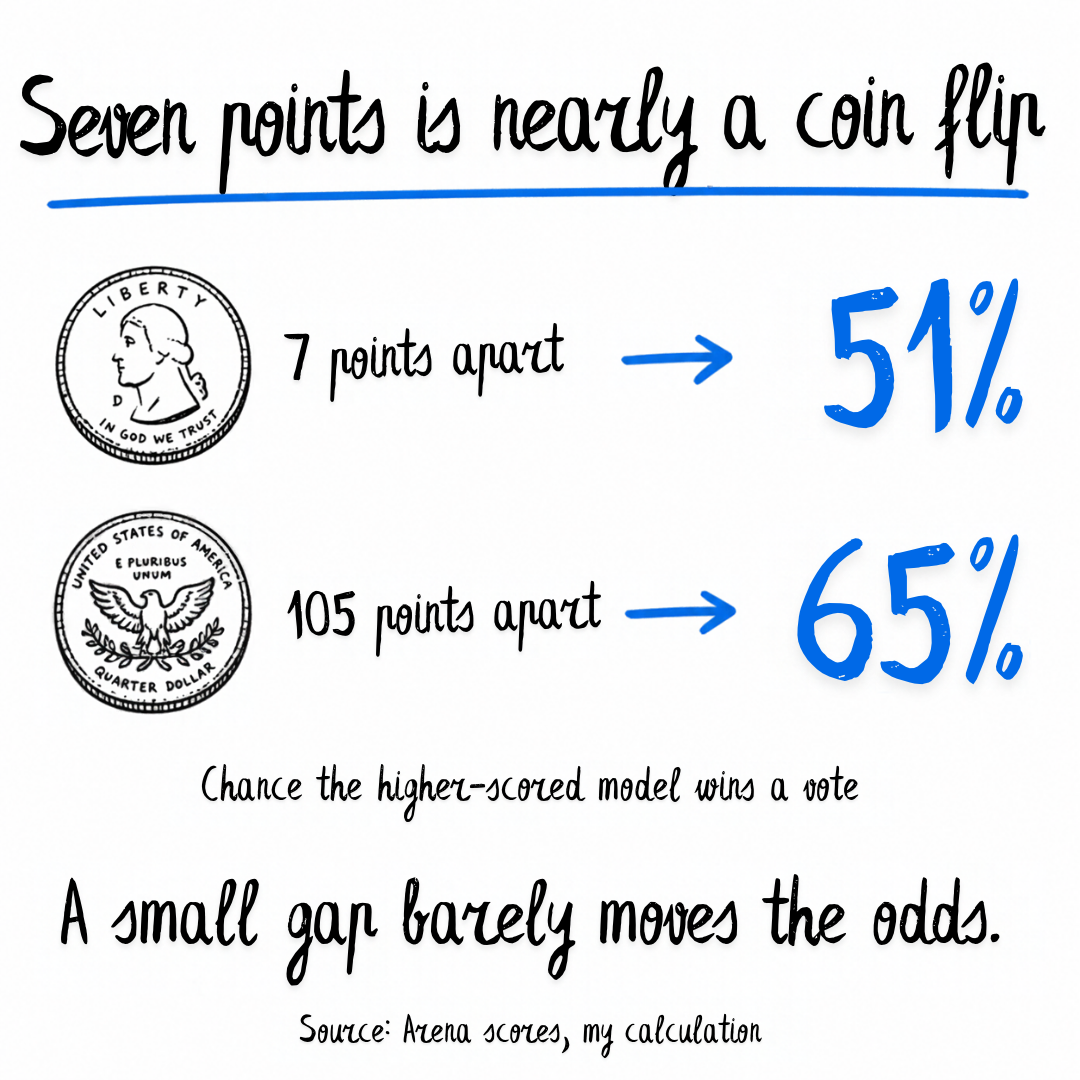
So “#13” and “#12” are not far apart. Anything within a few points of MAI-Code-2.1 is, on this evidence, a tie in practice. That is true of every row on the board, and it is the main reason I read the scores and the intervals rather than the rank numbers.
What AutoEval means for this score
Waiting for enough human votes takes days. In July 2026 Arena introduced AutoEval to give new models a day-one number. It trains a reward model on millions of past pairwise votes so that it learns to predict which response a person would prefer. For a new model, Arena generates responses on prompts sampled from live evaluations, has the reward model score them against other models’ responses, turns the score differences into soft votes, and combines those with the real human votes already on the board. Arena says the result correlates above 0.98 with live evaluations and that it recalibrates the reward model weekly.
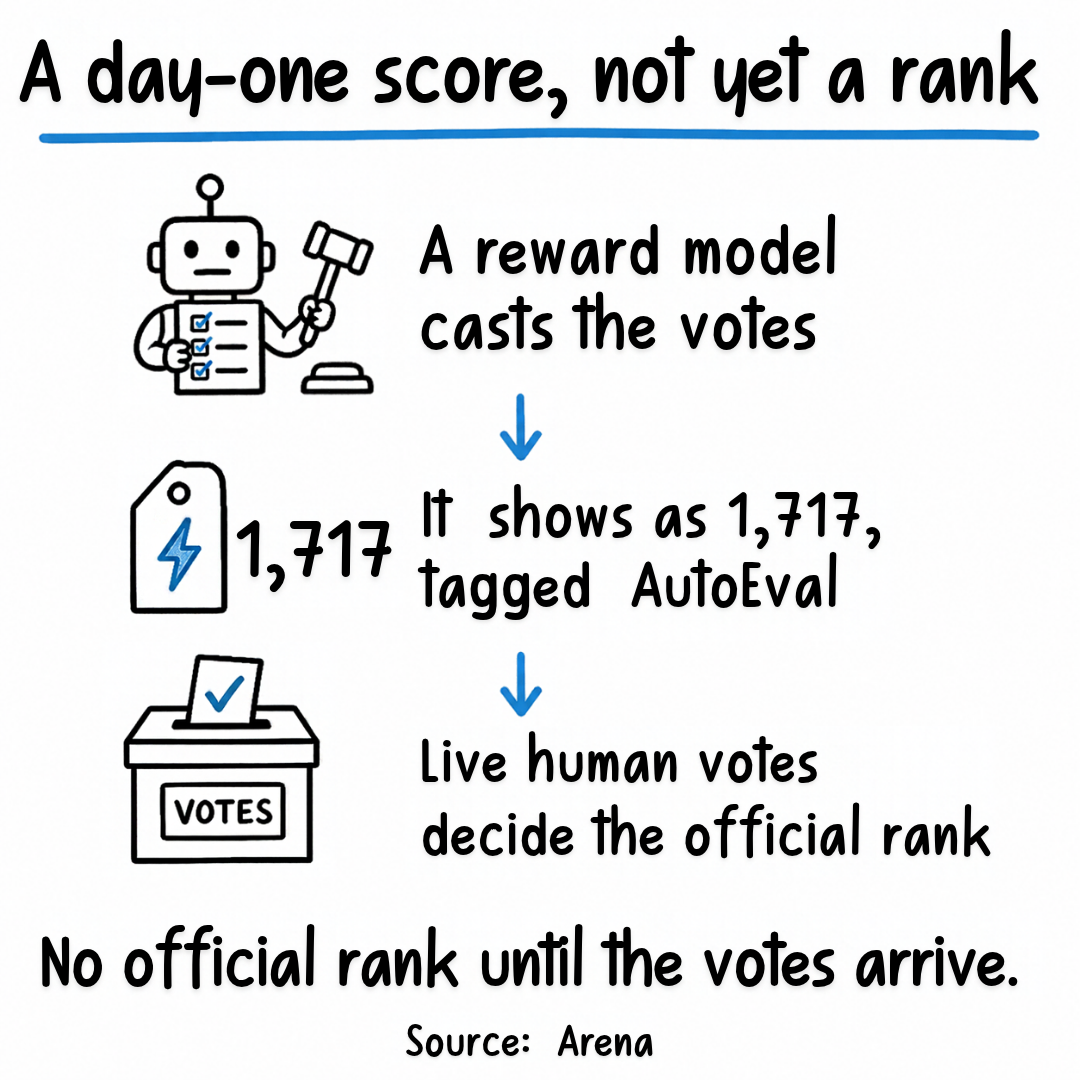
Arena labels these rows “AutoEval” and says it updates them “once enough human votes arrive to validate them.” That is the status of MAI-Code-2.1’s 1,717. The text of Arena’s post doesn’t mention AutoEval, but the chart in it does, and so does the board row, whose cost columns read N/A.
| Human-vote score | AutoEval score | |
|---|---|---|
| Who casts the votes | People choosing between two anonymous builds | A reward model trained on human votes |
| How soon it appears | Days to weeks, as votes accumulate | Within hours of a launch |
| What it is | The measured result | Arena’s calibrated estimate of it |
| What happens next | Moves with each new vote | Replaced or confirmed as live votes arrive |
The number may well hold up. Arena’s correlation figure is its own claim and I couldn’t test it independently, so for now a rank taken from an AutoEval row is a forecast, and Microsoft’s #13 reads best that way until human votes land.
Who sits around 1,717
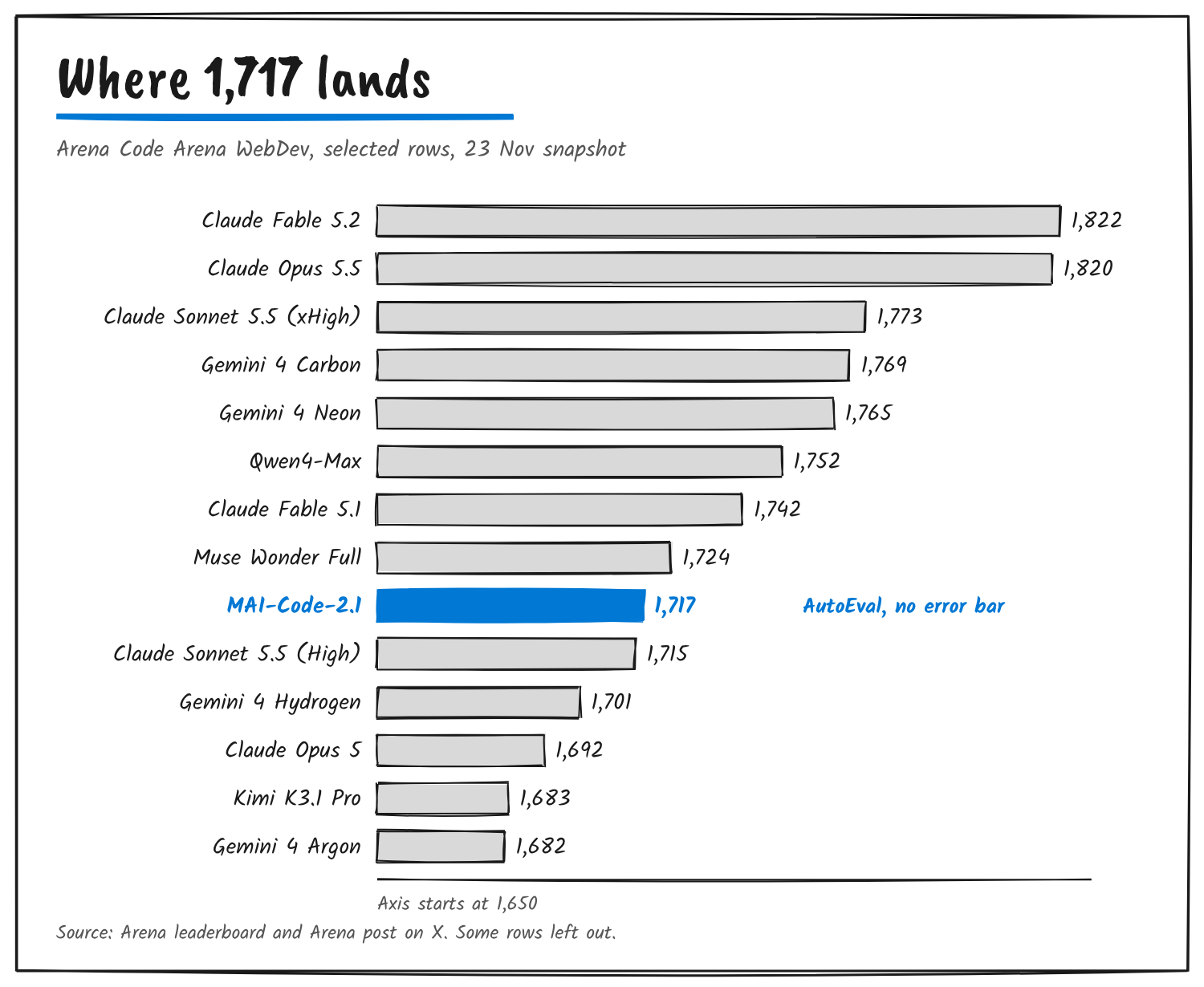
I built the chart below from Arena’s 23 November snapshot, the one that matches the numbers in Arena’s post. I show the models around MAI-Code-2.1 and a selection of rows above and below it. Scores shift by a point or so between snapshots, so a row can differ by one from the live board.
| Model | Score | Blended price, US$ per million tokens |
|---|---|---|
| Claude Fable 5.2 (xHigh) | 1,822 | 32 |
| Claude Opus 5.5 (Max) | 1,820 | 16 |
| Claude Sonnet 5.5 (xHigh) | 1,773 | 8 |
| Gemini 4 Neon (High) | 1,765 | 6 |
| Qwen4-Max (xHigh) | 1,752 | 3.75 |
| Claude Fable 5.1 (Max) | 1,742 | 40 |
| Muse Wonder Full (Max) | 1,724 | N/A |
| MAI-Code-2.1 | 1,717 | N/A on Arena; about 1 at Microsoft’s launch rate |
| Claude Sonnet 5.5 (High) | 1,715 | 8 |
| Gemini 4 Hydrogen (High) | 1,701 | 6 |
| Claude Opus 5 (Max) | 1,692 | 20 |
MAI-Code-2.1 lands among the mid-table Claude and Gemini rows, with the leaders about 100 points ahead. It’s the only entry in that stretch with no price on Arena’s board, and the models directly around it are separated by single digits, which on the win-probability maths above is noise.
The price argument
The reason this result matters commercially is price. Microsoft says MAI Code 2 delivers 96% of Claude Opus 5.5’s performance at 5% of the cost. Its figures, averaged across four coding benchmarks on Microsoft’s own MSBench harness at maximum reasoning effort, are a 63.2% pass rate at US$0.309 a task for MAI Code 2 against 65.3% at US$6.306 for Opus 5.5. The tech site tbreak notes that all cost and performance figures are Microsoft’s own, that the MAI Code 2 cost reflects a 50% promotional price, and that no independent validation had been published.
| MAI Code 2 | Claude Opus 5.5 | |
|---|---|---|
| Average pass rate, four benchmarks | 63.2% | 65.3% |
| Average cost per task | US$0.309 | US$6.306 |
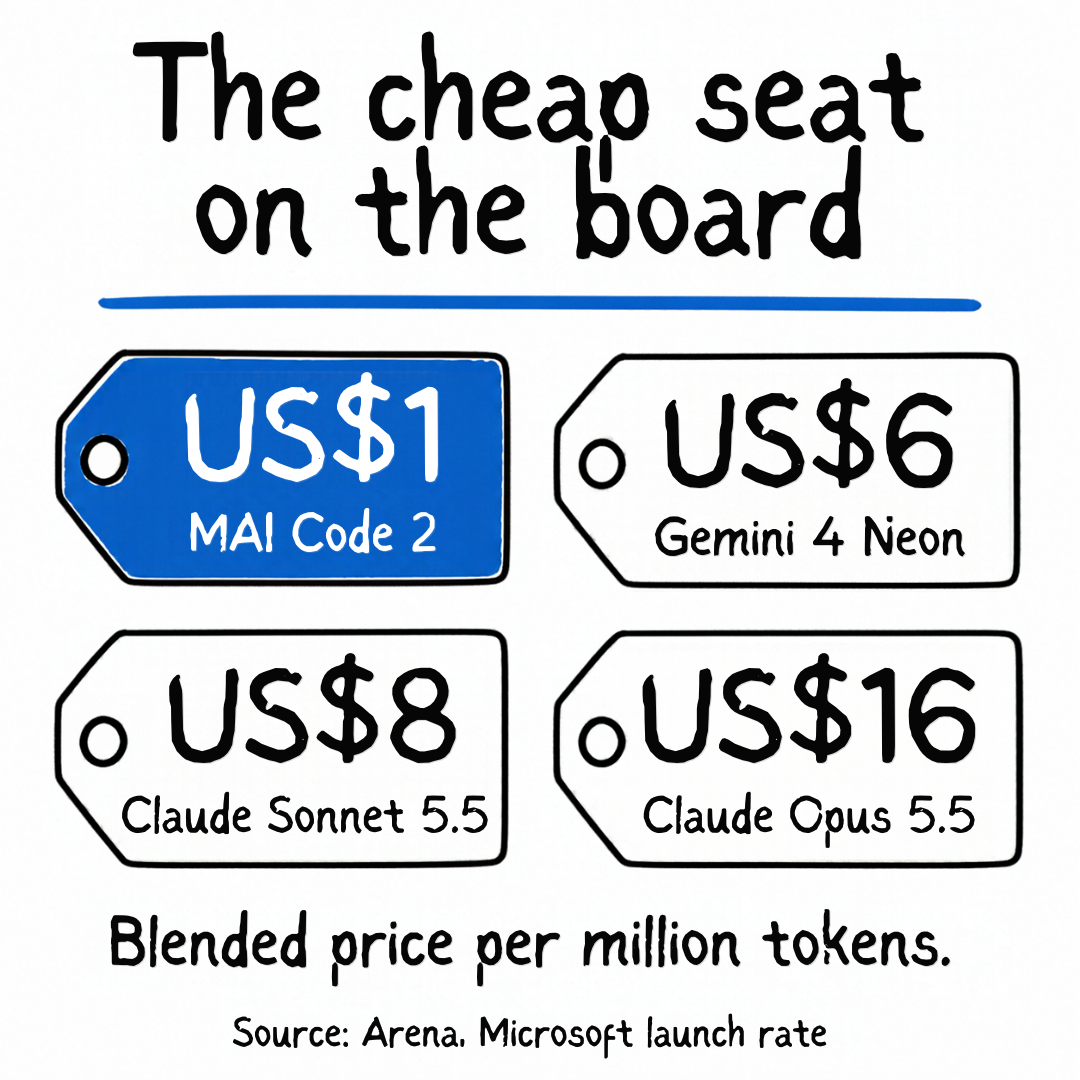
At the launch rate of US$0.50 for input and US$2.50 for output, a 3:1 blend works out to US$1 per million tokens, against US$6 to US$16 for the models in the infographic. The discount ends in May 2027, according to The Next Web. If the promotional price is half the list price, as tbreak’s 50% figure implies, the blended list price is about US$2, which is still the cheapest on that shortlist. Microsoft publishes its price under the name MAI Code 2 and hasn’t listed a rate for 2.1.
Arena’s own board is the better check on the price claim, because it measures cost per task on its own prompts. For MAI-Code-2.1 that column is empty, so Arena hasn’t yet verified the 5% figure on WebDev work. Until it does, all I can say is that MAI is priced low, scores mid-pack on this board, and that the value claim rests on Microsoft’s numbers.
MAI-Code-2.1 versus MAI Code 2
Microsoft launched MAI Code 2 and MAI Code 2 Flash at Ignite on 17 November. Every Microsoft page I read uses the name MAI Code 2: the launch post, the model page, the model card and GitHub’s changelog. None mentions 2.1, and I found no Microsoft announcement of a 2.1 release. Arena lists the model as MAI-Code-2.1 and doesn’t say what changed from 2.0.
That leaves three possibilities that I can’t separate from here: a point release Microsoft hasn’t announced, an updated checkpoint behind the same product name, or Arena’s name for the build it evaluated. For a reader choosing a tool, the question is concrete: does the model you select in GitHub Copilot match the one Arena scored? Microsoft hasn’t answered that publicly.
Where you can use it
- GitHub Copilot: MAI Code 2 is available on Copilot Pro, Pro+, Max, Business and Enterprise for eligible annual subscribers, under usage-based billing. Admins on Business and Enterprise can switch it off in the model policy.
- Microsoft Foundry: only MAI Code 2 Flash is in limited-access preview there. MAI Code 2 isn’t listed.
- Other tools: Microsoft says it will release the models “soon” on OpenRouter, Vercel, Hermes, OpenCode and Kilo.
- Your own Azure: Microsoft also plans to let organisations customise MAI models and run them in their own Azure through MAI Licensed Weights, not generally available yet.
Microsoft adds a limit of its own. It says the models are “explicitly not yet tuned for harder problems, like fundamental science research and very long-horizon agentic work.” A WebDev score measures building web apps people can look at and click, so it doesn’t speak to that boundary.
Burke Holland, who works on Microsoft’s Copilot CLI team, said on 24 November that they were using MAI Code 2 exclusively that week, which we covered. One person on the vendor’s own team isn’t a test, but it shows where the model is being tried first.
How other day-one AutoEval scores looked
MAI-Code-2.1 isn’t the first AutoEval row Arena has promoted, so there are precedents for the shape of this announcement.
| Model | Date | Day-one AutoEval score | How Arena framed it |
|---|---|---|---|
| GLM-5.3-Flash (Z.ai) | 26 August 2026 | 1,634 | “Around #5” on WebDev, #2 among open models |
| Qwen3.8-Flash-Next (Alibaba) | 26 August 2026 | 1,617 | “~#8” on WebDev, #3 among open models |
| ERNIE 5.5 Flash Preview (Baidu) | November 2026 | 1,668 | Shown with no rank and no vote count; interval of about 16 points either way, per a third-party reading of the row |
| MAI-Code-2.1 (Microsoft) | 25 November 2026 | 1,717 | “#13 overall,” #6 among labs |
Arena’s wording has hardened. In August it said “around” and “~”; here it says a flat “#13”, for the same kind of score. The ERNIE row shows what sits behind a headline like that: a tolerance of about 16 points, no vote count and no official rank. If MAI-Code-2.1’s band were similar, it would reach Muse Wonder Full above and Gemini 4 Hydrogen below.
What nobody has published yet
- A confidence interval for the 1,717. AlphaSignal notes that Arena’s chart omits one.
- What MAI-Code-2.1 changes from MAI Code 2, or whether Copilot serves the same build.
- Arena’s cost per task for the model, which would test Microsoft’s price claim on WebDev work.
- A human-vote score. Until enough votes arrive, the number is Arena’s estimate.
- An independent test of Microsoft’s 96% and 5% figures. tbreak found none at launch, and I found none since.
What to do with this
If you build web interfaces and already pay for Copilot, MAI Code 2 is worth a trial on your own prompts, because it’s cheap to try and Microsoft says it is strong on interface work. Treat Arena’s 1,717 as a reason to test it, not a ranking to switch on. If you choose models by leaderboard, wait for the AutoEval tag to drop and for the interval to appear. If you follow Microsoft’s model strategy, the score matters in a different way: AlphaSignal notes Microsoft began shipping its own foundation models within the past year, and it now sits within 7 points of Meta on a board that Anthropic, Google, Alibaba and others lead.
Terms used in this piece
- Arena
- The site where people compare anonymous AI models and the votes rank them.
- Code Arena: WebDev
- Arena’s board for models that build working web apps from a prompt.
- AutoEval
- An Arena score where a reward model trained on human votes casts proxy votes for a new model.
- Reward model
- A model trained to predict which of two responses a person would prefer.
- Bradley-Terry
- A statistical model that turns pairwise wins and losses into a strength score for each competitor.
- Confidence interval
- A range around a score that shows how much it could move. Few votes make it wide.
- Blended price
- Arena’s single price per million tokens, weighting input and output tokens 3 to 1.
- MSBench
- The harness Microsoft used for its own MAI Code 2 benchmark runs.
Arena has given Microsoft a day-one result that reads well and is, by Arena’s own labelling, an estimate. The next thing to watch is whether the tag comes off, where the score lands once people have voted on it, and whether Microsoft explains what 2.1 is.
Sources
- Arena on X, MAI-Code-2.1 post, 25 November 2026 (US time)
- Arena, Code Arena: WebDev leaderboard, read 26 November 2026 NZT, with the 23 November snapshot
- Arena, “Introducing AutoEval to the Arena leaderboards”, 30 July 2026, updated 12 August
- Arena, “Introducing the Arena 3D Leaderboard”, 24 November 2026, for the 23 November snapshot and Elo-scale win-chance method
- Microsoft AI, “MAI Code 2 and Code 2 Flash”, 17 November 2026, and the MAI Code 2 page
- MAI Code 2 and MAI Code 2 Flash model card, 17 November 2026
- GitHub changelog, MAI Code 2 and MAI Code 2 Flash in GitHub Copilot, 17 November 2026
- tbreak, MAI Code 2 launch coverage, 18 November 2026, for the benchmark table and promotional price note
- The Next Web on MAI Code 2 pricing and licensed weights, 19 November 2026
- AlphaSignal, MAI-Code-2.1 on Arena, 25 November 2026, for the promotional rate and the missing confidence interval
- The Sequence Chat, issue 930, interview with Arena’s Anastasios Angelopoulos, 10 September 2026, for the weekly AutoEval recalibration
- OrcaRouter, ERNIE 5.5 Flash Preview on Code Arena, 12 November 2026
- Arena on X, GLM-5.3-Flash and Qwen3.8-Flash-Next, 26 August 2026
Discover more from Sulat AI & Tech News
Subscribe to get the latest posts sent to your email.