
Perplexity has added a date cutoff to its Search API and Context API, so a developer or an agent can ask the web a question as it stood on a day in the past. The feature is called Time Machine. It works through one new parameter, snapshot_as_of, on requests people already make, and it costs the same as any other call.
Perplexity announced it on 25 November US time. Its post makes one claim in plain terms: “The live web always knows how things turned out.” Ask an agent today what was known before an election or an earnings call, and it’ll find pages that already report the result. Time Machine is meant to stop that, so a past question can be scored fairly against what happened next.
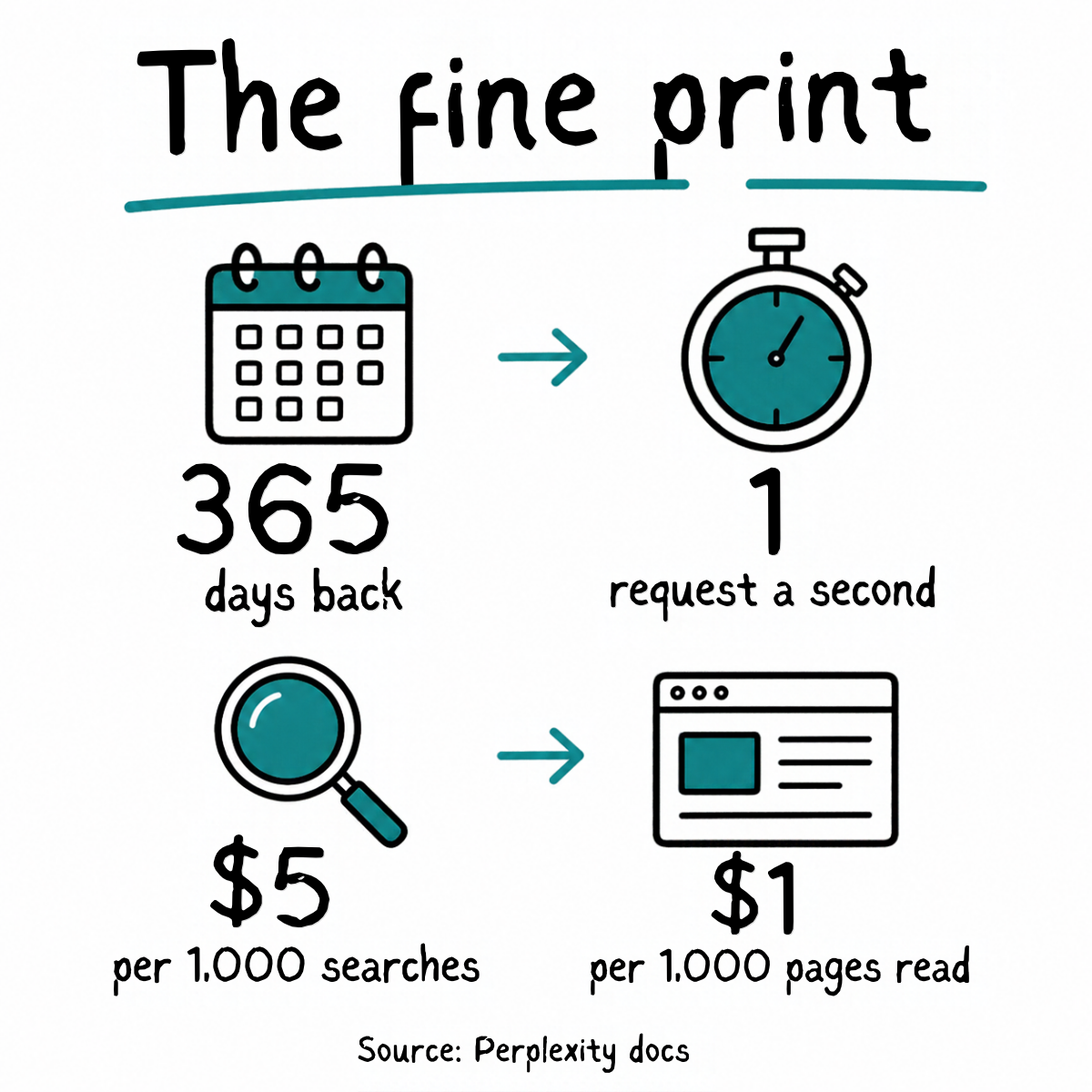
365
days back, on a rolling window
1 a second
default search rate limit with a cutoff set
0.77 to 0.80
held-out reward after training with Time Machine, against 0.79 for the market
18 v 62
of 1,000 queries with a flagged page, Perplexity against Exa, in Perplexity’s own test
How Time Machine works
Each time Perplexity crawls a page, it saves a copy with the time it was saved. Every URL builds a version history, and a request with snapshot_as_of answers from that history instead of the live site. The value is an RFC 3339 timestamp with a time zone, and it can’t be in the future or more than 365 days old. Perplexity says the window grows as the archive does.
On search, only pages published or first crawled by the cutoff are considered. Each candidate is swapped for its latest copy saved at or before the cutoff, and ranking scores the query against that older text. A page that was later updated with the outcome can’t rank for it, and the result’s title, date and snippet come from the same old copy. On the Context API, the full text comes from the stored copy and the live site is never contacted.
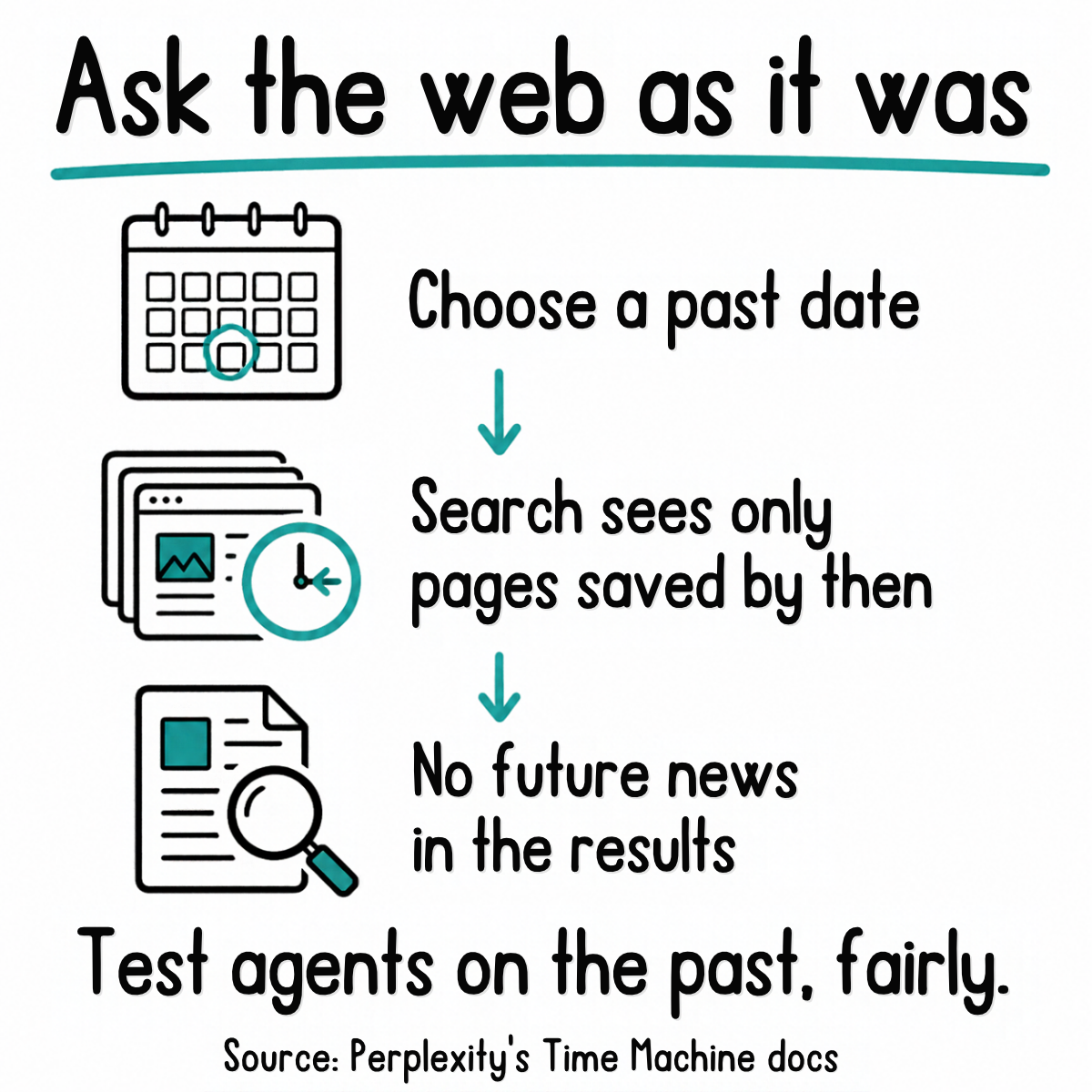
The docs add the edges. Search results with a cutoff can’t be combined with recency, publication-date or last-updated filters, and people search isn’t supported. A page that can’t be shown as of the cutoff is left out, so a search can return fewer than the requested results, or none. Stored copies keep the page text but not its HTML or links, so the Context API with a cutoff returns markdown and highlights, not HTML or links. In the Agent API, the cutoff goes in the filters of the web search and URL fetch tools.
The Python search call from Perplexity’s post
from perplexity import Perplexity

client = Perplexity()
search = client.search.create(
    query="Latest Python 3 Release on the Python Source Releases page",
    snapshot_as_of="2026-10-20T00:00:00Z",
    search_domain_filter=["python.org"],
    max_results=5,
)
for result in search.results:
    print(result.title, result.url)
The docs say the Python examples need the perplexityai package at version 0.50.0 or later. Perplexity’s demo is plain on purpose: a search of python.org with a cutoff of 20 October 2026 returns the page as it was then, and the Context API read of the same page lists Python 3.15.0 as the latest release rather than the newer version on today’s page.
Price and limits
There’s no surcharge for historical requests. Search is US$5 per 1,000 requests and the Context API is US$1 per 1,000 URLs fetched, and an existing API key works. The catch is the rate limit. Perplexity’s docs say search requests with a cutoff have their own limit, with a default of one request a second, and that higher limits are available by contacting the API team. That’s fine for a handful of evaluations and slow for a training run that needs thousands of searches. Context requests use the normal limits.
The Polymarket experiment
Perplexity’s showcase is a reinforcement-learning run. It trained GLM-5.3 Flash to forecast real political events from 2026 listed on Polymarket. Each question asks about a future event, and the model estimates the chance as of the day the question was asked. The actual outcome sets the grade: an 80% forecast on a candidate who wins scores higher than a 50% one, and the score is the reward.
The problem is that these questions have already resolved, so a model on the live web can find the answer. Before any training, Perplexity says the model scores 0.94 on held-out questions with the live web and 0.77 with Time Machine. The market scores 0.79, which is the Polymarket price on the day each question was asked, scored the same way. The live-web number is the leak showing.
It then trained the model twice, once on the live web and once with Time Machine, and scored both on the same held-out questions with Time Machine on. With the live web, every forecast finds the answer and scores the same, so about 90% of training groups have zero gradient and teach nothing. With Time Machine only about 25% do, and held-out reward rises from 0.77 to 0.80, above the market’s 0.79.
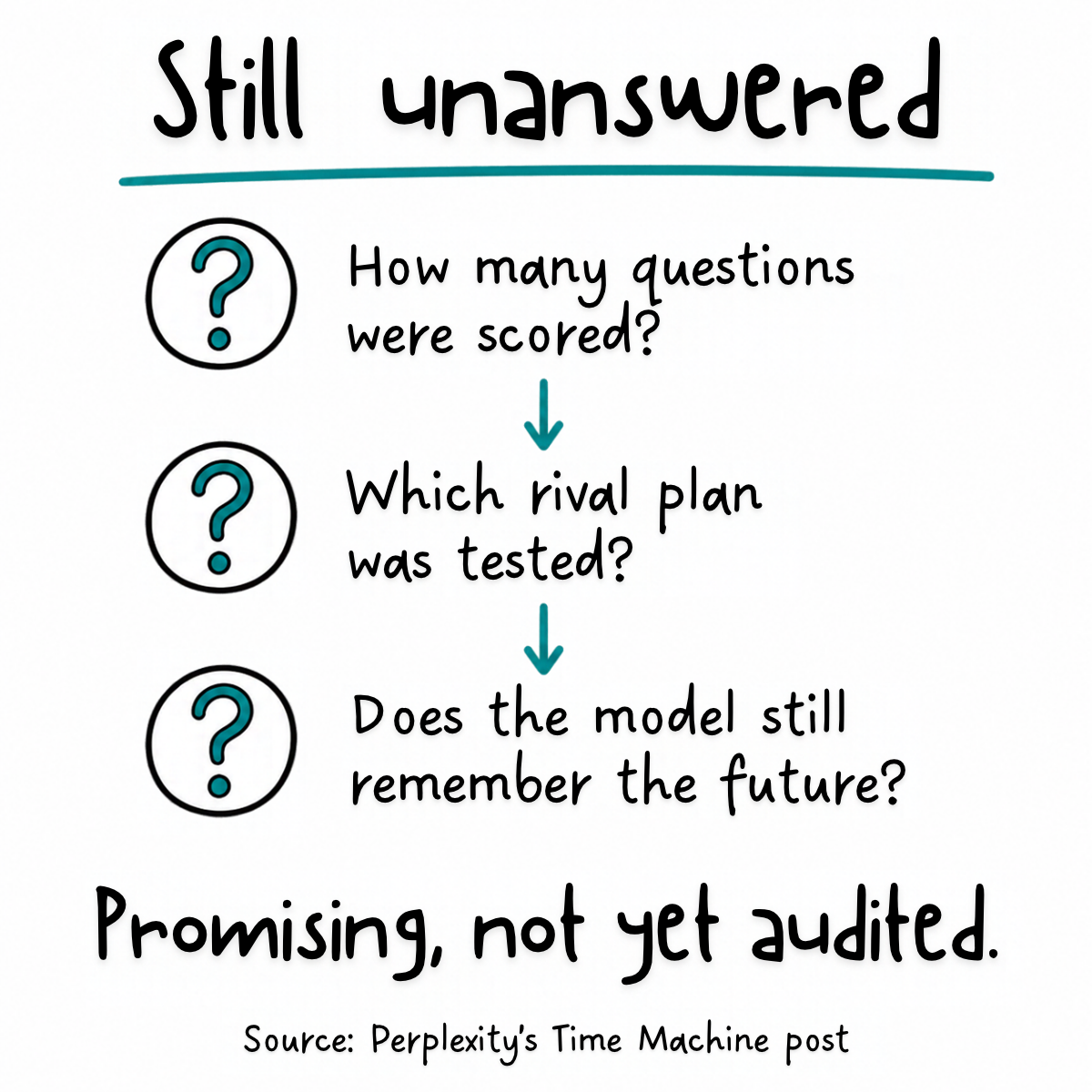
The result is plausible in direction and thin in detail. Perplexity doesn’t say which scoring rule it used, how many questions were in the held-out set, or what the confidence interval is on a gain of 0.03. The edge over the market is 0.01, and without an interval I can’t tell you that’s real. It’s a training experiment, not a forecasting product, and the post names no live use.
Against Exa Snapshot
Perplexity also ran a head-to-head with Exa’s Snapshot feature, on three sets of 1,000 queries: a random sample of Time Machine queries, news queries and prediction-market research queries, with the same cutoff for each. It reports two measures.
| Measure | Time Machine | Exa Snapshot |
|---|---|---|
| Pages returned with a publication date | 98.8% to 99.5% | 66.1% to 77.7% |
| Pages flagged as post-cutoff, random sample | 0.25% | 1.10% |
| Queries with at least one flagged page, random sample | 18 of 1,000 | 62 of 1,000 |
That’s a vendor testing a rival, with an automated judge, and Perplexity doesn’t say which model the judge was or which Exa plan it ran. The headline gap is also on the random sample. On news and prediction-market queries the gaps were smaller, and Perplexity doesn’t give those figures in the post. Treat it as a claim worth repeating, not a ruling.
Where it fits among the peers
Time Machine arrives a day after Epochal, a startup from three xAI co-founders, launched Time Portal, which serves search, fetch and a sandbox as of a chosen instant. I covered that in Epochal’s launch. The two take different routes to the same need. Epochal goes back to 1970 and sells a whole-machine sandbox. Perplexity goes back one year and bolts the cutoff onto APIs a lot of developers already use.
| Option | How it sets the past | Reach back | Source |
|---|---|---|---|
| Perplexity Time Machine | snapshot_as_of on Search and Context API calls | 365 days, rolling | Perplexity docs |
| Epochal Time Portal | Accept-Datetime header on search, fetch and sandbox | Search and fetch to 1 January 1970; sandbox from 1 April 2023 | Epochal docs |
| Exa Snapshot | A cutoff on Exa’s search | Not stated in the post | Perplexity’s comparison |
| Wayback Machine availability API | Returns the closest stored snapshot | Not stated here | Epochal’s description |
| Google and DuckDuckGo date filters | Filter by a page’s date | Not applicable | UCSD ACL 2026 paper |
The reason the comparison matters is the failure the table’s last row describes. A UCSD paper at ACL 2026 found that date-filtered Google and DuckDuckGo returned at least one page with major post-cutoff leakage for 71% and 81% of questions, and revealed the answer outright for 41% and 55%. A forecasting score with leaks was 0.10 on the Brier scale against 0.24 without, where lower is better. The paper pointed at page updates, related-content modules and unreliable metadata, which is the reason Perplexity swaps in the old copy and takes the date and snippet from it.
Prophet Arena runs a time-gated search benchmark that scores engines for leakage. As I read its method page, it lists Perplexity’s date filters, not snapshot_as_of, and it admits ranking can leak. I found no independent leak audit of Time Machine yet, so the only numbers on its cutoff are the ones Perplexity ran itself.
What it’s for
Perplexity lists six uses. Reinforcement learning is the lead, where a cutoff keeps the reward about reasoning rather than lookup. Forecasting replays resolved questions at several points before resolution. Finance teams can backtest web signals with a cutoff hours before earnings calls, central-bank announcements or acquisitions. Reproducible evaluations pin a benchmark to one timestamp, so score changes reflect the model rather than new content. Agent replay reruns a past session against the web of that day, to tell a model error from what the web said. And a historical page check reads the same URL at two timestamps, to see what a pricing page or terms of service said on each date.
The last one is the use I’d watch. It turns a search API into a lightweight audit trail, though Perplexity’s archive only reaches back a year and only holds what its crawler happened to capture. A dispute that goes back further, or hinges on a page it never saved, needs the Internet Archive or the site’s own records.
It also fits a pattern in Perplexity’s developer push. The company has been adding APIs in quick succession, among them the Context API, the Monitor API and the Orchestrator API, and Time Machine builds on the first of those. Cloudflare made a related move the same week with Search for Agents, which is about giving agents a search index, not about the past.
What Perplexity hasn’t said
| Question | What’s on the record |
|---|---|
| How many questions in the Polymarket run | Not stated. No count for the held-out set, and no confidence interval on the 0.77 to 0.80 gain. |
| The scoring rule | Described as a score where a confident correct forecast earns more. The formula isn’t named. |
| Which Exa plan was tested | Not stated, and neither is the judge model. |
| Model memory | A cutoff gates what search returns, not what a model already learned in training. The post doesn’t address a model trained after the cutoff date. |
| Coverage | No figure for how many URLs have a copy at a given date. |
| Independent audit | None found. |
| Higher rate limits | Available by contacting the API team. No price or tiers published. |
The number to watch is a result on questions that resolved after a model’s training cutoff, with the question list published. That would show whether a cutoff-trained forecaster beats the market out of sample, rather than on questions the base model may have seen. Until someone outside Perplexity repeats the leak test, Time Machine is a well-specified feature with a vendor-run scorecard.
Sources
- Perplexity, Freeze the web with Perplexity Time Machine, 25 November 2026
- Perplexity docs, Time Machine for the Search API
- Perplexity docs, Context API formats and freshness
- Epochal, Introducing Time Portal, 24 November 2026
Discover more from Sulat AI & Tech News
Subscribe to get the latest posts sent to your email.