Perplexity has launched the Orchestrator API, one endpoint that reaches models from Anthropic, Google, xAI, OpenAI and open-weight labs such as GLM, Kimi and DeepSeek. It chooses the provider for each call based on availability, capacity and latency, and bills everything against a single pool of credits with no platform fee added. The headline claim is reliability: across a month of Perplexity’s own production traffic, Claude requests succeeded more often through the Orchestrator than on any one provider it measured.
Perplexity announced the API on X on 17 November, alongside two blog posts. Co-founder and CTO Denis Yarats added his own thread. His argument is that general-purpose model routing breaks the KV cache and is usually tuned to a handful of benchmarks, so Perplexity leaves the choice of model per task to you. The API follows the Context API and Monitor API, which Perplexity launched earlier this month.
Introducing the Perplexity Orchestrator API.
November 17, 2026
Orchestrator lets you choose the right model for the right task, and automatically selects the provider based on availability, capacity, and latency.
All open-weight and proprietary models are in one API with unified billing.
One endpoint, many providers
Behind the API sits the model layer Perplexity already runs for its own products. It handles hundreds of millions of requests across more than 85 models and over a dozen providers, with open-weight models served by Perplexity or its inference partners. The endpoint accepts three request formats: OpenAI Chat Completions, OpenAI Responses and Anthropic Messages. To switch an existing app over, you swap the API key and the base URL. The docs give that URL as api.perplexity.ai/orchestrator/v1, and model IDs carry a provider prefix, for example anthropic/claude-fable-5-2 or perplexity/glm-5.3. Calling the models endpoint returns the list your tier can use. There’s no server-side state between requests.
You pay per token at each model’s published rate, and there’s no per-request fee. Cache reads get a discount, while reasoning tokens count as output. The API Console breaks spend down by model, project, API key and date. Admins can restrict models, limit users and set spend caps.
Failover and routing
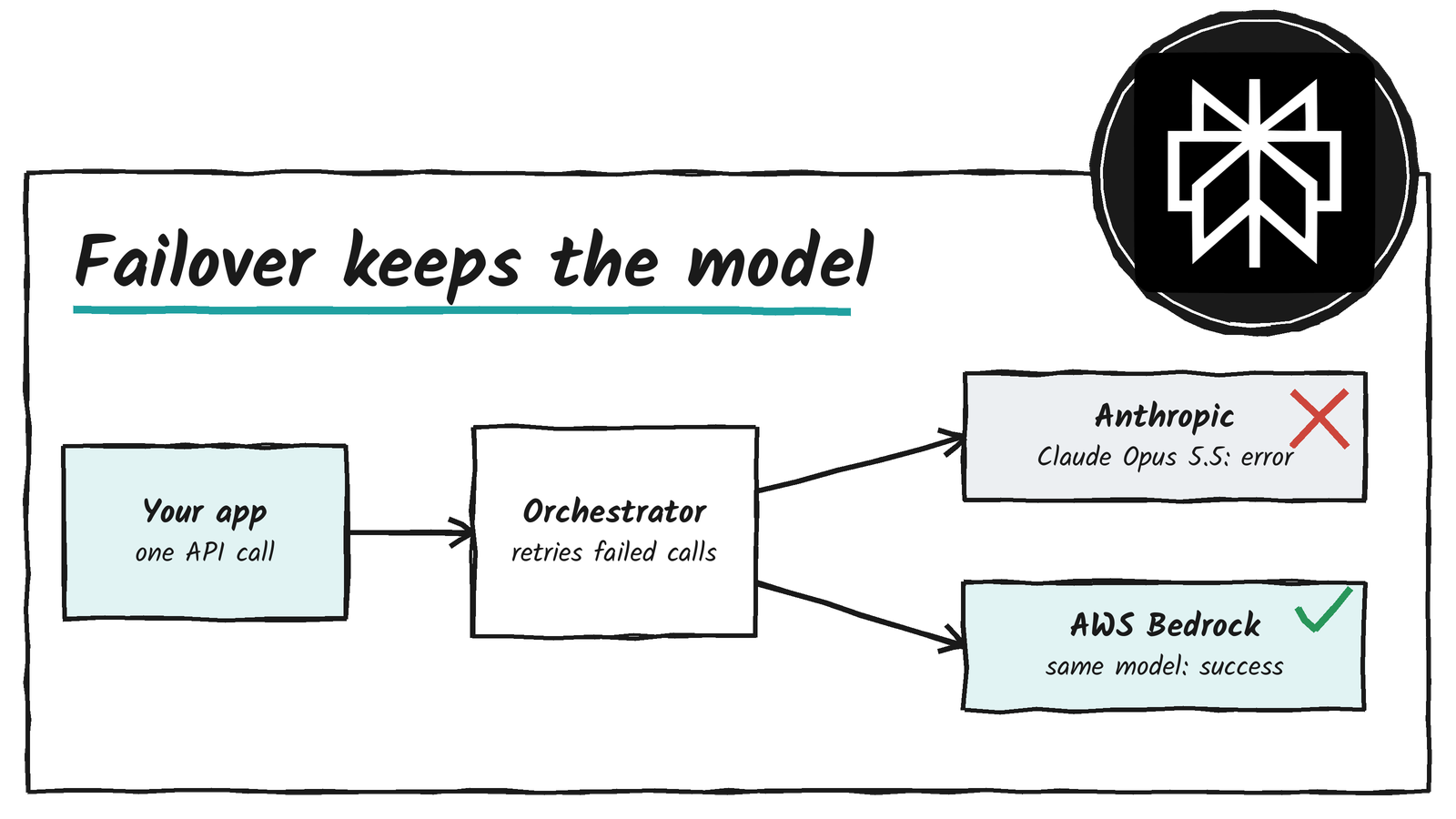
Failover keeps the same model and changes where it runs. If a Claude call errors, hits a rate limit or times out on Anthropic, the Orchestrator retries it on another deployment, such as AWS Bedrock. Every attempt has its own cap on time to first token and total duration, and the per-token rate stays put. Perplexity tracked success rates from 4 October to 2 November and says Claude through the Orchestrator beat each provider on its own, with less swing from day to day.
Providers also differ on speed. For Claude Opus 5.5, Anthropic had the faster median output speed on 15 of the 30 days Perplexity looked at, and AWS Bedrock led on the other 15. Perplexity says it’s building routing that accounts for speed.
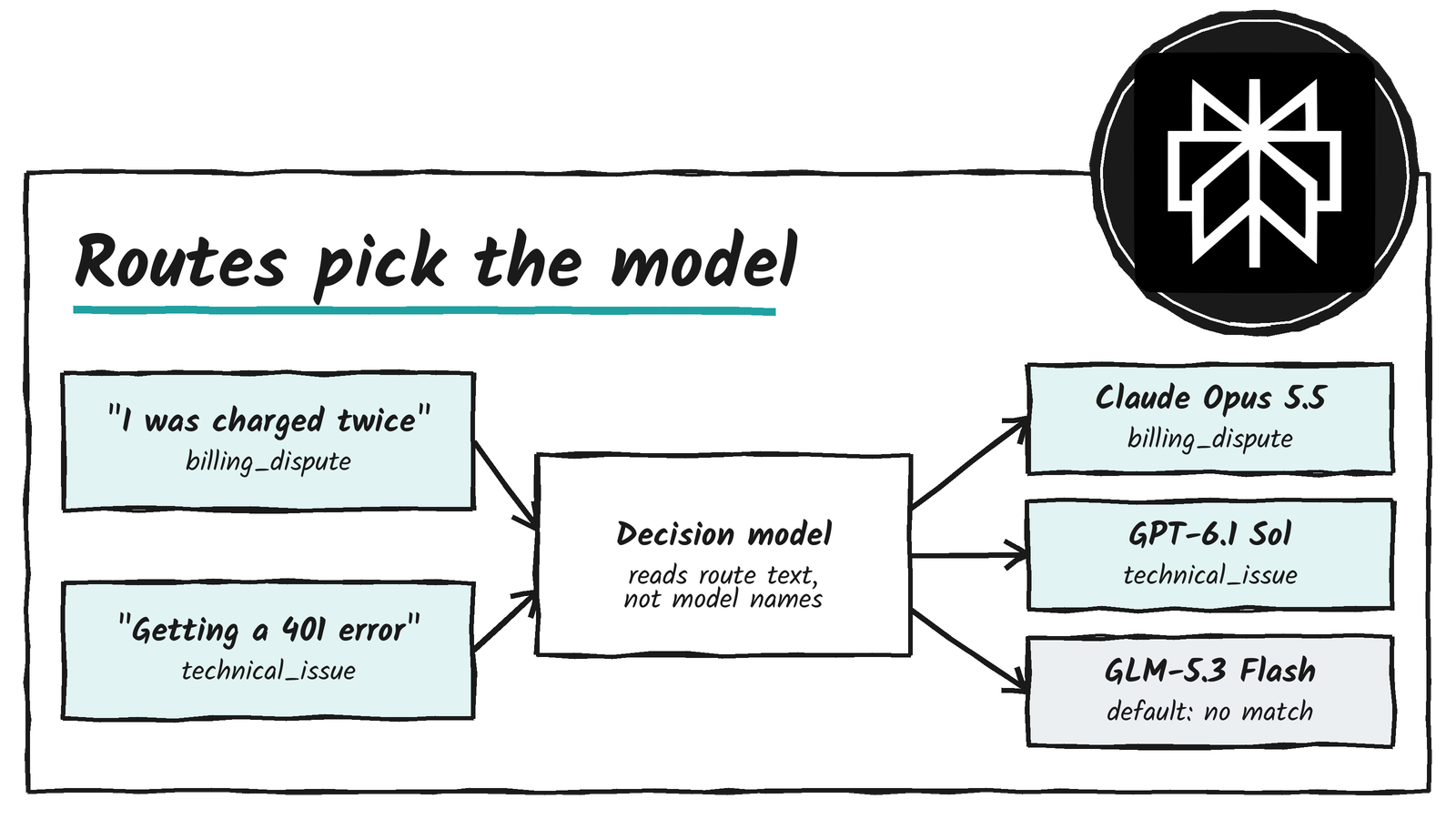
Two features are still in preview. The first is routes. You write a plain-language description of the requests each model should take and pick a default for everything else. Perplexity’s support example defaults to GLM-5.3 Flash, sends billing disputes to Claude Opus 5.5 and sends technical problems to GPT-6.1 Sol. A small decision model reads the conversation and the route descriptions, never the model names. If nothing matches, or the decision model fails or times out, the default answers. Response headers say whether the request was routed and which route won. The second preview feature, Auto effort, changes the reasoning effort on a supported model’s next turn according to a policy you set.
Prompt caches don’t carry across models. Perplexity’s advice is to send a stable prompt_cache_key so a conversation stays on one deployment, though that’s best effort and a failover can still move it. With no routing object at all, simple requests go to GPT-6 Luna and everything else goes to GPT-6.1 Sol.
One test covers refusals. Perplexity cites Anthropic’s own documentation that Claude Fable 5.2’s safeguards can block some harmless cybersecurity and biology work. On a 63-task subset of Terminal-Bench 4.1, Claude Code with Fable alone solved 38 tasks. When routes passed refused requests to another vendor’s model, it solved 41, and the estimated cost per task went up.
What it costs
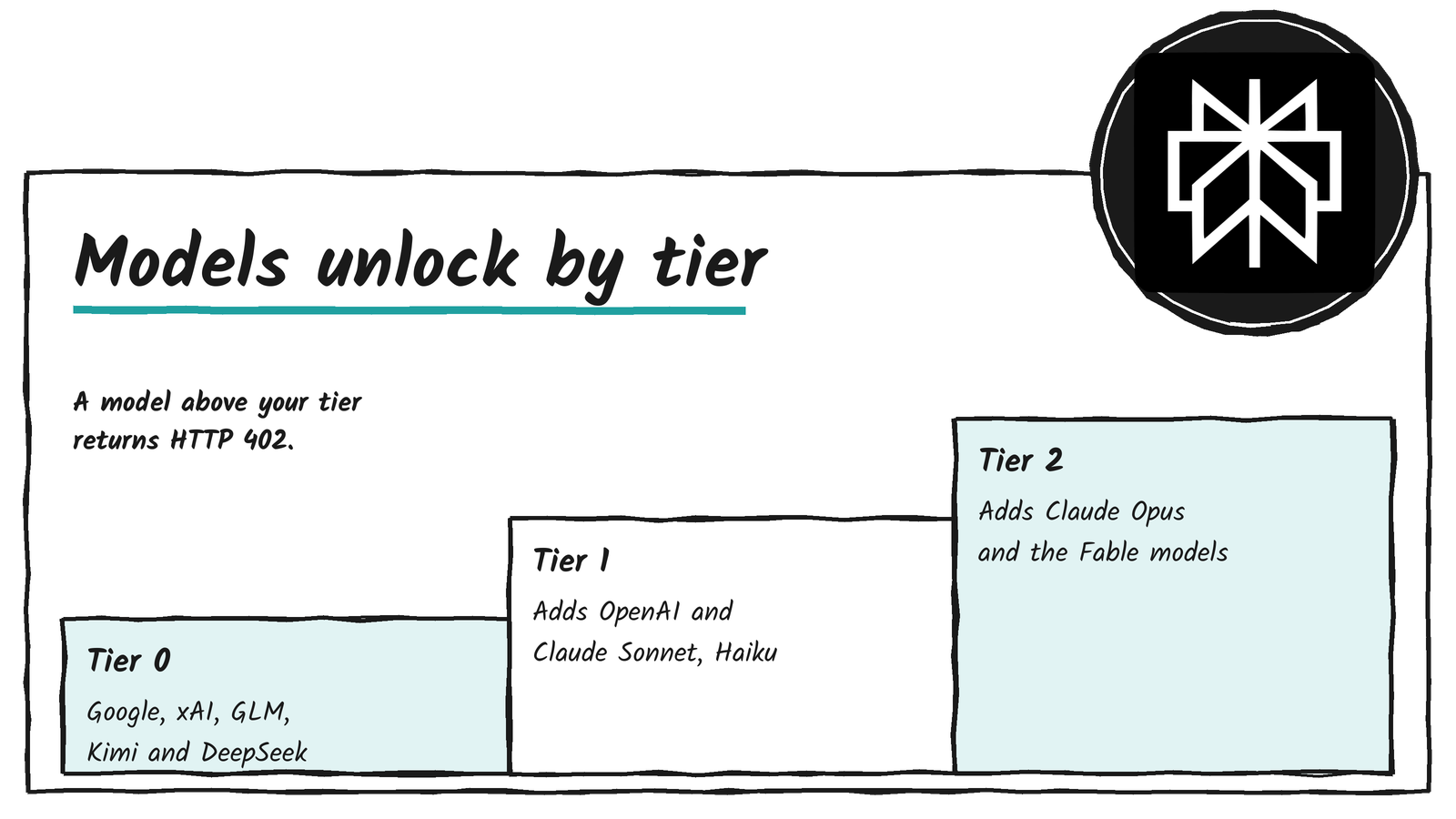
Which models you can call depends on your usage tier. Google, xAI and open-weight models start at Tier 0, OpenAI and Anthropic models at Tier 1, and Claude Opus 5, Opus 5.5 and the Fable models at Tier 2. A call above your tier returns HTTP 402. The Fable models can’t be used with zero data retention.
| Model | Input per 1M tokens | Output per 1M tokens | Tier |
|---|---|---|---|
| Claude Fable 5.2 | US$8.00 | US$40.00 | 2 |
| Claude Opus 5.5 | US$4.00 | US$20.00 | 2 |
| Claude Sonnet 5.5 | US$2.00 | US$10.00 | 1 |
| Claude Haiku 5.5 | US$0.10 | US$0.50 | 1 |
| Gemini 3.8 Flash | US$0.75 | US$3.75 | 0 |
| Grok 4.7 | US$2.00 | US$6.00 | 0 |
| GLM-5.3 | US$1.40 | US$4.40 | 0 |
| GLM-5.3 Flash | US$0.15 | US$0.50 | 0 |
| DeepSeek V4 Pro | US$1.32 | US$3.96 | 0 |
| Kimi K3 | US$3.00 | US$15.00 | 0 |
Cache writes cost extra on some models: 1.25 times the input rate for Anthropic and several OpenAI models, and twice the input rate for Anthropic’s one-hour cache. Credits can be bought through AWS Marketplace. Teams with large or committed workloads can email [email protected] about volume pricing and capacity, and the same address takes requests for models missing from the catalogue.
Discover more from Sulat AI & Tech News
Subscribe to get the latest posts sent to your email.