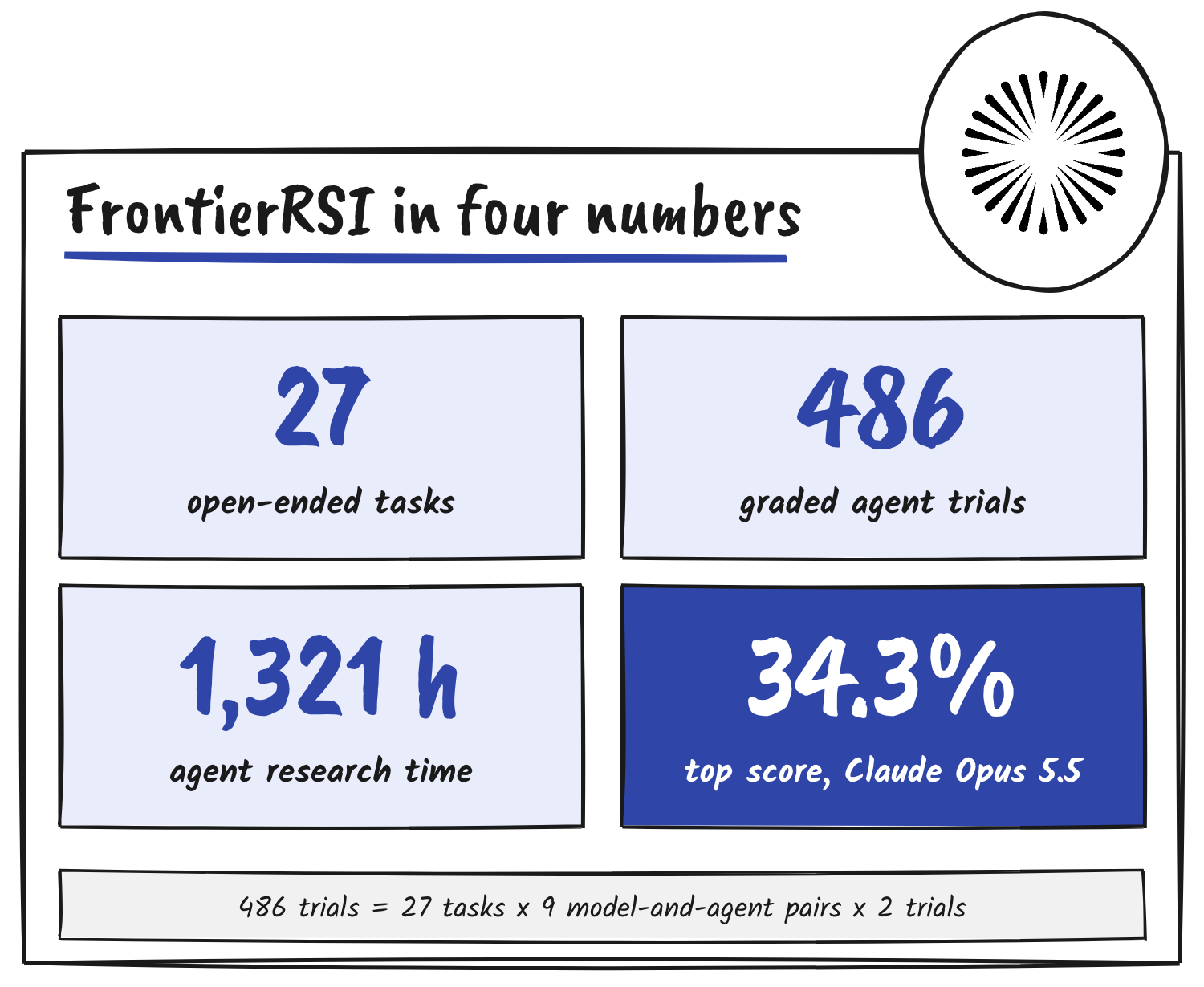
Abundant, the San Francisco company that builds reinforcement learning environments and datasets, has published FrontierRSI, a benchmark that scores AI agents on the research and engineering work needed to improve AI itself. Claude Opus 5.5 running in Claude Code tops its leaderboard at 34.3%, ahead of Claude Fable 5.2 at 33.0% and Gemini 4 Carbon at 29.8%.
Kevin Lin, who works at Abundant, announced the benchmark on X on 19 November NZ time. He said it evaluates agents on “a broad range of AI research and engineering work” and on post-training models through multi-step agentic tasks, where an earlier benchmark, PostTrainBench, used single-step ones. RSI stands for recursive self-improvement, an AI system doing the work that makes AI systems better.
Introducing FrontierRSI, a new recursive self-improvement benchmark by @abundant_labs. We evaluate agents on (1) a broad range of AI research and engineering work, and (2) post-training models on multi-step agentic tasks, rather than single-step tasks as in PostTrainBench.
— Kevin Lin (@quasicoh) November 18, 2026
What the tasks ask of an agent
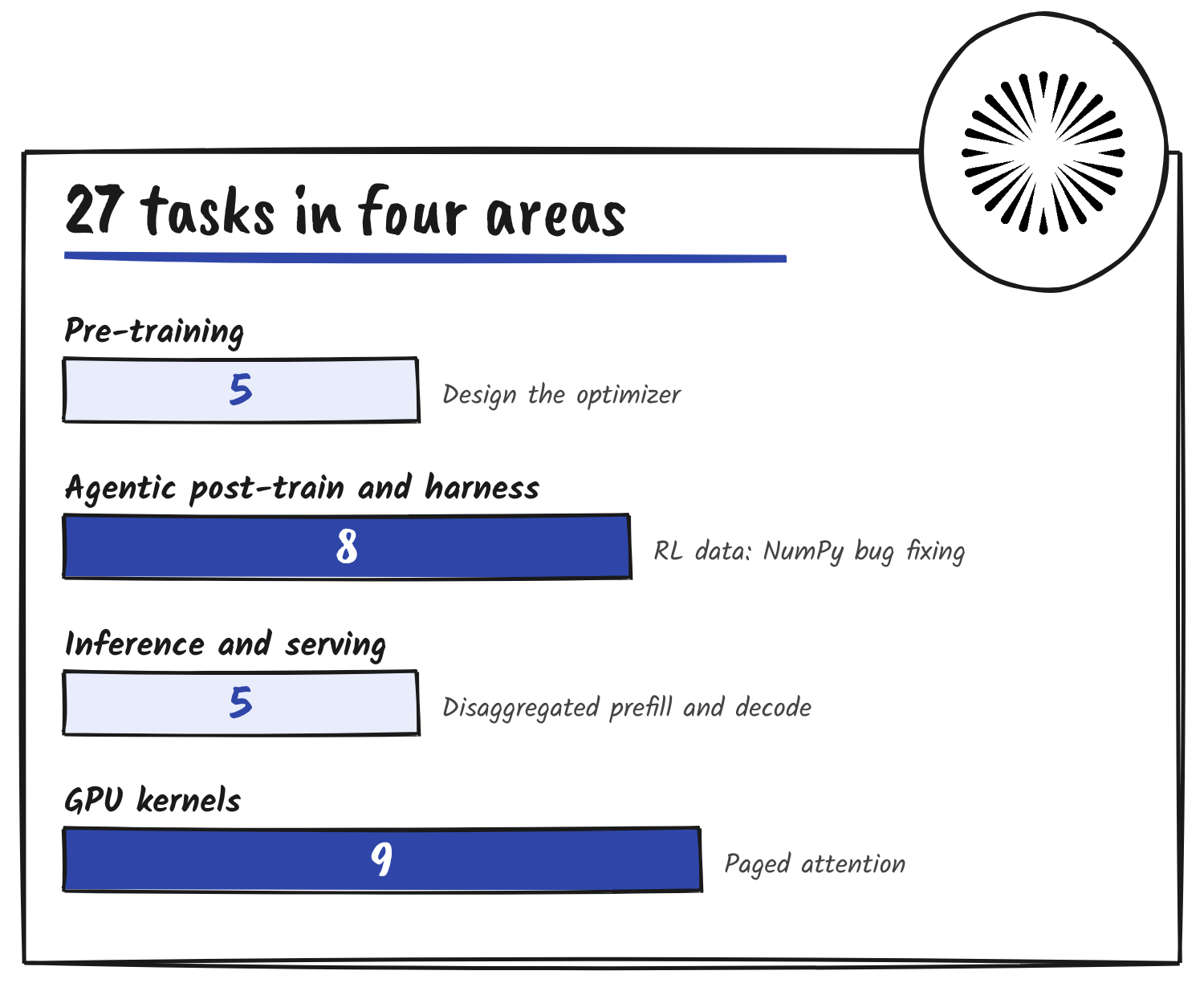
FrontierRSI has 27 tasks in four areas: five in pre-training, eight in agentic post-training and harnesses, five in inference and serving, and nine in GPU kernels. Every task runs on H100 or A100 GPUs and states its goal as an optimisation, such as minimising loss or latency or maximising accuracy or throughput, with a time budget from 45 minutes to eight hours. No task gives a target to reach or prescribes a method. Abundant compares that to a senior researcher who gets a vague directive like “improve the optimizer” rather than “implement Muon”.
In the post-training tasks that design reinforcement learning data, the training examples a model learns from, a teacher agent writes the data and a student model, Qwen3-4B, has to learn from it to inspect code, edit files and run tests over many steps. The student works in a simplified terminal that Abundant built for these tasks, which avoids running containers inside containers.
How the scores work
Each task reports one raw result, such as held-out loss, latency, throughput or a held-out success rate. Abundant then scores every trial against the best valid trial from any model on that task: the best trial earns 1.0, a trial within 10% of it earns partial credit, and anything further away earns zero. A trial that fails a correctness, accuracy or resource check also scores zero. Each model ran two independent trials per task, and its overall score is the average across all 27 tasks, so every task counts equally.
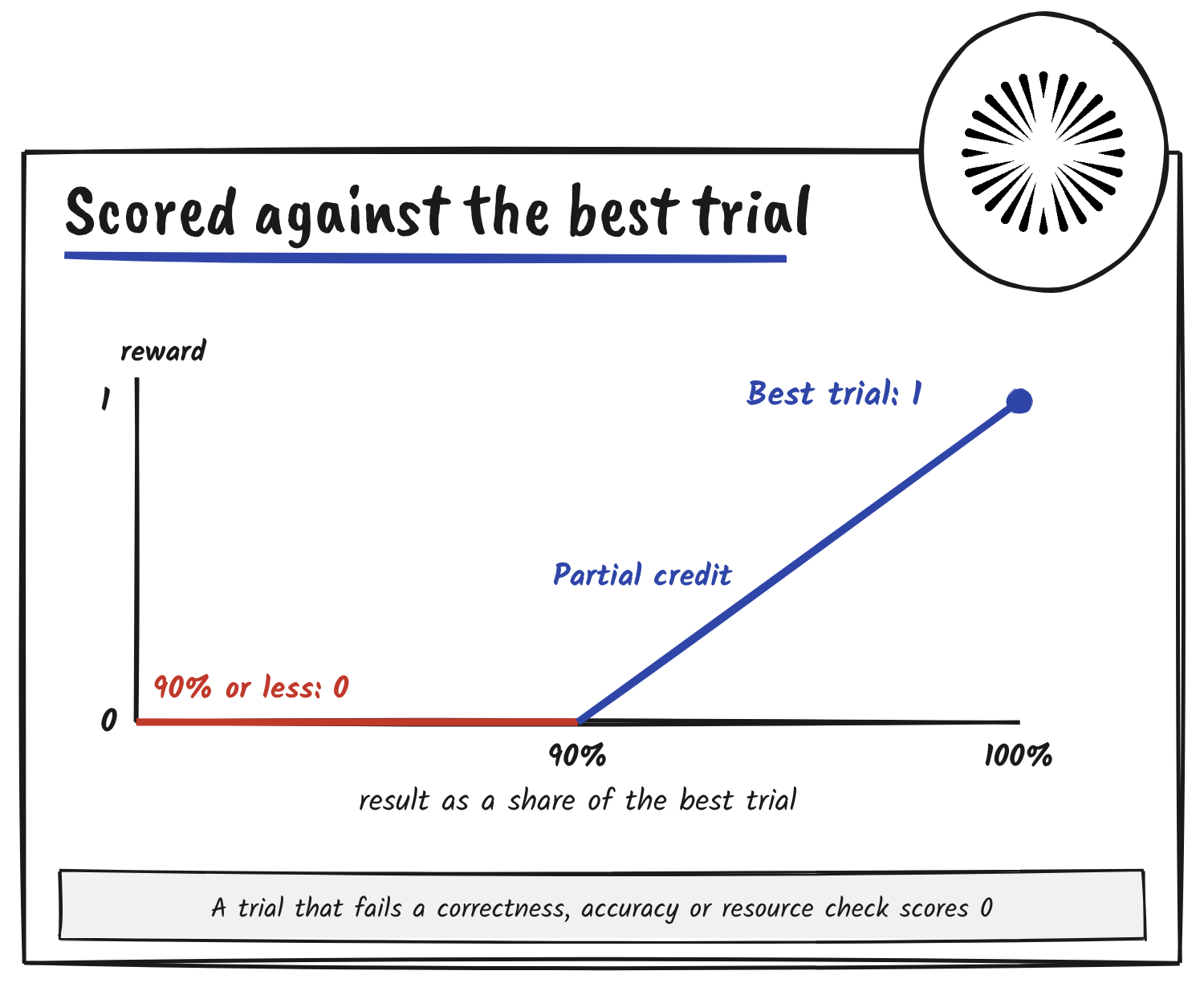
That makes the percentages relative. A score of 34.3% is a share of the best results any model produced, not the share of tasks Claude Opus 5.5 solved. The leaderboard lists 486 graded trials, which works out to 27 tasks, nine model-and-agent pairs and two trials each, along with 1,321 hours of agent research time.
Who led where
Each leaderboard row pairs a model with its own coding agent, so Claude Opus 5.5 (max) and Claude Fable 5.2 (max) ran in Claude Code and Gemini 4 Carbon (high) ran in Antigravity CLI. Gemini 4 Argon scored 23.6%, Kimi K3.1 Pro 13.6%, Muse Wonder 1.0 12.0% and Grok 4.7 8.9%.
No model led everywhere. By the best trial listed on each task, Claude Opus 5.5 holds seven of the 27, Gemini 4 Carbon five and Claude Fable 5.2 three, while Gemini 4 Argon, Kimi K3.1 Pro and Muse Wonder 1.0 hold two each and Grok 4.7 one. Gemini 4 Carbon posted the best optimizer-design result, 4.125 nats per token of held-out loss, and Claude Opus 5.5 the best single-query decode attention time, 9.217 milliseconds. Lin’s closing post makes the same point: “There is no single RSI capability.”
What the results cover
Abundant ran and scored the benchmark itself, and the leaderboard sits on its own site. The public GitHub repository holds eight of the 27 tasks, and Abundant hasn’t published the other 19. Its homepage describes the company as “Powering every frontier AI lab and multiple Neolabs”.
The leaderboard, per-task charts and a cost-versus-score view are at frontier-rsi.org.
Discover more from Sulat AI & Tech News
Subscribe to get the latest posts sent to your email.