
Cloudflare has put a search endpoint for AI agents behind a toggle. Turn on Search for Agents for a domain on your account and Cloudflare builds an AI Search index of the site, serves it at /.well-known/search on your own domain, and tags every page so agents can find it. The endpoint returns scored chunks of Markdown, not an answer. The site owner pays for the queries, at US$0.75 per 1,000 after the first 1,000 a month, and on the Free plan Cloudflare crawls only 500 pages a day.
Cloudflare announced it on 25 November. I read the launch post, the Search for Agents docs and the AI Search limits and pricing page, then ran GET and QUERY requests against Cloudflare’s own docs site, where the post says it’s switched on. The post says the feature is available to all customers, and the docs label it beta. I set it beside the docs-hosting MCP servers, NLWeb, llms.txt and the whole-web search APIs below, and left out any comparison that wasn’t backed by a vendor page.
500
pages crawled a day on the Free plan, with no daily cap on Paid
1,000
queries a month included, then US$0.75 per 1,000
50
scored results returned for every query I sent to Cloudflare’s docs site
1 Dec
when AI Search billing begins, per Cloudflare’s pricing page
- What Cloudflare launched
- How an agent finds it and what it sends
- What I saw when I queried it
- What the toggle sets up
- Who pays, and how much
- The Free plan limits
- What you can and can’t control
- How it compares with MCP servers, NLWeb and search APIs
- How AI Search got here
- What Cloudflare hasn’t published
- Who should turn it on
What Cloudflare launched
The setup is one switch. In the Cloudflare dashboard you pick a domain, go to Overview and turn on Search for Agents under Quick Actions, or you call the API. Cloudflare then creates an AI Search instance named search-for-agents-<ZONE_ID> in your account’s default namespace, uses your domain as its website data source, crawls it, and starts serving search from https://yourdomain/.well-known/search.
The pitch in the post is that this is Markdown for Agents applied to search. Markdown for Agents converts one page to Markdown when an agent asks for it. Search for Agents lets the agent ask the whole site a question instead of fetching pages one by one. Cloudflare’s own discovery text says as much: use this search API “instead of crawling individual pages.”
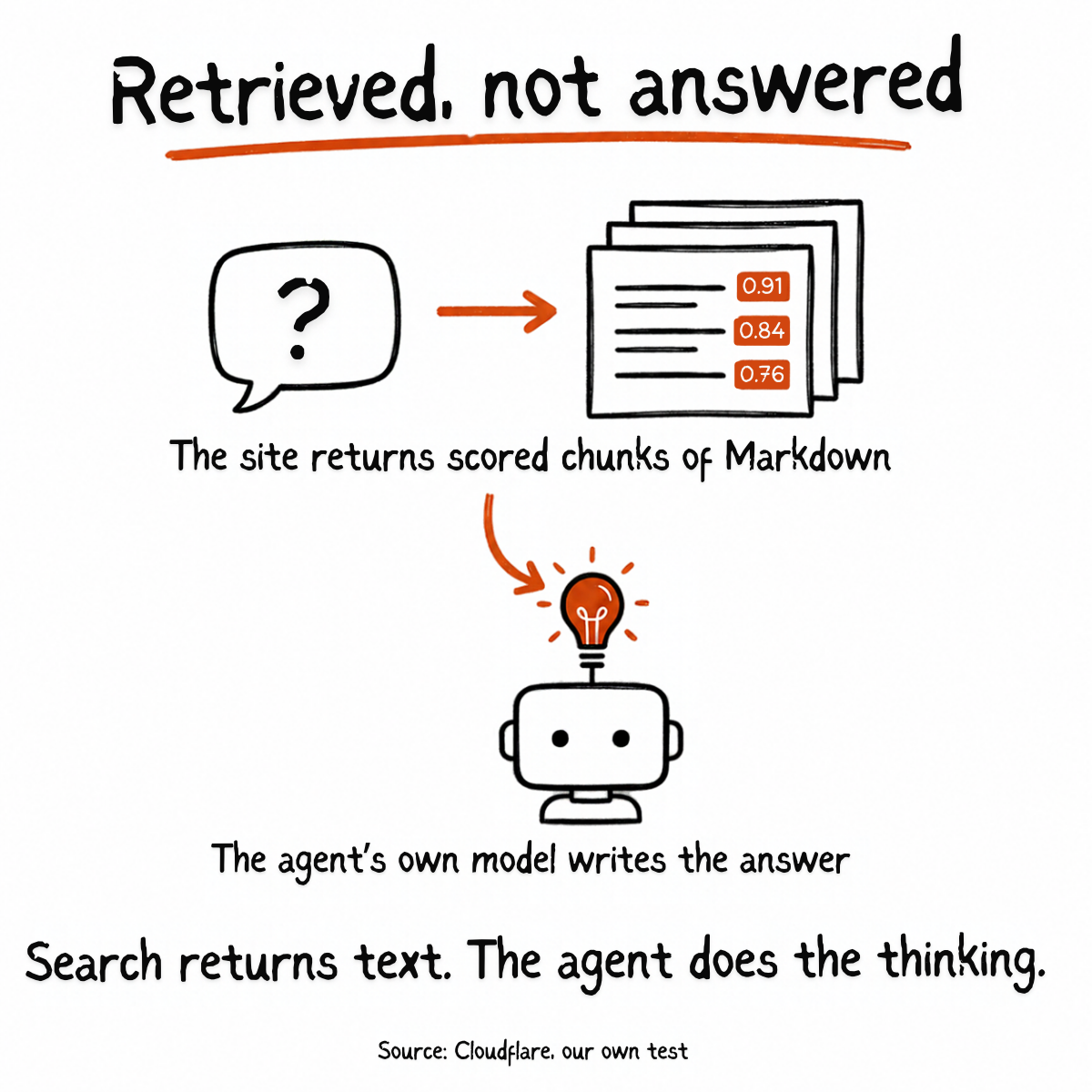
Two things stand out. First, the endpoint hands back retrieved text. The post says the agent “already has an AI model and a conversation with the user; all it needs is the relevant information from your site, not another AI model’s attempt to answer on its behalf.” Second, it’s an ordinary AI Search instance in your account, so the usual options apply: reranking, cache settings, a public REST or MCP endpoint, a Workers binding, or an embedded search box for human visitors.
Cloudflare says it has been running it on its developer documentation ahead of the announcement and that “agents do a good job of discovering the search API and using it during their tasks.” The post shows one OpenCode session answering “What is the maximum push size for Cloudflare Artifacts?” and doesn’t give adoption numbers.
How an agent finds it and what it sends
An endpoint nobody knows about is useless, so Cloudflare advertises it on every page of the site. For HTML responses it adds four meta tags to the head. If you’ve also turned on Markdown for Agents, an agent requesting Accept: text/markdown gets the same instructions as YAML front matter.
<meta name="agent:instructions" content="Use this search API to find relevant content across this site with keywords or natural-language queries, instead of crawling individual pages. Results are returned in Markdown.">
<meta name="agent:endpoint" content="https://developers.cloudflare.com/.well-known/search?q={query}">
<meta name="agent:method" content="GET">
<meta name="agent:documentation" content="https://developers.cloudflare.com/ai-search/how-to/search-for-agents/">
The agent then sends the question. A plain GET works, and so does the new HTTP QUERY method, which carries the search in a request body. Cloudflare’s post says QUERY is an IETF Proposed Standard published in June 2026 as RFC 10008, co-authored by its own James Snell. The body can be plain text or JSON.
# GET
curl --get "https://developers.cloudflare.com/.well-known/search" \
  --data-urlencode "q=What is the maximum push size for Cloudflare Artifacts?"

# QUERY, plain text
curl -X QUERY "https://developers.cloudflare.com/.well-known/search" \
  --header "Content-Type: text/plain" \
  --data "What is the maximum push size for Cloudflare Artifacts?"

# QUERY, JSON
curl -X QUERY "https://developers.cloudflare.com/.well-known/search" \
  --header "Content-Type: application/json" \
  --data '{"q":"What is the maximum push size for Cloudflare Artifacts?"}'
A few facts about the path itself. The name /.well-known/search is Cloudflare’s convention. I pulled IANA’s well-known URI registry on 26 November and found no entry for search, so it isn’t a registered standard yet. The post says curl and undici have adopted QUERY and that browser vendors are discussing it, so some agent stacks will need GET for a while.
What I saw when I queried it
I ran the requests from a cloud server on 26 November against developers.cloudflare.com. That’s Cloudflare’s own configuration, so it shows how the feature behaves when Cloudflare sets it up, not what a default zone will do.
| Request | What came back |
|---|---|
| GET with the Artifacts push-size question | HTTP 200, text/markdown, 50 results, 50.6 KB. The top result, scored 1.000, was the Artifacts limits page, which lists 64 MiB per push. That matches the post. |
| QUERY with a JSON body | HTTP 200, 57.5 KB, about 1.6 seconds. |
| QUERY with a plain-text body | HTTP 200, 44.6 KB, 50 results. |
| An off-topic question about pizza dough | HTTP 200 and 50 results. The top hit, scored 1.000, was a Topaz video-enhancer model page. There’s no empty result for a question the site can’t answer. |
| A one-word query, “pricing” | HTTP 200, 50 results, 26 KB. Two pricing pages tied at 1.000. |
No q parameter | HTTP 400 in 0.07 seconds: “Missing query parameter: ?q=”. |
The response headers include accept-query: text/plain, application/json, so the endpoint advertises which bodies QUERY accepts. A typical request took between about 0.9 and 2.4 seconds. Repeating the same question took roughly the same time, and I saw no cache header on the response.
Two things matter if you build an agent on this. The scores are relative: the best result is always 1.000, even when the best result is irrelevant, so an agent can’t treat a high score as proof of a good match. And the size is large. The Artifacts response was about 11,800 tokens and the plain-text QUERY about 10,300 on the cl100k_base tokenizer, so an agent that searches five times in a session pulls roughly 50,000 to 60,000 tokens of results into its context. Cloudflare’s docs list a default of 10 chunks per query, and its own site returned 50, so its docs instance is set up differently from the default. I can’t tell which setting does it.
What the toggle sets up
Search for Agents explicitly chooses Discover crawling and hybrid search and takes AI Search’s defaults for the rest. You can change most of them later in the instance’s Settings tab, but the embedding model and the data source are fixed when the instance is created.
| Setting | Default |
|---|---|
| Crawl type | Discover, using sitemaps and links, no sitemap required |
| Crawl page limit and depth | 100,000 pages, five link hops from your domain |
| Subdomains | Off |
| Crawl cache age and sync interval | 24 hours each |
| Search mode | Hybrid, vector plus keyword, fused with Reciprocal Rank Fusion |
| Embedding model | @cf/qwen/qwen3-embedding-0.6b |
| Chunk size and overlap | 1,024 tokens, 10% overlap |
| Results and match threshold | 10 chunks, threshold 0.4 |
| Query rewriting and reranking | Off |
| Similarity cache | On, strong threshold, 48 hours |
Two defaults affect freshness. The crawler re-syncs every 24 hours and caches crawled pages for 24 hours, and the similarity cache can hold a repeated question for 48 hours. A page you fix at 9am may still be served in its old form to an agent a day or more later.
Who pays, and how much
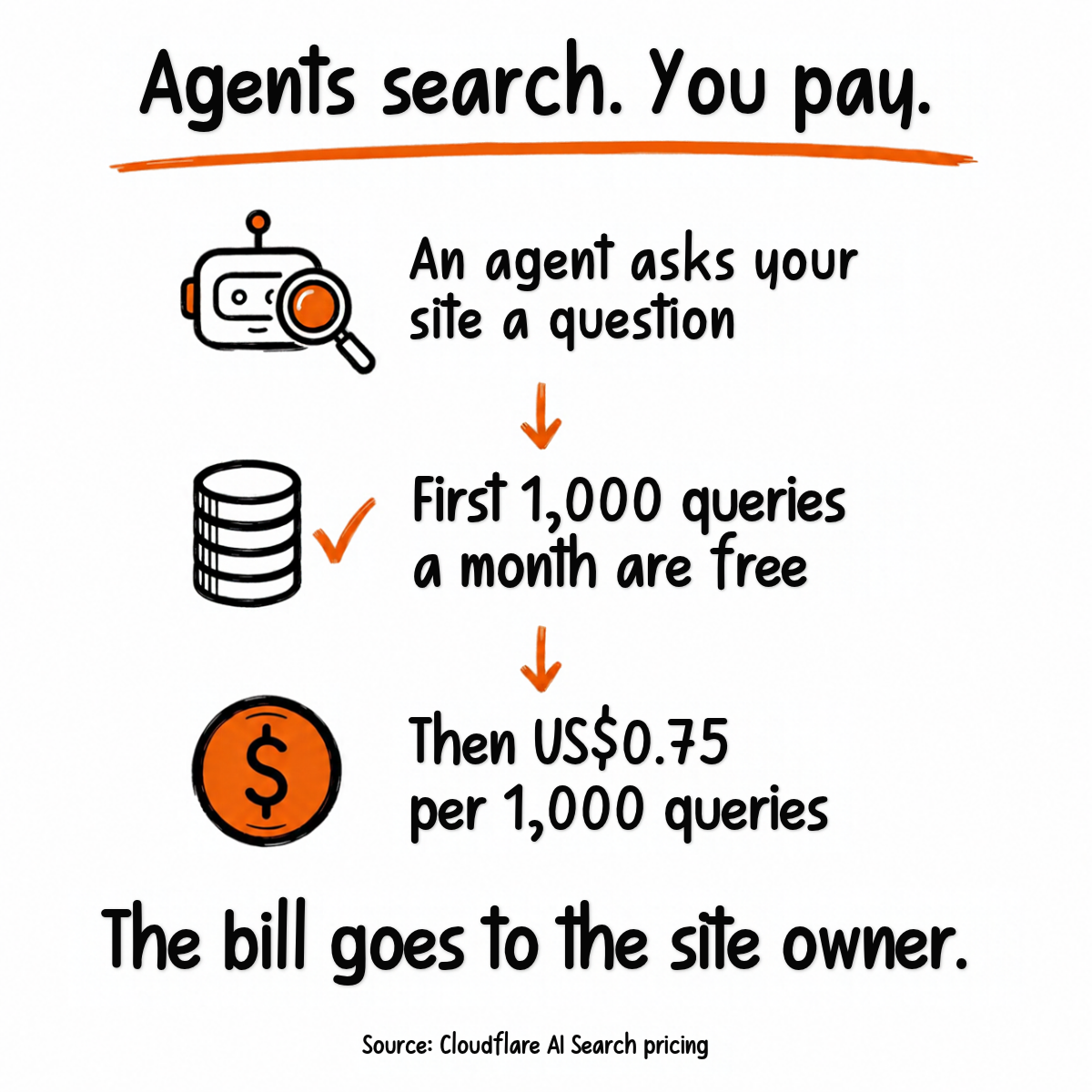
The launch post says usage “follows the AI Search pricing”, covering ingesting content, storing the index and serving queries. So the bill lands on the site owner, and the agent that asks the question pays nothing to Cloudflare for asking. AI Search billing begins on 1 December 2026, and every account gets a monthly allowance first.
| Item | Included each month | Beyond that |
|---|---|---|
| Ingestion | 5 million tokens | US$0.75 per million tokens; images and OCR add US$0.50 per million |
| Storage | 10 GB-month | US$2.00 per GB-month |
| Semantic, vector and hybrid queries | 1,000 | US$0.75 per 1,000 |
| Full-text queries | 1,000 | US$0.10 per 1,000 |
Search for Agents runs hybrid search, so I’ve priced each agent request as one hybrid query. The table below is my arithmetic from the page’s rate and ignores ingestion and storage. It also assumes a similarity-cache hit still counts as a query, which the docs don’t say.
| Agent queries a month | Billable queries | Query cost |
|---|---|---|
| 1,000 | 0 | US$0 |
| 10,000 | 9,000 | US$6.75 |
| 100,000 | 99,000 | US$74.25 |
| 1,000,000 | 999,000 | US$749.25 |
Ingestion is the other bill. Cloudflare counts tokens on the final indexed chunks with the cl100k_base tokenizer, and overlap is counted in each chunk it appears in. A 10,000-page site averaging 2,000 tokens a page is about 20 million tokens, or roughly 22 million with the 10% overlap. After the 5 million allowance that’s about US$12.75 for one full index. That figure is mine, and the page doesn’t say whether a re-sync re-ingests unchanged pages.
Here’s the context. On Cloudflare’s third-quarter call on 5 November, Matthew Prince described an agent that looks at 1,000 restaurant websites for one dinner booking: “999 of those restaurants have now had a cost that has been applied to them, but they’re not getting any benefit.” The Register reported him saying some customers see agents as “a bane to their business and want to keep them away.” I covered the call in an earlier piece on the OpenAI page-change hints.
Search for Agents answers that complaint in a particular way. An agent that queries the index doesn’t have to crawl 1,000 sites page by page. But Cloudflare isn’t charging the agent for the lookup here. The site owner still carries a cost per query, at a small rate, and whether that counts as the “additional way to pay for it” Prince talked about is a different question from what this launch does.
The Free plan limits
Cloudflare says the feature is open to Free accounts “with limits”. The limits page gives the numbers, and one of them bites early.
| Limit | Workers Free | Workers Paid |
|---|---|---|
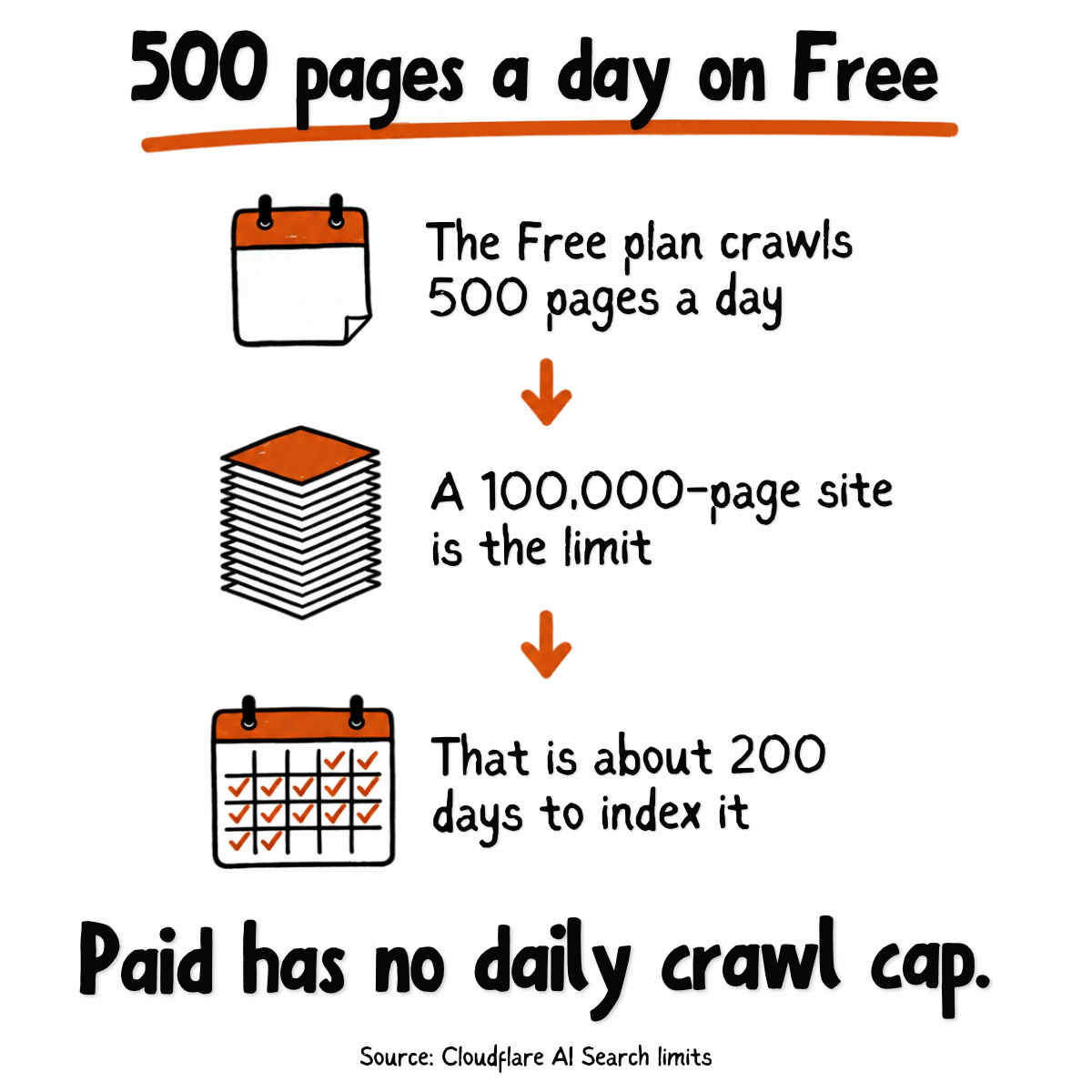
| Maximum pages crawled per day | 500 | Unlimited |
| Files per instance | 100,000 | 1M, or 500K for hybrid search |
| Pages per Discover crawl | 100,000 | 100,000 |
| AI Search instances per account | 100 | 5,000 by default |
| Maximum file size, text or code | 10 MiB | 10 MiB |
| Maximum size, PDFs without OCR and other formats | 4 MiB | 4 MiB |
The page says that on Workers Free “the daily limit of 500 pages is the binding one”. A site with 100,000 pages needs about 200 days to finish its first index at that rate, and even a 5,000-page site takes ten days. A Paid instance running hybrid search, as Search for Agents does, is capped at 500K files, which only matters for very large sites.
Cloudflare doesn’t say what happens when a Free account passes its included usage after 1 December. The pricing page lists the same included amounts for Free and Paid and the overage rates once, so I can’t tell whether Free usage is billed, throttled or blocked.
What you can and can’t control
The docs tell you to “only index content that you intend to make publicly searchable.” The crawl is a public crawl of your domain, and requests to the search endpoint stay “subject to” your AI Crawl Control and Web Application Firewall settings. The post adds bot management to that list. In practice, the same rules that decide whether an agent can fetch a page decide whether it can search the site.
- The crawler. AI Search’s crawler identifies as
Cloudflare-AI-Search. Cloudflare renamed it fromCloudflare-AutoRAGon 9 February 2026, and the old name still works inrobots.txt. Cloudflare’s crawl service for Browser Run, which AI Search uses for website crawling, honoursrobots.txtdirectives and doesn’t bypass bot protection or CAPTCHAs. - What gets indexed. You can narrow it with path filtering in the instance, which also lowers storage cost. Subdomains are off by default.
- What gets advertised. The meta tags go on every page of the site. The docs I read describe no per-page opt-out for the tags.
- Who can query. Agents can call the endpoint on your domain unless your WAF, AI Crawl Control or bot rules stop them. The docs don’t describe an authentication option for it.
If a site has content behind a login or content you don’t want an agent to paraphrase, check what the crawler can reach before you flip the switch. In a16z’s agent shopping tests, login walls stopped every run, and I’d expect a crawler to hit the same wall.
How it compares with MCP servers, NLWeb and search APIs
Search for Agents sits between three groups: hosted docs platforms that give each site an agent-facing server, open protocols you run yourself, and search APIs that cover the whole web. The difference that matters is who pays and how far the search reaches.
| Option | Who runs it | Who pays | Scope | How an agent finds it |
|---|---|---|---|---|
| Cloudflare Search for Agents | Cloudflare, from your zone | Site owner, at AI Search rates | One site | agent:* meta tags, front matter, /.well-known/search; GET and QUERY |
| Mintlify search MCP server | Mintlify, for sites it hosts | Not stated on the docs page | One docs site | /mcp path and a /.well-known/mcp discovery document |
| GitBook MCP server for published docs | GitBook, for published sites | Not stated on the docs page | One docs site | /~gitbook/mcp; also llms.txt and .md pages |
| NLWeb | You, self-hosted open source | You: hosting, vector store and model | One site | An ask method; every instance is also an MCP server |
| llms.txt | You, a static file | Nobody | One site | /llms.txt; an index of pages, with no search |
| Exa, Tavily, Brave Search API | The vendor | The agent’s operator, per request | The whole web | The operator wires it into the agent |
The first four are about your own site. Mintlify says it generates a search MCP server for your site and hosts it at /mcp, and that on a public site it’s available to anyone with no setup. GitBook says every published site automatically includes an MCP server at /~gitbook/mcp, read-only, and that it has to be switched on in the site’s settings. Both are MCP servers, so an agent needs an MCP client and the server’s address. Cloudflare’s route is plain HTTP, discovered from the page itself, which asks less of the agent but returns plain text chunks only.
NLWeb is the closest idea. Its repository describes open protocols and sample code for conversational endpoints, a core ask method that answers with Schema.org data, and an MCP server in every instance. You run it yourself, and the repository lists Cloudflare AutoRAG, the old name for AI Search, among its supported vector stores. llms.txt is a different tool again, a file that lists pages, and GitBook and Mintlify both generate one automatically.
The search APIs answer a different question, which is where on the internet to look. Prices from each vendor’s page:
| API | Entry price | Free allowance |
|---|---|---|
| Exa | US$4 per 1,000 instant searches; US$7 per 1,000 for fast and auto | US$10 in credits a month, up to 2,500 instant searches |
| Tavily | 1 credit per basic search; US$0.008 a credit pay as you go, so US$8 per 1,000 | 1,000 credits a month |
| Brave Search API | US$5 per 1,000 requests | US$5 in credits a month |
Cloudflare’s US$0.75 per 1,000 is lower than all three, but it isn’t a like-for-like price. Those APIs search the whole web and the operator pays. Cloudflare searches one site and the site pays. For a docs site, an agent that goes straight to the site’s own index can skip a general search, and that is the case Cloudflare is making. I’d also point to Supabase’s knowledge base built for coding agents as another way a site gets its content in front of agents.
How AI Search got here
- 25 September 2025. Cloudflare renamed AutoRAG to AI Search.
- 9 February 2026. The AI Search crawler’s user agent was renamed from
Cloudflare-AutoRAGtoCloudflare-AI-Search. - 10 March 2026. Browser Rendering’s
/crawlendpoint launched in open beta. It respectsrobots.txtand AI Crawl Control by default. - 16 April 2026. Cloudflare’s “search primitive for your agents” post said new instances were free during the open beta and promised at least 30 days’ notice before billing.
- 18 June 2026. All AI Search instances finished moving to managed infrastructure with built-in storage, vector index and crawling.
- 25 November 2026. Search for Agents launched. AI Search billing starts on 1 December.
That order explains why the launch carries a price. Search for Agents isn’t a new product so much as a switch on one that’s about to start billing.
What Cloudflare hasn’t published
- Whether a cache hit is billed. The docs say the similarity cache is on for 48 hours and don’t say whether a cached answer counts as a query.
- What happens on Free after the allowance. No page says whether Free accounts are billed, throttled or stopped.
- Any usage numbers. The post says agents discover and use the endpoint well and gives no counts of agents, queries or sites.
- A per-page opt-out for the discovery tags, or any authentication for the endpoint.
- A date for leaving beta. The docs say beta; the post doesn’t.
- Whether the 500-page daily cap counts re-crawls or only newly discovered pages.
I tested Cloudflare’s own docs site only. I haven’t turned it on for a zone of my own, so the default-instance behaviour above comes from Cloudflare’s docs rather than from my account.
Who should turn it on
- Documentation and developer-content sites already on Cloudflare. This is the case Cloudflare built it for, and the 1,000 free queries cover a trial. Watch the query bill once agents find it.
- Small sites on the Free plan. It works, but budget a slow first crawl at 500 pages a day, and check what the crawler can reach first.
- Sites that already sell agent access or restrict crawlers. Decide whether an open search endpoint fits your AI Crawl Control rules before you enable it.
- Anyone on Mintlify or GitBook. You probably already have an MCP server and an llms.txt; test whether agents use them before you pay for a second index.
Terms used in this piece
- AI Search
- Cloudflare’s service that indexes your content and lets you search it, formerly called AutoRAG.
- Zone
- A domain on your Cloudflare account.
- Chunk
- A piece of a page, cut to a fixed size, that is indexed and returned on its own.
- Hybrid search
- Search that combines meaning-based vector matching with keyword matching.
- Well-known URI
- A standard place under
/.well-known/where a site publishes machine-readable information. - HTTP QUERY
- A request method that sends a search in the body, safely and without changing anything on the server.
- MCP
- Model Context Protocol, a standard way for AI tools to connect to outside services.
- Markdown for Agents
- A Cloudflare feature that serves a page as Markdown when an agent asks for it.
- Ingestion token
- A unit Cloudflare counts when it indexes your text, about three-quarters of a word.
Cloudflare has made agent search a toggle, and it has made the site owner the one who pays for it. The next thing to watch is whether Cloudflare publishes usage numbers, a date for leaving beta, and how it bills cache hits, because those decide whether a busy site’s query bill stays small.
Sources
- Cloudflare blog, “Introducing Search for Agents”, 25 November 2026
- Cloudflare docs: Search for Agents, read 26 November 2026
- Cloudflare docs: AI Search limits and pricing, read 26 November 2026
- Cloudflare docs: AI Search release notes and the /crawl endpoint docs
- Cloudflare blog, “AI Search: the search primitive for your agents”, 16 April 2026
- RFC 10008, the HTTP QUERY method
- The Register, “AI agents are a ‘bane’ for some website operators, says Cloudflare”, 6 November 2026, and the Cloudflare Q3 2026 earnings call transcript (FactSet CallStreet), 5 November 2026
- Mintlify search MCP server docs and GitBook MCP servers for published docs
- NLWeb repository
- Exa pricing, Tavily credits and pricing and Brave Search API pricing
- IANA well-known URI registry, checked 26 November 2026
Discover more from Sulat AI & Tech News
Subscribe to get the latest posts sent to your email.