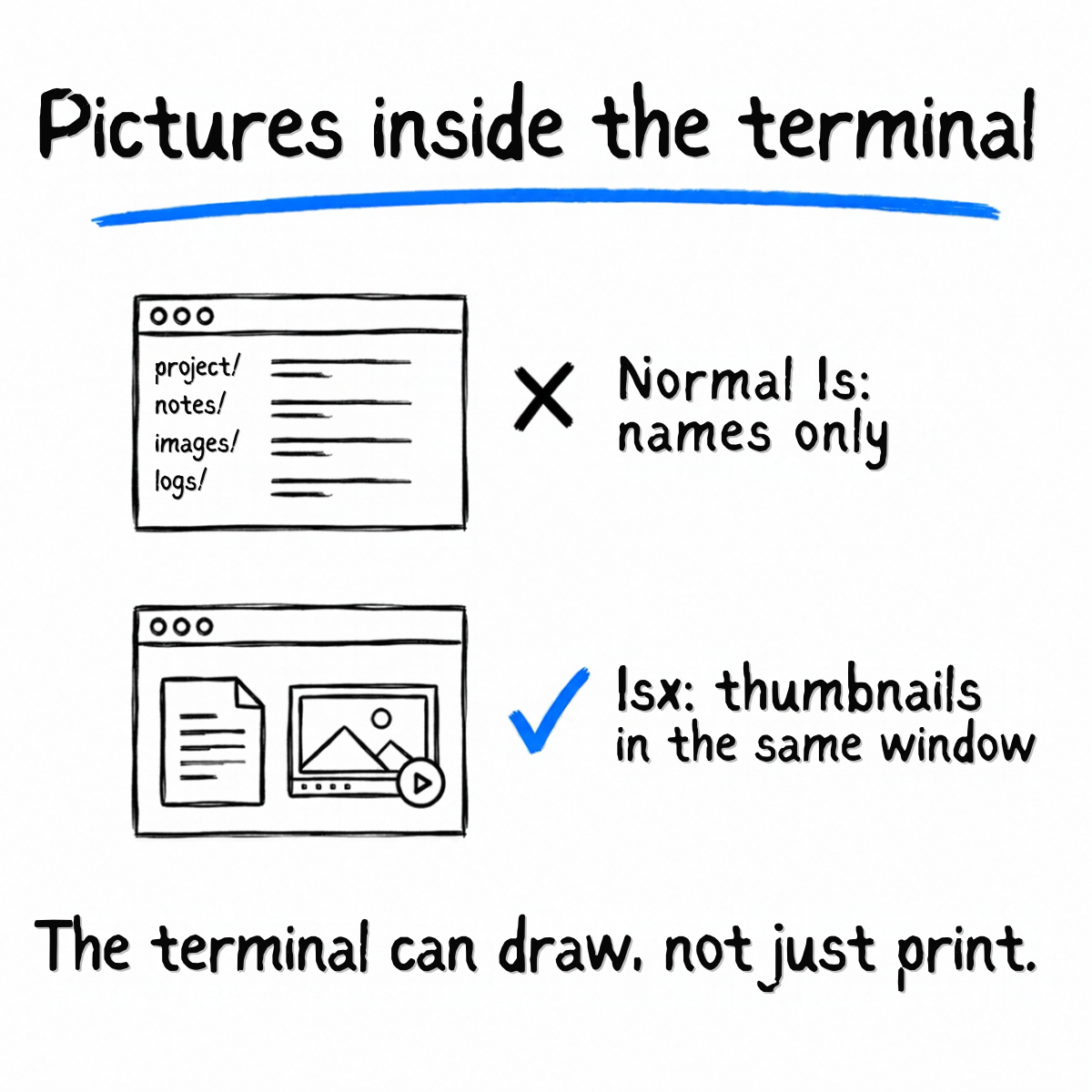
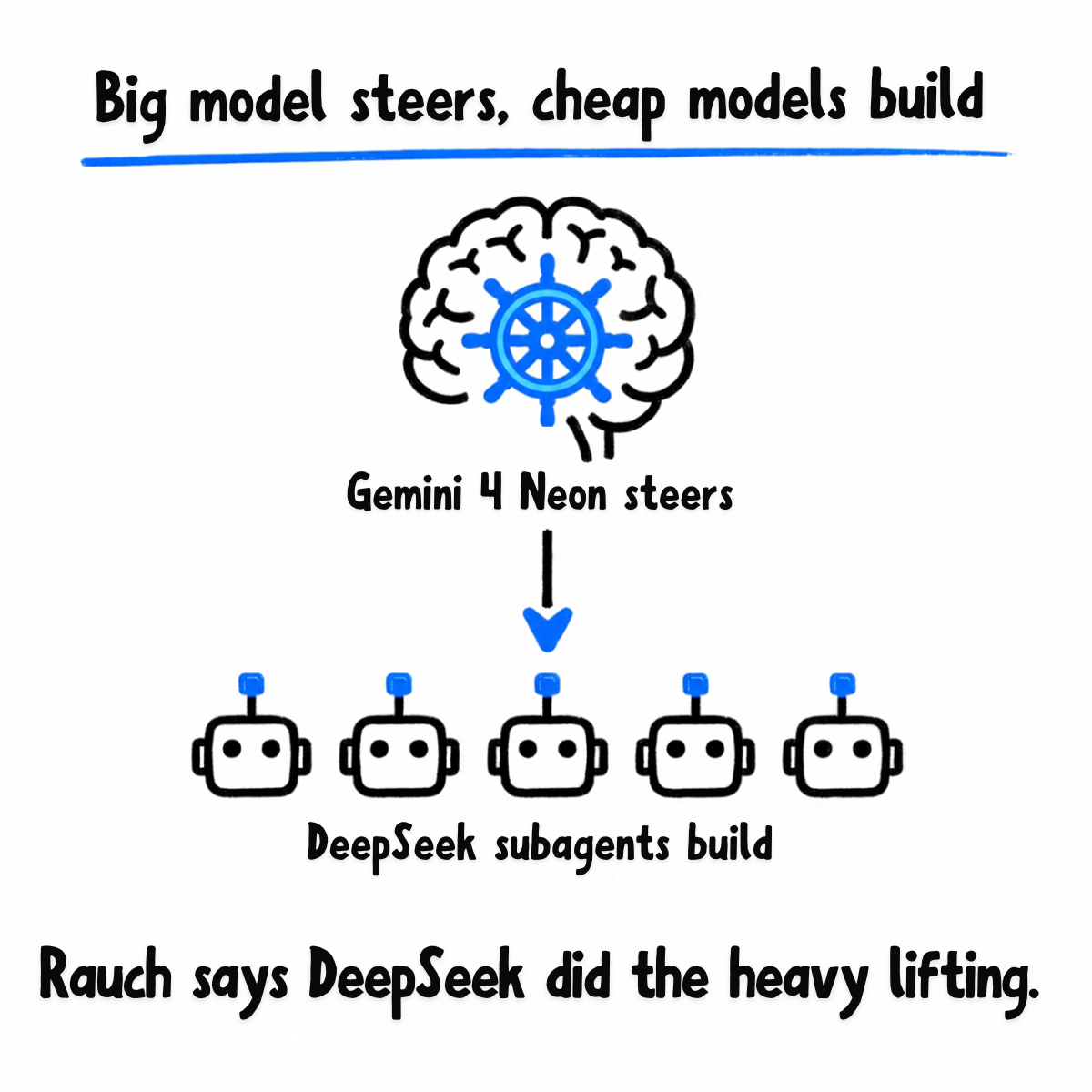
Guillermo Rauch, Vercel’s chief executive, posted a 35-second demo of lsx on X at 7:52pm NZ time on 25 November. He calls it “Finder in the terminal”: a command that draws thumbnails of PDFs and videos inside the shell, plus an interactive mode with a preview pane. He says he “one-shotted” it with fx, Vercel Labs’ coding agent, using Gemini 4 Neon to steer and DeepSeek subagents to write the code. The post links no repository, install command or release.
What lsx does in the video
The demo runs in a Mac terminal, in a Downloads folder. Type lsx and it prints a grid of thumbnails with the file name under each: the first page of a PDF, a frame from a video. lsx download.mp4 does the same for one file.
lsx -i opens an interactive browser. The left pane lists the folder, the right pane previews the selected file, and an info panel under the preview gives its kind, size, and created, modified and last-opened times, then pixel dimensions and either a page count or a duration. A key bar along the bottom lists arrows to select, Enter to open, Space to zoom, f to reveal the file in Finder, a key to go up a folder, a to toggle hidden files and q to quit.
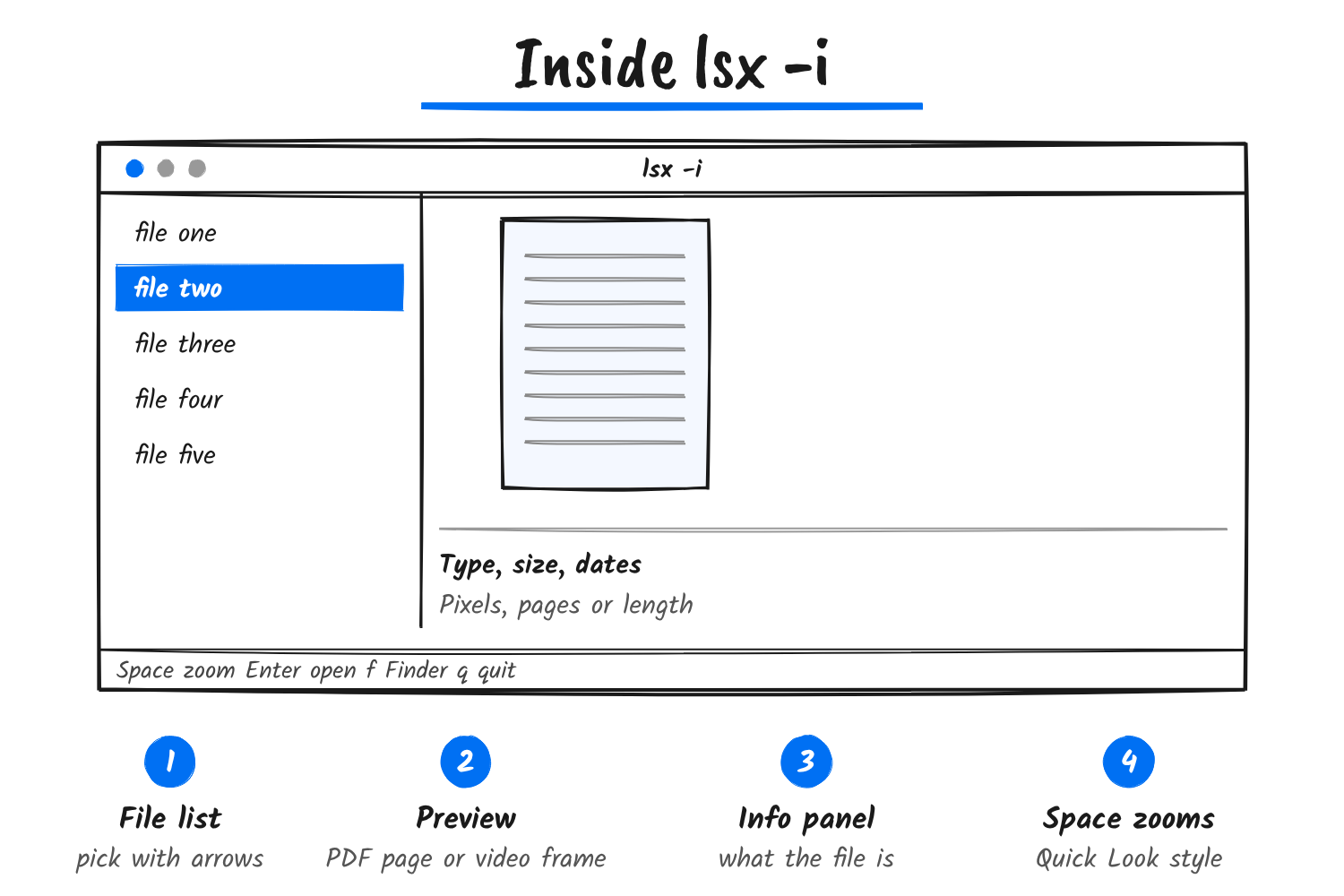
Space is the Quick Look part. It fills the pane with the file, steps to the previous or next file, and closes on Space or Esc. In the zoomed view a video appears as a still frame with its size, pixel dimensions and length: one clip is 5 seconds at 1536 by 936, another 32 seconds at 1920 by 1080. One of the previewed clips is a recording of fx 0.0.17 with gemini-4-neon in its status line, which matches the model Rauch names.
How Rauch says it was built
I instructed fx to use the Kitty graphics protocol and build inline and interactive modes. It implemented CLI Quick Look of its own volition.
DS actually did all the heavy lifting. This was very cheap! I just told it to use DS 1017 fast subagents.
Guillermo Rauch, X, 25 November 2026
So the split is his instruction (the Kitty protocol, an inline mode, an interactive mode), Neon in the steering seat and DeepSeek writing the code. Quick Look was fx’s own addition. Rauch gives no token count, no dollar figure and no number of subagents. “Very cheap” is his only measure.
The two models, priced
“Gemini Neon” is Gemini 4 Neon, which Google released on 18 November at US$3 per million input tokens and US$15 per million output tokens, with a 1 million-token context window. Our earlier piece covers the launch. Rauch doesn’t give the DeepSeek model ID. The AI Gateway catalogue entry that fits his shorthand is deepseek/deepseek-v4.1-flash-1017-fast, a higher-throughput variant of DeepSeek’s 17 October V4.1 Flash release, served by Baseten and listed at US$0.60 input and US$2.40 output per million tokens. We covered Baseten’s engine for the same model family on 15 November.
| Model | Input per million | Output per million | Context |
|---|---|---|---|
| Gemini 4 Neon (Google) | US$3.00 | US$15.00 | 1M tokens |
| DeepSeek V4.1 Flash 1017 fast (AI Gateway, Baseten) | US$0.60 | US$2.40 | 1M tokens |
| DeepSeek V4.1 Flash 1017 (DeepSeek API, off-peak) | US$0.15 | US$0.60 | 1M tokens |
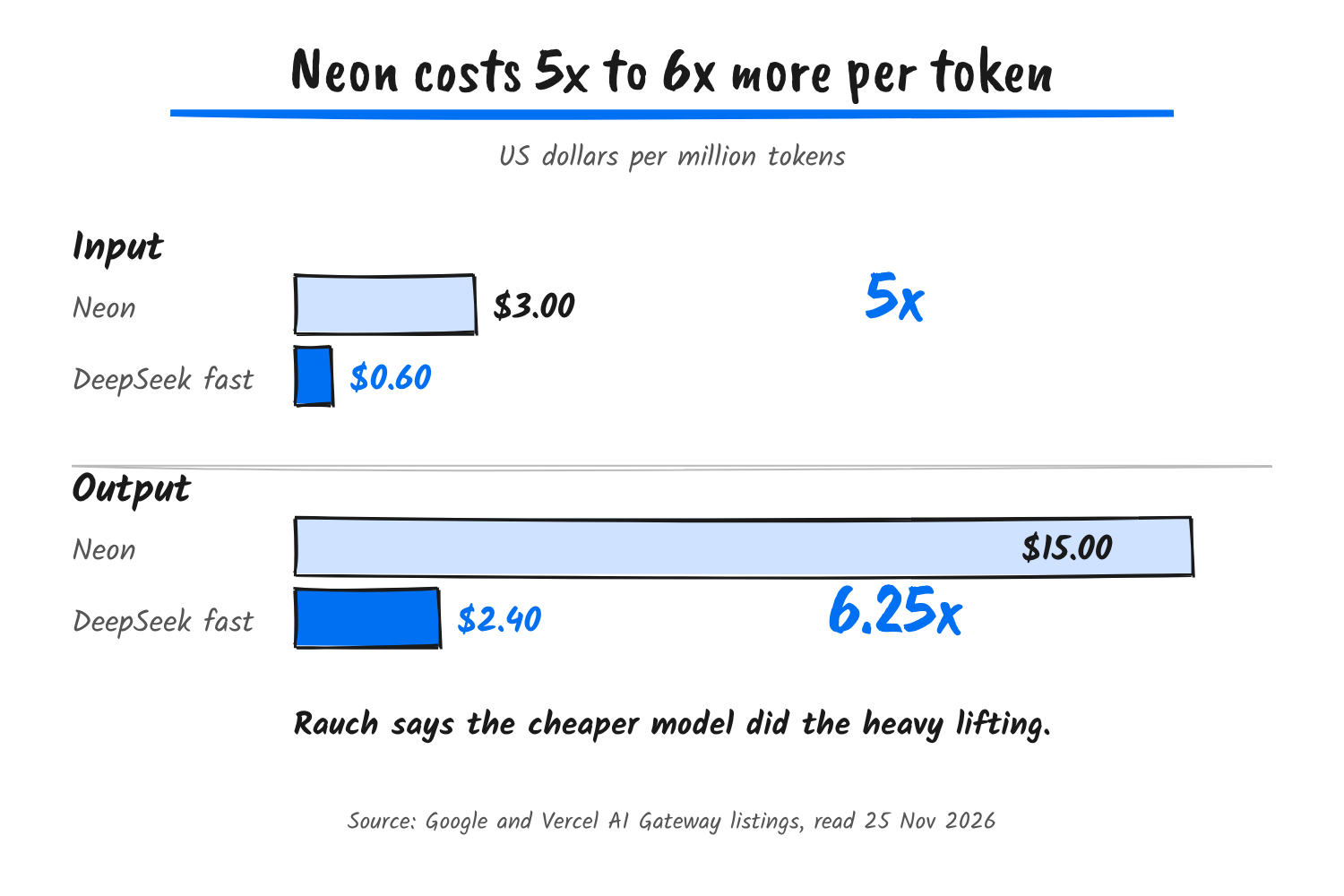
Neon costs 5 times as much per input token and 6.25 times as much per output token as the fast DeepSeek model. The fast variant carries a premium of its own: DeepSeek’s API lists the same 1017 model at a quarter of its price off-peak and half at peak. What the premium buys is speed. AI Gateway lists 1,121 tokens a second for the fast variant, against 210 for the standard model served by DeepSeek itself.
DeepSeek’s own model card puts the 1017 release at 77.0 on DeepSWE v1.1 and 42.3 on Terminal-Bench 4.0, up from 74.2 and 31.2 for the September release. Those are DeepSeek’s figures, not an independent test, and no benchmark covers a job like lsx.
The fx pattern: steer big, build cheap
fx is a Vercel Labs project: one native binary written in Zig, Apache-2.0 licensed, with output that scrolls like a shell instead of taking over the screen. Release 0.0.17 came out on 14 November, which is the version in Rauch’s video. Per-subagent models arrived in 0.0.9 on 12 September, when Rauch announced it with the example of Fable planning and Grok executing. The fx docs describe the idea in one line: “This lets you use a stronger model to plan and review, then delegate implementation to a lower-cost model.”
The lsx session is that pattern with Neon in the planner’s seat. It’s also Vercel’s own stack end to end. fx signs in through AI Gateway, the DeepSeek variant Rauch names is sold there, and Vercel says AI Gateway passes provider pricing through with no markup. When a team has Token Pass, fx defaults to deepseek/deepseek-v4.1-flash, a setup our Token Pass piece covers. fx also underlies fxs, the Vercel Sandbox tool by Vercel engineer Pranit Sharma that Lizard’s lzs was modelled on.
Why the Kitty graphics protocol matters
The Kitty graphics protocol lets a program send pixel images to the terminal as escape sequences, so a thumbnail is a real image and not text characters. It comes from the Kitty terminal. A tool that uses it only works in a terminal that understands it. Yazi’s documentation lists Kitty and Ghostty as using the Kitty protocol, Konsole as using Kitty’s older version, and iTerm2 and WezTerm as using the separate inline-images protocol. Rauch’s video doesn’t name his terminal.
Rauch’s footnote on the post makes the larger claim: “This allows a CLI to essentially render anything! A full OS, if you will. I will.” That’s a statement of intent, and the post names no project.
How lsx sits beside the peers
| Tool | How it shows images | Notes |
|---|---|---|
| lsx | Kitty graphics protocol, per Rauch | Thumbnail grid, interactive pane, Space zoom. No public code |
| Yazi | Kitty, iTerm2, WezTerm and Konsole protocols built in; Überzug++ on X11 and Wayland; Chafa text fallback | Written in Rust, built on async I/O |
| ranger | w3mimgdisplay, ueberzug, mpv, iTerm2 or Kitty methods | Vi-style keys; the Kitty method needs Pillow |
| lsix | Sixel graphics | Like ls, but for images |
Previews in the terminal aren’t new. Yazi and ranger already show them in a pane and lsix already prints thumbnails, so the pane and the grid aren’t the news. What’s new is how lsx was made: a chief executive describing a working tool built in one shot, with a cheap model doing the bulk of the writing and a frontier model steering.
What isn’t published
- The post links no repository, install command or release for lsx.
- Rauch doesn’t say which terminal the demo runs in.
- The prompts he gave fx aren’t shown beyond his description of them.
- He gives no cost, token count or number of subagents for the build.
Until Rauch shares code, lsx is what the 35-second video shows: a clean thumbnail grid, a three-part browser and a Space-bar zoom. The part to watch is the recipe. fx has a per-subagent model setting, DeepSeek’s fast variant lists at a fifth of Neon’s input price, and one post says the combination produced lsx. The fx docs, Rauch’s post and the AI Gateway model pages hold the details used here.
Disclosure: I’m a Vercel customer.
Discover more from Sulat AI & Tech News
Subscribe to get the latest posts sent to your email.