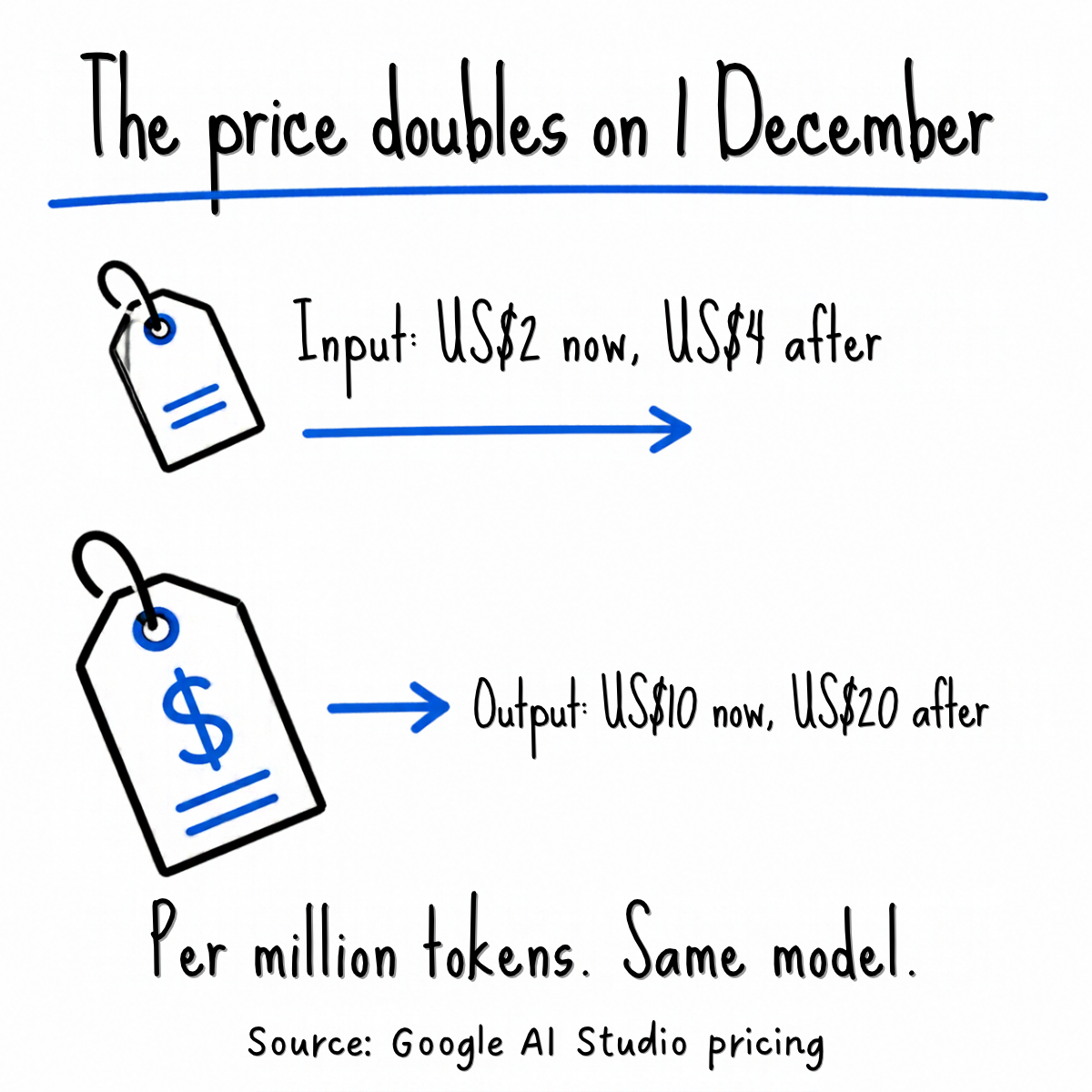
Gemini 4 Argon’s introductory price ends on 30 November. From 1 December, Google’s pricing page lists US$4 per million input tokens and US$20 per million output tokens, double the current US$2 and US$10. On 14 October, Patrick Loeber of Google’s AI Studio team pointed developers at four guides for the model, and those guides are the manual for spending the tokens.
I read all four guides and Google’s pricing page on 25 November. None of them turns token counts into dollars, so I did that from Google’s own tables. This piece covers what the guides say, what they leave out, and where Argon sits against the rest of Google’s line-up and against Anthropic’s.
US$4
Argon input price per million tokens from 1 December, up from US$2
US$20
Argon output price per million tokens from 1 December, up from US$10
1M
tokens shared across input, thinking and output in one request
65,536
default output cap; long decode lifts it
- What Loeber posted, and what has moved since
- The price change in dollars
- Long decode and what it bills
- Thinking levels and the migration list
- Verification loops
- Argon as orchestrator, Flash as workhorse
- Where Argon runs
- The 3D games guide
- Where Argon sits
- What the guides don’t show
- What to do before 1 December
What Loeber posted, and what has moved since
Loeber’s post is short: “our team shipped a bunch of guides to help you build with Gemini 4 Argon”, then four links. The developer guide and the 3D games guide both carry a 13 October publication date, which is the day Google says it rolled Argon out to developers and enterprises. The developer guide is credited to Geneviève Huskens, a staff developer relations engineer, and Jack Wotherspoon, a member of the technical staff. Huskens wrote the 3D guide. Google says Argon is trained to “work longer” and “retain context better” than any earlier Gemini model, and that it targets software engineering, enterprise knowledge work and cybersecurity defence.
The post is six weeks old and the line-up around it has changed. Google announced Argon on 1 October as “rolling out soon”, and the brief is on the site. Three more Gemini 4 models have followed.
| Date | What happened | Source |
|---|---|---|
| 1 October 2026 | Google announces Gemini 4 Argon, rolling out soon | Argon brief |
| 13 October | Argon developer guide and 3D games guide published; Argon rolls out to developers | Google AI Studio guides |
| 14 October | Loeber posts the four guide links on X | His post, embedded above |
| 11 November | Gemini 4 Carbon opens to paying API users and Google AI Ultra subscribers | Carbon report |
| 12 November | Gemini 4 Hydrogen launches at US$1.50 and US$7.50 per million tokens | Hydrogen report |
| 18 November | Gemini 4 Neon released at US$3 and US$15 | Neon report |
| 30 November | Argon and Carbon introductory prices end | Google pricing page |
| 1 December | Argon and Carbon move to US$4 and US$20 | Google pricing page |
| 1 January 2027 | Gemini 3.8 Flash moves from US$0.75 and US$3.75 to US$1.50 and US$7.50 | Google pricing page |
Two of the four links have drifted. The “what’s new and migration checklist” link in Loeber’s post, aistudio.google.com/docs/latest-model, now opens a page headed “Latest Gemini models”. It compares Carbon, Neon, Hydrogen and Flash-Lite and links to what’s-new guides for Carbon, Neon and Hydrogen. Argon has no card on it. The migration items are still in the developer guide itself, so nothing is lost, but the post’s second link no longer goes where it said.
The long decode link has changed in the other direction. The developer guide says client-side continuation is “currently only available via the legacy GenerateContent API” and will “soon come” to the Interactions API. The long decode page as it stands now documents client-side continuation on the Interactions API, with minimum SDK versions: Python 2.34.0, JavaScript 2.32.0, Go 1.77.0, Java 1.80.0 and .NET 1.28.0.
The price change in dollars
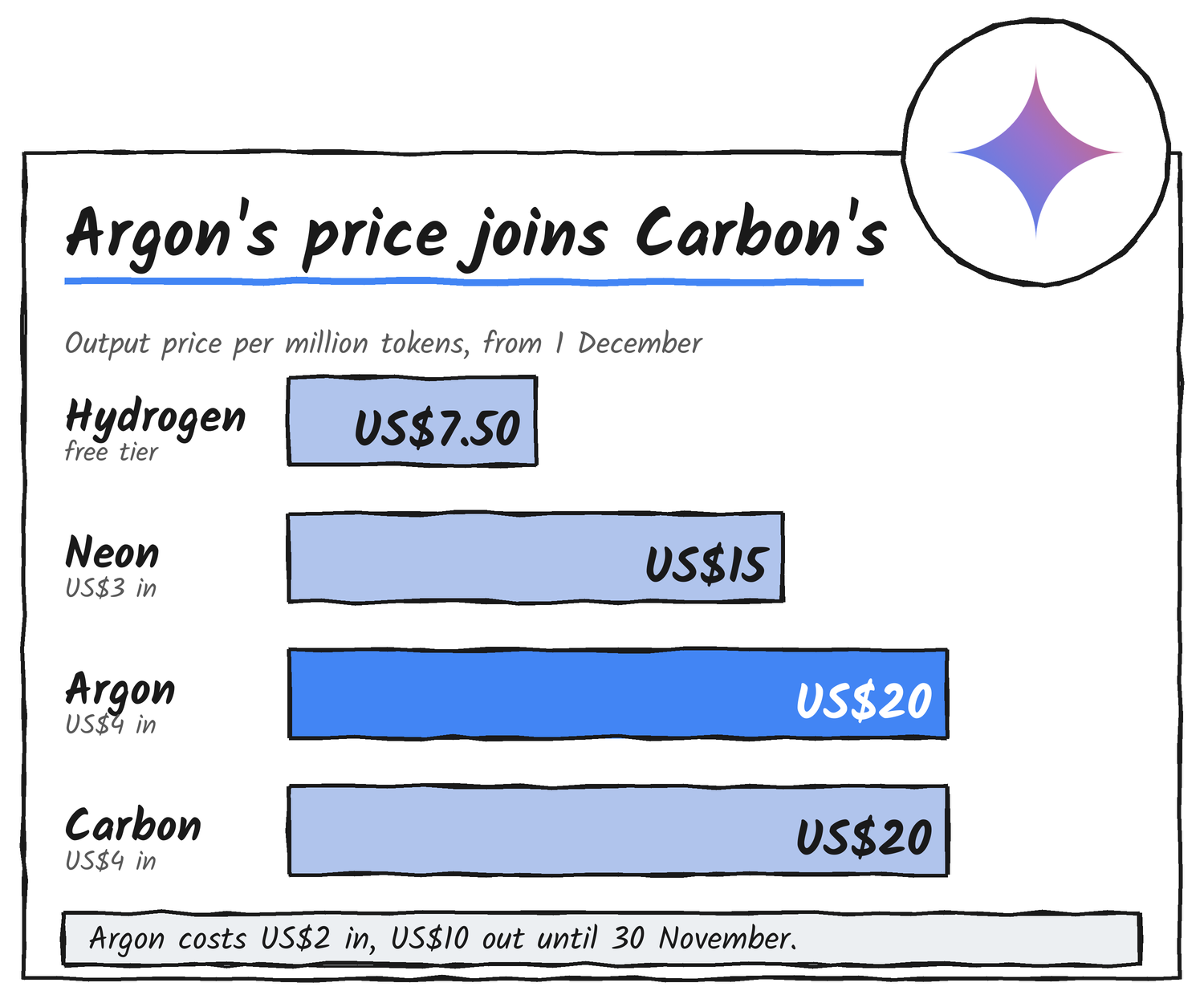
Argon and Carbon share one price schedule. Neon and Hydrogen have flat prices with no scheduled change. The table below sets out the Gemini 4 family as Google’s pricing page lists it on 25 November, with Gemini 3.8 Flash for reference, because the guides tell developers to use Flash as Argon’s helper.
| Model | Input per 1M | Output per 1M | Cached input per 1M | Free tier |
|---|---|---|---|---|
| Gemini 4 Argon, to 30 November | US$2.00 | US$10.00 | US$0.10 | No |
| Gemini 4 Argon, from 1 December | US$4.00 | US$20.00 | US$0.20 | No |
| Gemini 4 Carbon, same schedule | US$2.00, then US$4.00 | US$10.00, then US$20.00 | US$0.10, then US$0.20 | No |
| Gemini 4 Neon | US$3.00 | US$15.00 | US$0.15 | No |
| Gemini 4 Hydrogen | US$1.50 | US$7.50 | US$0.075 | Yes |
| Gemini 3.8 Flash, to 31 December | US$0.75 | US$3.75 | US$0.075 | Yes |
| Gemini 3.8 Flash, from 1 January 2027 | US$1.50 | US$7.50 | US$0.15 | Yes |
From 1 December, Argon’s list price is above Neon’s and equal to Carbon’s. Google’s pricing page describes Argon as “our efficient Gemini 4 frontier reasoning model” with “faster responses and lower token spend per turn” than Carbon. That is a claim about tokens used, not about the rate, and the page gives no figure for it.
A response that fills the default 65,536-token output cap costs about US$0.66 in output now and US$1.31 from 1 December. Most calls sit well under that. Long decode is where the bill gets large.
Long decode and what it bills
Earlier Gemini models stopped at 64K tokens of thinking plus answer. Argon shares one 1,048,576-token window across input, thinking and output, so a request can write up to that total minus its input. Google calls the mechanism long decode. Set background=True on the Interactions API and a max_output_tokens above 65,536, and Google’s servers run the generation in sequential hops, each continuing from where the last stopped, for up to 24 hours.
| How you call it | Output limit | Per-hop cap on Argon |
|---|---|---|
Foreground, max_output_tokens not set | 65,536 tokens | Not applicable |
| Foreground, above 65,536, SDK automatic continuation (the default) | Your value, up to 1,048,576 minus input | 32,768 per non-streaming hop; 65,536 per streaming hop |
| Foreground, above 65,536, REST or continuation switched off | 65,536 per streaming hop, 32,768 per non-streaming hop; you loop with a continuation token | As left |
| Background, above 65,536 | Your value, up to 1,048,576 minus input | 65,536 per hop, run by Google’s servers |
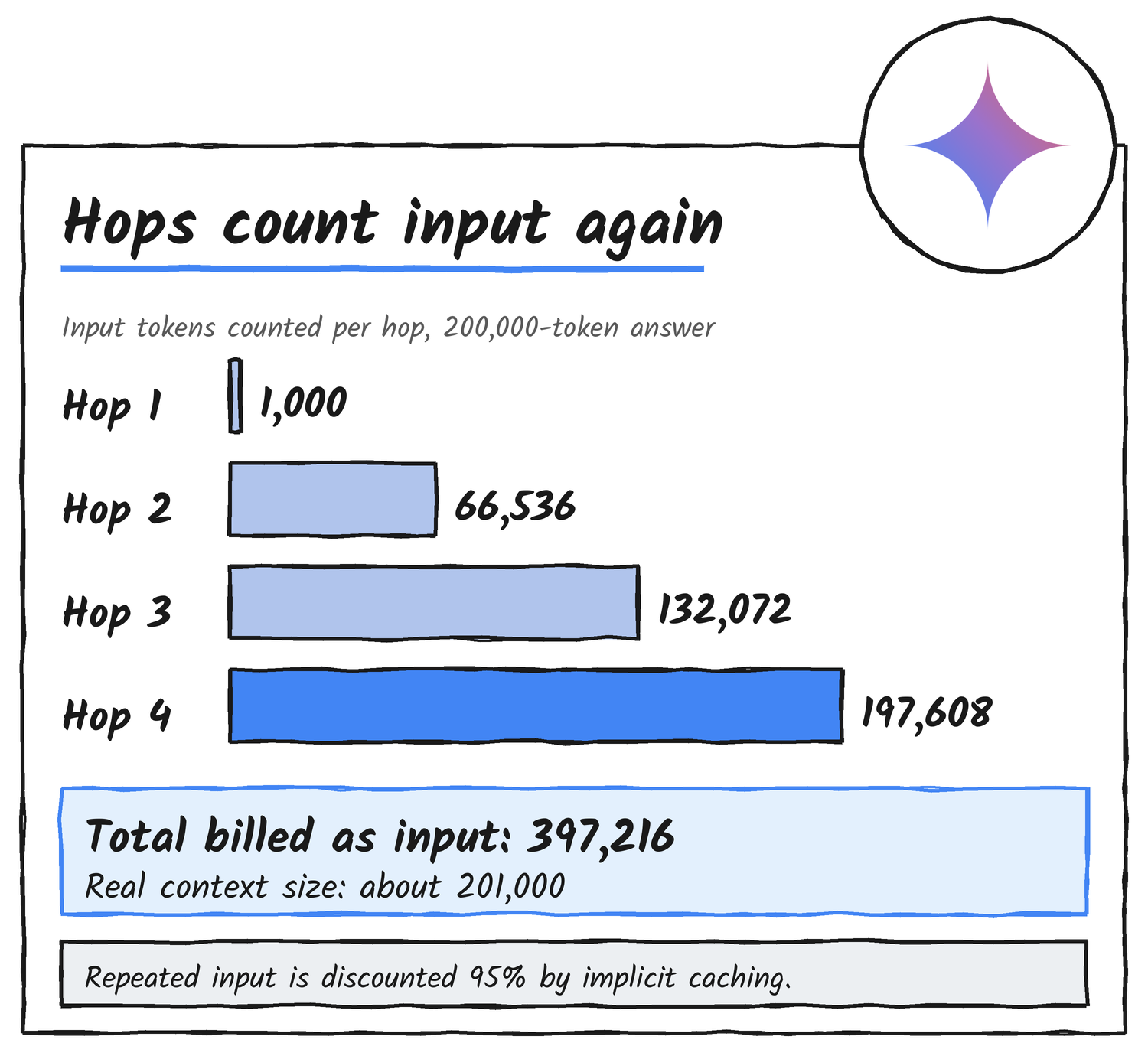
Each hop sends the prompt plus everything generated so far back to the model, so the same tokens count as input again in every later hop. Google’s example is a 1,000-token prompt that produces 200,000 tokens of thinking and output. It takes four 64K hops and reports 397,216 input tokens in total, though the real context is about 201,000. Google says implicit caching discounts the repeated input by 95%, so those tokens cost 5% of the input rate.
Run that example through the rates. The first hop’s 1,000 prompt tokens bill at the full input price. The other 396,216 input tokens bill at the cached price. The 200,000 output tokens bill at the output price.
| Line | Tokens | Now (to 30 Nov) | From 1 December |
|---|---|---|---|
| Prompt, hop 1 | 1,000 | US$0.002 | US$0.004 |
| Repeated input, hops 2 to 4, cached | 396,216 | US$0.040 | US$0.079 |
| Output, thinking and answer | 200,000 | US$2.000 | US$4.000 |
| Total | about US$2.04 | about US$4.08 |
Output is 98% of that bill, and the output rate is the one that doubles. A run that burns the full 1,048,576-token window on output would cost about US$10.49 now and US$20.97 from 1 December before input, by the same arithmetic.
Google also says what not to use long decode for: chat, summarisation, classification, extraction, agents that make many short tool calls, latency-sensitive requests, and anything that asks for a fixed length, because “the model doesn’t follow length targets”. Its warning on the setting: always set max_output_tokens above 65,536 for long decode, and check the value in your agent framework, because “a low value, such as 8,192, stops the model before it finishes thinking.”
The background call, as Google’s developer guide shows it
import time
from google import genai

client = genai.Client()

interaction = client.interactions.create(
    model="gemini-4-argon",
    input="Write a complete, rigorous proof of the prime number theorem.",
    background=True,
    generation_config={
        "max_output_tokens": 262144,
        "thinking_level": "high",
    },
)

while interaction.status in ("in_progress", "queued"):
    time.sleep(5)
    interaction = client.interactions.get(id=interaction.id)
Source: Google’s Gemini 4 Argon developer guide. The guide then joins the text of every model_output step and prints the usage. Background runs need store: true, and a status of incomplete with empty text means the model spent every token thinking.
Thinking levels and the migration list
Argon takes a thinking_level of low, medium or high, and medium is the default. Google’s guide matches high to multi-file debugging, security patching, formal maths and upfront architecture, medium to interactive coding and agentic tool use, and low to classification, routing and extraction. Neon and Hydrogen default to high and go up to xhigh; Carbon and Argon stop at high. Thinking tokens bill as output, so the level is also a cost dial, and it matters more at US$20 than at US$10.
| If your code does this | Google says |
|---|---|
Passes thinking_budget | Replace it with thinking_level; the old parameter is deprecated and returns a warning |
Sets temperature, top_p or top_k | Remove them; Argon ignores custom sampling values and returns a deprecation warning |
Creates or passes explicit cached_content | Remove it; implicit caching is on automatically at a 95% discount on cached input |
| Uses a short client timeout | Raise it to at least 15 to 20 minutes, or use background=True; hard reasoning prompts can take several minutes |
The implicit caching line is the one that touches the bill. Cached input costs 5% of the input price, US$0.10 now and US$0.20 from 1 December. Explicit caching isn’t supported on Argon, so a cost model built on explicit cache storage prices needs rewriting rather than re-pricing.
Verification loops
Argon does its best long-horizon work when it can test its own changes against a real feedback loop.
Gemini 4 Argon developer guide, Google AI Studio, 13 October 2026
The guide’s second tip is to give Argon a pass-or-fail signal instead of telling it to keep going until it’s right: a test suite, runtime logs, browser screenshots, or a script it writes itself. Google’s example prompt asks Argon to write a headless Chrome script that crawls every route, records a baseline accessibility score, groups failures by shared cause, and re-runs after each fix “with zero regressions”.
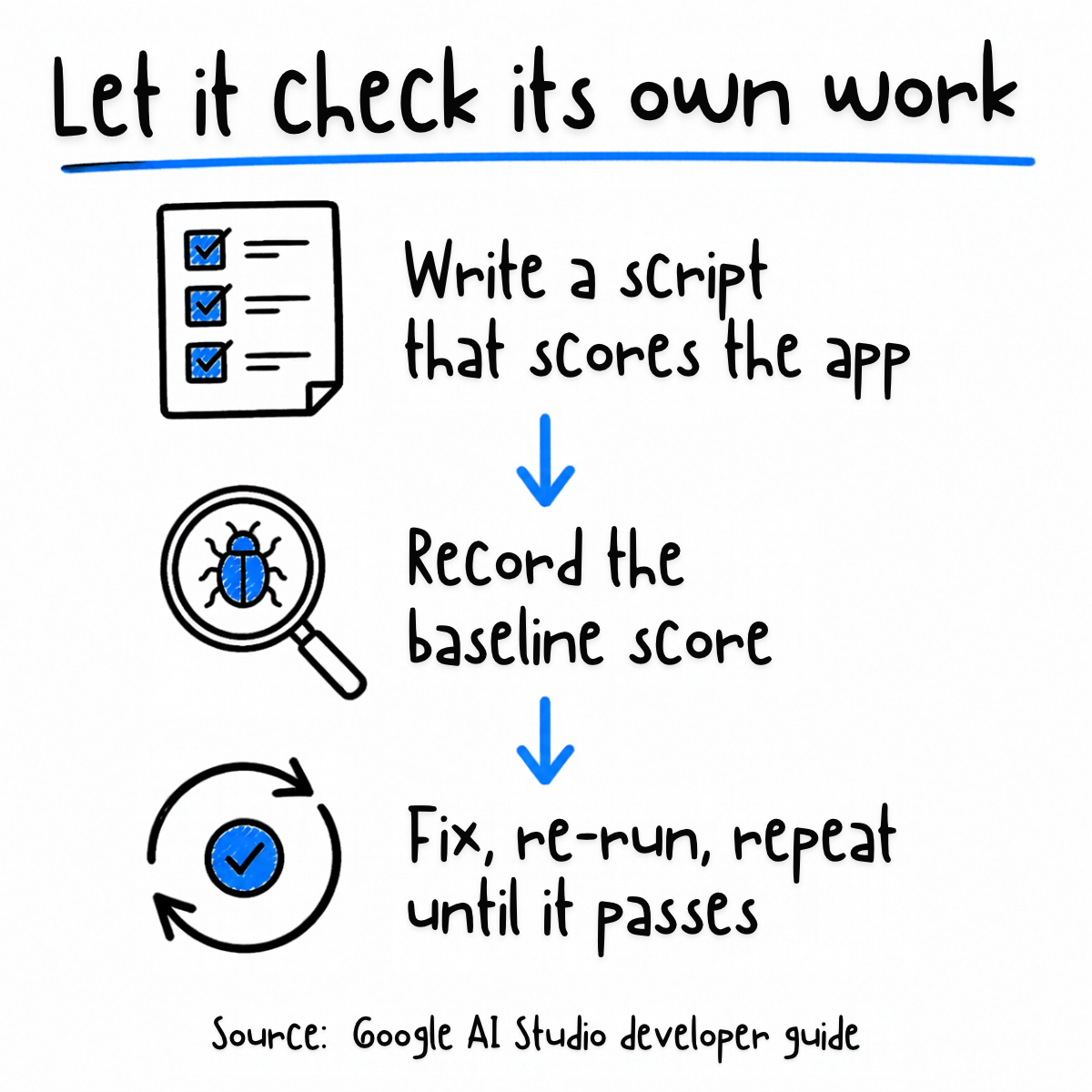
A loop that re-runs a check after every change also re-reads the context every turn, so at US$20 per million output tokens a loop with no measurable stopping point costs more to run blind. The guide’s other four tips are to align on intent before long runs, use multimodal references, use Argon as an orchestrator, and have it reflect on past work by writing lessons into AGENTS.md or a reusable skill.
Argon as orchestrator, Flash as workhorse
The guide’s fourth tip splits the work between two models. Google says developers across the company pair Argon as lead orchestrator, at medium or high thinking, with Gemini 3.8 Flash subagents for parallel, well-scoped work such as codebase exploration, boilerplate tests, leaf-module migrations and high-frequency checks. Argon plans and reviews; Flash executes. For richer apps it suggests Argon directing other models, with Nano Banana for images and sprites and Gemini 3.8 Flash TTS or Lyria for voice and music.
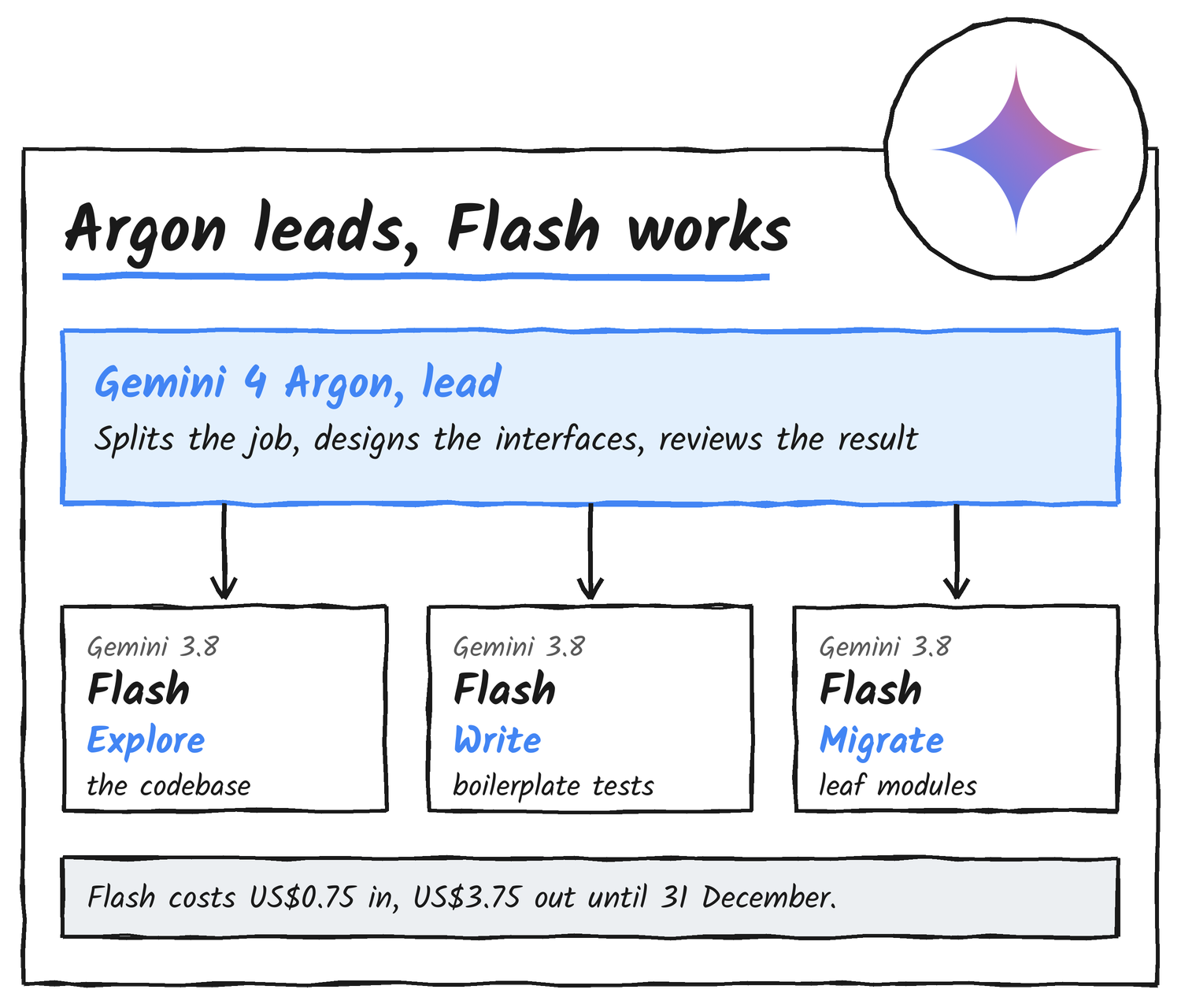
From 1 December Argon costs 5.3 times Flash’s current rate on both input and output (US$4 against US$0.75, and US$20 against US$3.75). Flash doubles on 1 January 2027, which narrows the gap to 2.7 times at US$1.50 and US$7.50. The guide’s Mars Rover example says Argon with Flash subagents “land the rover faster and cheaper than Argon alone”. It publishes no times or costs for the run, so the claim is Google’s, not a measurement.
Where Argon runs
The developer guide lists where to use the model. Google AI Studio has a Playground and a full-stack Build mode, with Argon available to Google AI Ultra subscribers and developers on a paid Gemini API tier. The Gemini API takes gemini-4-argon on the Interactions API with day-one support in the google-genai SDKs. Google Antigravity, its agent-first development platform, offers it to Ultra subscribers for planning, /goal runs and multi-agent orchestration. The guide also lists third-party support in Vercel’s AI SDK, LiteLLM, OpenRouter, Pydantic, OpenCode, LiveKit, Browserbase, Eigent and Cua.
Argon also runs inside Managed Agents, where the Gemini API provides a hosted sandbox and the Antigravity harness. The guide’s example calls the agent antigravity-preview-09-2026 with gemini-4-argon as its model and asks it to audit a site for performance, Core Web Vitals and search indexing. The agent can search the web, write code, verify its work and call MCP tools in one API call. The guide showcases two sample builds, Finance Story and Pixel Arcade, and Google’s showcase page lists 14 launch apps. Argon isn’t available on the free tier.
The 3D games guide
The 3D guide is the most prescriptive of the four. It sets out six workflows: align on creative direction first, using /grill-me in Antigravity so Argon interviews you before writing code; split the build across parallel subagents; call an adversarial critic subagent at the end of each round; build tools such as a progress.html screenshot gallery and on-screen sliders so a human stays in the art director’s seat; use Nano Banana to render a photorealistic target for the scene; and, for the hardest builds, draw a 2D plan with measurements before modelling in 3D.
Google’s guide says models told to keep iterating “until the 3D scene looks amazing” often stop after round two, so the critic must list at least three specific flaws, score the scene out of 10 and send it back until it clears 9. The worked example is Desk Racer, a go-kart game built on the author’s own desk. The guide reports 68 coaster pillars landing flush on the desk after intersection checks, and a scale change from 1:87 to 1:150 in one prompt. Both are Google’s account of its own build.
Where Argon sits
Inside Google’s line-up, Argon is no longer the newest model. Carbon is the “most capable reasoning model” on the pricing page at the same price. Neon, covered in the launch report, costs less than Argon will from 1 December. Hydrogen costs less than half as much. The linked reports have the detail on each.


Against Anthropic, the prices line up on paper. Anthropic’s pricing page lists Claude Sonnet 5.5 at US$2 and US$10 per million tokens, the same as Argon’s introductory rate, and Claude Opus 5.5 at US$4 and US$20, the same as Argon from 1 December.
| Model | Input per 1M | Output per 1M | Cache read per 1M |
|---|---|---|---|
| Claude Sonnet 5.5 | US$2 | US$10 | US$0.10 |
| Claude Opus 5.5 | US$4 | US$20 | US$0.20 |
| Claude Fable 5.2 | US$8 | US$40 | US$0.20 |
| Gemini 4 Argon, from 1 December | US$4 | US$20 | US$0.20 |
Rates don’t give cost per task. Anthropic’s page says Claude 4.7 and later models use a tokeniser that produces about 30% more tokens for the same text. Google says Argon spends fewer tokens per turn than Carbon. Neither page says how many tokens a given job takes on the other’s model, so the table compares rates, not outcomes, and nothing here ranks the models on quality.
What the guides don’t show
- The developer guide carries no benchmark scores. Its claims about long-horizon work, such as refactoring C++ to Rust or remediating vulnerabilities, are descriptions of what Google says Argon can do, backed by 14 launch apps rather than a published evaluation.
- No guide gives dollar costs, run times or token counts for its examples, including the Mars Rover run and the Desk Racer build.
- Google’s pricing page lists no end date for the 1 December rates, and the Neon launch report notes that Neon replaced Argon in the Gemini app for Pro and Ultra subscribers.
- The guides are written by Google staff about Google’s product. Loeber’s post links the team’s own work, and the “faster and cheaper” subagent claim has no number behind it.
What to do before 1 December
- Count your Argon spend in output tokens, thinking included, since output is the larger part of any bill, and double it to see the new run rate.
- Search your code for
thinking_budget,temperature,top_p,top_kandcached_content, and clear them as the migration list says. - Set
max_output_tokensabove 65,536 only on the calls that need it, run those withbackground=True, and readusagefrom the finished interaction, not the sum of hop inputs. - Try Flash subagents on the parallel parts of an agent job, and compare cost per finished task, not per token.
- Decide whether the work needs Argon at all. Neon and Hydrogen both list cheaper rates on Google’s page.
Terms used in this piece
- Hop
- One continuation step in long decode. Each hop picks up from the tokens generated so far.
- Long decode
- Google’s name for generating past 65,536 output tokens, up to the 1,048,576-token window minus your input.
- Implicit caching
- Automatic reuse of repeated input at 5% of the input price. Explicit caching isn’t supported on the Gemini 4 models.
- Interactions API
- The Gemini API endpoint the guides use for
gemini-4-argon. - Managed Agents
- Hosted agents in the Gemini API with a sandbox and the Antigravity harness.
- Thinking level
- The
low,mediumorhighsetting that controls how much Argon reasons before it answers.
Google hasn’t published a test behind its Argon claims, and none of the four guides prices a long run in dollars. The pricing page holds the live rates, and the long decode page holds the hop arithmetic.
Sources
- Gemini 4 Argon: Developer Guide, Google AI Studio, 13 October 2026
- Building 3D Games and Procedural Worlds with Gemini 4 Argon, Google AI Studio, 13 October 2026
- Long decode, Google AI Studio documentation, read 25 November 2026
- Gemini Developer API pricing, Google AI Studio, read 25 November 2026
- Latest Gemini models, Google AI Studio documentation, read 25 November 2026
- Claude API pricing, Anthropic, read 25 November 2026
- Patrick Loeber on X, 14 October 2026
Discover more from Sulat AI & Tech News
Subscribe to get the latest posts sent to your email.