
Yegor Sak, the founder and chief executive of Toronto-based VPN provider Windscribe, told a Canadian Senate committee on Monday 23 November (Ottawa time) that he’ll move the company out of Canada if Bill C-22 becomes law without substantial changes. The bill would let Ottawa order service providers to build surveillance access and keep subscriber metadata. The committee began voting on amendments the next afternoon.
Sak appeared by videoconference before the Standing Senate Committee on National Security, Defence and Veterans Affairs, on the same final day of witnesses as Apple, Google and the Canadian Bar Association.
Canada’s rule of law and respect for privacy are the primary reasons we incorporated here in 2015. Bill [C]-22 destroys all of that.
Yegor Sak, Windscribe CEO, to the Senate committee on 23 November, as quoted by TechRadar and CBC
What Sak told the committee
He said Windscribe is used by more than 100 million people, mostly in countries run by authoritarian regimes. When authorities, Russia among them, ask for user data, he said, Windscribe can tell them it has none. “If someone breaks into Windscribe today, there’s nothing to steal,” he told senators, according to The Globe and Mail.
Metadata retention is the sticking point. Sak argued there has never been a worse time to order companies to store it, because AI is helping hackers find and exploit software flaws faster than before.
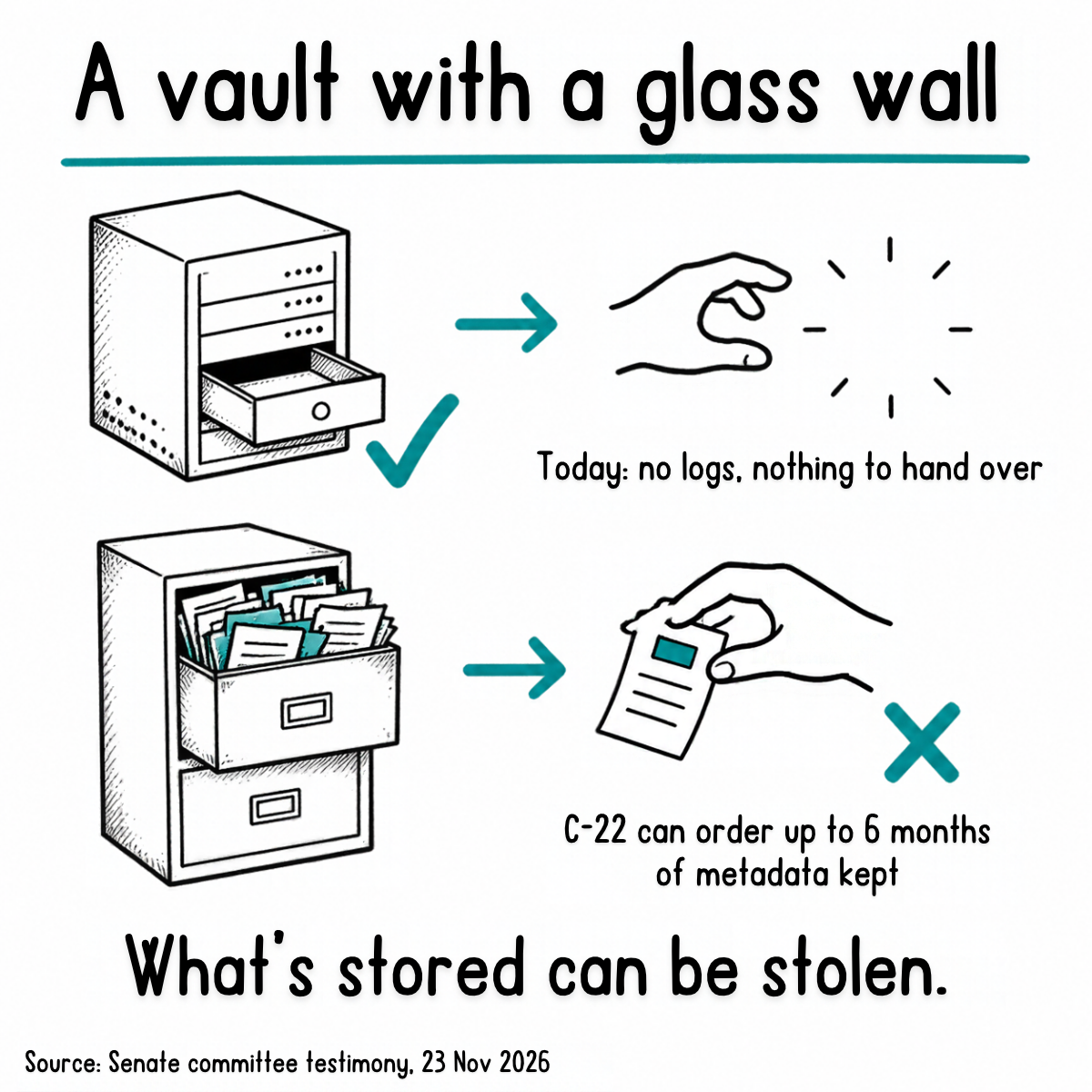
He told The Globe and Mail he’s already preparing a move abroad and “will pull the trigger if this bill gets Royal Assent” without amendments. TechRadar reports he has weighed a move since May. His closing line to senators was: “Please don’t make leaving Canada the price of keeping the trust.”
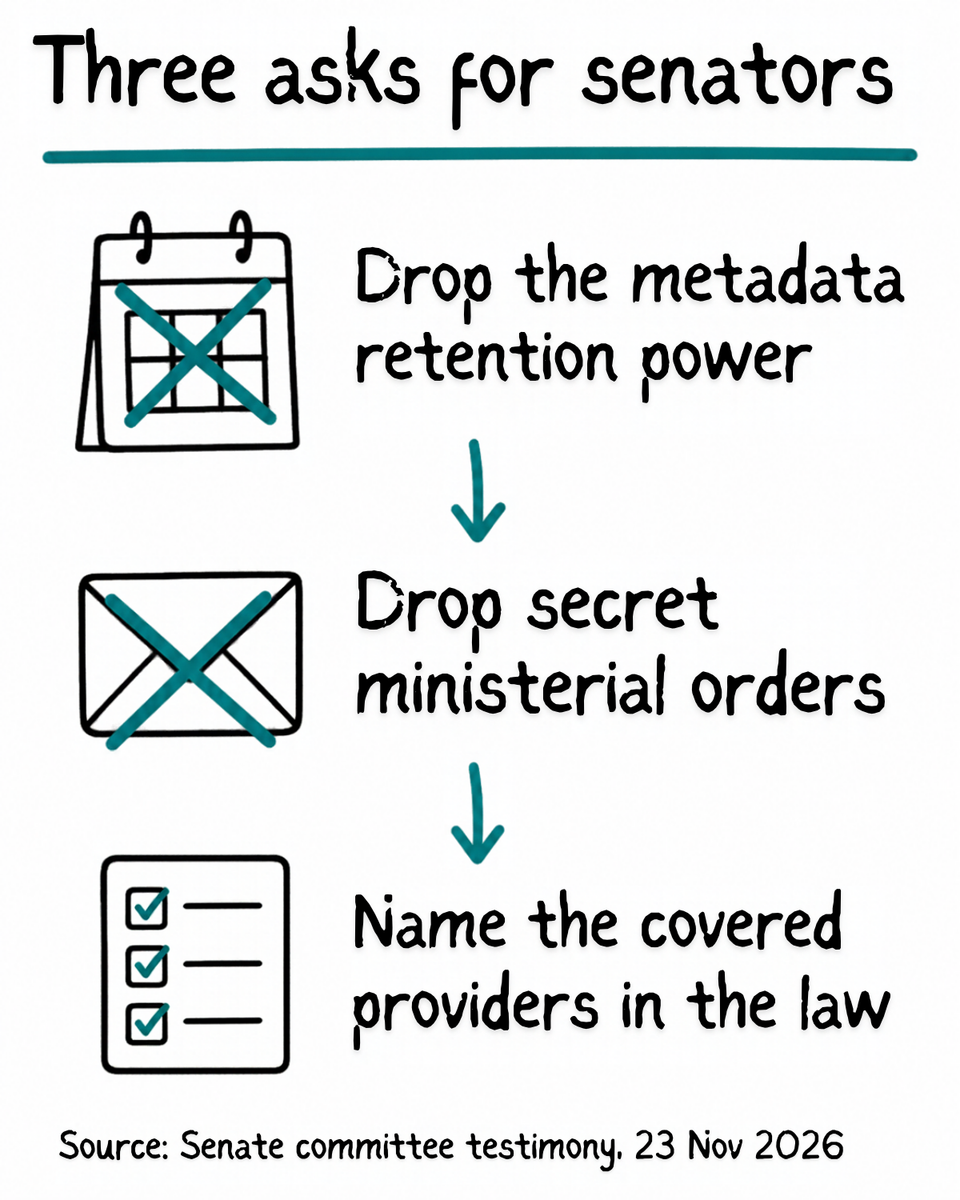
The changes Windscribe wants come down to three: drop the metadata retention power, drop secret ministerial orders, and name the covered providers in the law instead of leaving them to regulation.
What Bill C-22 does
Bill C-22, the lawful access bill, would require telecoms, internet companies and other electronic service providers to change their systems so police and the Canadian Security Intelligence Service can get electronic information faster. The Public Safety Minister could issue ministerial orders to companies, and the companies would have to keep those orders secret.
- Retention: regulations could require providers to keep IP addresses and connection metadata for up to six months. Amendments cut that from 12 months.
- Encryption: providers wouldn’t have to decrypt data unless they supplied the encryption and hold the key, and orders that create a “systemic vulnerability” are barred.
- Reach: the definition of an electronic service provider covers firms that serve Canadians or do business in Canada.
- Trigger: the bill alone doesn’t start any logging. Ottawa would still need to issue a regulation or an order aimed at a provider.
Public Safety Minister Gary Anandasangaree’s office says the law wouldn’t create systemic vulnerabilities or backdoors, CBC reports. Critics point out that cabinet and the minister, not a judge, can impose these orders. The bill lists factors the government must weigh, such as cost, feasibility and the effect on privacy and cybersecurity, but no requirement that the obligations be necessary or proportionate, according to Michael Geist.
Where the bill stands
The House of Commons passed C-22 in June. The Senate sent it to the national security committee on 22 October. Committee chair Marty Deacon said it would have heard from more than 50 witnesses over 11 hours of hearings before clause-by-clause review. The last witnesses, Windscribe among them, appeared on 23 November. Clause-by-clause review started at 2:15 pm Eastern on 24 November. I found no published result of that vote when I wrote this.
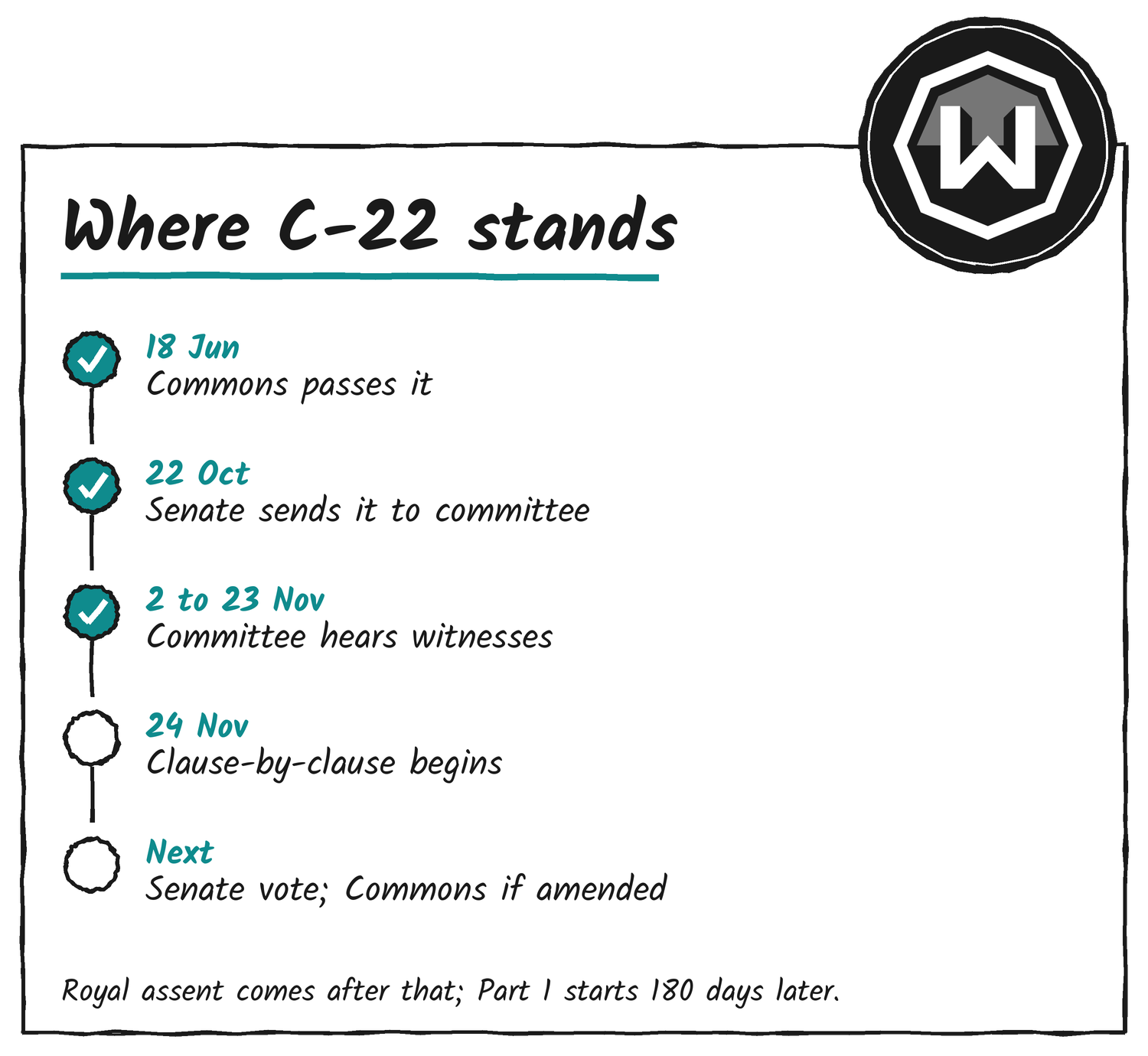
If senators amend the bill, it goes back to the House of Commons. If they pass it unchanged, it moves closer to royal assent.
What the other witnesses said
| Witness | Position |
|---|---|
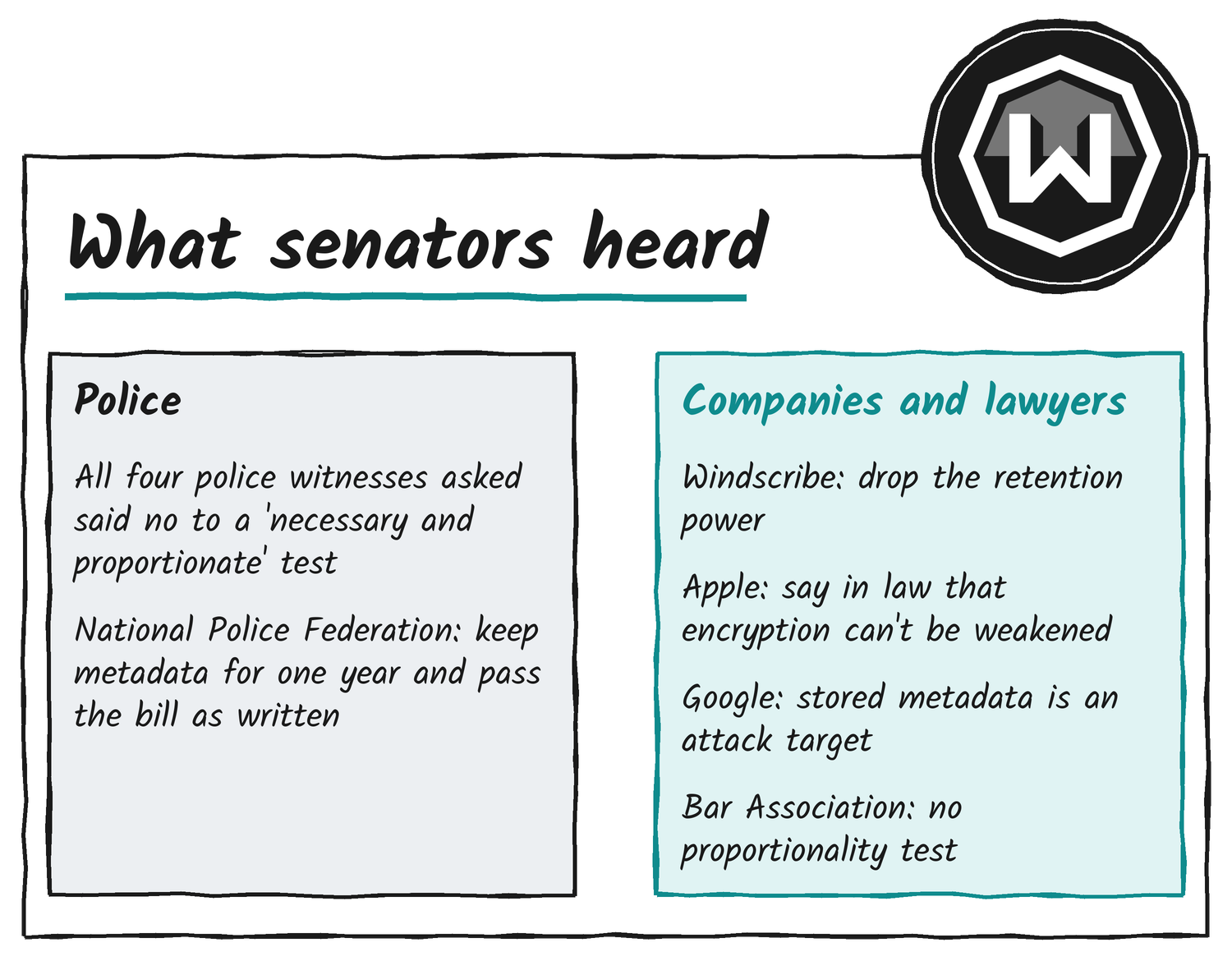
| Apple | Its written submission warns the bill could be used to make companies weaken end-to-end encryption, “something Apple will never do”. It wants the law to say no provider can be required to weaken encryption. |
| John Hultquist said the bill “introduces new dimensions of risk”. Google told senators the metadata mandate means keeping records on millions of Canadians not suspected of any crime, which “creates attractive new attack surfaces for bad actors”. | |
| Canadian Chamber of Commerce | David Pierce said a “fundamental disagreement” with business remains despite earlier amendments, and that the bill cuts against Canada’s strategy of attracting companies. |
| Canadian Bar Association | It notes the power to impose obligations on core providers comes with no proportionality test. |
| Police witnesses (18 November) | Asked by Senator John McNair whether they’d back a “necessary and proportionate” amendment, all four said no, per Geist. Rob Farrer of the National Police Federation said police would prefer a year of metadata and that it was “very important that this pass as it is written now”. |
Privacy lawyer David Fraser, former Ontario judge Michael Code, Tufts professor Susan Landau, the Digital Governance Council’s Keith Jansa and two Australian Home Affairs officials also appeared on 23 November. The Privacy Commissioner recommended the necessary-and-proportionate standard earlier this month, according to The Circuit.
Other companies have made threats too
Windscribe wasn’t the only company to ask for changes. Signal has threatened to pull out of Canada if the bill passes as written. Meta has said it would consider pulling WhatsApp. Tailscale’s chief executive, Avery Pennarun, told senators his company has explored moving services outside Canada, and Beauceron Security’s David Shipley warned the bill could let police join encrypted conversations as “ghost participants”. Shopify has flagged the burden on smaller companies, and Proton has questioned its Canadian expansion plans, according to the Progress Chamber.
The UN Office of the High Commissioner for Human Rights found several parts could violate human rights, including blanket metadata retention and obligations that could break end-to-end encryption.
Would moving even work?
TechRadar notes that moving Windscribe’s Toronto office alone wouldn’t automatically shield the VPN if it kept local servers or corporate ties, because the bill reaches firms that do business in Canada. Windscribe has previously pledged not to change its no-logs policy. It has opposed the bill since at least September, when it posted that it had signed a letter against it. We covered a different side of the company on 14 November, when it started selling VPN access to AI agents through an API.
What’s next
The committee’s clause-by-clause vote decides whether the bill returns to the Commons. Sak has said any move waits for royal assent, so the outcome of that vote sets the clock for Windscribe.
Sources
- Senate committee notice of meeting, 23 November 2026
- LEGISinfo: Bill C-22
- TechRadar, Windscribe CEO tells Canadian Senate he will move the VPN abroad unless Bill C-22 changes
- CBC News, Big tech, law enforcement make final pitches as Senate considers data access bill’s future
- The Globe and Mail, report on the 23 November hearing
- Michael Geist, No Compromise: Senate heads to clause-by-clause on Bill C-22
- The Circuit, Senators vote on Bill C-22’s amendments today
- Progress Chamber, We’re running out of time to fix Bill C-22 in the Senate
Discover more from Sulat AI & Tech News
Subscribe to get the latest posts sent to your email.