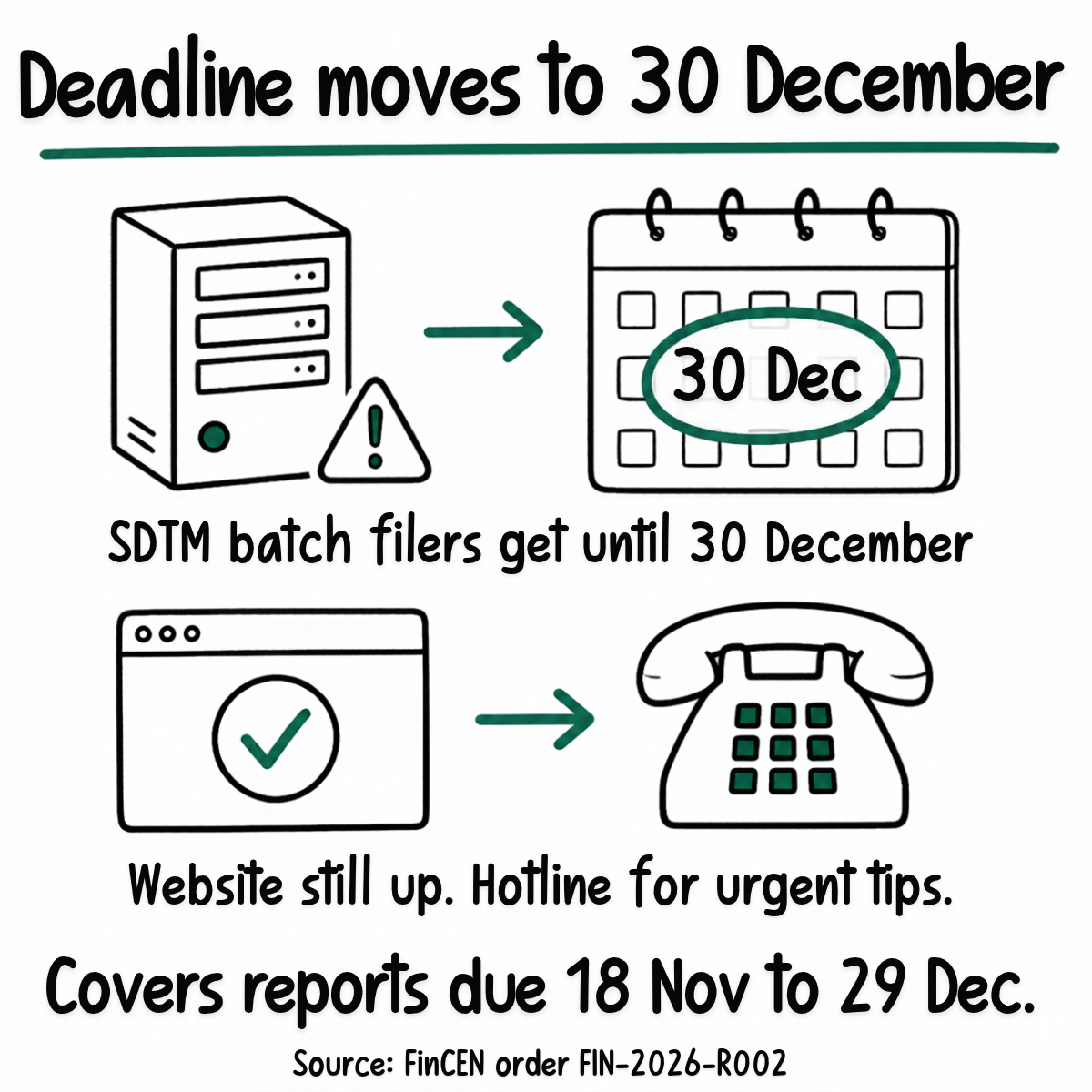
FinCEN, the US Treasury bureau that collects banks’ suspicious activity reports, said on Tuesday 24 November (US time) that it’s investigating a cybersecurity incident that “resulted in unauthorized access to a limited subset of its systems”, The Verge reports. It has taken some systems offline as a precaution. On the same day it gave some filers until 30 December to submit reports that fell due between 18 November and 29 December.
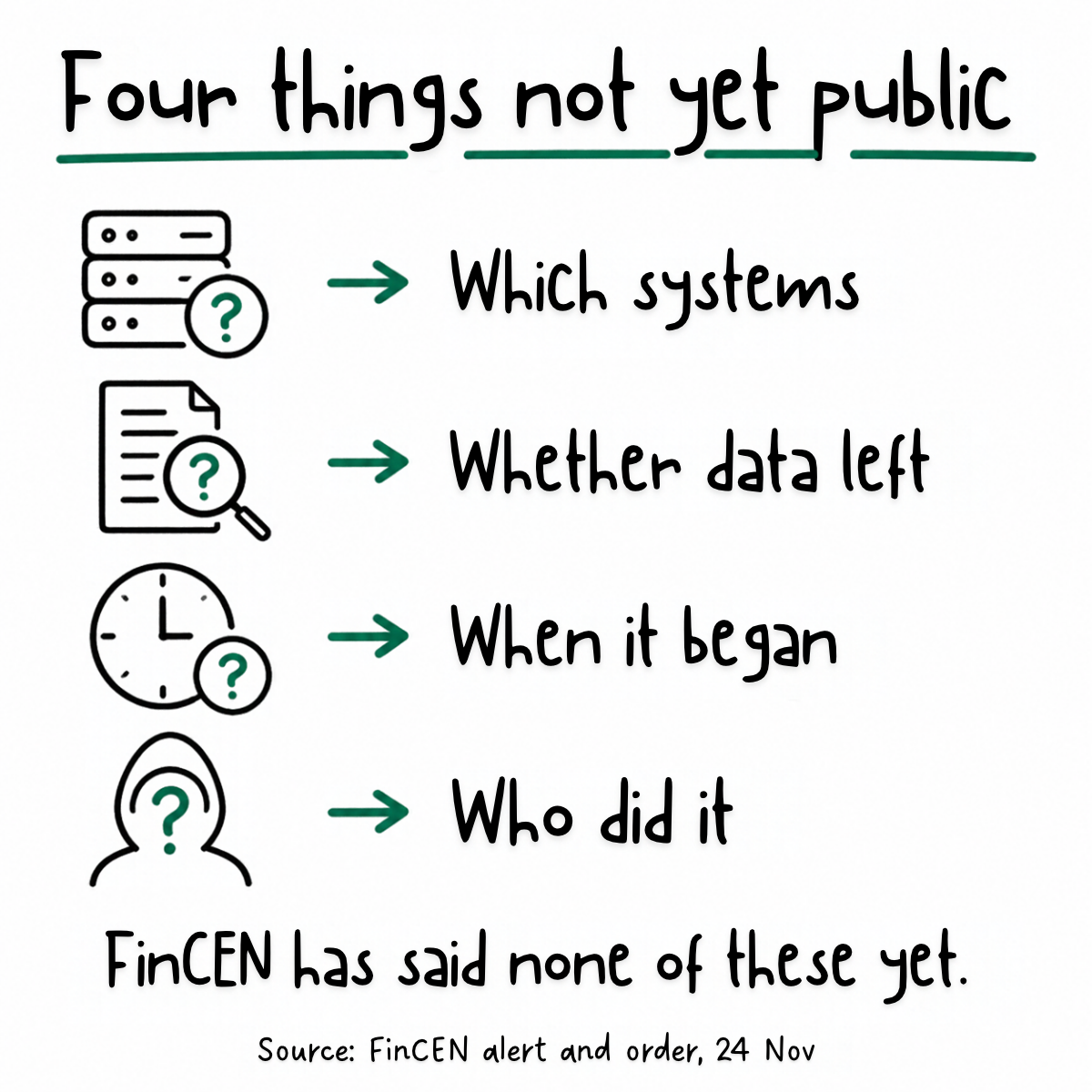
The incident is at FinCEN, not across the whole department. I found no statement from Treasury or Secretary Scott Bessent about it. FinCEN hasn’t said which systems were reached, whether any data was taken, when the intrusion began or who was behind it.
4.8M
suspicious activity reports filed with FinCEN in the 2025 financial year
335,000
banks and other firms that file Bank Secrecy Act reports with it
30 Dec
new date for covered reports due 18 November to 29 December
What FinCEN has said
- Said: it’s investigating an incident that resulted in unauthorised access to a limited subset of its systems, and it has taken some systems offline.
- Said: the BSA E-Filing website is still operational, though some services may not be immediately available, according to The Verge’s account of the alert.
- Said: its Financial Institutions Hotline, 1-866-556-3974, isn’t affected, so banks can still send urgent suspicious activity information to law enforcement that way.
- Said, in its order: the extra time is a response to “a service disruption that is hindering filers’ ability to adhere to reporting obligations”. The order doesn’t mention a cybersecurity incident.
- Not said: which systems were accessed, whether data left them, when the intrusion began, how the intruder got in, who it was, and whether the incident is tied to any other federal breach.
The filing problem was public four days earlier
The disclosure wasn’t FinCEN’s first sign of trouble. By Friday 20 November (US time), JBizNews reports, FinCEN had an alert on its BSA E-Filing site about a disruption to Secure Direct Transfer Mode, or SDTM. That’s the server-to-server route large filers use to send reports in batches without uploading them through the website. The alert said the website was fully operational and could take both single reports and batches. It gave no cause, no timeline and no relief from deadlines.
Four days later the order arrived, and it reaches back to 18 November, six days before the cybersecurity disclosure. FinCEN hasn’t said whether the SDTM outage and the unauthorised access are the same event.
| Who | What the order says | New deadline |
|---|---|---|
| Financial institutions that used SDTM to file BSA reports as of 18 November | Reports due from 18 November to 29 December can wait | 30 December |
| Reporting companies that must file a beneficial ownership report | Reports due in the same window can wait | 30 December |
| Individuals who must update a FinCEN ID | Updates due in the same window can wait | 30 December |
| Everyone else | The order doesn’t mention them. FinCEN’s alert says the website still takes reports | No change |
The relief isn’t a pause on policing. The order says institutions must still meet every other anti-money laundering duty, including ongoing monitoring for suspicious transactions. The beneficial ownership group is also small now. FinCEN’s August 2026 final rule exempts US companies, so the reporters left are certain foreign companies registered to do business in the US.
What FinCEN holds
FinCEN’s own figures show 4.8 million suspicious activity reports, 21.5 million currency transaction reports and 1.8 million foreign bank account reports in the 2025 financial year, from roughly 335,000 filers. A suspicious activity report is a bank’s private account of why it distrusts a customer or a transaction. ICIJ, which analysed a leaked batch in 2020, describes the reports as a narrative plus attached spreadsheets that can run to hundreds of lines of raw transaction data.
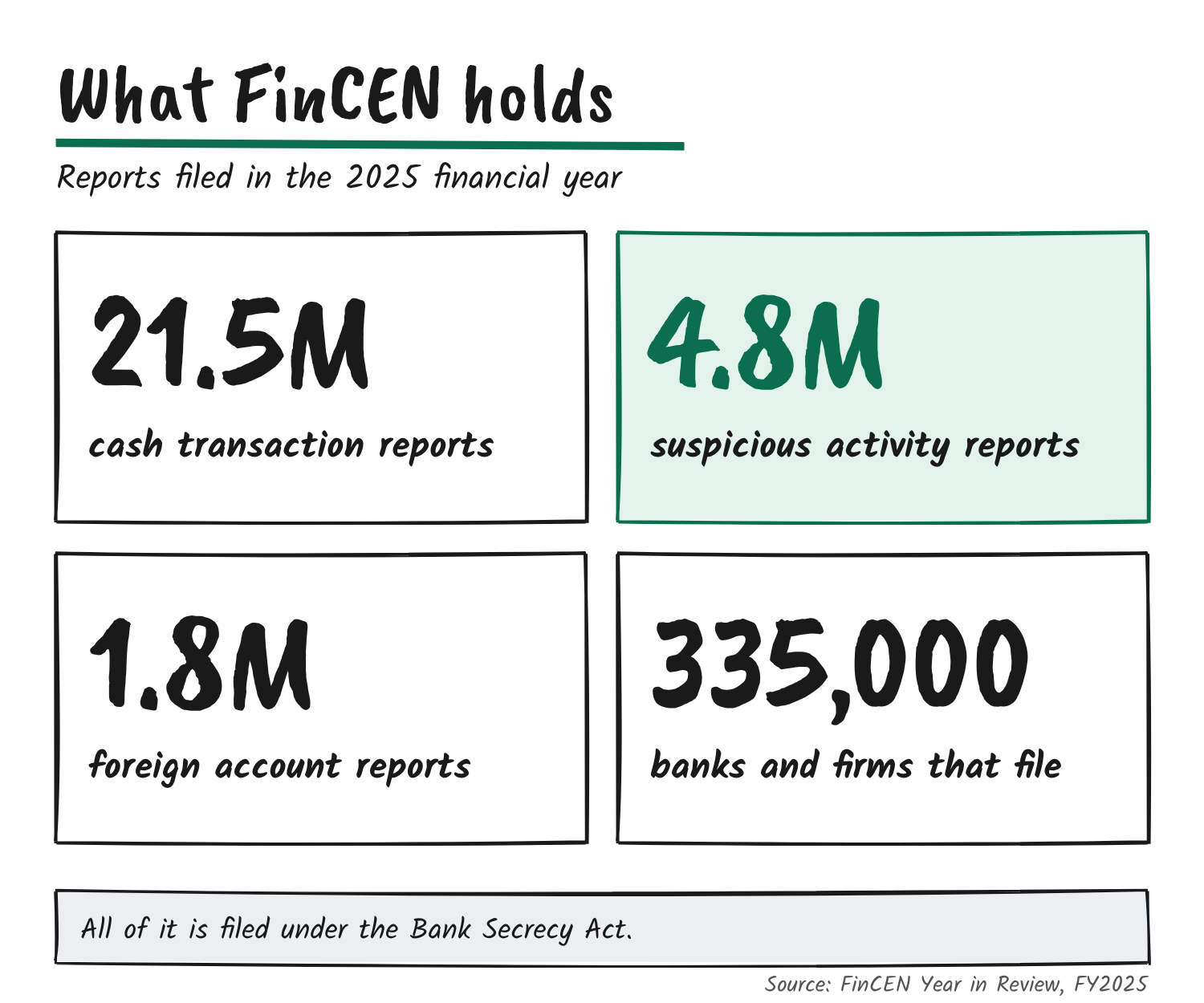
That’s why senators Tim Scott and French Hill wrote to the Treasury secretary after the 2024 breach that the department “maintains some of the most highly sensitive information on U.S. persons throughout government, including tax information, business beneficial ownership, and suspicious activity reports”. Whether any of that sits in the systems FinCEN took offline is the open question.
The nearest precedent is a leak, not a hack. In 2020 BuzzFeed News obtained more than 2,100 suspicious activity reports and about 2,600 documents in all, and ICIJ and partners published the FinCEN Files. FinCEN called the material “unlawfully disclosed”. ICIJ says the batch was under 0.02% of the more than 12 million reports filed between 2011 and 2017. Nothing FinCEN has said so far suggests any reports were accessed this time.
Treasury’s third disclosure in two years
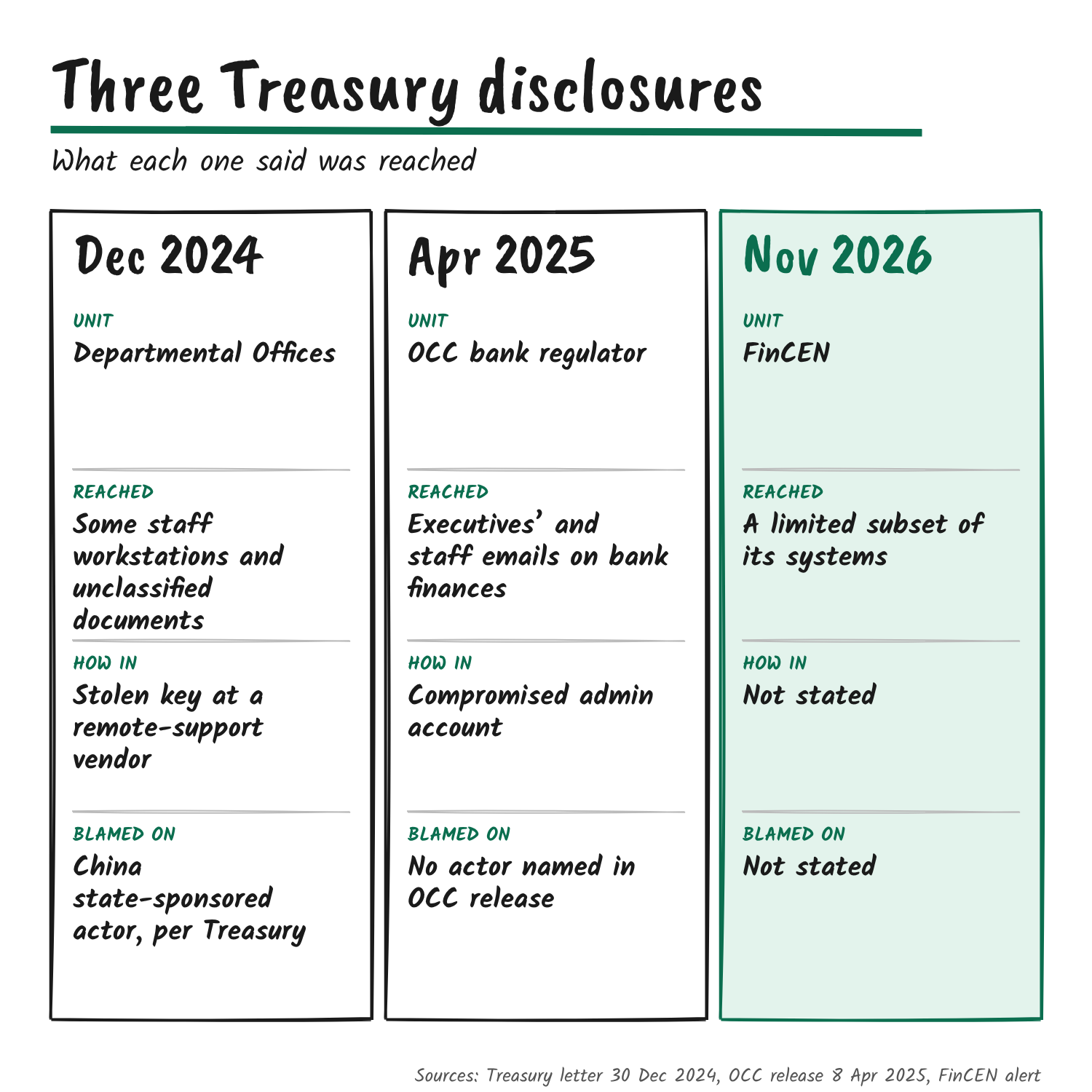
FinCEN is the third part of Treasury to disclose an intrusion since December 2024, going by the statements I can find. The first two came with more detail than this one has.
| Disclosed | Unit | What Treasury or the unit said |
|---|---|---|
| 30 December 2024 | Departmental Offices | A threat actor stole a key from remote-support vendor BeyondTrust, reached certain user workstations and read certain unclassified documents. Treasury attributed it to a China state-sponsored actor and called it a major incident. |
| 26 February and 8 April 2025 | Office of the Comptroller of the Currency | Unauthorised access to executives’ and employees’ emails, which held “highly sensitive information relating to the financial condition of federally regulated financial institutions”. The OCC told Congress it was a major incident. Bloomberg’s sources put the haul at about 150,000 emails, as BleepingComputer relayed. |
| 24 November 2026 | FinCEN | Unauthorised access to a limited subset of its systems. Some systems are offline. No actor, entry route or data named. |
A run of incidents across federal agencies
FinCEN’s disclosure came hours after The New York Times reported that the CIA and the Office of the Director of National Intelligence had found a breach of an open-source intelligence system. The Verge says it’s unclear whether the two are related, and FinCEN hasn’t linked its incident to that one or any other.
| Agency | What’s been reported | Our report |
|---|---|---|
| FinCEN (Treasury) | Unauthorised access to a limited subset of systems; some offline; filing deadlines moved | This article |
| CIA and ODNI | Breach of an unclassified open-source intelligence system, per the Times; officials say classified systems weren’t affected | CIA and ODNI breach |
| FBI | An apparent breach of the National Crime Information Center database, which the FBI is investigating | FBI NCIC breach |
| Department of Agriculture | Multiple applications taken offline after a security incident, disrupting payment tools for farmers, Nextgov and Government Executive reported | Not covered |
| NSA | A classified network went down on 17 November; the DNI tied it to patching and the NSA cites maintenance | NSA network outage |
Both Director of National Intelligence Jay Clayton and Bessent spoke on the Sunday talk shows on 22 November, before FinCEN’s disclosure. Clayton said the month’s outages weren’t coordinated or state-sponsored. Bessent told CBS the banks are “by far the most resilient companies in the U.S. economy” and that glitches from patching are like a vaccine’s side effects. Neither was talking about FinCEN, but FinCEN sits in Bessent’s department and is the bureau banks report to. The earlier outages are in our roundup of eight US outages in six days and our look at WIRED’s patching theory.

What to watch
Five questions FinCEN and Treasury haven’t answered
- Which systems were reached, and did they hold suspicious activity reports or beneficial ownership data?
- Does Treasury class the incident as “major” under the federal security law and notify Congress, as it did on 30 December 2024 and as the OCC did on 8 April 2025?
- Does FinCEN extend the 30 December date, which the order says it may do, and when does SDTM return?
- Does FinCEN say whether the SDTM outage that started by 20 November and the unauthorised access are one event?
- Does anyone tie FinCEN to the CIA, FBI or USDA incidents?
Terms used here
- FinCEN
- The Financial Crimes Enforcement Network, a Treasury bureau that collects and analyses financial intelligence to fight money laundering and terrorism financing.
- BSA
- The Bank Secrecy Act, the law that requires banks and other firms to report suspicious and large transactions to FinCEN.
- SDTM
- Secure Direct Transfer Mode, a server-to-server route for sending batches of BSA reports to FinCEN.
- Beneficial ownership report
- A report naming the real owners of a company. FinCEN ID is the identifier an individual can use when filing one.
Sources
- FinCEN, Order FIN-2026-R002, 24 November 2026
- The Verge, US financial crimes bureau discloses ‘cybersecurity incident’
- JBizNews, FinCEN’s automated batch-filing route disrupted
- FinCEN, Year in Review for FY 2025
- Treasury letter to Senate Banking, 30 December 2024 and the senators’ reply, 31 December 2024
- OCC news release 2025-30 and BleepingComputer on the OCC breach
- ICIJ, FinCEN Files
- Nextgov on the CIA and ODNI breach and the USDA incident
Discover more from Sulat AI & Tech News
Subscribe to get the latest posts sent to your email.