
Laravel’s MCP package now lets a server hand out agent skills. laravel/mcp v1.3.0 supports the MCP Skills extension, so a Laravel app that already exposes tools to outside agents can also publish the instructions for using them, as ordinary Markdown files in a folder. A post by @pushpak1300 on X flagged the release.
The API change is small. Before it, a tool list told an agent what a server could do and nothing about the order of steps, the limits or the house rules. A skill holds those. We installed v1.3.0 in a scratch Laravel app, wrote two skills and called the server by hand, so the examples below were run, not copied from the docs.
60.8M
total Packagist installs of laravel/mcp on 25 November NZ. Installs, not live servers
512
files allowed in one skill, with a 16 MiB total cap
3
routes for skills in the Laravel ecosystem: Boost, the AI SDK and MCP
0
extra routes or controllers needed: the skill rides on the server you already have
- What shipped
- Why it matters, in three uses
- What we ran
- Hiding a skill per user
- Boost, the AI SDK or MCP
- How it compares
- Limits, risks and what isn’t known
What shipped
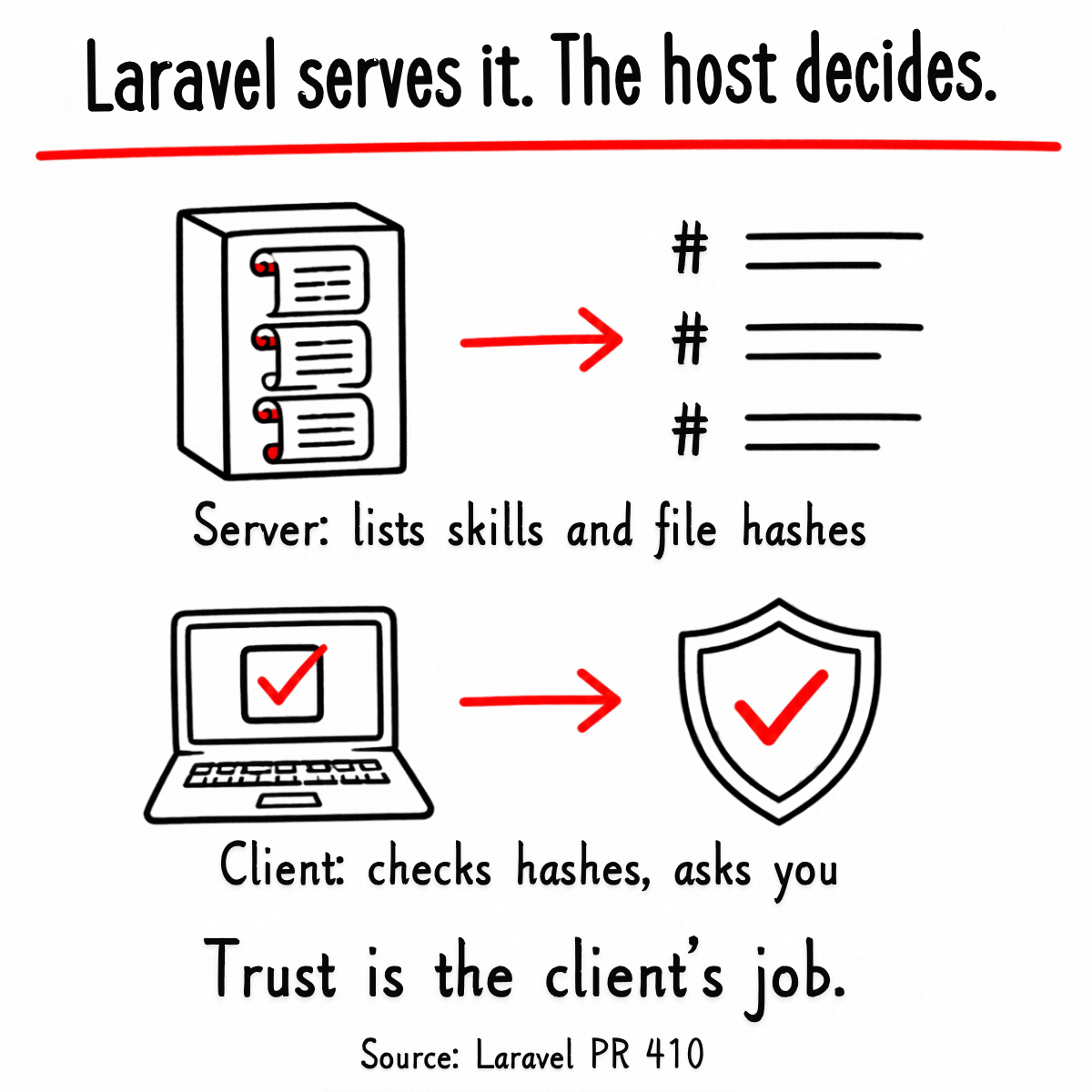
The protocol piece is the io.modelcontextprotocol/skills extension (SEP-2640, marked Final, with the extension itself at Beta). A server lists skills with skills/list, fetches one with skills/get, and serves the files as skill:// resources. Each file in the manifest has a sha256 digest and a size. Anthropic put the host side into public beta on 24 November, which we covered in Claude Code now loads skills straight from MCP servers.
Laravel’s side is three pieces. A server declares protected array $skills. Each entry is either a folder path or a class extending Laravel\Mcp\Server\Skill, which has a path() method and an optional shouldRegister(Request $request). An artisan command, make:mcp-skill, scaffolds one. A skill folder follows the Agent Skills layout: a SKILL.md with name and description in its frontmatter, plus any reference files.
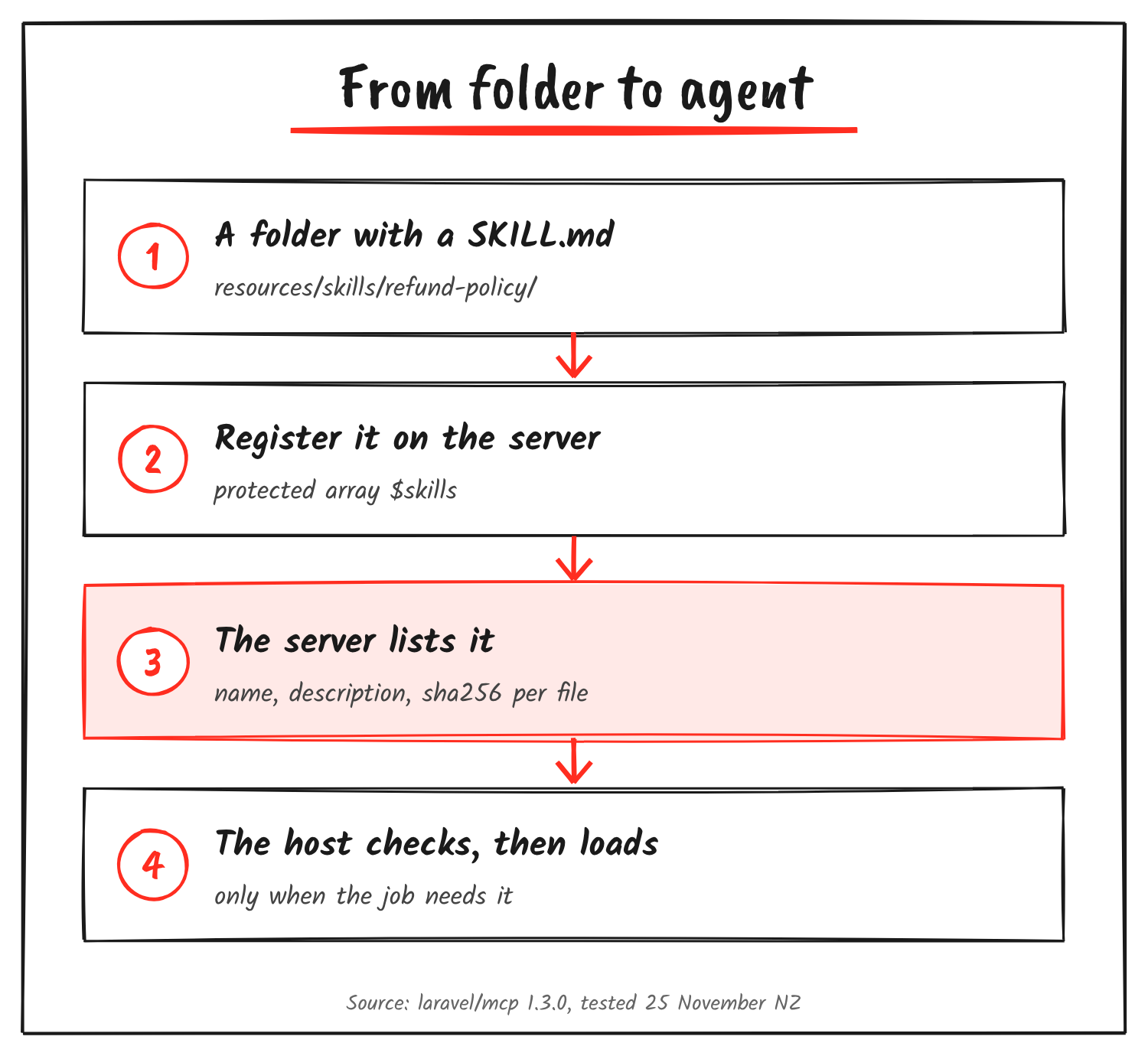
Why it matters, in three uses
Skills aren’t new. Agent Skills already exist and Laravel already had two ways to use them. What’s new is that a server owner can ship the how-to alongside the tools, to agents they don’t control, and edit it in one place.
1. A shop that lets an agent issue refunds
An MCP server exposes find-order and issue-refund. The tool descriptions say what each does. They don’t say that refunds close at 30 days, that NZ$200 is the cap without a manager, or that an over-cap case goes to a human. Put that in a refund-policy skill and each connecting agent reads the same rules, written by the people who own them. Nobody has to paste a prompt into a settings page.
2. One server, different skills for different people
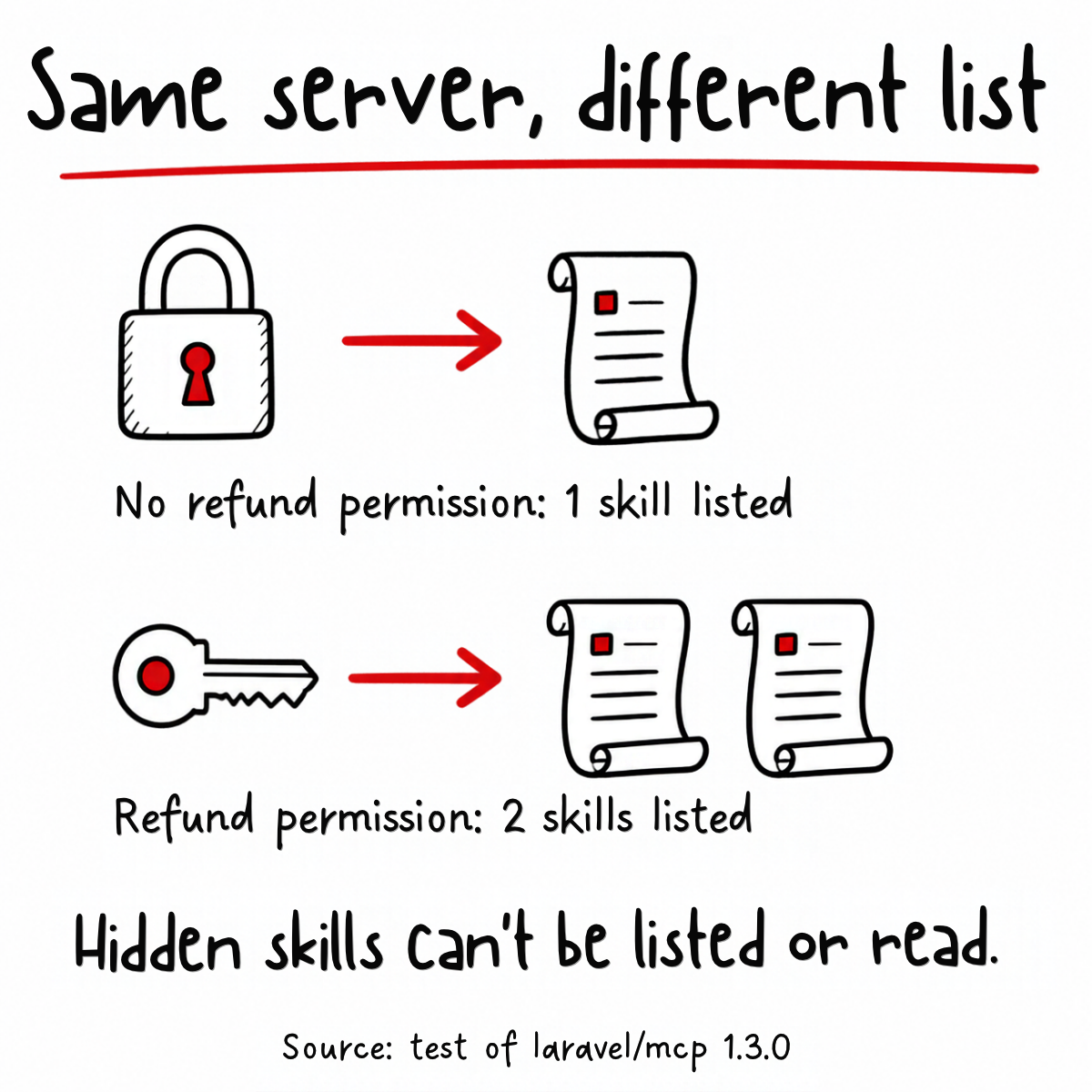
Because shouldRegister() receives the request, the refund policy can be visible to staff who can issue refunds and invisible to everyone else. A support intern’s agent never sees the procedure for a task it can’t do. We tested this; the results are below.
3. A package that ships its own instructions
A Laravel package that exposes an MCP server, a billing integration or an internal admin tool for example, can bundle the skill that explains it. The instructions version with the code and update on composer update, instead of living in a wiki that drifts. The caveat is the one in the limits section: the host still decides whether to load it.
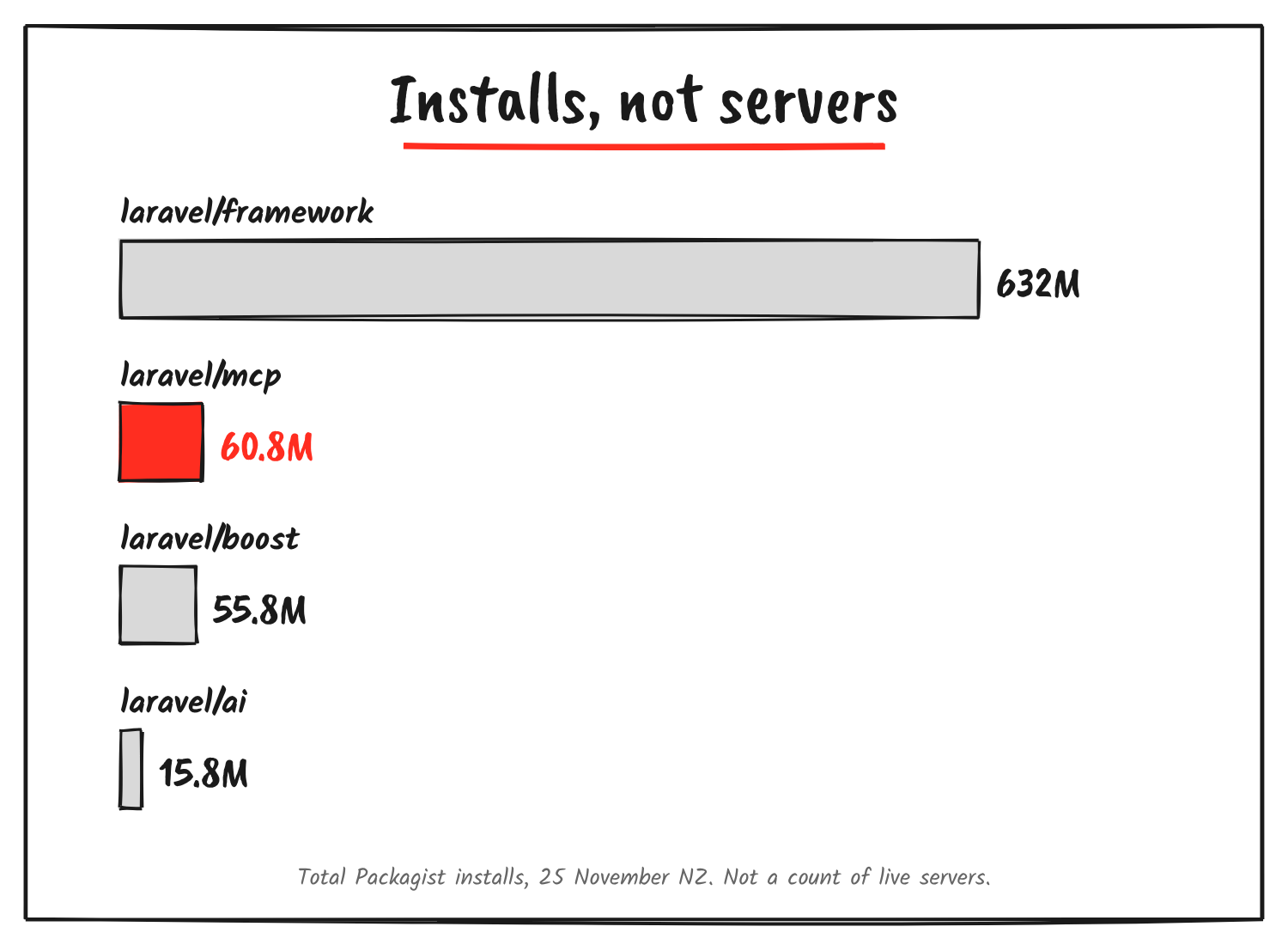
For scale: Packagist shows 60.8 million total installs of laravel/mcp against 632 million for laravel/framework. Install counts include CI runs and dependency resolution, so they say the package is widely pulled, not how many production MCP servers exist. We found no public count of Laravel MCP servers in production.
What we ran
The test app was a fresh Laravel 13 install on PHP 8.3 with laravel/mcp v1.3.0, a “Shop Server” registered as a local server in routes/ai.php, and two skills. We drove it over stdio with hand-written JSON-RPC messages, declaring the skills extension in initialize.
// app/Mcp/Servers/ShopServer.php
#[Name('Shop Server')]
#[Version('1.0.0')]
#[Instructions('Order lookups and refunds for the shop.')]
class ShopServer extends Server
{
    protected array $skills = [
        RefundPolicy::class,     // a Skill class, gated below
        'skills/public-faq',     // a plain folder path
    ];
}

// routes/ai.php
Mcp::local('shop', ShopServer::class);---
name: refund-policy
description: Decide whether an order qualifies for a refund and issue it with the issue-refund tool. Use when a customer asks for money back.
---
# Refund policy
1. Look up the order with the `find-order` tool.
2. Read `references/limits.md` for the refund window and the cap per order.
3. Under the cap and inside the window: call `issue-refund`.
4. Over the cap or outside the window: stop and hand the case to a human.The server advertised the extension in its capabilities and answered skills/list with both skills. Each entry carried its frontmatter and a manifest of files, with a digest and a size. For the public FAQ the manifest said 181 bytes and a sha256 beginning 9c1e9b15. We hashed the file on disk independently and got the same value, so the digest is the file’s real hash. A call to resources/read for the refund limits file returned its text: a 30-day window and a NZ$200 cap.
Hiding a skill per user
This was the check we cared about most. Without it, a skill is just a document on a web page. The refund skill is a class:
class RefundPolicy extends Skill
{
    public function path(): string
    {
        return 'skills/refund-policy';
    }

    public function shouldRegister(Request $request): bool
    {
        return $request->user()?->can('issue-refunds') ?? false;
    }
}
We ran the same server twice, once with no signed-in user and once with a user who had the issue-refunds ability.
| Caller | skills/list | Reading the refund skill |
|---|---|---|
| No permission | public-faq only | skills/get and resources/read both fail with “not found”-style errors, as if it didn’t exist |
| Has issue-refunds | refund-policy and public-faq | Reads normally, including its reference file |
A hidden skill returned the same error an unknown skill would: skills/get said the URI “must be the URI of a registered skill”, and resources/read said the resource was not found. So a caller can’t tell the skill exists. Laravel’s documentation says the same of resources/list, which we confirmed lists nothing for the hidden skill.
We also probed the file rules. A dotfile in a skill folder, a symlink and a ../ path to a sibling skill all came back not found. That matches the package’s own constants, which cap a skill at 512 files and 16 MiB (Skill::MAX_FILES and MAX_SIZE in the source).
Boost, the AI SDK or MCP
A skill in Laravel can now live in three places, and picking the wrong one is an easy slip. All three use the SKILL.md format. What differs is who reads the skill.
| Route | Who reads it | Where it lives | Use it for |
|---|---|---|---|
| Laravel Boost | The coding agent working on your repository | .ai/skills | How to write code in this app |
Laravel AI SDK (HasSkills) | Agents your app runs itself | Your app’s agent classes | Skills for your own in-app agents |
| Laravel MCP | Outside agents that connect to your server | $skills on an MCP server | How to use your tools, for people you don’t control |
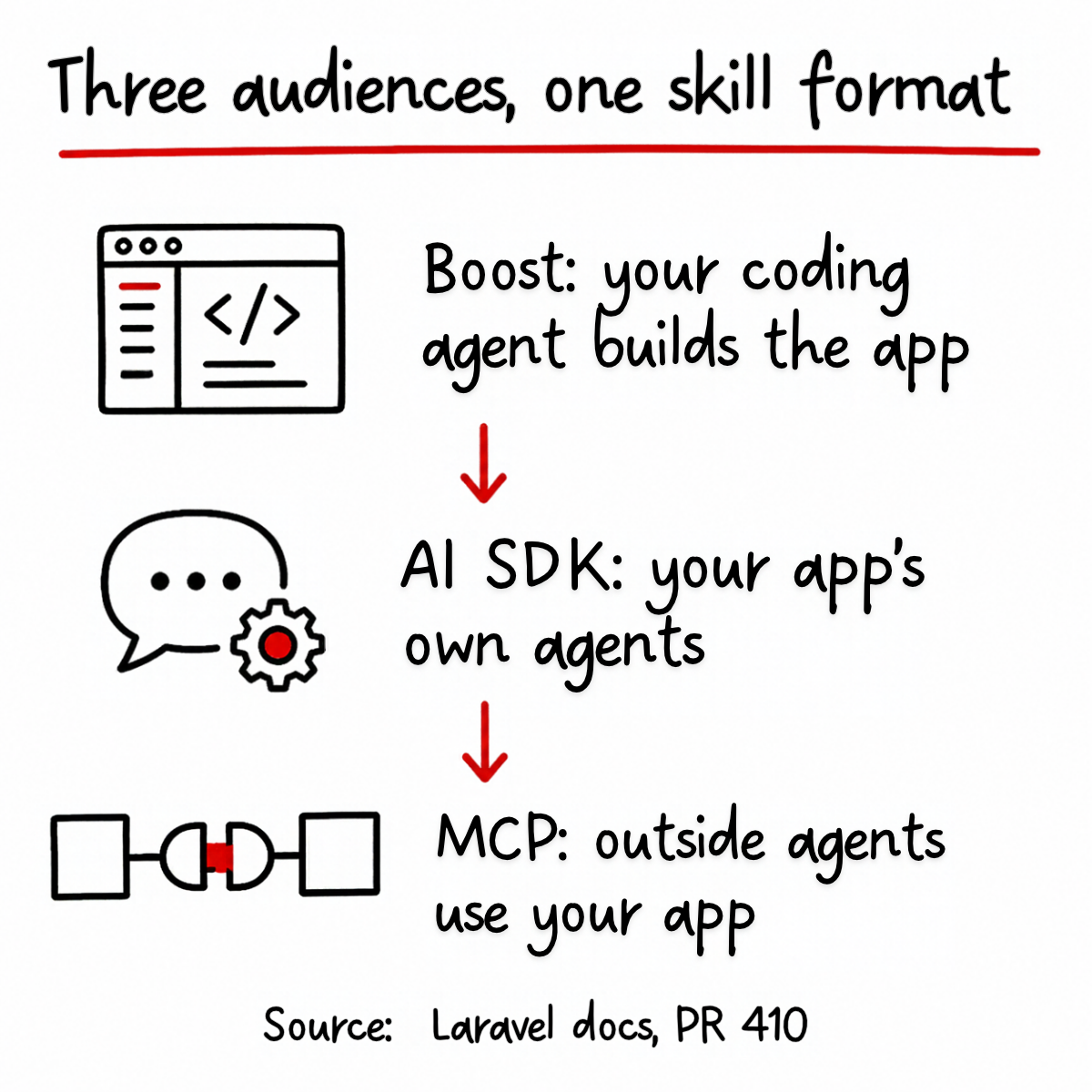
A rule of thumb from the table: if the reader is your own developer’s agent, use Boost; if it is an agent your app runs, use the AI SDK; if it is somebody else’s agent connecting in, use MCP. Our piece on Laravel’s A2A package covers a neighbouring route, agent-to-agent calls, and where PHP already had SDKs.
How it compares
Laravel is not first. Servers and SDKs in other languages were ahead, and the MCP project’s community implementations list showed this on 25 November NZ. It is community-maintained and changes often.
| SDK or stack | Skills support, per the list |
|---|---|
| TypeScript SDK | 2.4.0 |
| C# SDK | 2.4.0 |
| Rust (rmcp) | 3.9.0 |
| Ruby SDK | 1.9.0 |
| FastMCP | 4.2.0 (beta) |
| Python SDK | Merged, not yet released |
| Go, Java and PHP SDKs | In progress |
| Laravel MCP | Shipped in v1.3.0 (our test) |
On the host side, Claude Code and VS Code with GitHub Copilot load server skills, and several other clients are in progress. The detail, including where Claude Code doesn’t support it yet, is in our Claude piece. The practical effect for a Laravel developer is that a skill you publish today reaches a short list of hosts, not every MCP client.
Limits, risks and what isn’t known
Hiding a skill is not access control. shouldRegister() stops a caller reading the instructions. It doesn’t stop them calling the tools the instructions describe. The refund tool must check the same permission itself, as it would without any skill. The skill is guidance; the tool is the gate.
The host decides, not the server. The digest proves a file matches the manifest. It doesn’t prove the server deserves trust, and a skill can tell an agent to run code. Claude Code’s own documentation warns that servers can change skills at any time and to add only servers you trust. If you publish skills, expect users to be asked, and keep your changes small and described.
Not everything is supported. The package doesn’t implement resources/directory/read, the optional method that reads a whole skill folder in one call. Hosts fetch files one at a time instead.
Not measured. We tested behaviour, not benefit. We found no public measurement of whether a server-shipped skill makes an agent better at a job than a well-written tool description, and our test didn’t involve a model. The extension is Beta, and the MCP project doesn’t say where it is headed.
How to try it yourself
In a Laravel app, run composer require laravel/mcp (v1.3.0 or later), publish the routes file with php artisan install:mcp, and scaffold a skill with php artisan make:mcp-skill. Put a SKILL.md in a folder under resources/skills, add it to your server’s $skills array, and call skills/list from an MCP client that declares the skills extension. Check the exact commands against the package README for your version, as we ran our server by hand rather than through the installer.
Sources: laravel/mcp v1.3.0 source and our own test run in a scratch Laravel 13 app (25 November NZ); Laravel documentation for Boost, the AI SDK and MCP; MCP Skills extension specification (SEP-2640) and the MCP project’s community implementations list; Packagist install totals; Claude Code documentation; @pushpak1300 on X.
Discover more from Sulat AI & Tech News
Subscribe to get the latest posts sent to your email.