
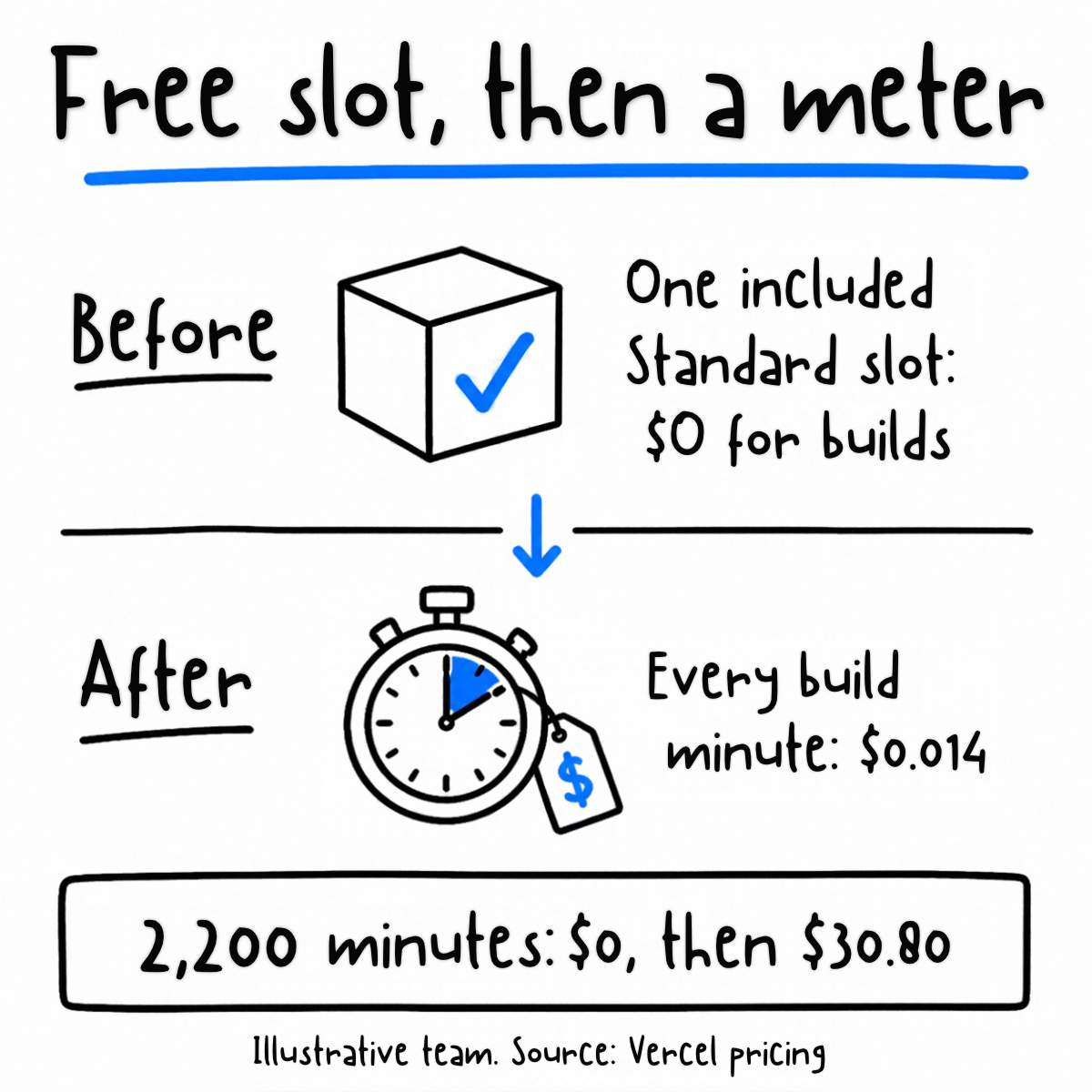
Vercel has told Pro customers that Standard builds are moving to usage-based billing at $0.014 a build minute. I’m a Pro customer, and the email reached me too. It says: “We are moving Standard builds for existing Pro teams to the same usage-based billing model as other build machines.” The monthly usage credit applies, so builds draw on the same $20 credit as everything else on the account.
The email gives no start date. Its words are “Your team will keep its included Standard build slot until billing starts,” and “We will email you before billing starts for your team, so you have time to review your build usage.” Vercel’s public changelog entry of 17 November covers new Pro and Enterprise teams only, and none of the entries I found, through 24 November, covers existing teams. The notice I received is the only statement I’ve found that does.
What Vercel has and hasn’t said
| Item | Where it stands |
|---|---|
| Price | $0.014 per build minute on Standard, in the email and on Vercel’s pricing page |
| Credit | The monthly usage credit applies. Pro’s credit is $20 and covers every metered resource, not only builds |
| Included slot | Kept until billing starts |
| Start date | Not given. Vercel says it will email first |
| Concurrency after the switch | Not stated |
| Public changelog | The 17 November entry covers new teams. No entry for existing teams |
What the included slot was
Vercel’s knowledge base says every account gets a single concurrent build slot by default, which means one deployment builds at a time. The same guide, last dated November 2025, lists Pro at up to 12. The Standard machine has 4 vCPUs and 8 GB of memory, and until now the slot ran those builds without a per-minute charge.
Vercel’s own pages describe the old rule in two ways. A version of its pricing docs that I read says builds on Standard machines are “only billed when on-demand concurrency is enabled or Elastic build machines are selected.” Its Managing Builds page says projects have on-demand concurrent builds enabled by default, and that you are billed for the CPU minutes you use. A team that already runs Elastic machines or on-demand concurrency is already paying per minute. The email changes the most for a team that builds in its one included slot and queues the rest.
The price in context
| Machine | vCPUs | Per build minute |
|---|---|---|
| Basic | 2 | $0.007 |
| Standard | 4 | $0.014 |
| Enhanced | 8 | $0.028 |
| Turbo | 30 | $0.105 |
| Elastic | 4 to 30, auto-scaled | $0.0035 per CPU minute |
Every machine costs the same $0.0035 per vCPU minute, so Standard’s $0.014 is four vCPUs for one minute. Billable time is build plus post-build time, rounded up to the next whole minute. A build that runs 61 seconds is billed as two minutes, or $0.028.
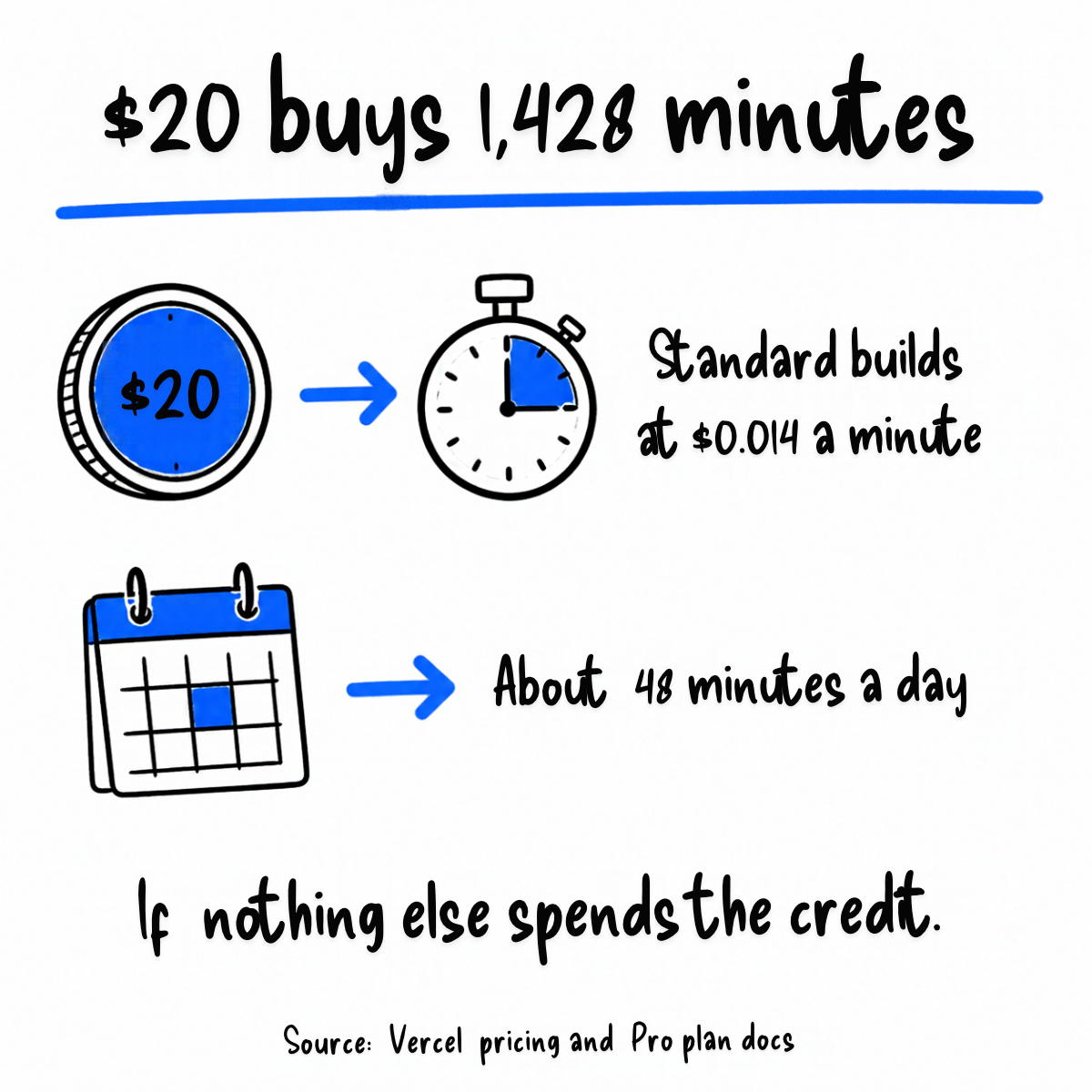
The $20 credit expires at the end of each month and covers functions, bandwidth and every other metered resource. If nothing else touches it, $20 pays for 1,428 Standard minutes, about 48 a day across a 30-day month. Every dollar spent on something else leaves less for builds.
Before and after: four teams
Vercel hasn’t published usage profiles, so these are mine. Each assumes the Standard machine, whole-minute rounding and the $0.014 rate. “Before” is $0 for builds on the included slot. The right-hand columns show the extra bill if the credit is untouched, and if other usage has already spent $10 of it. Every number is illustrative and none is a Vercel figure.
| Profile | Builds a month | Minutes each | Minutes | Cost before credit | Extra bill, $20 credit free | Extra bill, $10 credit left |
|---|---|---|---|---|---|---|
| Solo developer | 120 | 2 | 240 | $3.36 | $0 | $0 |
| Small team | 550 | 4 | 2,200 | $30.80 | $10.80 | $20.80 |
| Busy monorepo | 1,320 | 6 | 7,920 | $110.88 | $90.88 | $100.88 |
| Agent-driven | 4,500 | 3 | 13,500 | $189.00 | $169.00 | $179.00 |
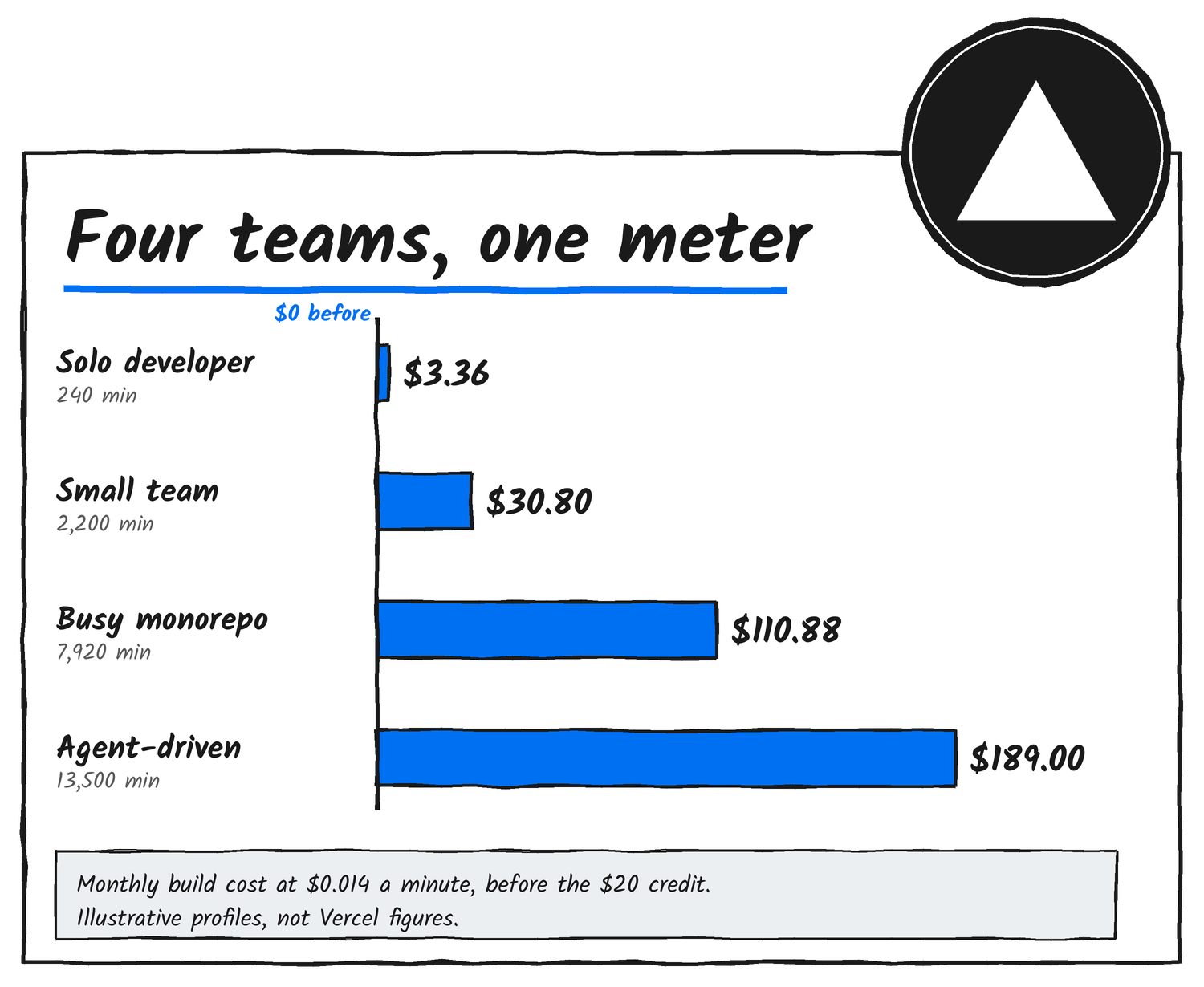
- Solo developer. About five builds a working day at two minutes each. The credit absorbs all $3.36, so the invoice doesn’t change.
- Small team. Five developers, 25 builds a working day across production and previews, four minutes each, 22 working days. That’s 2,200 minutes and $30.80. The credit covers most of it unless functions or bandwidth have spent it first.
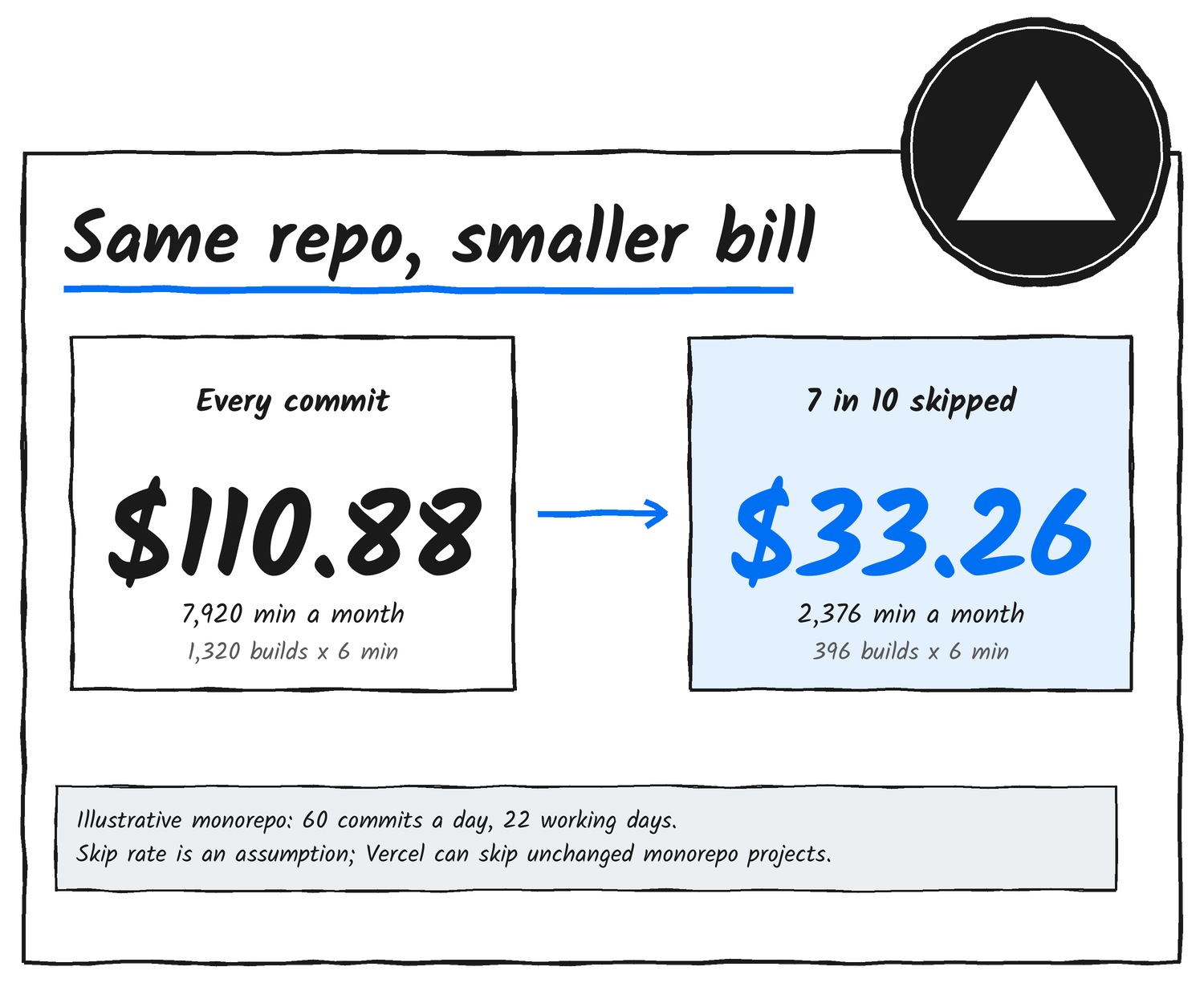
- Busy monorepo. Five apps, 60 builds a working day because one commit fans out to several projects, six minutes each. That’s 7,920 minutes and $110.88. This is the profile where skipping unchanged projects matters most.
- Agent-driven. Coding agents and bots pushing preview branches, 150 builds a day, every day of a 30-day month, three minutes each. That’s 13,500 minutes and $189.00, and the bill follows the agents’ output, not the team’s size.
The scenarios assume the team builds on Standard today without on-demand concurrency. A team that already pays for Elastic or on-demand builds sees no change in the minutes it’s billed for, so its “before” isn’t $0. Open Builds on the Usage page to see which side you’re on.
What happens to concurrency
The slot was also a limit. One slot means one build at a time, and extra commits wait. Vercel’s docs say Pro supports up to 500 concurrent deployments with on-demand concurrency, billed for the CPU minutes used. Vercel hasn’t said whether Standard builds keep any concurrency limit once they’re metered, or whether the one-build-at-a-time queue stays as a default. A team that has accepted queueing to avoid a bill should assume the queue is the part Vercel may change.
How to cut build minutes
Vercel’s own guide to reducing build costs frames it as three levers: run fewer builds, make each build shorter, or use fewer vCPUs. In the order I’d work through them:
- Find the heavy projects. Builds on the Usage page shows Build CPU Minutes by project. Start with the top two.
- Skip unaffected monorepo projects. Vercel skips builds automatically when a project’s source, internal dependencies and lockfile haven’t changed. Check that Skip deployment is on under Root Directory. Where it doesn’t fit, a custom Ignored Build Step can run
turbo query affected. - Preview pull requests only. Preview builds from branch pushes can make up most of a project’s builds. Set the Ignored Build Step to build previews only for pull requests, or turn off deployments for branches you never preview with
git.deploymentEnabled. - Tame bots and agents. Set on-demand concurrency to run up to one build per branch, so a burst of commits on one branch builds once.
- Stop rebuilding for content. A CMS webhook that calls a Deploy Hook on every publish creates a deployment each time. Revalidate content instead.
- Fix failures before redeploying. Vercel bills every redeploy of a failed build as a full build, and redeploys can’t read Turborepo Remote Cache artifacts.
- Shorten each build. Use filtered installs in a monorepo, return fewer paths from
generateStaticParams, and drop the--webpackflag if you’ve set it. Turbopack has been the default fornext buildsince Next.js 16, and Vercel’s guide says its release reported production builds 2 to 5 times faster. - Check the machine. A bigger machine saves money only if it cuts build time by at least as much as it adds vCPUs. A 3-minute build on Standard is 12 CPU minutes, and on Enhanced it must finish in 1 minute to cost less. Going the other way, Basic costs less than Standard unless the build takes more than twice as long on 2 vCPUs.
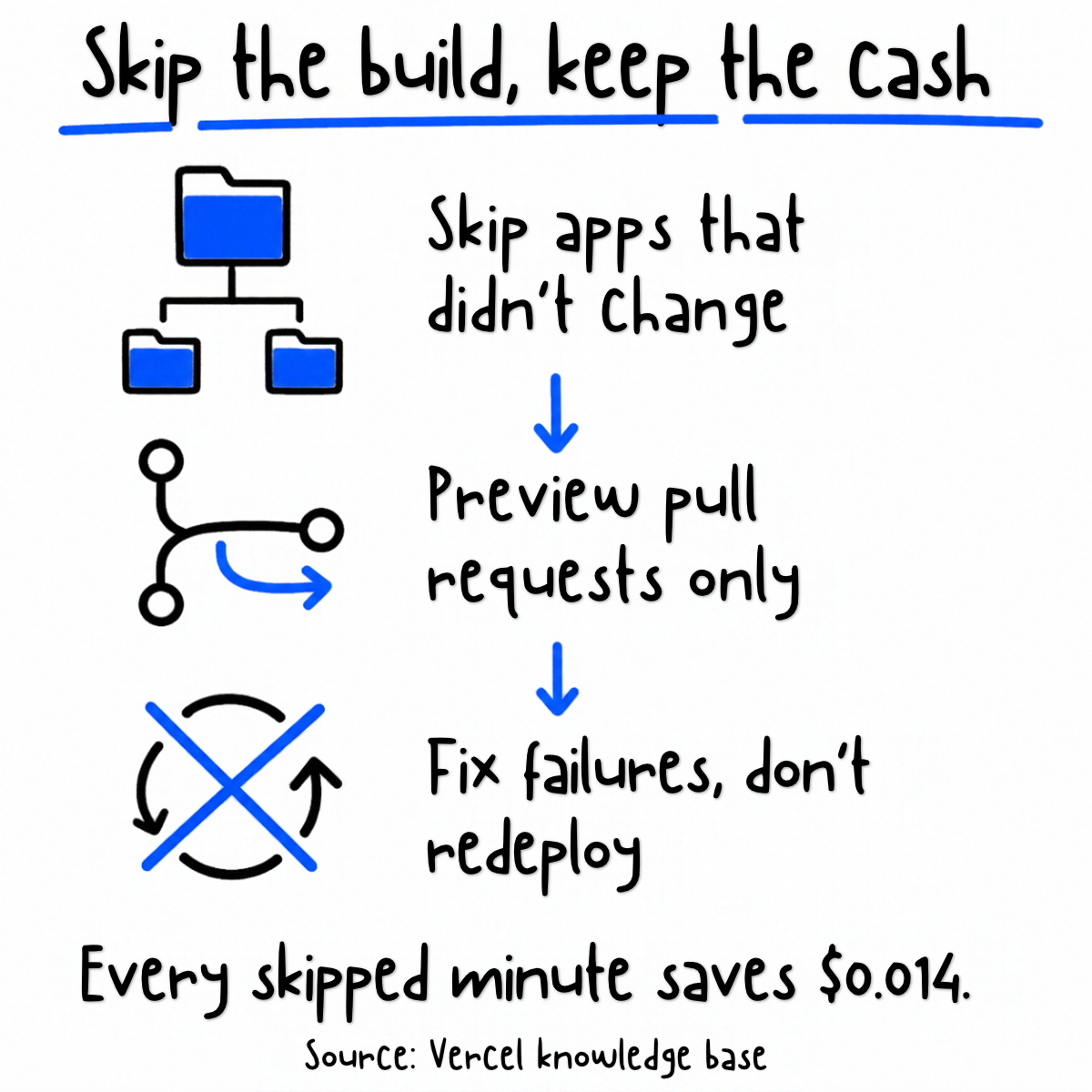
Applied to the profiles above, skipping 7 in 10 builds takes the monorepo from $110.88 to $33.26. Previews for pull requests only, plus one build per branch, would take the agent-driven team’s $189.00 to $75.60 if they cut 60% of its builds. Both cuts are assumptions, not measurements.
How the price compares with peers
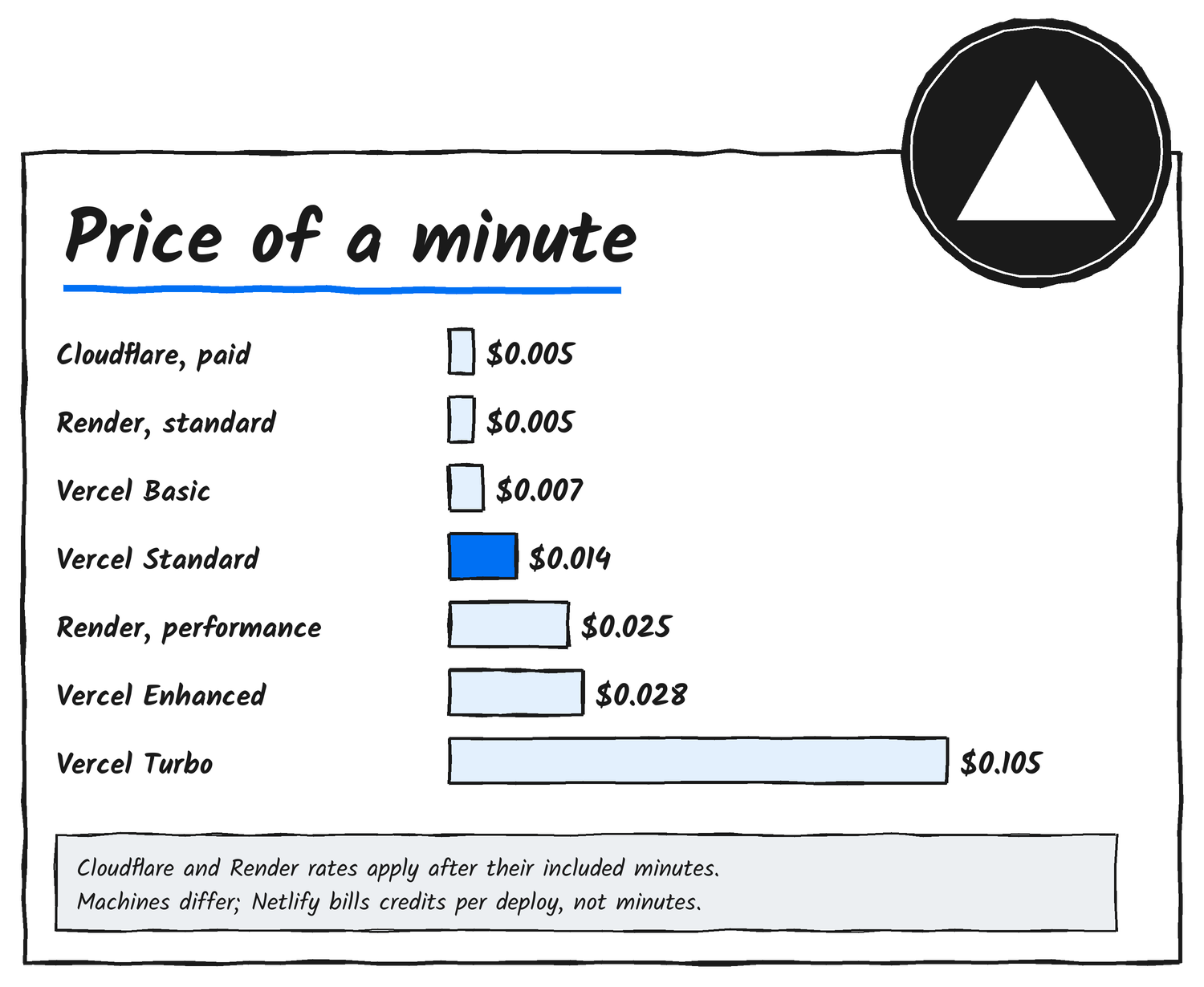
The hosts meter builds differently, so the fair comparison is the per-minute price after each host’s included allowance. Cloudflare and Render both charge $0.005 a minute past their included minutes, which makes their standard minute about a third of Vercel’s Standard. This table compares price, not machine speed, and leaves out each plan’s base fee.
| Host | Build meter | Included | Cost for 2,200 / 7,920 / 13,500 minutes |
|---|---|---|---|
| Vercel Pro, Standard | $0.014 a minute, 4 vCPUs | $20 credit shared with all usage | $30.80 / $110.88 / $189.00 before credit |
| Cloudflare Workers Builds, paid | $0.005 a minute, 4 vCPUs | 6,000 minutes | $0 / $9.60 / $37.50 |
| Render Pro, standard pipeline | $5 per 1,000 minutes | 1,000 minutes | $6.00 / $34.60 / $62.50 |
| Render Pro, performance pipeline | $25 per 1,000 minutes | None listed | $55.00 / $198.00 / $337.50 |
| Netlify credit plans | No build-minute meter; 15 credits per production deploy | Credits by plan | Not comparable by minute |
Cloudflare’s paid Workers Builds also allows 6 concurrent builds and a 20-minute timeout, against Vercel’s 45-minute build limit. Cloudflare’s separate Pages limits are 500 builds a month on Free, one at a time. Netlify’s billing FAQ says build minutes aren’t calculated as their own metric on credit-based plans, so a team deploying to production 20 times a month uses 300 credits, the whole of the Free plan’s allowance. Concurrent builds are a $40 add-on on Netlify’s Personal and Pro plans, and Netlify accounts created before 4 September 2025 can keep legacy plans.
Standard is a four-vCPU machine, as Cloudflare’s paid tier is, so the hardware comparison is like for like and Vercel’s price is nearly three times higher. Whether Vercel’s workflow is worth that gap is a call each team makes, and Vercel hasn’t made the case in its notice.
What to do this week
- Open Builds on the Usage page and note last month’s build minutes by project.
- Multiply Standard minutes by $0.014, or CPU minutes by $0.0035.
- Subtract the credit left after functions, bandwidth and everything else the credit covers.
- Check which machine each project uses, and whether on-demand concurrency is on. Both are billed per minute already.
- Set a Spend Management amount. New Pro teams get a $200 default, and Vercel’s docs say reaching it can optionally pause all projects.
- Make the cuts above before the start date arrives, so the first invoice reflects them.
What Vercel hasn’t said
- When billing starts for existing teams.
- Whether the one-build-at-a-time slot stays as a concurrency limit once Standard is metered.
- What the included slot was worth to each team, so a team can’t price the loss from Vercel’s pages alone.
- Whether the 17 November changelog entry will be updated to cover existing teams.
My read, not Vercel’s: the moves point one way. Hobby keeps the Basic machine included, new teams lost the Standard slot on 17 November, and existing Pro teams are next. Vercel is moving every paid build onto one meter, and that makes a team’s build bill a number it can steer.
Sources
- Vercel changelog: Standard builds move to usage-based billing for new teams, 17 November 2026
- Vercel pricing
- Pricing on Vercel (docs)
- Vercel docs: Managing builds
- Vercel docs: Pro plan
- Vercel Knowledge Base: How to reduce build costs on Vercel
- Vercel Knowledge Base: Why are my Vercel builds queued?
- Cloudflare: Workers Builds limits and pricing
- Cloudflare: Pages limits
- Render pricing
- Netlify: Billing FAQ for credit-based pricing plans
Disclosure: I’m a Vercel Pro customer.
Discover more from Sulat AI & Tech News
Subscribe to get the latest posts sent to your email.