Warp has released Warp Learn, a free course that walks you through building a software factory: a set of coding agents that take a request from an issue to a pull request you review. Warp announced it on 19 November and promoted it again on X on 24 November, US time. Two of its three units are live, nine lessons that Warp times at 2 hours 22 minutes in total.
The course, titled Build a self-improving software factory, teaches on Warp’s own Factories platform. It needs a Warp account, a GitHub organisation you own and a usage balance. The lessons are free; on Warp’s published pricing, the runs they start aren’t.
What the course teaches
Warp builds the course around a job title, the factory engineer. In Warp’s words, product engineering is the collaboration loop with an agent across planning and pull request review, and factory engineering is building the system of agents that builds the product. The factory engineer owns the cost of each unit of work, the quality of the code that comes out and the secrets, skills and MCP servers every agent can reach. The first lesson argues that agents now do most of the implementation, so the hard questions have moved to planning and review.
| Lesson | Time | What you do |
|---|---|---|
| Unit 1: What is factory engineering? | 5 min | Read the case for the role |
| Unit 1: What is a software factory? | 4 min | Learn the path from automations to the inner loop to the outer loop |
| Unit 1: Set up your factory | 15 min | Copy the Marky starter app, connect GitHub, create a factory and send it a first message |
| Unit 1: Tour the factory floor | 8 min | Walk through the files that define a factory |
| Unit 2: Hello factory | 15 min | Build one worker that turns a prompt into a pull request |
| Unit 2: Connect an issue backlog | 20 min | Let labelled GitHub issues start runs, using 10 sample issues |
| Unit 2: Route work with triage and specs | 25 min | Add triage and spec stages with a human approval gate |
| Unit 2: Add verification and merge risk | 20 min | Add video proof and a risk rating to every pull request |
| Unit 2: Close the loop with alert monitoring | 30 min | Let an error alert start a fix |
| Unit 3: Measure and improve | Coming soon | Scorers, self-improvement agents and benchmarks, per Warp’s blog |
How the build goes
Everything in the course is a file. A factory is a factory.yaml with a blueprint, a state machine of stages such as triage, spec, implement and handoff, beside folders for workers, stages, automations, runners and skills. Scorers and benchmarks, used in Unit 3, get their own folders. The schema line at the top of the file reads v1alpha2. The practice project is Marky, a markdown app you copy from a template repository on GitHub. Warp’s agents work on it in a cloud sandbox, so Node.js and pnpm are only needed to run it locally.
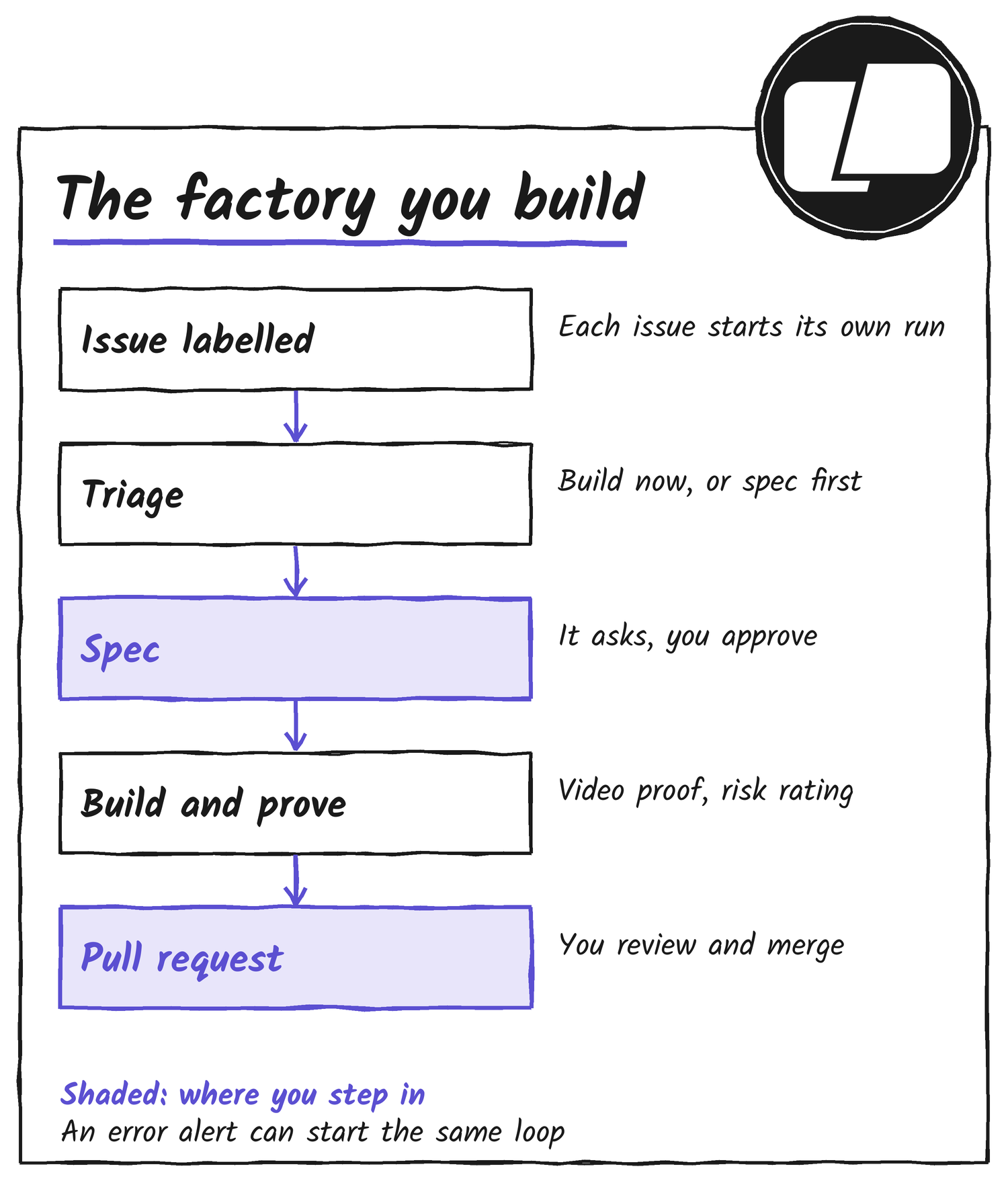
Unit 2 starts small. One worker takes a prompt, makes a change and opens a pull request, told to use static checks and skip computer use. The lesson then splits the job between a foreman, which handles intake and handoff, and a builder that writes the code. The second lesson adds the first automation: a file under automations/ that fires when a GitHub issue gets a label called factory. A seed script copies 10 sample issues into your repository and labels them, and each one starts its own run. Warp warns that issue text is untrusted, because anyone who can file an issue can write instructions in it, and says to restrict the label to maintainers on a public repository. Linear and Jira work too, with webhooks for anything else.
The third lesson is where people come in. A triage stage sorts each request into an answer, a change or unclear, rates its complexity and decides whether it needs a spec. A spec stage then interviews you through the foreman, puts its questions in one round, writes a spec document and opens a draft pull request for it. It loops back on every piece of feedback and only moves to implementation once you approve. Warp’s test case, a control to expand and collapse sidebar folders, went to spec and came back with questions, each carrying a recommended answer.
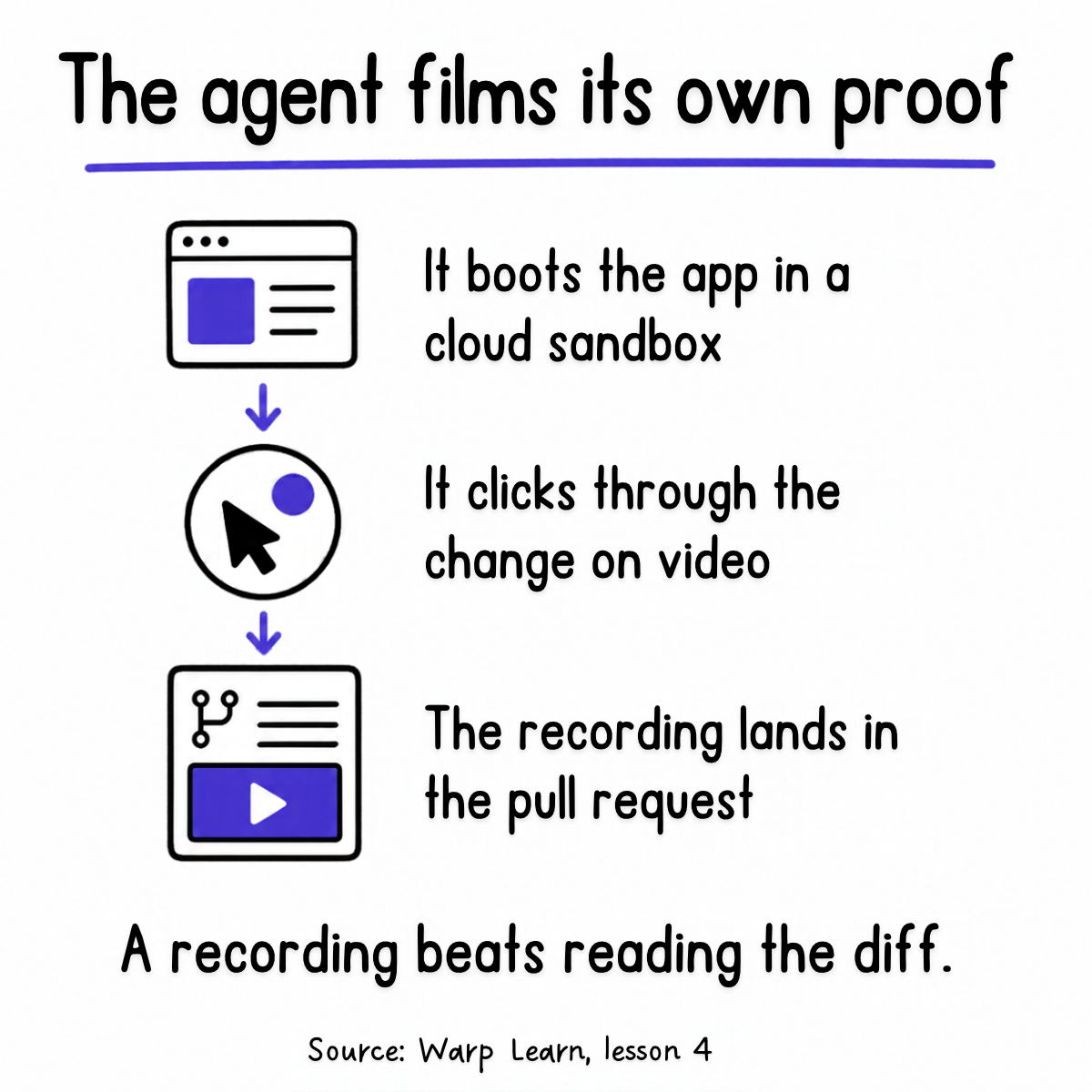
The fourth lesson adds two skills. The first, ui-verification, tells the worker to boot the app in its cloud sandbox with Chrome DevTools Protocol switched on, drive it with computer use, record a video and add a Visual proof section to the pull request description. Warp’s reasoning is that a recording says more than reading the CSS or the unit tests.
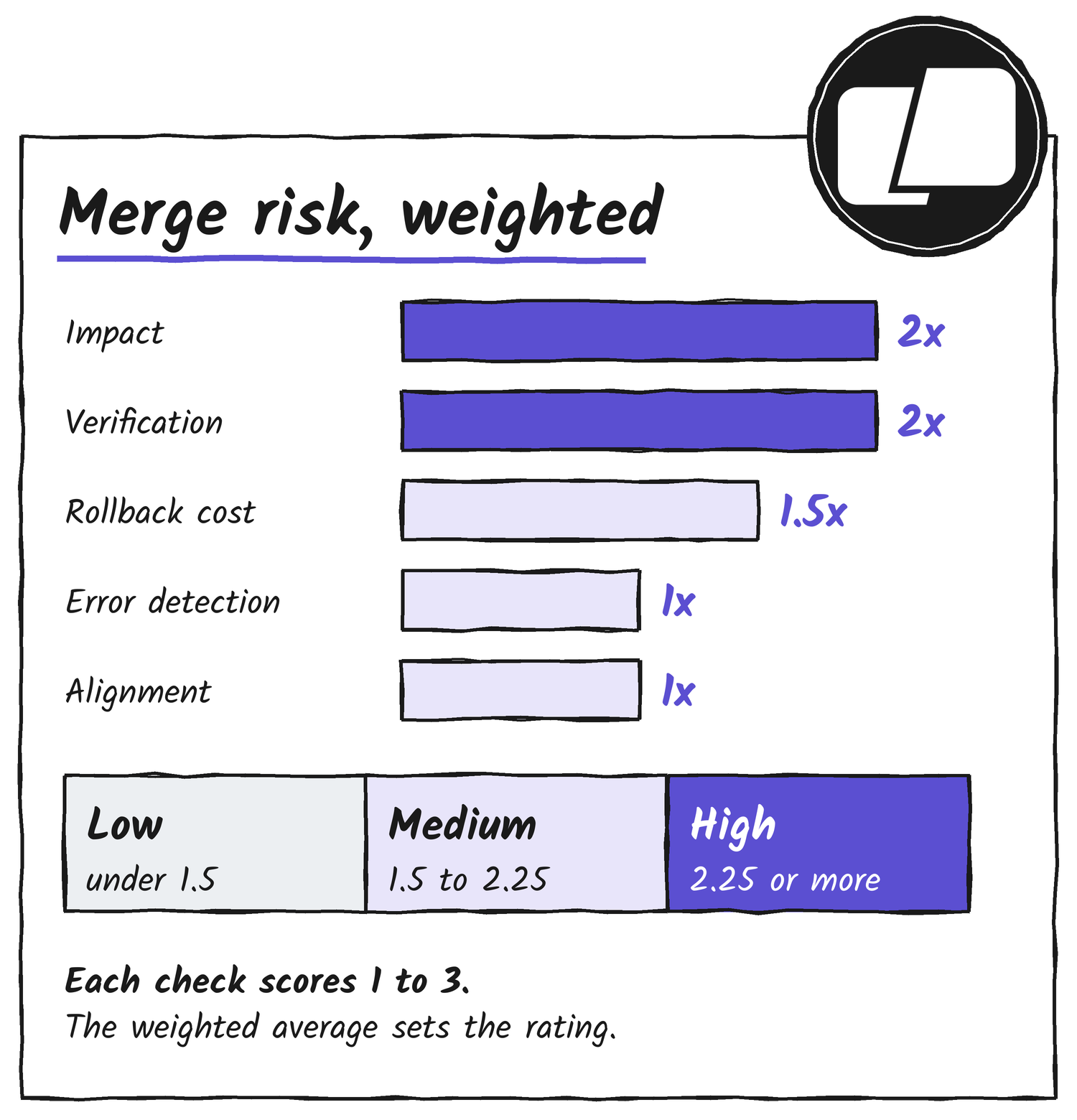
The second skill, merge-risk, rates every change on five checks: alignment with the issue, impact, verification, rollback cost and error detection. Impact and verification count double and rollback cost counts one and a half times. Each check scores from 1 to 3, and the weighted average sets a low, medium or high rating, with a cut-off of 1.5 for low and 2.25 for high. The pull request shows the rating, not the arithmetic.
Warp’s own run shows the check at work. The worker for the sidebar folders change ran on a Linux cloud runner, but the View menu it touched only renders on macOS, and the risk assessment flagged that as a verification gap. The fifth lesson then closes the loop. A mock error monitor on your machine reports a crash in Marky, a webhook with bearer-token authentication carries the alert to the factory, and triage reads the stack trace and opens a draft pull request with a fix. Warp says the same setup works with Sentry or Grafana.
What it needs, and what it costs
Setup in Unit 1 takes a Warp account, a GitHub account and an organisation you own, where you install the Warp Factories GitHub app. Warp says the whole course works with the “More cost-efficient” model preset, and it has you turn self-improvement off until Unit 3. The factory files in the lessons name the models glm-5.3-fireworks and glm-5.3-flash-fireworks.
Warp’s Factories pricing has three plans. Start is US$0 a month plus usage for up to 10 seats, with no included usage, inference at API rates and US$3.50 an agent hour for compute. Scale is US$250 a month per team for up to 50 seats, with US$150 of usage included and US$3 an agent hour. Enterprise is custom. Warp’s billing FAQ says the personal allowance on a Warp Terminal subscription doesn’t fund factory runs, which draw on shared team usage, and its quickstart lists available usage in your team’s balance as a prerequisite. A run with no balance can be blocked with an insufficient-credits error.
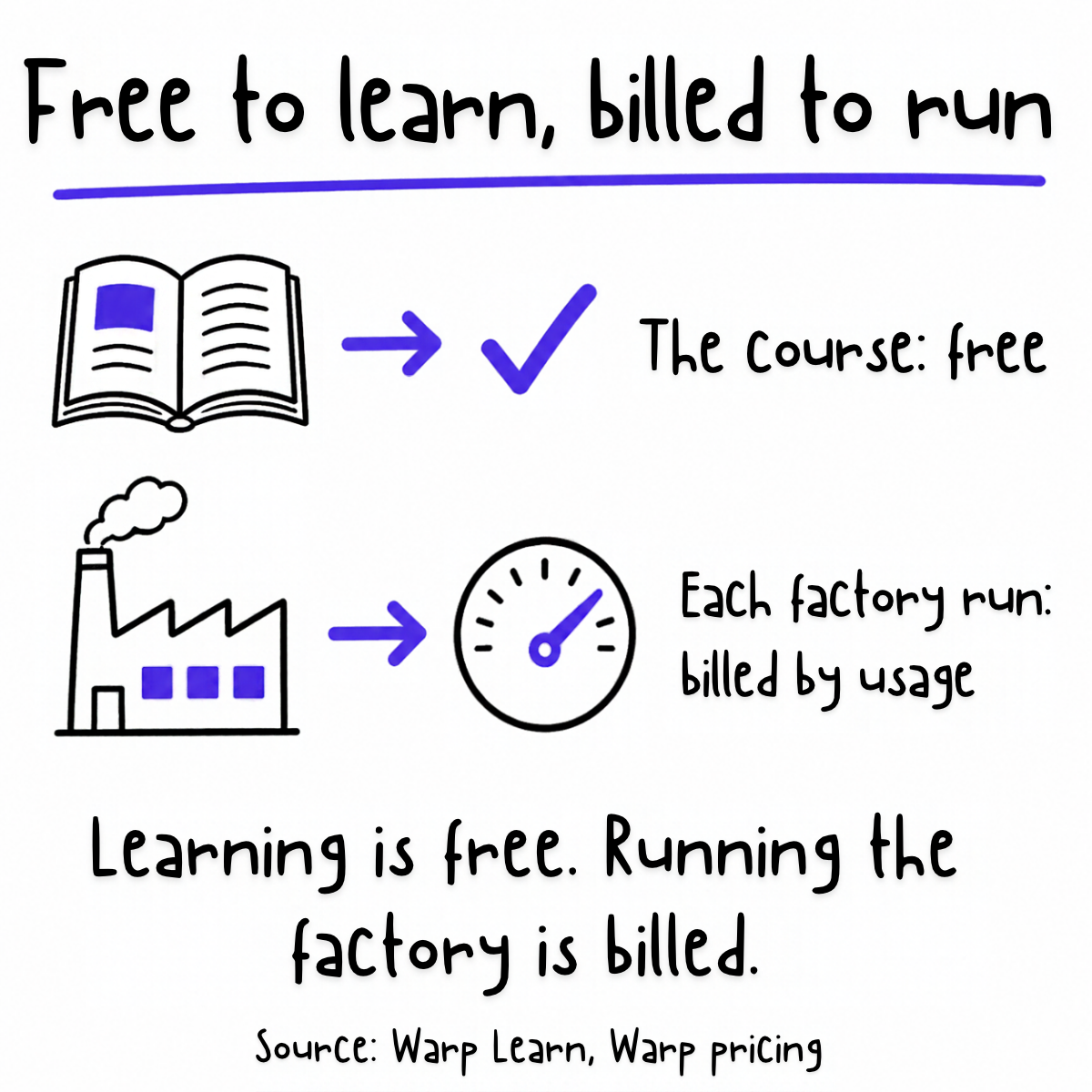
Neither the course pages nor the pricing page say what the nine lessons cost to run, and the backlog lesson alone starts 10 runs. Warp offers free Factories credits to teams of 10 or more engineers who book a call with a Factories specialist, and in August it offered qualified companies US$10,000 of factory use in the closed beta. Warp’s homepage still labels Factories “request access”, while the course setup sends you to a sign-in at platform.warp.dev.
How it compares with other courses
Teaching teams to run coding agents as a pipeline has become a small category. Warp Learn is free and built on one vendor’s platform. hackers&wizards runs its training in Claude Code, Codex, GitHub Copilot, Gemini CLI or Cursor, and a general agents course sits at the other end of the range.
| Course | Format and price | What it covers |
|---|---|---|
| Warp Learn | Free and self-paced; nine lessons live, Unit 3 coming; runs billed on Warp’s Factories plans | A backlog agent grown into triage, specs, verification, merge risk and alert monitoring on Warp Factories |
| Build a Software Factory (Maven; Matt Wynne, Aldric Giacomoni, David Laing, Jeremy Lightsmith) | Live cohort US$2,450, 12 January to 5 February 2027; self-paced US$995 in beta | Shaping work into iterations a factory can finish, a separate validator, a foreman, and simplifying a factory that stops converging |
| Agentic Software Factory (hackers&wizards) | Two-day team training; price not listed | A planner, refine and implement pipeline, adversarial plan review, capped review loops, a QA gate and orchestration |
| Build a software factory small enough to understand (LaunchDarkly) | Blog tutorial, 2 October 2026 | The layers from model gateways, agent registries, credential custody and cost tracking up to the agents, with humans setting goals and approving plans |
| Agentic AI (DeepLearning.AI, Andrew Ng) | 9 hours 55 minutes in Python; graded assignments and a certificate need PRO | Reflection, tool use, planning and multi-agent patterns, not software delivery in particular |
What sets Warp Learn apart is the lab. Its lessons have you create and run a factory in Warp’s own web app, so finishing the course leaves you with a working factory on Warp’s platform.
Other software factories
The idea isn’t new to Warp’s docs. Its platform page describes two loops. In the inner loop, triage, spec, implementation and reviewer agents turn an issue into a pull request for human review. In the outer loop, a scheduled agent reviews past runs, notes where maintainers made corrections and opens a pull request that updates the skill files behind the inner loop. The same page advises starting with one agent role, usually triage, and Warp’s open-source reference implementation, oz-for-oss, runs all four roles. Factory sells its Droid agents as the foundation of a software factory and routes each task to a model.
Elsewhere on Sulat, Motion applied the factory label to video channels, and Lauren Tan, whose Grok Bot team shipped 11,000 pull requests in a month, advises building foundations before a software factory.
About Warp
Warp is a New York company best known for its terminal. It raised a US$50 million Series B led by Sequoia Capital in June 2023. Zach Lloyd introduced Warp Factories on 18 August 2026 as open infrastructure for cloud software factories, in closed beta, and Warp’s pricing page now has separate tabs for Terminal and agents and for Factories.
Warp’s pages give no date for Unit 3, no cost for finishing the course and no count of people who’ve taken it. I read the pages for all nine lessons and haven’t run the factory myself. Warp’s next event is a webinar on 3 December, “Trust coding agents with formal verification”, on guardrails built from static analysis, end-to-end verification, property-based testing and TLA+.
Discover more from Sulat AI & Tech News
Subscribe to get the latest posts sent to your email.