
Anthropic put Skills over MCP into public beta in Claude and Claude Code on 24 November (US), the day the Model Context Protocol turned two. It also made two older MCP features, Tasks and Elicitation, generally available for Pro, Max and Ultra plans. A skill is a folder of instructions that tells Claude how to do a job well. Until now it reached Claude separately from the server it described. Now the server can carry it.
Boris Cherny of Anthropic’s Claude Code team flagged the launch on X, and the ClaudeDevs account opened a thread with “MCP turns two!” Anthropic’s own summary of the idea is the pull quote below.
Claude can work with a server more like it works with another agent: learning from it, delegating to it, and exchanging input and files along the way.
Anthropic, MCP servers can now ship skills, run tasks, and more with Claude, 24 November 2026
10,000+
connectors for Claude, by Anthropic’s count on 24 November
700M
monthly MCP SDK downloads, up from 100 million at the start of 2026
2,500+
unique contributors to the protocol, per the MCP project
100
skills per server that Claude Code will load
- What shipped
- Why a skill belongs in the server
- How it works
- What Claude Code does with it
- Tasks and Elicitation
- MCP at two
- Who else supports it
- What to do next
- What isn’t known yet
What shipped
Four things landed in one post. Skills over MCP is the headline, and it’s the only one still labelled beta. Tasks and Elicitation are described as generally available. File Uploads is next.
| Feature | Status | Who gets it | Named examples |
|---|---|---|---|
| Skills over MCP | Public beta in Claude and Claude Code | On by default for Pro, Max and Ultra; Team once an admin enables it; Enterprise coming soon | Shopify, HubSpot and Atlassian; Carta coming soon |
| Tasks | Generally available | Pro, Max and Ultra; rolling out to Team and Enterprise | ZoomInfo |
| Elicitation | Generally available | Pro, Max and Ultra; rolling out to Team and Enterprise | Supabase, Railway and GitHub |
| File Uploads | Rolling out soon | Not stated | Sends PDFs, spreadsheets and images to a server without passing through the context window |
Anthropic also says tool search cuts tool-definition context by more than 85% in setups with several servers. That’s its figure, and it matters here because skills load on demand in the same spirit: the model sees a short description first and pulls the rest only when the job calls for it.
Why a skill belongs in the server
Anthropic puts the gap plainly: “Tool names and descriptions tell Claude what a server can do, but don’t cover how to handle specific use cases.” A server can list its tools. It can’t easily say which of three similar tools to reach for first, or how a multi-step job should run. That knowledge used to live in a separate skill that a user had to find, install and keep current.
The pattern wasn’t new on 24 November. In an April post, Anthropic said providers such as Canva, Notion and Sentry were already listing a skill next to their connector, and that the community was working on an extension to deliver skills from the server itself. It described two patterns: bundle the skill and the connector as a plugin, or distribute the skill from the server. The second is what shipped.
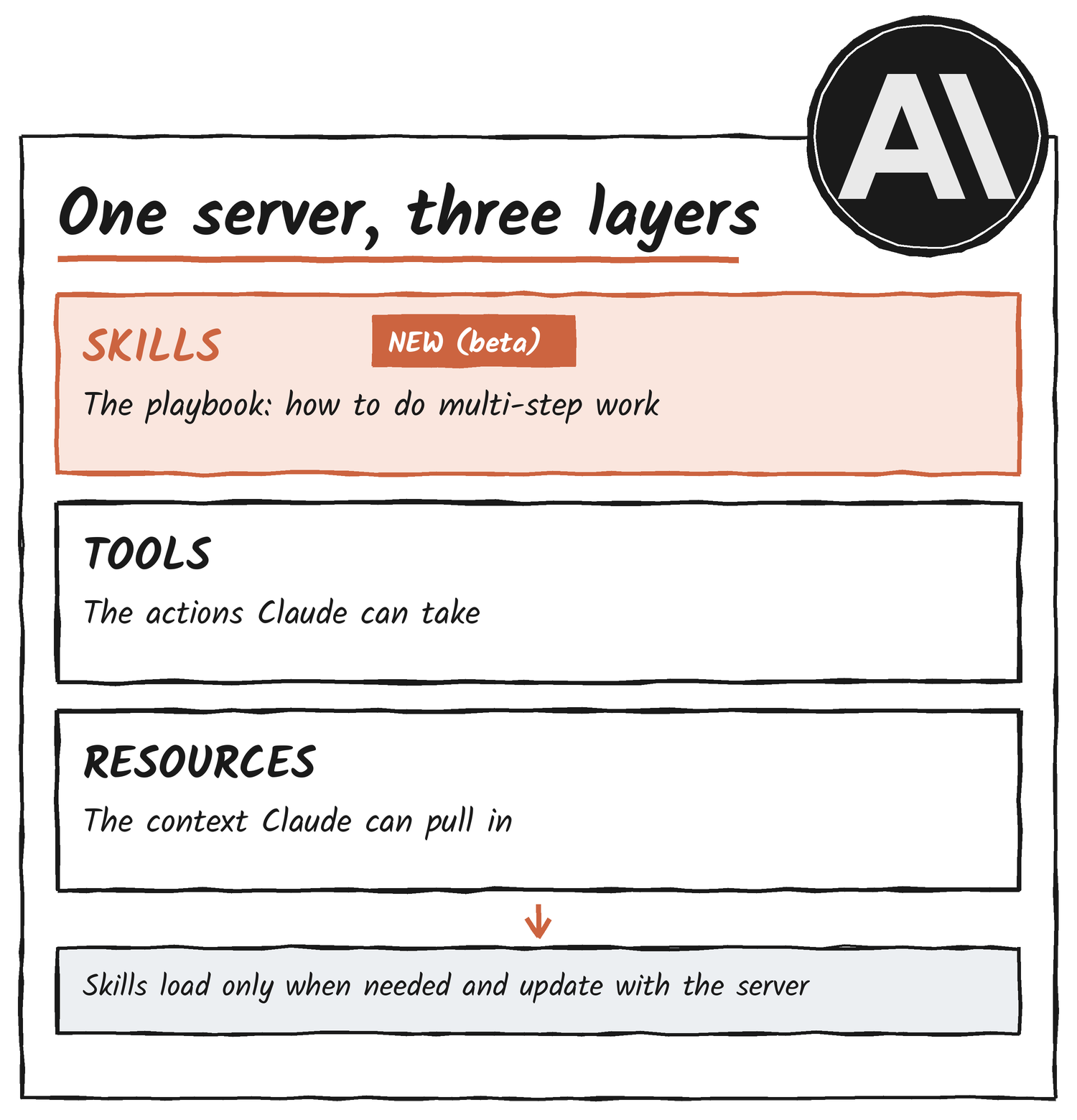
The protocol side is a formal extension. Its identifier is io.modelcontextprotocol/skills, the proposal behind it (SEP-2640) is marked Final, and it was created on 23 April and merged on 13 September. The authors are Peter Alexander, Ola Hungerford, Sambhav Kothari and Aditya Kumar, for the Skills Over MCP Working Group. The MCP project lists the extension as Beta and doesn’t say where it’s headed. Tasks, by comparison, is listed as “Beta, to Core”.
We’ve followed the pieces leading up to this. Tailscale’s Aperture already shares skills through Skills over MCP, and our Canva MCP deep dive covers one of the providers Anthropic named in April.
How it works
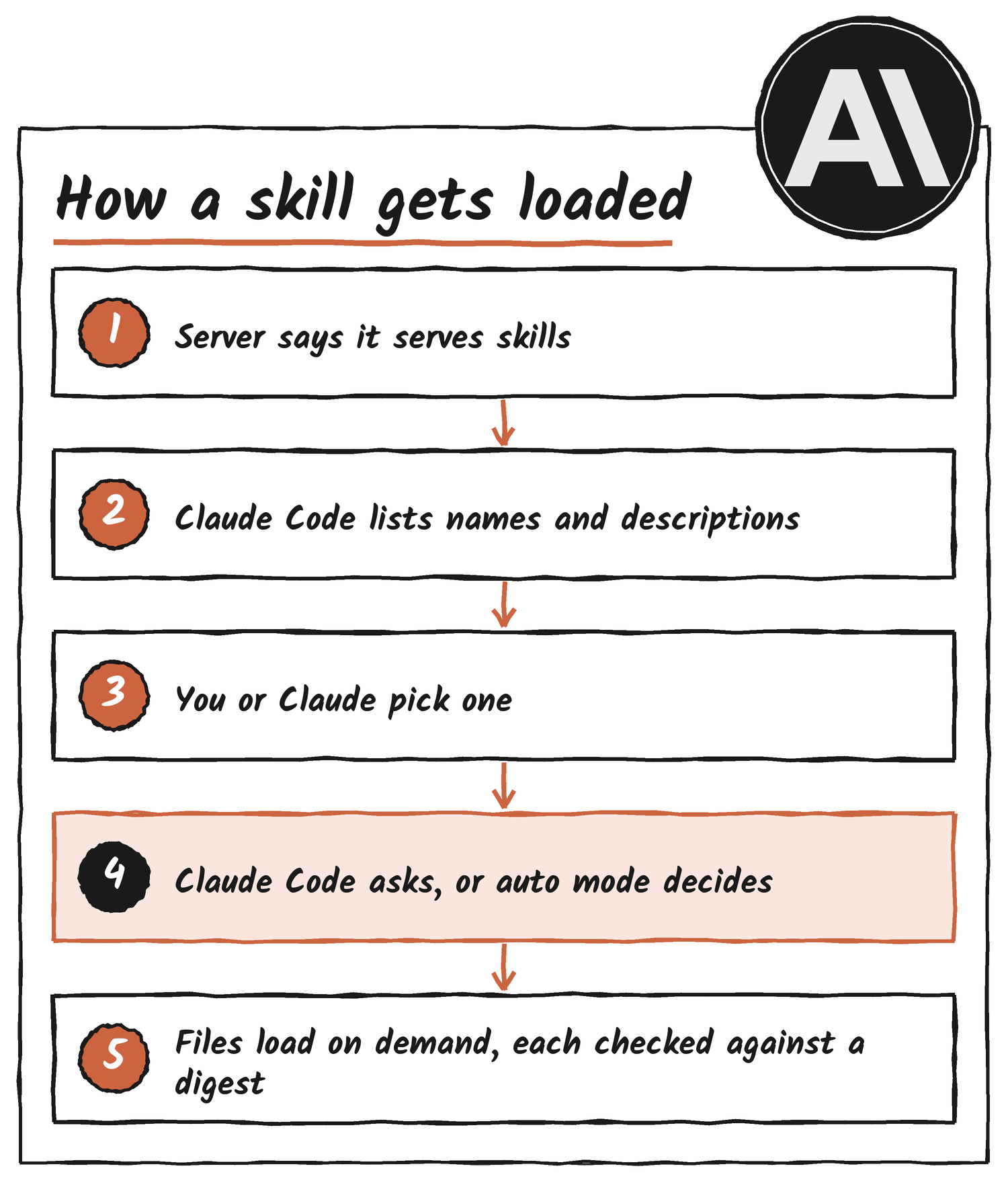
A skill is a directory with a SKILL.md file, following the Agent Skills specification. The server exposes it as resources under the skill:// scheme. A client discovers and fetches skills with three methods.
skills/list                  # what skills does this server offer?
skills/get                   # fetch one skill
resources/directory/read     # optional: read a skill's folder in one go

skill://...                  # URI scheme the skills are served under
Each entry in the server’s manifest carries a sha256 digest and a size. Hosts must verify them, and a user’s saved approval binds to the file addresses and their digests, so a changed file asks again. The spec is careful about what that proves. A digest shows the file matches the manifest. It doesn’t show the server deserves trust. Servers shouldn’t exceed 512 files or 16 MiB per skill.
The spec revision of 28 July also reshaped the ground underneath. The core protocol became stateless, Tasks moved out of core into its own extension, and Roots, Sampling and Logging were deprecated. Anyone building a server today is building against that revision.
What Claude Code does with it
Claude Code’s documentation is where the detail sits, and where the beta label shows. MCP skills need version 2.1.331 or later, which was published on 23 November, and a recent model: Fable, or Opus 4.8, Sonnet 5, Haiku 5.5 or later. A skill appears as <server>:<skill>, and a Claude connector’s skill is prefixed claude_ai_<Name>:skill. You invoke one with / or browse them in /skills.
Whether a skill loads without asking depends on the permission mode.
- Auto mode, the default: a classifier decides whether the skill loads, without reading it, and there’s no prompt.
- Manual and acceptEdits modes: Claude Code prompts. “Allow this version” skips the prompt until the server changes that skill’s files.
- Rules: permission rules can allow, ask or deny by pattern. An allow rule works only at user or managed scope, and needs 2.1.331 or later.
Skill(mcp__docs__*)    # works in deny, ask or allow
                       # allow: user or managed scope only
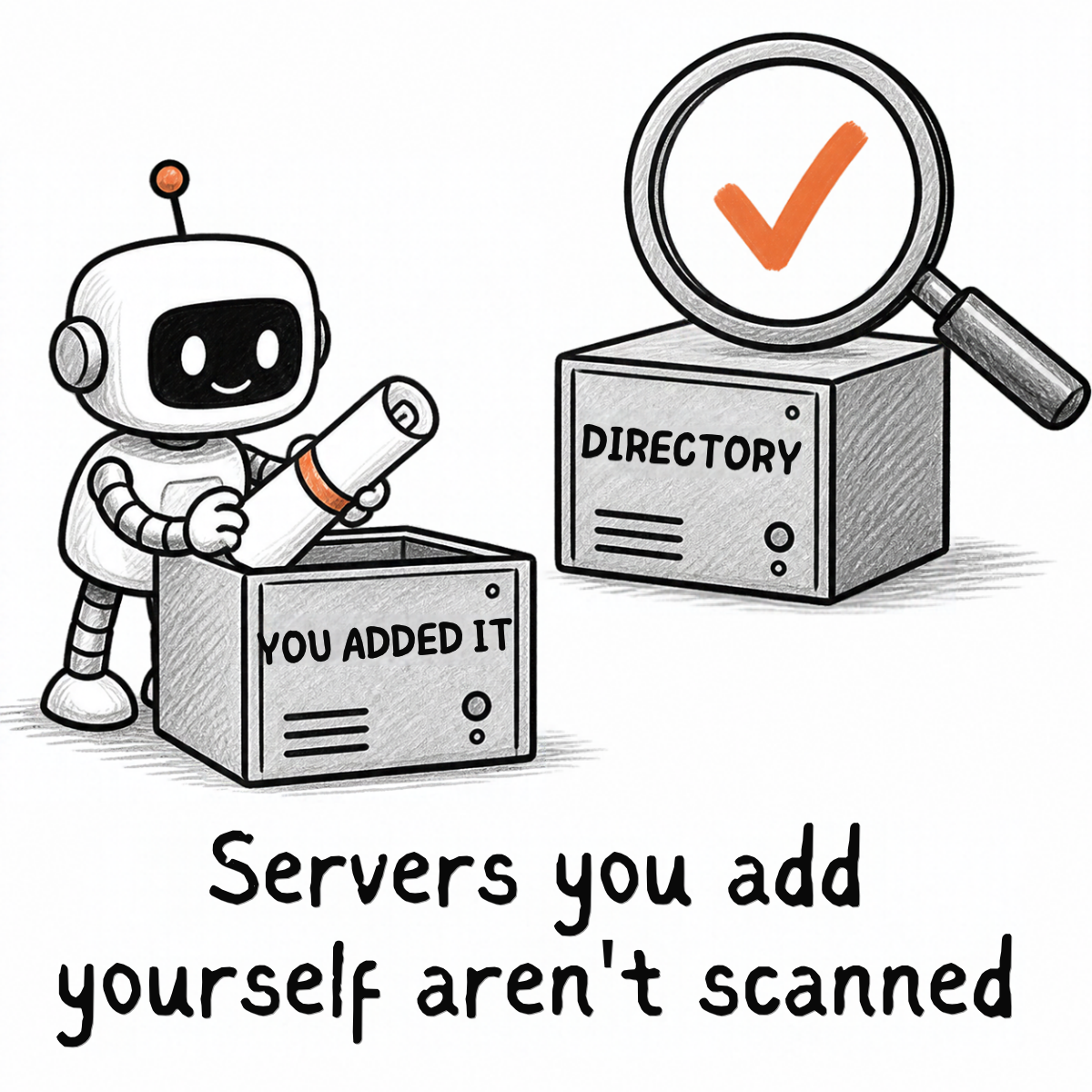
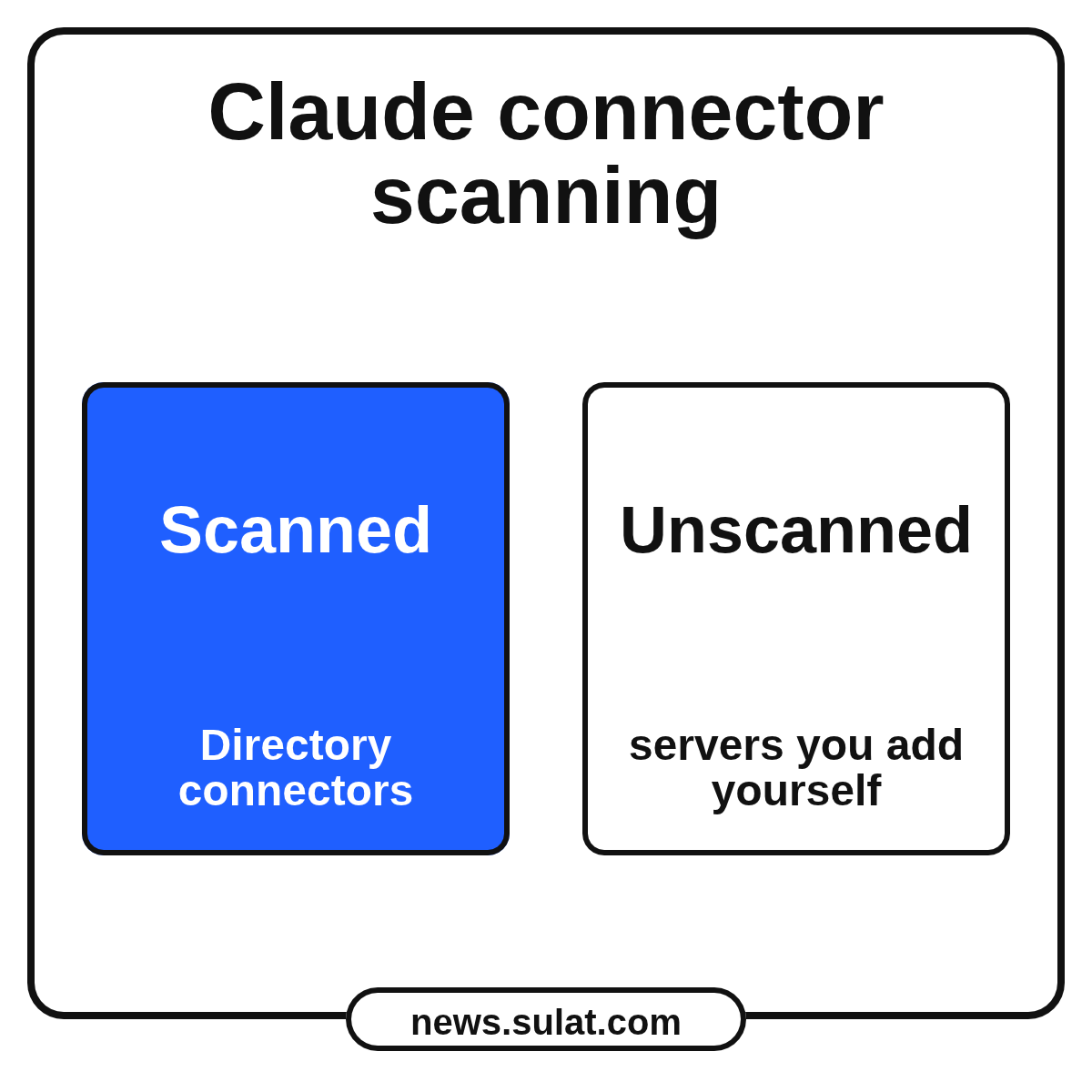
The risk is spelled out in the docs: “Skills can direct Claude to run code. Servers can change skills at any time. Add only servers you trust.” Anthropic scans skills only from third-party Directory connectors on claude.ai, and from custom connectors for Enterprise organisations that have scanning on. It doesn’t scan other connectors or servers, and that includes Directory servers you add yourself with claude mcp add. Pair that with an auto-mode default that loads without reading, and the “Allow this version” prompt in manual mode starts to look like the safer setting for any server you didn’t vet.
Limits are generous but real. A server can offer up to 100 skills. Scanned skills are capped at 100 KB per text file and 400 KB per skill, and archives or unusual binaries won’t load.
Who can switch it on
On Pro, Max and Ultra it’s on after /login. On Team and Enterprise it stays off until the organisation enables it: an Owner turns on Skills over MCP under Organization settings, Connectors, and the Skills setting must also be on. Servers other than claude.ai connectors additionally need the managed setting disableDirectMcpSkills set to false. Admins can restrict a connector to Ask or Blocked. Sign-in with an API key or the Console is described as “rolling out”, and with a token, key or Console login the claude.ai connectors don’t load at all.
Where it doesn’t work
Anthropic’s announcement says “public beta in Claude and Claude Code”. The Claude Code documentation is narrower.
| Where | MCP skills |
|---|---|
| Terminal (including JetBrains) and local Desktop app sessions | Supported |
| VS Code extension | Rolling out |
Cloud sessions, claude -p, claude remote-control server mode, GitHub Actions, the Agent SDK | Not supported |
Desktop connectors, Desktop extensions, servers in claude_desktop_config.json | Not supported |
Cloud providers, a custom ANTHROPIC_BASE_URL, apiKeyHelper, ANTHROPIC_AUTH_TOKEN | Not supported |
| Organisations with HIPAA or zero-data-retention settings (and CMEK for connectors) | Not supported |
| Anywhere feature-flag fetching is off | Not supported |
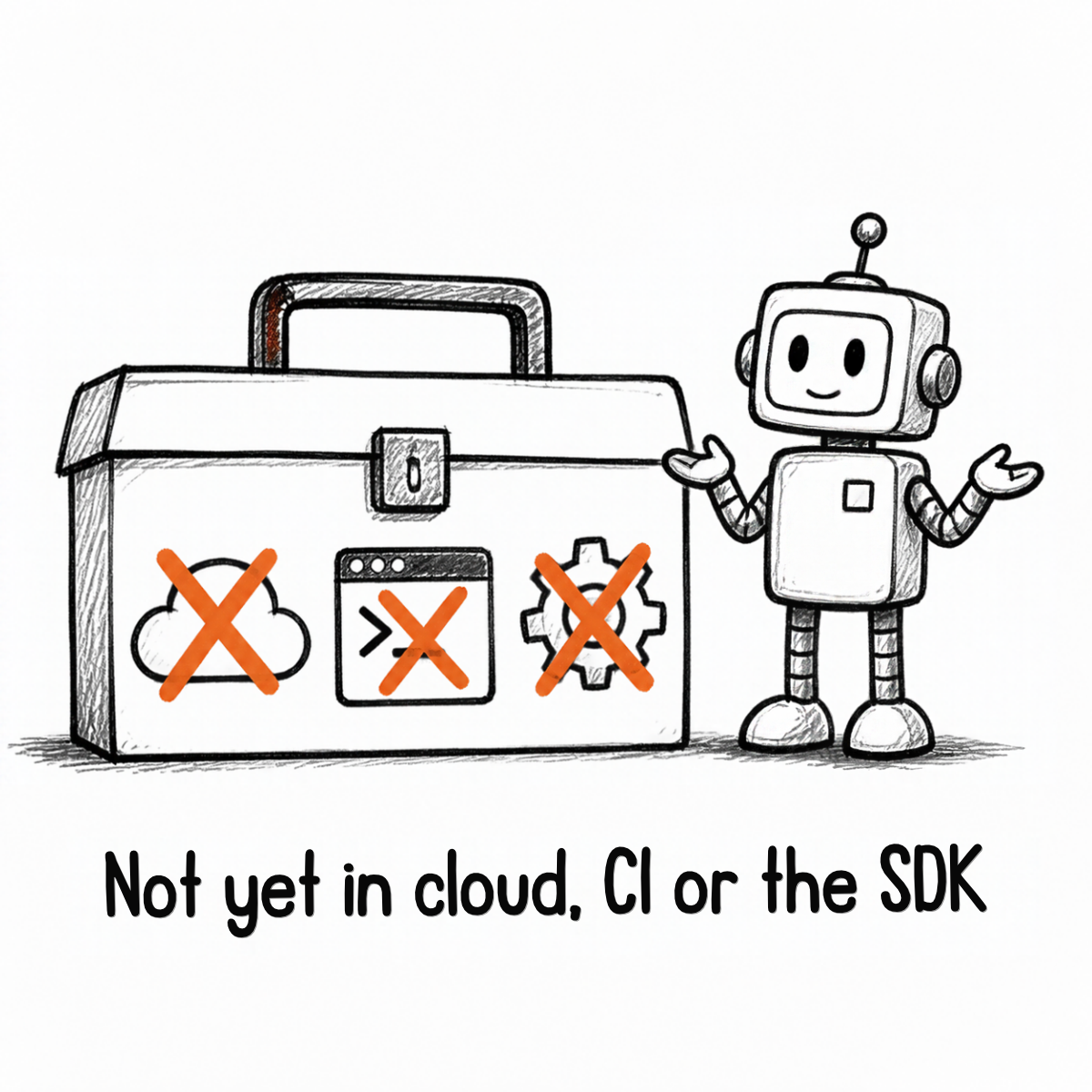
The compliance exclusions are the same line that ruled out Claude Ship a day earlier, and the safeguards on the other side of it are in our zero-data-retention report. Our earlier piece on Anthropic’s code execution with MCP covers a different way the company is trying to shrink what a tool-heavy setup costs in context.
Tasks and Elicitation
Tasks let a server accept a long job, hand back a handle and keep working while the conversation moves on. Elicitation lets a server stop and ask the user a question mid-job. Anthropic calls both generally available in Claude, and gives ZoomInfo as the Tasks example, and Supabase, Railway and GitHub for Elicitation.
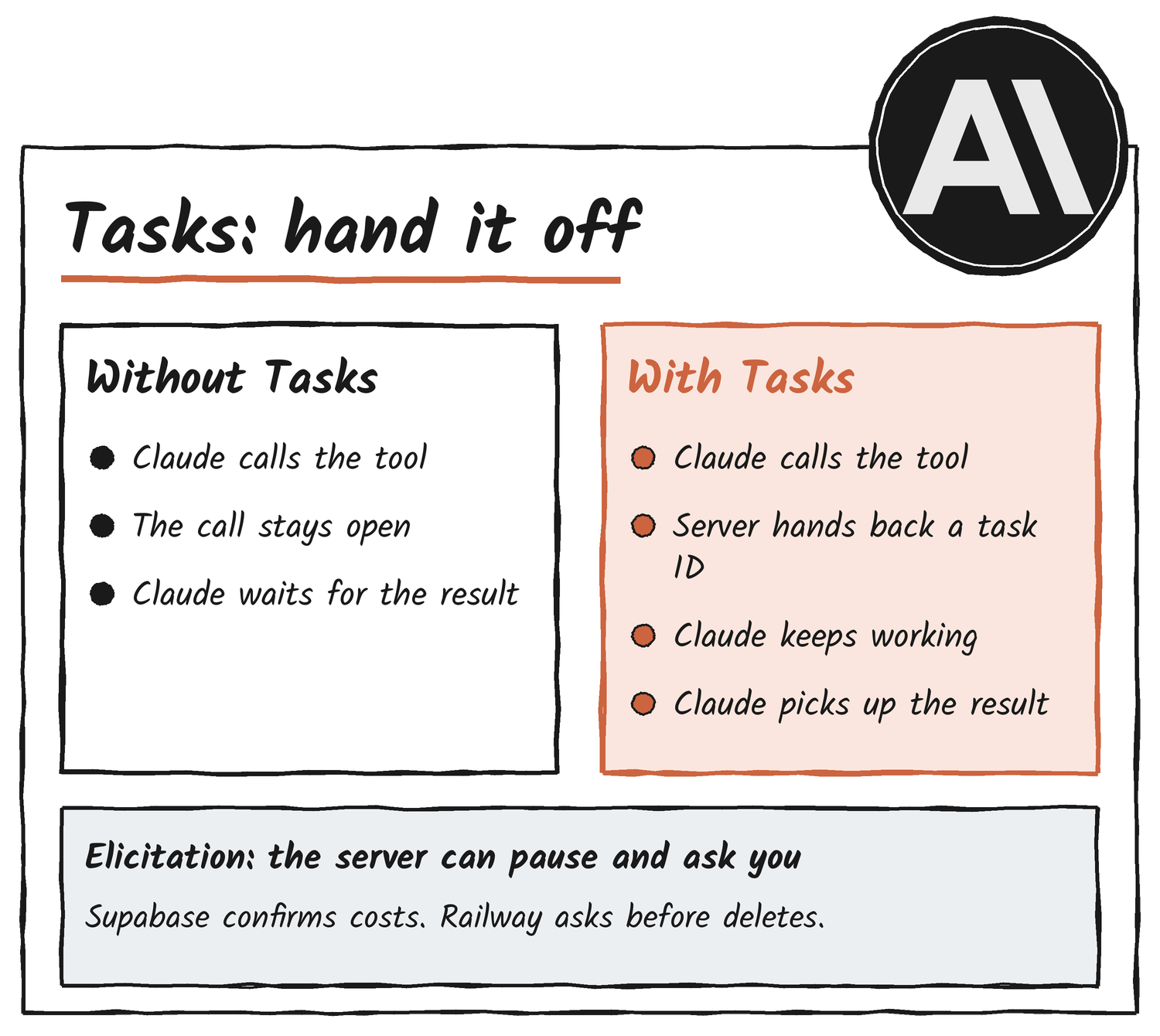
“Generally available” has two readings here. Anthropic means the feature is on for paid Claude plans. The MCP project’s own extensions page still lists Tasks as “Beta, to Core”, and Upstash’s blog said in October that Claude Code’s support was a public beta. Claude Code’s changelog adds tasks in the terminal on 6 November, in version 2.1.319, where a task moves to the background and the result is reported when it finishes.
Claude Code’s requirements for MCP tasks
Tasks need version 2.1.304 or later, protocol revision 2026-07-28 and feature-flag fetching, so Bedrock and similar setups are out. They work in the terminal, in Agent SDK sessions and in GitHub Actions (stream-json or interactive), and only in the main conversation, not in subagents. A one-shot claude -p "<prompt>" gets none. The poll interval is clamped between 250 and 30,000 milliseconds, with a default of 2,000. A task answer on an HTTP server has to start within the per-request timer. The footer shows “1 MCP task” while one runs, and /tasks lists them.
VS Code and the desktop app get tasks only if Anthropic has turned them on for the account. The documentation says neither shows a task’s question, and Claude Code asks the server to cancel the task unless an Elicitation hook accepts it. The task protocol itself changed in July: SEP-2663 moved it to the io.modelcontextprotocol/tasks extension, made it poll-based with tasks/get, added tasks/update and removed tasks/list.
MCP at two
Anthropic open-sourced MCP on 25 November 2024. In the project’s anniversary post, David Soria Parra recalls pitching the idea to Justin Spahr-Summers. Governance was formalised in July 2025, and MCP joined the Agentic AI Foundation in December 2025. The project counts more than 2,500 unique contributors, and says SDK downloads have passed 5 billion in total, 4.5 billion of them in the past year.
| Date | Monthly SDK downloads, per Anthropic |
|---|---|
| Start of 2026 | 100 million |
| 22 April | 300 million |
| 28 July | 400 million |
| 24 November | 700 million |
Be careful with the server counts. In April Anthropic spoke of “200+ servers in our directory”. In November it says “10,000+ connectors for Claude”. Those aren’t the same measure, so the jump from 200 to 10,000 isn’t growth in one number.
Agent Skills went the same way. It became an open standard on 18 December 2025 and was donated to the Agentic AI Foundation, according to Google’s Open Source Blog. Bloomberg has also published an engineering post, “Skills over MCP: How Bloomberg Helped Standardize Agent Skills at Scale”, dated 21 October. We could confirm only its title, so we haven’t drawn on what it says.
Who else supports it
Claude isn’t the only host. The MCP project keeps a community-maintained list of implementations, and on 25 November (NZ) it showed this.
| Host | Status | Notes |
|---|---|---|
| Claude Code | Public beta | See the limits above |
| VS Code with GitHub Copilot | Beta | On by default since 1.147, with per-server consent |
| Glean (client) | Beta | Admins import skills as a static snapshot |
| fast-agent | Beta | |
| MCP Inspector | Partial | Since 2.6.0; MCPJam Inspector and mcpc are in beta |
| opencode | In progress | Behind the mcp_skills flag |
| Hermes Agent | In progress | A community pull request |
| Cherry Studio | In progress | |
| Goose, Kilo Code | Planned | |
| Microsoft Agent Framework | Draft |
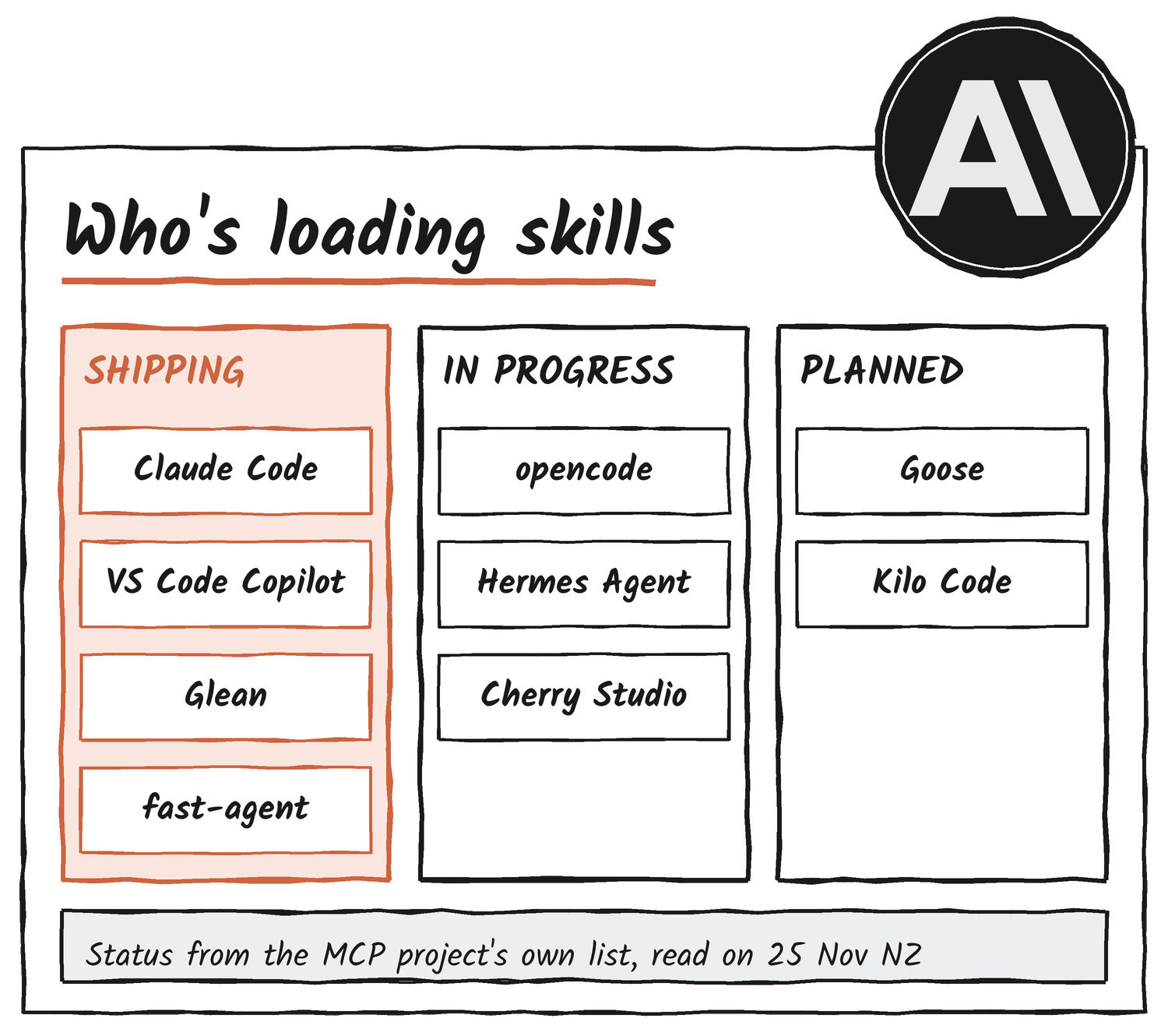
Microsoft’s side is worth a note. Pamela Fox described the VS Code support in a Microsoft blog post on 18 November, which gives its capability declaration and a sample skills/list entry, so a server author can test against a second host straight away.
| Server or SDK | Status |
|---|---|
| GitHub MCP Server | Opt-in since v2.2.0 |
| Cloudflare API MCP server | Serves the cloudflare/skills collection |
| Hugging Face (hf-mcp-server), Langfuse | Listed as supporting it |
| n8n | 2.46.0, behind a flag |
| Google MCP Toolbox | v1.16.0 |
| Outline | 1.11.0 |
| Context7 | Merged, not yet released |
| Supabase | Draft |
| Azure MCP Server, PostHog | Planned (PostHog serves skills through a tool today) |
| SDKs | TypeScript 2.4.0, C# 2.4.0, Rust rmcp 3.9.0, Ruby 1.9.0, FastMCP 4.2.0 (beta). Python merged but unreleased; Go, Java and PHP in progress; Kotlin planned |
The pattern is that servers and SDKs are ahead of hosts. Plenty of servers can serve skills, and fewer clients can load them. A server author shipping skills today reaches Claude Code, VS Code and a handful of others.
What to do next
If you run an MCP server
- Write one skill per job, not one per tool. A skill that says when to use three tools together is worth more than three that restate descriptions.
- Keep each skill well inside the limits: under 100 KB a text file and 400 KB a skill, so Anthropic’s scan will take it, and far below 512 files.
- Publish the digest and size for every file in the manifest. Hosts must check them.
- Remember that changing a skill’s files re-prompts users who chose “Allow this version”. Version your changes and say what moved.
- Test against both Claude Code (2.1.331 or later) and VS Code, since their approval behaviour differs.
If you administer Claude for a team
- Decide before the feature is on. Skills over MCP is off for Team and Enterprise until an Owner enables it.
- Restrict connectors you haven’t vetted to Ask, or block them. Unscanned servers can change a skill at any time.
- Set the managed setting
disableDirectMcpSkillsdeliberately. Leaving servers outside the claude.ai connector list on or off is a policy choice. - Check the exclusions against your compliance setup first. HIPAA and zero-data-retention organisations are out.
What isn’t known yet
Anthropic hasn’t given a date for Enterprise, or for File Uploads beyond “soon”. It hasn’t said when Skills over MCP leaves beta, and the MCP project doesn’t say whether the extension is headed for the core protocol. Nobody has published measurements of whether server-shipped skills make agents better at a job than skills installed separately. The claim is plausible and untested in public.
The sharpest open question is trust. The design lets a server change what Claude does next, and Anthropic’s scan covers only part of the connectors people will actually add. The docs’ own advice is to add only servers you trust.
Sources: Anthropic, MCP servers can now ship skills, run tasks, and more with Claude (24 November 2026) and its April 2026 post on skills and connectors; Claude Code documentation and changelog; MCP project, MCP turns two, Skills extension specification (SEP-2640), Tasks extension (SEP-2663), specification revision 2026-07-28 and community implementations list; Microsoft VS Code blog; Upstash blog; Google Open Source Blog; Boris Cherny and ClaudeDevs on X.
Discover more from Sulat AI & Tech News
Subscribe to get the latest posts sent to your email.