Synthetic has added Thinking Machines’ Inkling 2 Mini to its subscription and says the US$30 Standard plan now carries 3.45 billion tokens a month. The model isn’t new, since Thinking Machines released it on 20 November. The news is the hosting, and the quota depends on one line of small print in Synthetic’s announcement: that 90% of the tokens you use are cache hits. I read Synthetic’s pricing page on 26 November, redid its arithmetic, and checked its claims against Thinking Machines’ own tables.
Synthetic emailed its subscribers about the launch on 26 November. I’m treating the email as a lead and a vendor’s own claims, and I’ve tied each number below to a page I could read.
3.45B
tokens a month on Standard at 90% cache hits, per Synthetic
1.41B
the same plan with no cache hits, by my arithmetic from Synthetic’s rates
US$0.0087
average cost per million tokens at that mix, on plan rates
79.2%
Thinking Machines’ own SWE-bench Verified score, bash only
- What Synthetic announced
- The 90% cache-hit assumption, in plain English
- Checking Synthetic’s claims
- The model: 26B stored, 5.4B working
- Speed
- Where else you can run it
- Mini against the other models on the plan
- What isn’t published
- How to try it
What Synthetic announced
Synthetic runs open models in its own US and EU datacentres and sells them as flat monthly plans or per token. I covered its US$300 Bigger plan a week ago. This time the email says Inkling 2 Mini is on the subscription, in a tiny model that is “stronger at coding than the Opus 4.5 and 4.6 models from earlier this year” despite “only 27B parameters”. It lists four quotas, all per month:
| Plan | Price a month | Mini tokens a month, per Synthetic |
|---|---|---|
| Go | US$9 | Over 1 billion |
| Standard | US$30 | 3.45 billion |
| Big | US$90 | 10.3 billion |
| Bigger | US$300 | 34.5 billion |
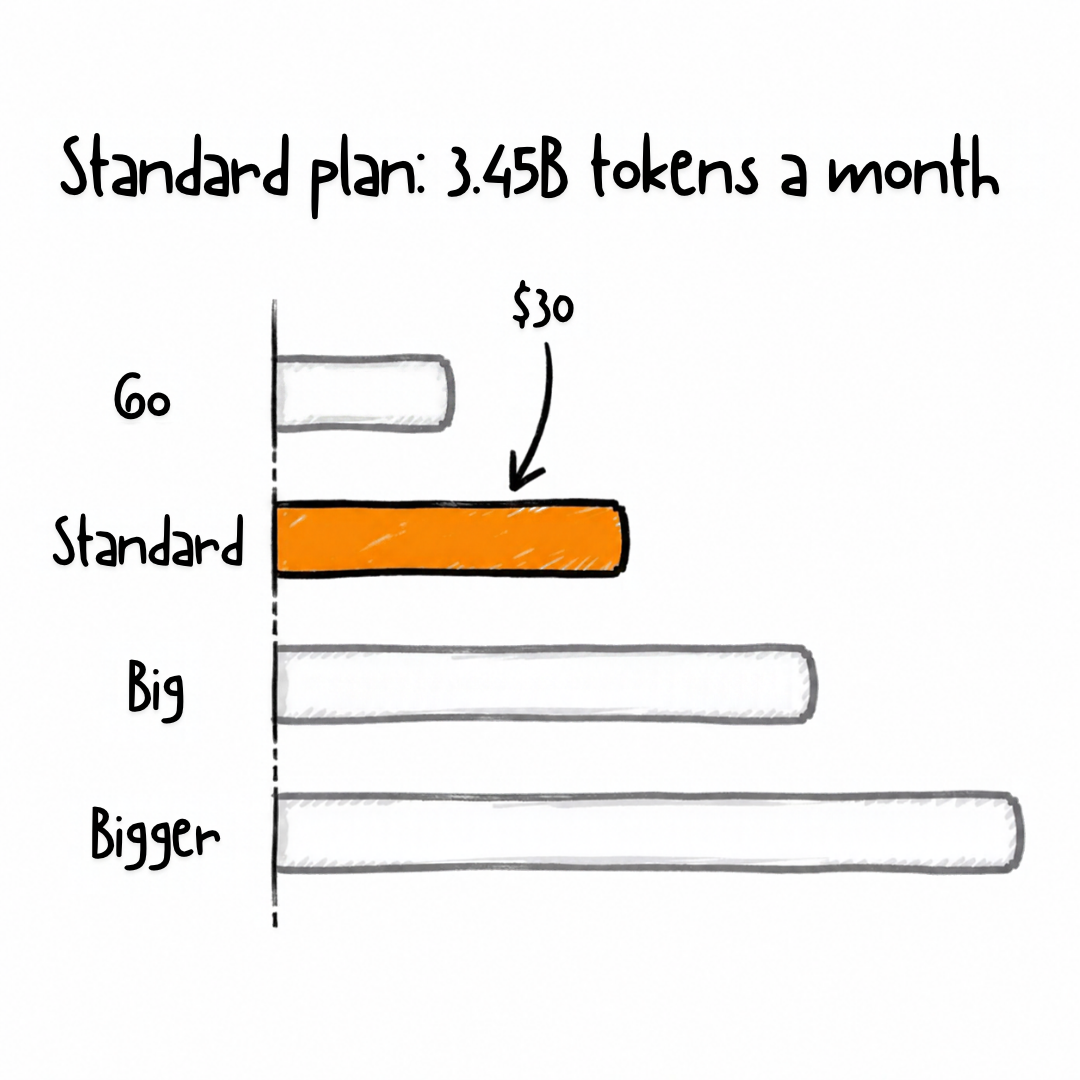
The tiers scale in a straight line, with Big and Bigger at three and ten times Standard. The pricing page also lists the same plan’s allowance for the other models, which I table further down. One oddity: a cached copy of Synthetic’s pricing page that I read first showed 2.86 billion tokens and about US$83 of API value for Mini on Standard. The live page and the email both show 3.45 billion and US$100, which is about 21% more. Synthetic hasn’t said what changed.
The 90% cache-hit assumption, in plain English
A model has no memory between messages, so a coding agent re-sends its whole conversation on every step. A provider can keep what it already read and charge much less to reuse it. A reused token is a cache hit, and a token it must read again is a miss. I explain the idea from scratch in my piece on Antigravity’s Neon cache.
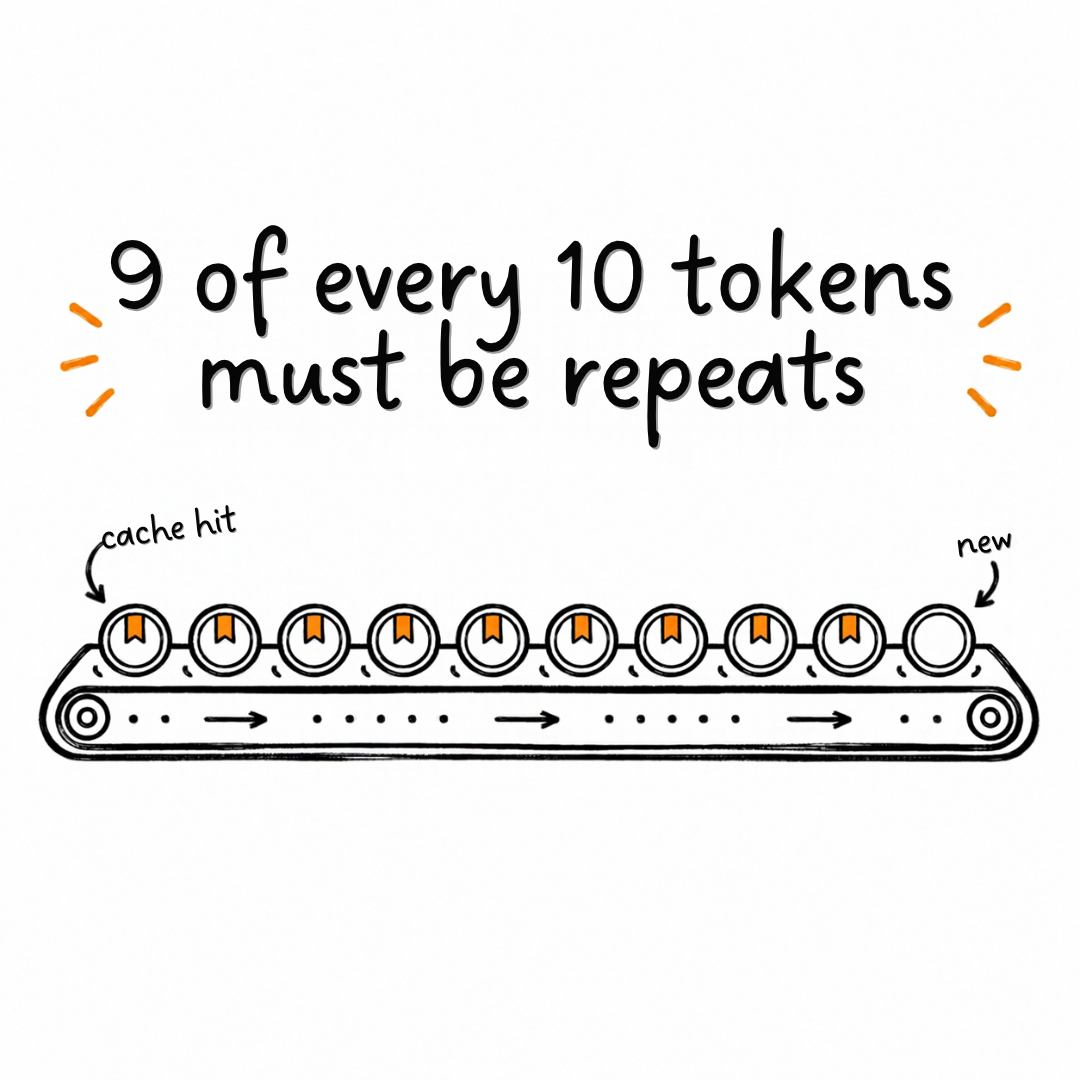
Synthetic’s quota is a dollar credit, not a token count. It spends the credit at its subscription rates and converts it into tokens using the 90/9/1 mix. Its rates for Mini are US$0.006 per million for a cached token, US$0.02 for fresh input and US$0.15 for output. At that mix a million tokens cost 0.9 × 0.006 + 0.09 × 0.02 + 0.01 × 0.15 = US$0.0087, and US$30 divided by that is 3.45 billion. Synthetic’s number checks out. It’s a result of the mix, though, and your mix is your own.
| Cache hit rate | Standard plan tokens a month | Share of headline |
|---|---|---|
| 95% | 3.75B | 109% |
| 90% (Synthetic’s assumption) | 3.45B | 100% |
| 80% | 2.97B | 86% |
| 50% | 2.10B | 61% |
| 0% | 1.41B | 41% |
The quota is less sensitive to cache misses than Neon’s, because Synthetic’s cached rate is 30% of its input rate rather than 5%. Even with no cache at all, Standard still gives 1.41 billion tokens. The headline is still a best case for the kind of workload Synthetic describes. I’d expect a coding agent in a long session to sit near the top of that table. A pile of short, unrelated prompts won’t, and neither will a session where you keep editing the top of the prompt. I found no cache lifetime or hit-rate figure for Mini on Synthetic’s pages, so I can’t say what a typical user sees.
The “tokens a month” figure also isn’t a monthly bucket you can empty in a day. The pricing page says the plan’s credits regenerate over the week. As I reported in the Bigger piece, the allowance refills 2% every 202 minutes, so the weekly limit is the one that bites.
What the plan is worth at list price
Synthetic’s pricing page lists Standard’s Mini allowance as worth US$100 a month at its usage-based prices (US$0.08 input, US$0.02 cached, US$0.40 output per million), and my arithmetic agrees at the 90/9/1 mix. For comparison, DeepInfra lists Mini at US$0.075 input, US$0.015 cached and US$0.30 output. At the same mix that is about US$0.023 per million, so 3.45 billion tokens would cost around US$80 there. That compares a capped plan with an uncapped per-token bill, so treat it as a rough yardstick and not a saving.
Checking Synthetic’s claims
| Claim in the email | What I found | Verdict |
|---|---|---|
| “Stronger at coding than the Opus 4.5 and 4.6 models” | Thinking Machines’ tables compare Mini with open models only (Qwen3.8-27B, Gemma 4 31B, Muse Glimmer, Nemotron 3.5 Super VL). Its 79.2% on SWE-bench Verified is below the 80.9% and 80.8% Anthropic reported for Opus 4.5 and 4.6. On Terminal Bench 2.1 its 71.6% is below the 78.2% quoted for Opus 4.6 on Qwen’s model card. Harnesses and settings differ, so none of these are like-for-like. | Not supported by any table I found |
| “Only 27B parameters” | 26.4B total, 3.4B active, 5.4B effective per token, per the model card. | Accurate |
| “Dominating effectively every coding benchmark for models of its size” | Thinking Machines reports Mini ahead on DeepSWE, SWE-bench Pro v2 Hard, SWE-bench Verified and SWE-bench Multilingual. It trails Qwen3.8-27B on Terminal Bench 2.1 (71.6% against 73.0%) and ties it on Terminal Bench 4.0 (5.6% each). All of it is the lab’s own reporting. | Mostly, not every one |
| Quotas of 3.45B, 10.3B and 34.5B tokens a month | Match the price list at the stated 90/9/1 mix (above). | Checks out, with the cache-hit caveat |
| About 300 tokens a second in fast mode and 150 in normal mode over 24 hours | Synthetic’s own averages. I found no outside measurement of Synthetic’s endpoint. | Vendor claim |
| “It can even generate 3D worlds and scenery” | The email credits AJ on X. The overlay on that image reads “Inkling-2-Mini Q4_K_M”, a quantised local build, and AJ’s post, as I read it, says it ran on an RTX 3090. It wasn’t produced on Synthetic’s hosting. | Real demo, but not of this service |
The Opus line is the one I’d treat with most care. It’s a plausible hope for a model that scores 79.2% on a hard coding test, but nobody has shown it, and the chart in Synthetic’s own email has no Opus row.
The model: 26B stored, 5.4B working
I covered the release in my 21 November piece, so here is the short version. Inkling 2 Mini is a looped transformer. It has 24 layers of weights and runs the middle 12 of them three times for every token, so each token goes through 48 layer applications. It’s a mixture-of-experts model that picks 8 of 128 experts per layer. The weights are about 20 GB in NVFP4 and MXFP8, the context window is 1 million tokens, it takes text and images, and the licence is Apache 2.0. Thinking Machines says it runs on a laptop.
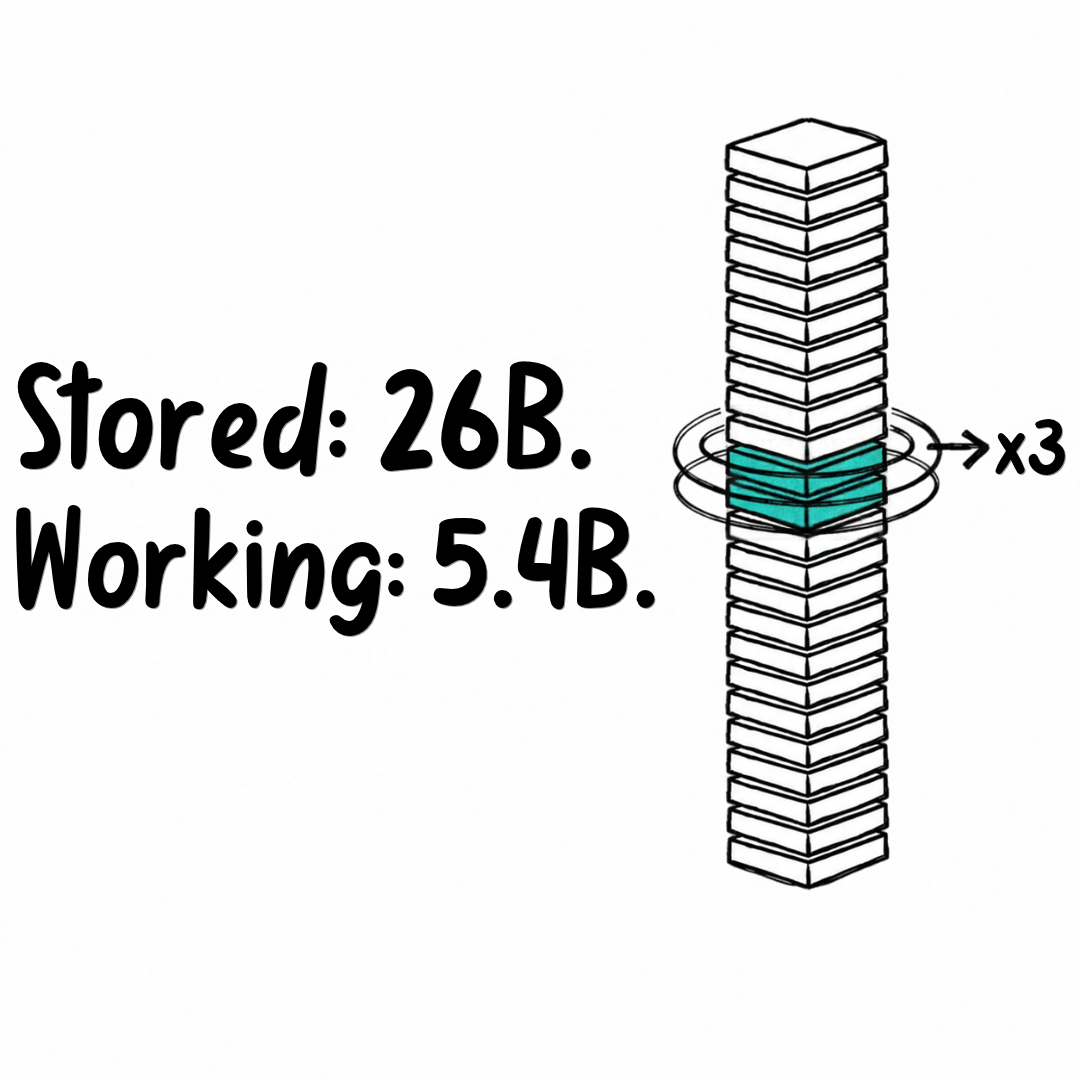
That design is why a host can quote big quotas. Each token touches about 5.4 billion parameters of work, and only 3.1 billion unique weights per text token, according to Artificial Analysis. Artificial Analysis, which is independent of the lab, scores Mini 20 on its Intelligence Index, level with Qwen3.8-27B. It measured about US$0.59 and 9.0 minutes per task for Mini against US$3.53 and 38.2 minutes for Qwen, though Mini used about 38% more output tokens for the same score. The cost figure uses Thinking Machines’ own first-party prices. Thinking Machines also lists weak spots: Qwen3.8-27B beats it at multi-turn chat and at instructions with many constraints, and it trails larger models on hard reasoning.
| Benchmark (Thinking Machines’ reporting) | Inkling 2 Mini | Qwen3.8-27B |
|---|---|---|
| SWE-bench Verified, bash only | 79.2% | 77.8% |
| SWE-bench Pro v2 (Hard) | 77.9% | 73.8% |
| DeepSWE v1.1 | 48.2% | 42.2% |
| Terminal Bench 2.1 | 71.6% | 73.0% |
| Artificial Analysis Intelligence Index v5.0 | 20.1 | 20.1 |
Speed
Speed depends heavily on who is serving the model, so the numbers don’t line up.
| Where | Tokens a second | Who measured it |
|---|---|---|
| Synthetic, fast mode | About 300 | Synthetic, 24-hour average |
| Synthetic, normal mode | About 150 | Synthetic, 24-hour average |
| Thinking Machines’ own endpoint | 200 | Artificial Analysis (sites quoting its data at other times give 261 and 280) |
| Prime Intellect | 95 | TKX, via the Hugging Face router |
| io.net | 117 | TKX, via the Hugging Face router |
| Mac Studio, local | About 210 | exo, as I reported on 22 November |
Synthetic’s 150 tokens a second in normal mode sits between the third-party figures. Its fast mode costs twice the limit for up to twice the speed, which is why the 300 figure comes with a price. The local number is the one I’d watch: exo’s report puts a quantised Mini at about 210 tokens a second on a Mac Studio, so renting speed from a host competes with owning a machine.
Where else you can run it
| Host | Input per 1M | Cached per 1M | Output per 1M | Billing |
|---|---|---|---|---|
| Synthetic, subscription rate | US$0.02 | US$0.006 | US$0.15 | Flat plan with a weekly credit limit |
| Synthetic, usage-based | US$0.08 | US$0.02 | US$0.40 | Per token |
| DeepInfra | US$0.075 | US$0.015 | US$0.30 | Per token |
| Prime Intellect, via OpenRouter | US$0.075 | US$0.015 | US$0.30 | Per token |
| io.net | US$0.12 | US$0.024 | US$0.50 | Per token, 262K context |
| Thinking Machines (Tinker) | US$0.15 | US$0.015 | US$0.50 | Per token |
Synthetic’s subscription rate is the lowest in the table, but you only get it on a plan, with a cap. Its usage-based price is in line with the market. I looked at OpenCode Go, Kilo’s list of coding plans and a coding-plan tracker for another flat-rate plan carrying Mini and found none. That isn’t proof there’s none, since these lists change daily. If you’d rather not rent it at all, Ollama’s preview build runs Mini on a Mac with 32 GB or more, per a Metarix write-up of 21 November.
Mini against the other models on the plan
| Model on Synthetic | Standard plan tokens a month | API value of that allowance |
|---|---|---|
| zai-org/GLM-4.7-Flash | 7.32B | US$234 |
| thinkingmachines/Inkling-2-Mini | 3.45B | US$100 |
| deepseek-ai/DeepSeek-V4.1-Flash-1017 | 2.70B | US$251 |
| zai-org/GLM-5.3-Flash | 1.02B | US$55 |
| Qwen/Qwen3.8-27B | 391M | US$56 |
| zai-org/GLM-5.3 (beta) | 248M | US$100 |
| moonshotai/Kimi-K3.1-Pro | 157M | US$72 |
Mini’s allowance is the second largest on the list, behind only GLM-4.7-Flash. On Standard you get about nine times as many Mini tokens as Qwen3.8-27B tokens (3.45 billion against 391 million) and 22 times as many as Kimi K3.1 Pro. That’s a count of tokens, not a statement about quality or work done, and Mini also spends about 38% more output tokens per task than Qwen. Cost per finished task is what matters, and nobody has measured that on Synthetic.
What isn’t published
- Any cache hit rate or cache lifetime for Mini on Synthetic, so the 90% is untested by anyone outside the company.
- Why the Standard quota moved from 2.86B to 3.45B between the cached page I read and the live one.
- An independent speed test of Synthetic’s Mini endpoint.
- Any head-to-head with Anthropic’s Opus models run in one harness, which is what the “stronger than Opus” line would need.
- Whether the weekly credit limit, not the monthly token figure, is what stops heavy users first. Synthetic says only that credits regenerate over the week.
How to try it
Synthetic exposes both an Anthropic-compatible and an OpenAI-compatible API, and addresses models as hf:owner/model. To point Claude Code at Mini, Synthetic’s docs give these settings:
export ANTHROPIC_BASE_URL=https://api.synthetic.new/anthropic
export ANTHROPIC_AUTH_TOKEN=${SYNTHETIC_API_KEY}
export ANTHROPIC_DEFAULT_SONNET_MODEL=hf:thinkingmachines/Inkling-2-Mini
export CLAUDE_CODE_DISABLE_NONESSENTIAL_TRAFFIC=1
export CLAUDE_CODE_ATTRIBUTION_HEADER=0- Check your own hit rate before you budget. The usage block of most APIs reports cached tokens, and cached divided by total input is your number.
- Keep stable text at the top of the prompt and new text last, so caches can match from the start.
- Cap output length and agent turns. The model card is said to warn about runaway reasoning, per Metarix, and an uncapped loop burns credits.
- Judge it on finished tasks per week of credit, not tokens. Run the same task on Mini and on your current model.


Terms used in this piece
- Token
- A chunk of text, roughly three-quarters of a word, that models read and write.
- Cache hit and miss
- A hit means the provider reused an earlier reading of your prompt at a lower price. A miss means it read the text again at full price.
- Looped transformer
- A model that runs some of its layers more than once for every token, adding compute without adding stored weights.
- Mixture of experts
- A design where each token is sent to only a few specialised sub-networks, so only part of the model works at a time.
- Active parameters
- The parameters used for one token, which is smaller than the total stored.
- NVFP4 and MXFP8
- Low-precision number formats that shrink the file and speed up inference.
- Quantised
- Stored at lower precision to save memory. Q4_K_M is a common 4-bit format for local runs.
- SWE-bench Verified
- A coding benchmark where a model fixes real software issues. Scores depend heavily on the harness.
Synthetic’s quota maths is sound and the model is a strong small coder on its maker’s own numbers. What the email hasn’t shown is the Opus comparison or a cache hit rate, and those are the two figures that would tell a buyer whether 3.45 billion tokens is a floor or a ceiling.
If you’re new to Synthetic, my referral link takes up to US$10 off your first month.
Disclosure: I’m a Synthetic affiliate and earn a commission on signups through that link.
Sources
- Synthetic’s announcement email to subscribers, 26 November 2026
- Synthetic pricing and model pricing, read 26 November 2026
- Synthetic API docs
- Introducing Inkling 2 Mini, Thinking Machines Lab, 20 November 2026
- Inkling 2 Mini model card and Hugging Face page
- Artificial Analysis on Inkling 2 Mini, 20 November 2026
- DeepInfra, OpenRouter, TKX and token.app listings
- Metarix, Inkling 2 Mini benchmarks, 21 November 2026
Discover more from Sulat AI & Tech News
Subscribe to get the latest posts sent to your email.