Synthetic has added a fourth subscription tier, Bigger, at US$300 a month. It carries 10 times the usage of the US$30 Standard plan and 5 times the infinite-mode concurrency of the US$90 Big plan. The same announcement lifts every plan’s Kimi K3.1 Pro quota by about 30%.
Matt, who founded Synthetic, posted both changes in the company’s Discord announcements channel on 19 November. The quota rise comes from work by Billy on the Kimi K3.1 Pro inference stack, which Matt says is “more optimized now”. The Bigger plan answers a request Synthetic says it kept hearing: “many people have asked for an even bigger plan than the Big plan. so we’re launching one.”
What the Bigger plan includes
Synthetic’s pricing page describes Bigger as “the biggest token limit for the biggest projects”. It has the same feature list as Big, plus 5x concurrent infinite mode: discounted models, the web search API, beta models, higher priority access, one usage reset a month, fast mode and infinite mode, both still in beta. Usage beyond the plan is billed at API pricing.
Matt’s two headline numbers are 27 billion tokens a month on DeepSeek V4.1 Flash 1017 and 1.57 billion on Kimi K3.1 Pro, both measured at a 90/9/1 mix of cache hits, cache misses and output. In other words, 90% of the tokens are repeated context the provider has already cached, 9% are fresh input and 1% is the model’s reply. That’s a typical shape for a coding agent, which re-sends most of its context on every step.
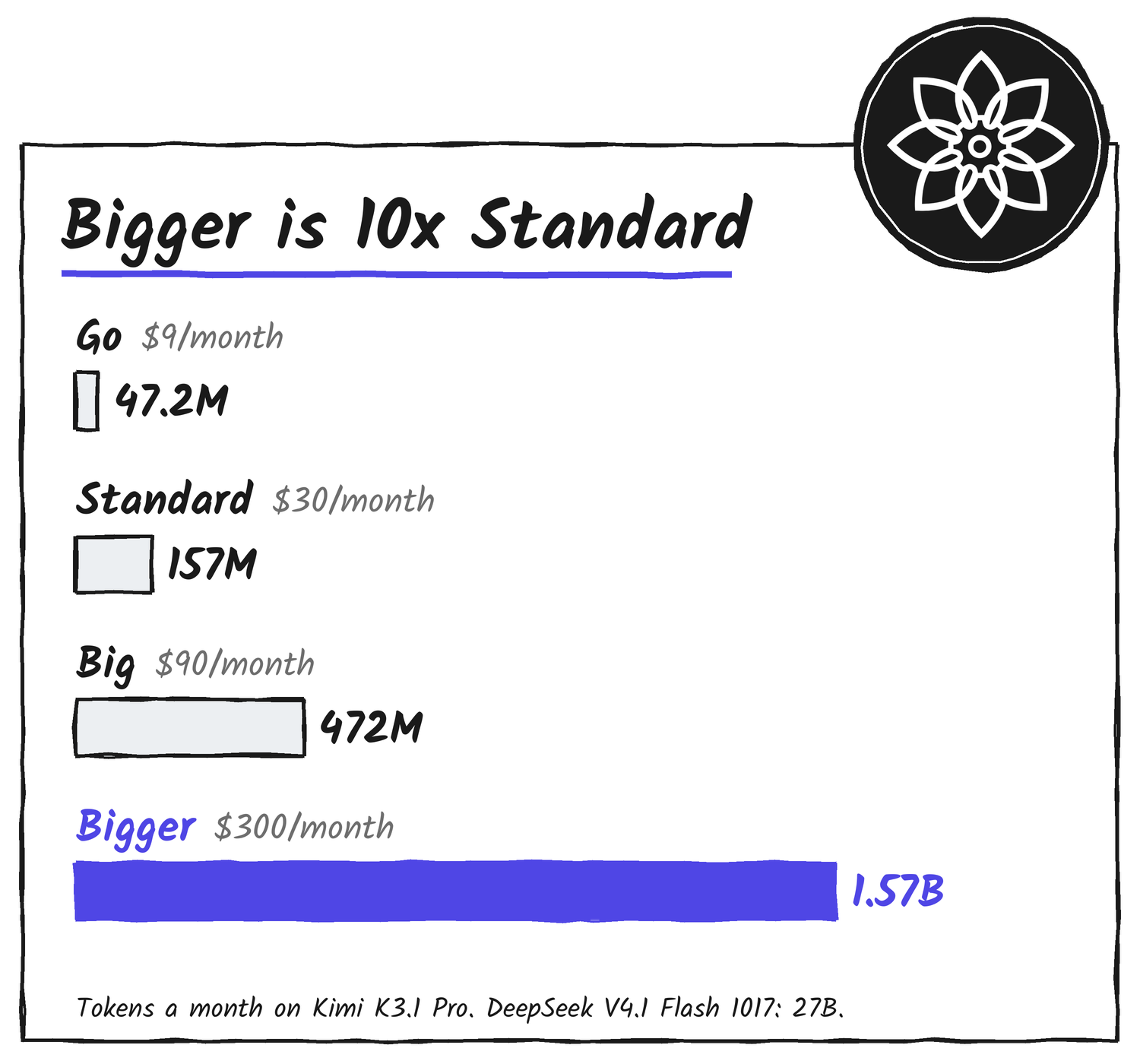
The tiers scale in a straight line: Go, Standard, Big and Bigger each buy about 5.25 million Kimi K3.1 Pro tokens per dollar, so Bigger isn’t a volume discount. What the extra US$210 over Big buys is a higher ceiling and more infinite-mode concurrency, which suits teams running several agents at once. The pricing page lists the allowances per model:
| Model | Standard (US$30) | Big (US$90) | Bigger (US$300) |
|---|---|---|---|
| Kimi K3.1 Pro | 157M | 472M | 1.57B |
| DeepSeek V4.1 Flash 1017 | 2.70B | 8.11B | 27.0B |
| GLM-5.3 (beta) | 248M | 744M | 2.48B |
| Qwen3.8 27B | 391M | 1.17B | 3.91B |
| GLM-5.3-Flash | 1.02B | 3.05B | 10.2B |
| gpt-oss-120b | 7.32B | 22.0B | 73.2B |
| GLM-4.7-Flash | 7.32B | 22.0B | 73.2B |
Matt’s pitch is about that scale at plan rates. “i don’t think anywhere else offers this many tokens at discounted plan rates,” he wrote. “usually you’d have to switch to pay-as-you-go, or juggle multiple plans, to get into the billions of tokens for Kimi or tens of billions for DeepSeek. not anymore!” He added that a few people at Synthetic had used Bigger internally for a week and that it “feels really nice for massive workloads”.
Kimi K3.1 Pro quotas rise about 30%
The second announcement applies to the plans you may already be on. Synthetic raised the Kimi K3.1 Pro allowance on Go from 36 million tokens a month to 47.2 million, on Standard from 120 million to 157 million, and on Big from 360 million to 472 million. The figures use the same 90/9/1 mix, and Matt says Synthetic is “still hard at work optimizing our inference stack and hope to continue offering even more in the future”.
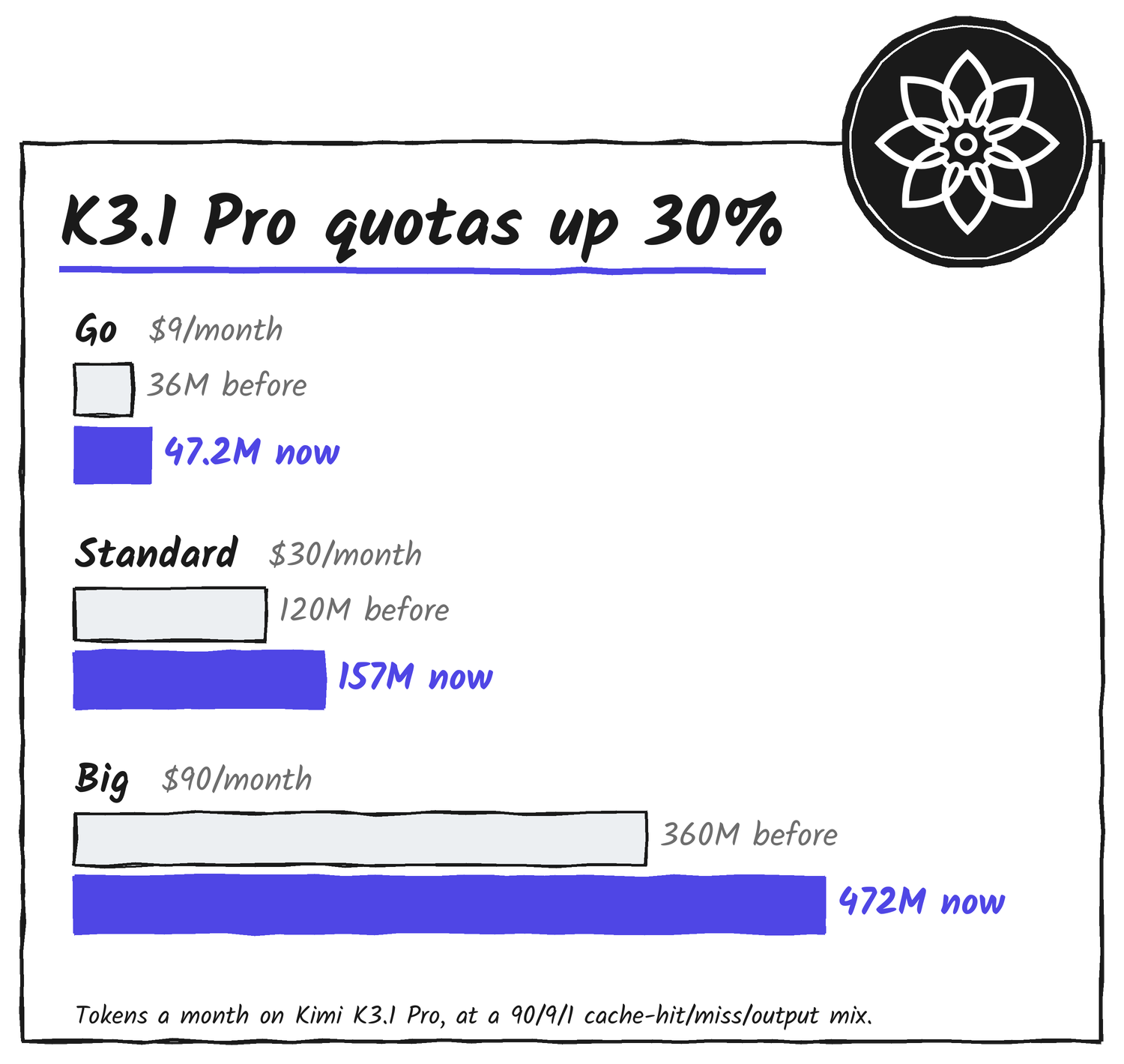
Kimi K3.1 Pro joined the subscription on 5 November, when Synthetic said its newer architecture allowed limits more than 60% above Kimi K3’s. On Go that meant 36 million tokens against 21.6 million for Kimi K3. This week’s change raises the K3.1 Pro figures themselves.
Infinite mode and fast mode
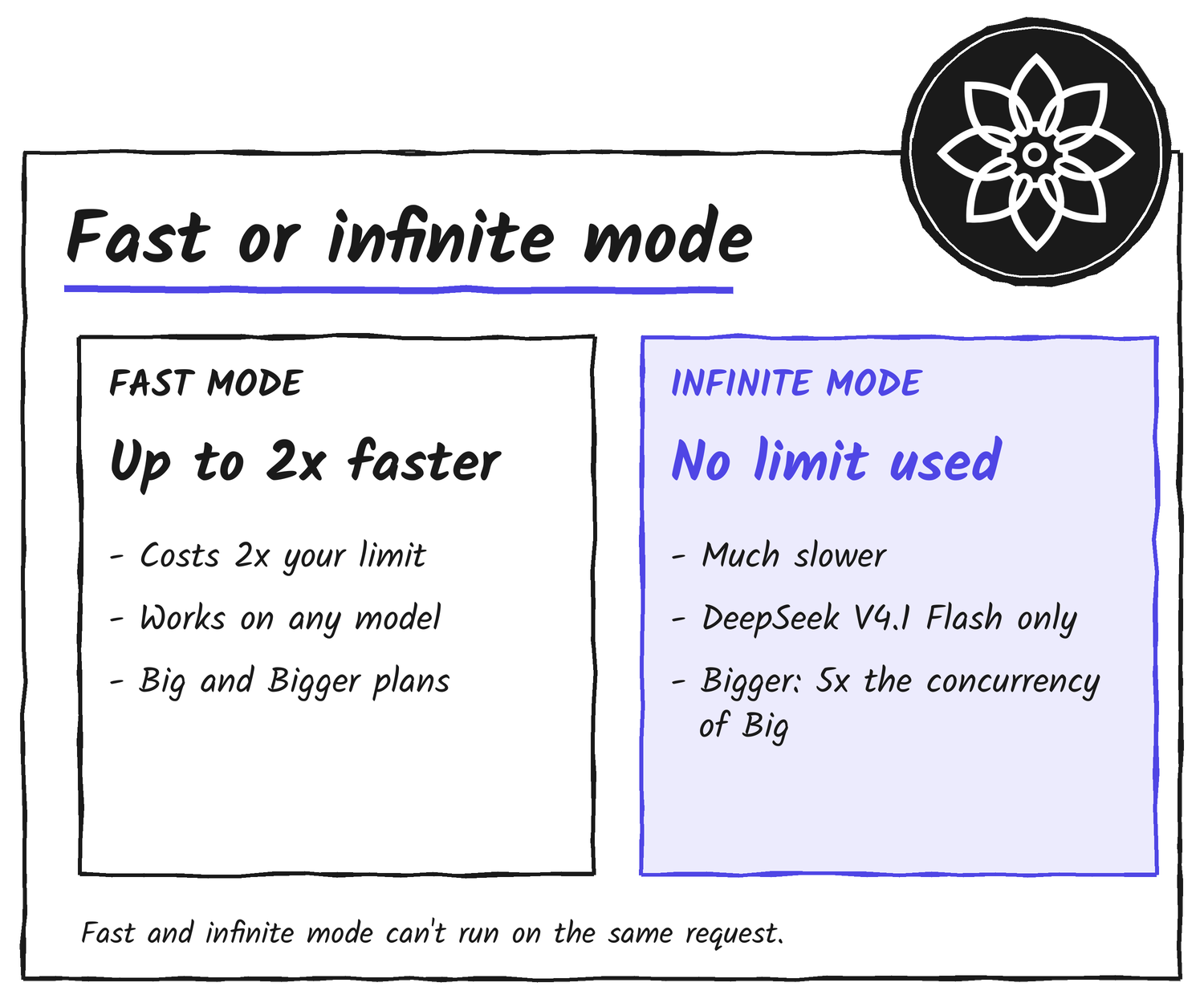
Two beta features come with Big and Bigger, and Bigger has the most room to use them. Infinite mode is built for background agents. Requests made through an infinite alias never count against your rate limit, and in exchange they run much slower. It currently covers DeepSeek V4.1 Flash only, and requests must stream so a long pause between tokens doesn’t time out the connection. Bigger gives you 5x the infinite-mode concurrency of Big, so five times as many of those background jobs can run at once.
Fast mode is the opposite trade. Prefix a model name with fast: and the request runs up to twice as quickly while using twice as much of your limit. It works on any model, and Synthetic says it refunds requests that don’t come back at least 20% faster. In its October launch notes the company reported averaging more than 210 tokens per second on DeepSeek V4.1 Flash in fast mode. Fast mode and infinite mode can’t run on the same request.
The limit those modes draw on is weekly. Synthetic dropped its five-hour windows in October, so the only cap is a weekly credit allowance that refills by 2% every 202 minutes, about 3.4 hours. A full week takes it from empty to full, and there’s no penalty for spending it all in one heavy session.
What Synthetic is
Synthetic is Synthetic Lab, a small San Francisco company founded in 2025. It runs open-source models in private datacentres in the US and EU, and sells access two ways: a flat monthly subscription, or usage-based pricing per token. The same models sit behind an OpenAI-style and an Anthropic-style API, so most coding tools need only a new base URL and key. Its docs include setup guides for Claude Code, OpenCode, Crush, GitHub Copilot, OpenClaw, Xcode Intelligence and its own agent, Octofriend, and Cline and Roo work too.
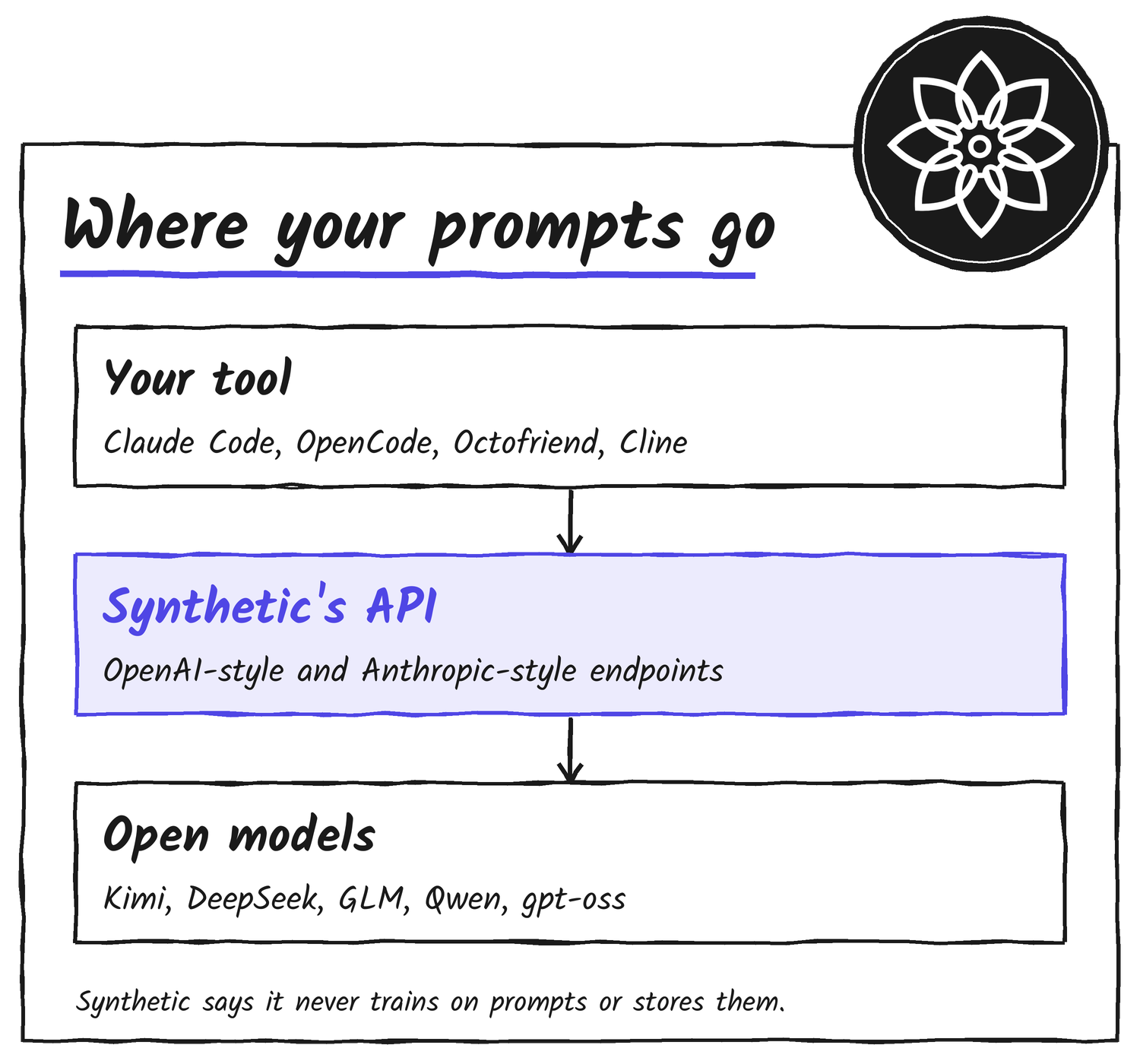
The current catalogue has seven always-on models: Kimi K3.1 Pro, DeepSeek V4.1 Flash 1017, GLM-5.3 (beta), GLM-5.3-Flash, GLM-4.7-Flash, Qwen3.8 27B and gpt-oss-120b. Kimi K3.1 Pro, DeepSeek V4.1 Flash 1017, GLM-5.3 and GLM-5.3-Flash have 512k-token context windows. Subscribers also get an embeddings model, Nomic Embed Text v1.5, which doesn’t count against the rate limit. Role-based aliases such as syn:large:text, syn:small:text and syn:large:vision point at the current recommended model, so an app keeps working when Synthetic rotates one out.
What sets it apart
Beyond price, Synthetic points to six things.
- Privacy. Synthetic says it never trains on your data and never stores API prompts or completions. Its privacy policy adds that it doesn’t share contact, identity, financial or profile data with inference partners.
- Tested against real agent bugs. Its open-source Synbad suite is built from bugs coding agents hit in the company’s Discord, which has more than 1,000 members. Synthetic reports a 100% pass rate across the models it tested, and says other providers score as low as 66% on the same tests. Those are Synthetic’s own results.
- Models as the labs released them. Synthetic has said it runs what the labs release and doesn’t quantise models itself.
- Its own agent and fixers. Octofriend is an MIT-licensed terminal coding agent with zero telemetry that lets you switch models mid-conversation. Synthetic trained and open-sourced two small models for it, one that applies code diffs and one that repairs malformed JSON, to rescue failed edits and tool calls from any coding model.
- Search without retention. A web search API for coding agents is included in the subscription, with zero data retention.
- One limit. Credits refill continuously through the week, with no five-hour window to trip over.
Plans at a glance
| Plan | Price | Kimi K3.1 Pro | DeepSeek V4.1 Flash 1017 | Fast and infinite mode |
|---|---|---|---|---|
| Go | US$9 | 47.2M | 811M | No |
| Standard | US$30 | 157M | 2.70B | No |
| Big | US$90 | 472M | 8.11B | Yes (beta) |
| Bigger | US$300 | 1.57B | 27.0B | Yes (beta), 5x infinite concurrency |
Plans and the full model list are on synthetic.new/pricing, and the API docs are at dev.synthetic.new.
If you’re new to Synthetic, my referral link takes up to US$10 off your first month.
Disclosure: I’m a Synthetic affiliate and earn a commission on signups through that link.
Discover more from Sulat AI & Tech News
Subscribe to get the latest posts sent to your email.