
Google has raised the cache hit rate for Gemini 4 Neon in Antigravity by another 4.5%, and says that lets subscribers finish 28% more tasks inside the same quota. Varun Mohan, who builds Antigravity at Google DeepMind, posted the numbers on 25 November. He didn’t say what the hit rate is, only how far it moved.
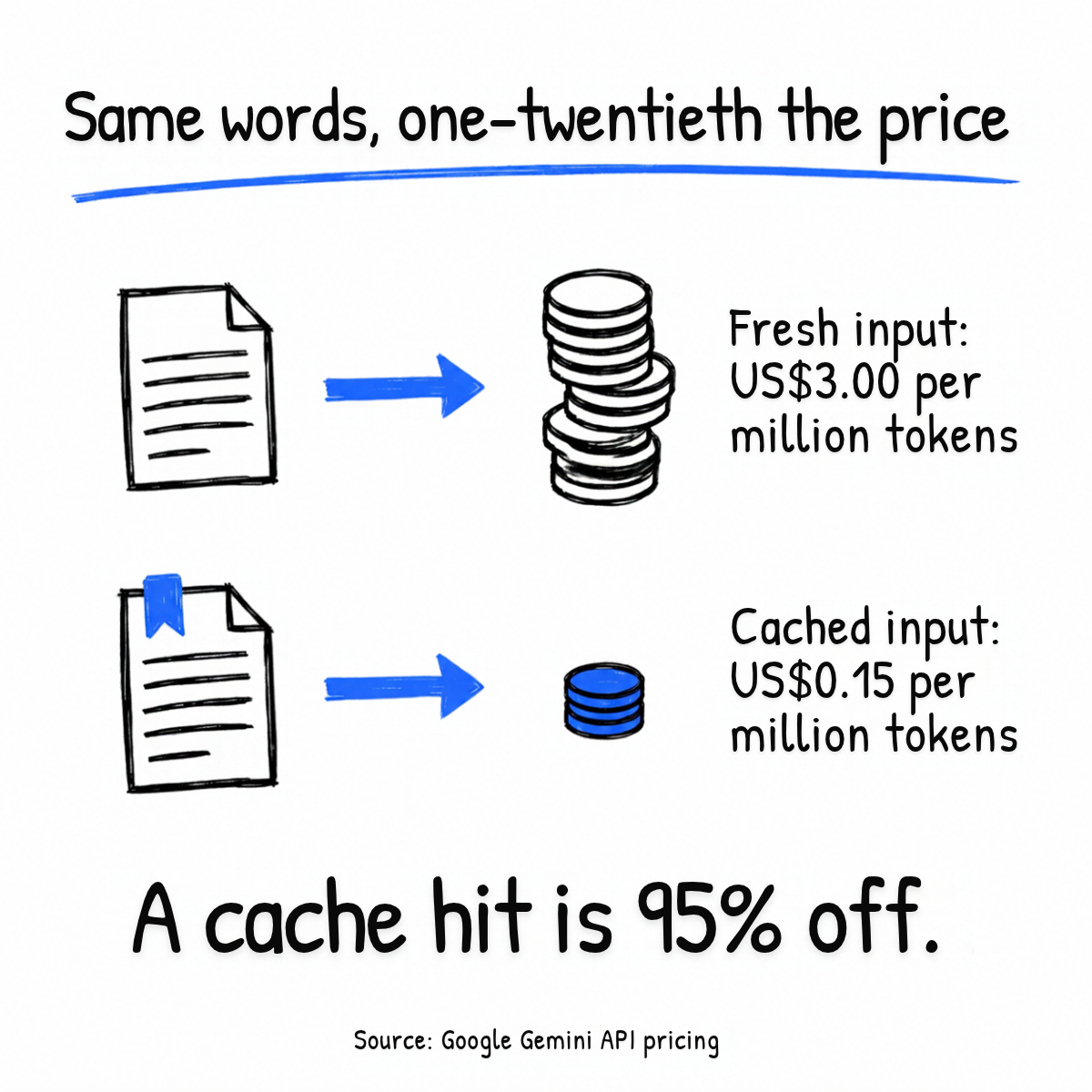
The reason a cache tweak moves a quota is in Google’s own price list. A cached input token on Neon costs US$0.15 per million, and an uncached one costs US$3. That 20-to-1 gap is the whole story, and I explain it from scratch below for anyone who has never met the term. I checked the prices against Google’s pricing page on 25 November, ran the arithmetic myself, and set Google’s numbers beside what users have measured and what Anthropic, xAI and DeepSeek charge for the same thing.
4.5%
further rise in Neon’s cache hit rate in Antigravity, per Mohan
28%
more tasks inside the same quota, Google’s claim
~75%
more Neon usage on the subscription in five days, caching plus harness work
US$0.15
per million cached input tokens, against US$3 uncached
- What Mohan posted, and the five days before it
- Input caching in plain English
- Why this is a big deal
- What users measured
- How Anthropic, xAI and DeepSeek handle it
- What Google hasn’t published
- What to do about it
What Mohan posted, and the five days before it
Mohan’s post reads, in full: “We’ve increased the cache hit rate for Neon in Antigravity again by another 4.5%. This means you can complete 28% more tasks within quota. In the last 5 days, we’ve effectively increased Neon usage on the subscription by close to 75% through caching and harness improvements!”
“Again” is the key word. This is the third step in a week. Google released Neon on 18 November at US$3 in and US$15 out per million tokens, and Antigravity subscribers on Google AI Pro and Ultra draw on it through a quota that refreshes every five hours with a weekly limit on top. Here is the run of changes, with the source for each.
| Date | What Google said or shipped | Source |
|---|---|---|
| 18 November | Gemini 4 Neon released at US$3 and US$15 per million tokens | Neon launch report |
| 20 November | Mohan says a much bigger cache pool lifts Neon’s hit rate by around 4% and “will increase what you can get done in quota by at least 20%”; a reset to follow | Mohan on X |
| 21 November | Quota reset for everyone; Mohan says the caching work lifted what you can get done in quota by 22% | Mohan on X |
| 23 November | Developers post logs and complaints that the weekly cap is still draining fast | Posts by Arun and Tekon Burns, below |
| 24 November | Antigravity v2.35.0 rolls out; Mohan says Neon uses 12% less quota per task and finishes tasks 17% faster | Mohan and Rohan Phadte on X |
| 25 November | Hit rate up another 4.5%, 28% more tasks in quota, close to 75% more Neon usage over five days | Mohan on X, embedded above |
The 75% is Mohan’s own sum, and he doesn’t show the working. I tried multiplying the three steps that were announced: 1.22 for the first caching change, 1.28 for this one, and about 1.14 for 12% less quota per task. That comes to roughly 1.77, near enough to “close to 75%” that the steps probably stack. That’s my inference. Google hasn’t said how it got there.
Input caching in plain English
Start with the thing most people don’t know: an AI model has no memory between messages. Every time you send one, the app sends the whole conversation again from the top, and the model reads all of it before it writes a word. You pay for the reading, counted in tokens, which are roughly chunks of words.
Picture reading a long book to a friend, and each time you add a new page you have to start again from page one. That’s how it works without caching. Input caching is a bookmark. The provider keeps the part it already read, so next time it only reads the new pages and picks up from the bookmark.
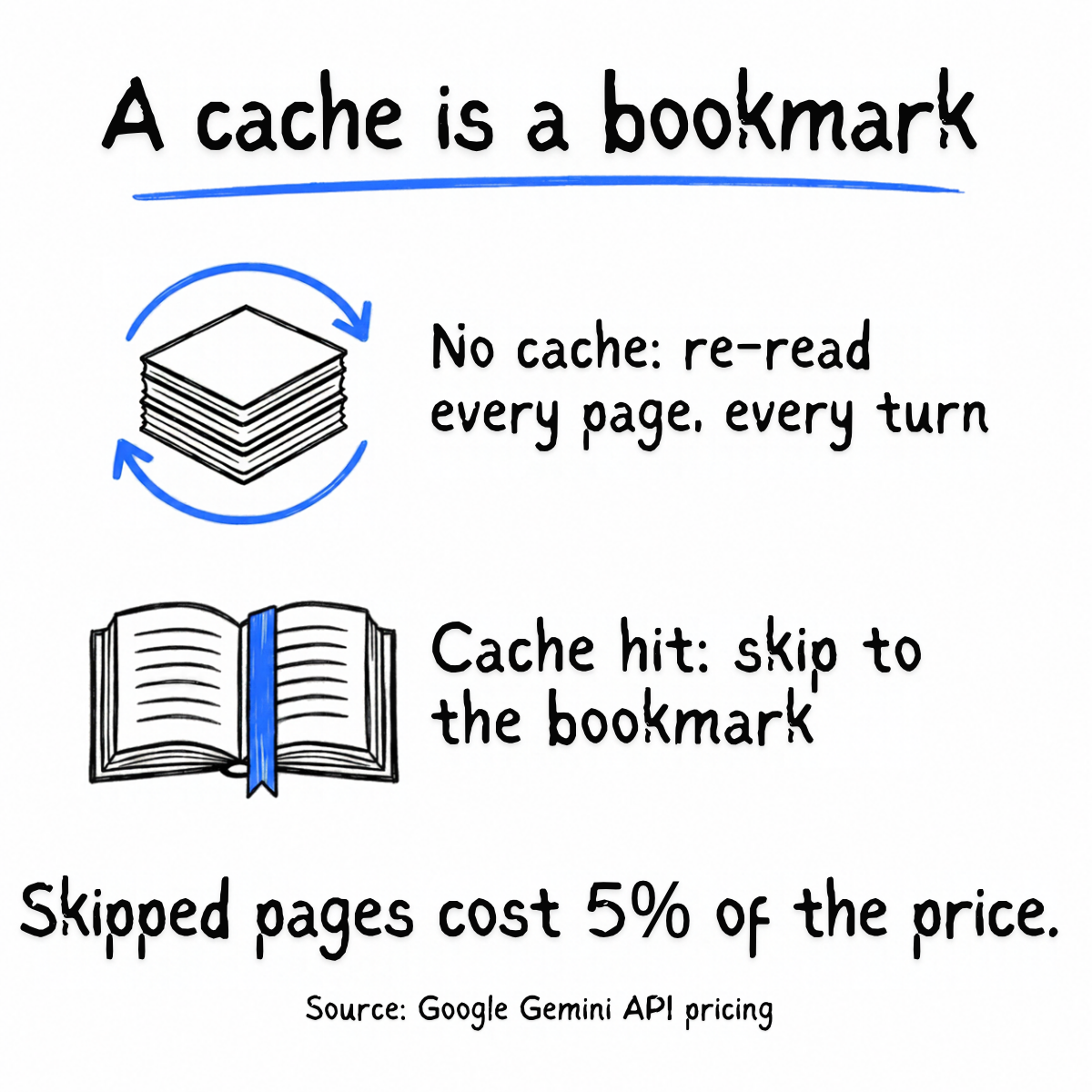
Two words do most of the work. A hit is when the provider finds your earlier reading in its cache and reuses it. A miss is when it can’t, and reads the lot again at full price. On Neon, Google’s pricing page lists US$0.15 per million tokens for a hit and US$3 for a miss, so a hit costs 5% of a miss.
Here is a worked case, using Neon’s list prices and my arithmetic. A coding agent is 100,000 tokens into a session and you send one more message that adds 1,000 new tokens.
| What happens | Input billed | Cost of this one turn |
|---|---|---|
| Miss: nothing found in the cache | 101,000 tokens at US$3 per million | US$0.303 |
| Hit: the first 100,000 are cached | 100,000 at US$0.15 plus 1,000 at US$3 | US$0.018 |
That’s about 17 times cheaper for the same turn, and an agent takes dozens of turns in a session. A session that stays in the cache is cheap. One that keeps falling out of it is not.
What makes a miss
- A change near the top. Caches match from the start of the prompt. Edit something early, such as a system instruction or the order of tool definitions, and everything after it counts as new text.
- Eviction. A cache is finite. When it fills, older entries are thrown out to make room, and your next request finds nothing.
- Sharing. Provider cache storage is a shared resource. When a popular model is busy, entries for everyone get pushed out sooner. That’s why Mohan’s 20 November post fixes the problem with “massive increasing the cache pool size”.
- Time. Some providers expire an entry after a set lifetime, and Anthropic publishes its figures (below). I found no lifetime stated on Google’s pricing page for Gemini 4 caching.
Gemini 4 caching is implicit. Google’s pricing page says explicit caching isn’t supported on the Gemini 4 models, so nobody sets a bookmark by hand. Google’s systems decide what to keep. That’s why this news came from the Antigravity team and not from a change to anyone’s code.
Why this is a big deal
Agents are mostly input. A chat message is short. A coding agent re-sends its whole transcript, file contents and tool results on every step, and only a thin slice of each request is new. Most of what it bills is repeated input, which is exactly what a cache discounts.
A subscription quota is a budget Google has to cover. Antigravity’s Pro and Ultra plans don’t bill per token. They give a quota that refreshes every five hours, plus weekly limits, and Mohan ties cache hits directly to how much you get done inside it. Google doesn’t publish how quota converts to tokens, so I can’t turn his percentages into dollars. The direction is clear, though. Cheaper repeated input means each task burns less of the same quota.
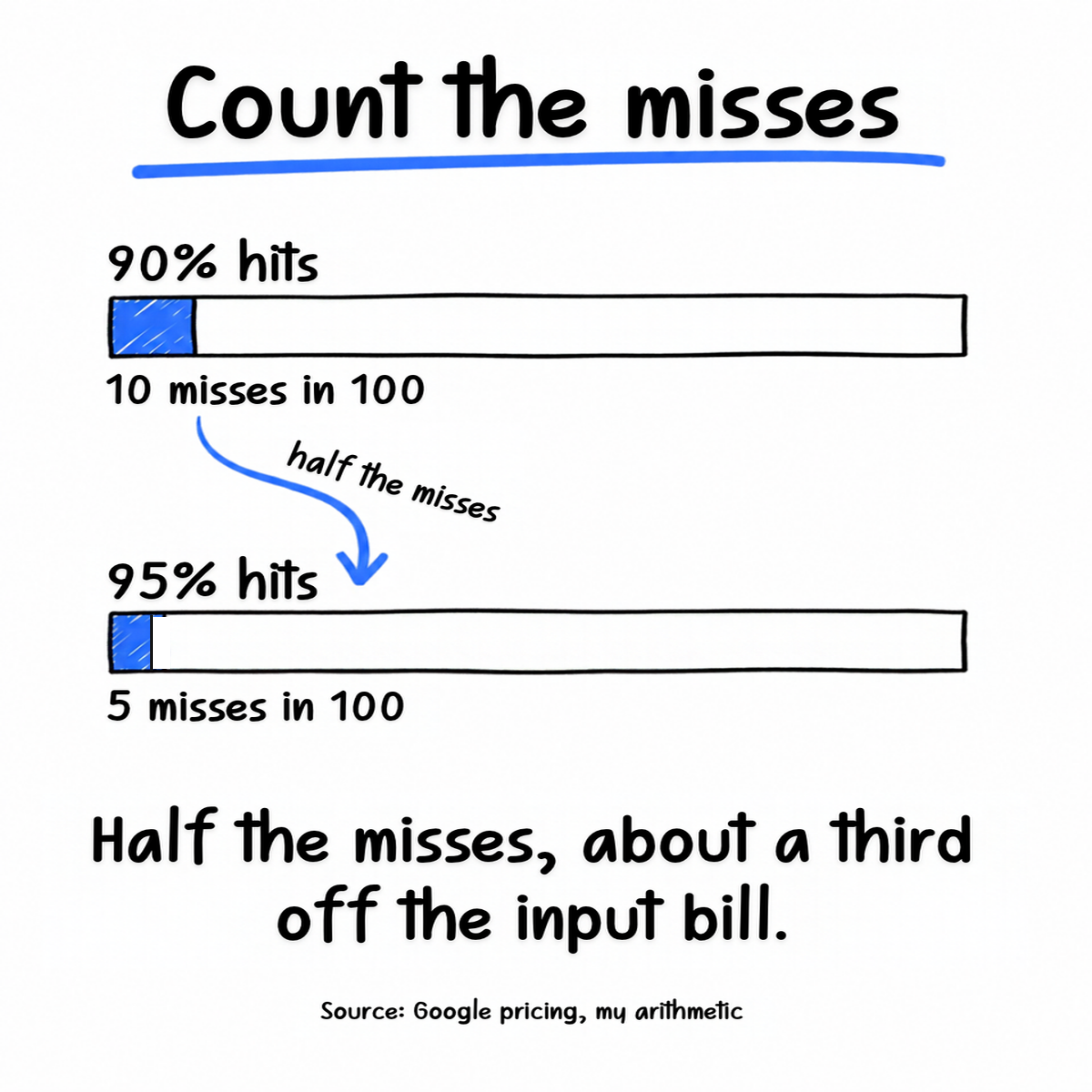
The miss rate, not the hit rate, sets the bill. Theo of t3.gg made the point on 20 November under Mohan’s first post: “reduced cache misses by 50%” sounds better than “increased cache hit rate by 4%”. Both can describe the same change. The tables below show why.
| Cache hit rate | Misses per 100 tokens | Average input price per 1M | Saving against no cache |
|---|---|---|---|
| 0% | 100 | US$3.00 | 0% |
| 80% | 20 | US$0.72 | 76% |
| 90% | 10 | US$0.435 | 85.5% |
| 95% | 5 | US$0.2925 | 90.25% |
| 99% | 1 | US$0.1785 | 94% |
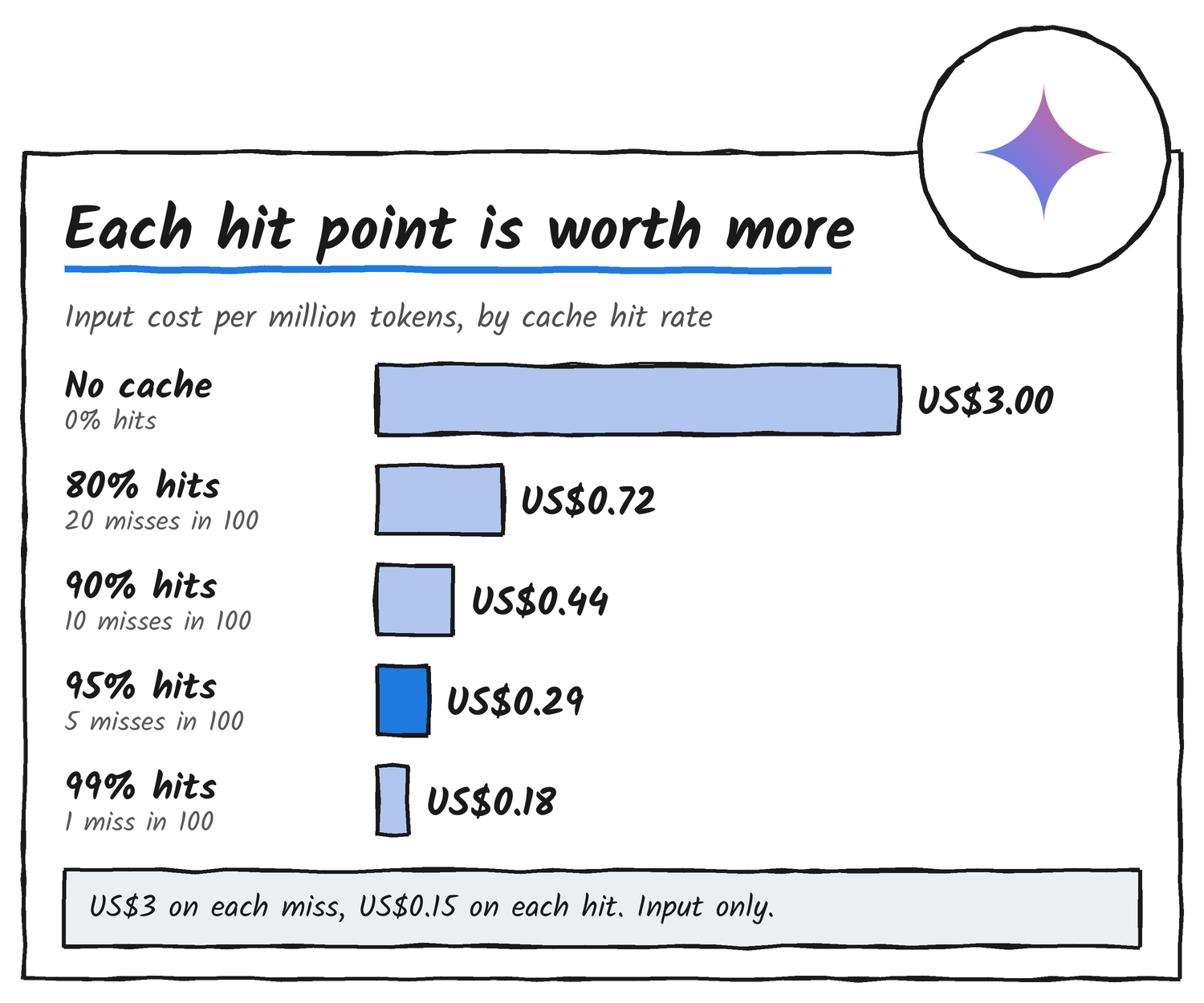
Going from 90% to 95% halves the misses from 10 in 100 to 5 in 100, and takes about a third off the input bill. Going from 80% to 90% also halves the misses, and saves about 40% of what’s left. Same-looking gains in the hit rate buy very different amounts depending on where you start.
I can also work backwards from Google’s 28%. If input were the only cost and tasks used the same number of tokens, a 4.5-point rise producing 28% more tasks implies a start of about 85%, ending near 89.5%. Output tokens and other costs dilute the effect, so for the same 28% the real starting rate would be higher than 85%. This is my inference from the price list. Google hasn’t published the hit rate, so treat the range as a plausibility check, not a measurement.
What users measured
Not everyone saw the savings before 25 November. On 23 November a developer posting as Arun (@hiarun02) said one five-hour session with Neon and Hydrogen “reportedly burned almost 50% of the entire weekly limit”. The same day Tekon Burns posted analysis of local logs from two developers. Across 385 Neon High calls, they said, zero-cache misses rose with context length.
| Context length | Zero-cache calls |
|---|---|
| 50k to 100k tokens | 10% |
| 250k to 300k tokens | 43% |
| 300k to 500k tokens | 65% |
Burns said that run used a full five-hour bar plus 58% of the weekly quota in three hours. A GitHub issue in the Antigravity CLI repository, 1665, and a newer follow-up, 1720, described the same pattern: cache misses on unchanged prefixes still burning quota after the 21 November change. Both were open in the report I read, and neither had a reply from Google staff at the time.
Those measurements pre-date Mohan’s 25 November change. I haven’t found anyone who has re-run them since, so there’s no outside figure for whether the 4.5% shows up in long sessions. The data does hint at where the misses were. Long contexts are where eviction bites hardest, since a big prefix is the most expensive thing to lose.
How Anthropic, xAI and DeepSeek handle it
The four providers below all discount cached input, but they differ on how steep the discount is, whether you pay to write the cache, and how much control you get. List prices below are per million tokens as of 25 November.
| Model | Input (miss) | Cache hit | Hit as share of input | Cache write |
|---|---|---|---|---|
| Gemini 4 Neon | US$3.00 | US$0.15 | 5% | No separate fee listed; implicit only |
| Gemini 4 Hydrogen | US$1.50 | US$0.075 | 5% | No separate fee listed; implicit only |
| Claude Sonnet 5.5 | US$2.00 | US$0.10 | 5% | 1.25x input (5-minute) or 2x (1-hour) |
| Claude Opus 5.5 | US$4.00 | US$0.20 | 5% | 1.25x or 2x |
| Claude Fable 5.2 | US$8.00 | US$0.20 | 2.5% | 1.25x or 2x |
| Grok 4.7 | US$2.00 | US$0.50 | 25% | No separate fee listed |
| Grok 4.3 | US$1.25 | US$0.20 | 16% | No separate fee listed |
| DeepSeek V4.1 Flash, off-peak | US$0.15 | US$0.003 | 2% | No separate fee listed |
| DeepSeek V4.1 Flash, peak | US$0.30 | US$0.006 | 2% | No separate fee listed |
Anthropic is the odd one out because it charges to write the cache and lets you pick how long it lives: a five-minute entry costs 1.25 times the input price to create, a one-hour entry costs twice. Reads then cost 5% of input on Opus 5.5 and Sonnet 5.5 and 2.5% on Fable 5.2. Developers mark where the cache should break, which puts some of the hit rate in their hands.
Google’s discount matches Anthropic’s on the mid-tier models, and the Gemini 4 pages list no write premium. The cost is control. With explicit caching unsupported on Gemini 4, the hit rate depends on what Google does with its cache pool, which is the lever Mohan has been pulling all week.
xAI’s discount is the shallowest in the table, with Grok 4.7’s cached rate at a quarter of its input price. DeepSeek’s is the steepest, 98% off, though the base price is so low that the saving per million tokens is small in dollars. DeepSeek also charges double during peak hours, which its trackers put at 01:00 to 04:00 and 06:00 to 10:00 UTC, Monday to Friday.
List prices don’t settle which one is cheaper for a given job. Tokenisers differ, so the same code can count as more or fewer tokens on each model, and hit rates differ by workload and by how the provider evicts. I haven’t compared hit rates across providers because none publishes one.


What Google hasn’t published
- Neon’s actual cache hit rate in Antigravity, before or after the change. Mohan gives only increases.
- Whether “4.5%” means percentage points or a relative rise. The post doesn’t say.
- The split of the “close to 75%” between the cache work, the v2.35.0 harness changes and the reset.
- How quota converts into tokens, which is what would let anyone check the 28% claim.
- How long an entry lives in the Gemini 4 cache. Google’s pricing page lists no figure.
- An outside re-test. Everything measured above was taken before the 25 November change, and the figures in Mohan’s post are Google’s own.
What to do about it
You can’t set Neon’s cache, but you can stop breaking it.
- Put stable content first and new content last. System instructions, tool definitions and reference files go at the top, in the same order every time, because caches match from the start.
- Don’t edit earlier turns. Rewriting history or reshuffling tools turns the whole tail into a miss.
- If you call the API, read the cached-token count in the usage block, which the Interactions API reports as
total_cached_tokens, and divide it by total input. That’s your own hit rate, and it’s the number Google doesn’t give you. - In Antigravity, watch context length. The one data set we have, from two developers, shows misses climbing past 250k tokens, so a fresh session may cost less than a very long one. That’s a hypothesis from user logs, not Google advice.
- Compare cost per finished task, not price per token. A cheaper rate with a lower hit rate can cost more.
Terms used in this piece
- Token
- A chunk of text, roughly three-quarters of a word, that models read and write. Prices are quoted per million tokens.
- Input caching
- Reusing an earlier reading of the start of a prompt, at a lower price, instead of reading it again.
- Cache hit and miss
- A hit means the provider found the earlier reading and reused it. A miss means it had to read the text again at full price.
- Prefix
- The beginning of a prompt. Caches only match text that is identical from the very start.
- Eviction
- Removing old cache entries to make room for new ones.
- TTL
- Time to live: how long a cache entry lasts before it expires.
- Implicit and explicit caching
- Implicit means the provider decides what to keep. Explicit means the developer marks what to keep.
- Quota
- The allowance a subscription gives, refreshed on a schedule, instead of a per-token bill.
Google has told us how far Neon’s cache hit rate moved and what that bought, but not where it started. Until it publishes the starting point, or someone re-runs the logs, the 28% is a claim I can check against the price list but can’t confirm.
Sources
- Varun Mohan on X, 25 November 2026
- Varun Mohan on X, 20 November 2026
- Tekon Burns on X, 23 November 2026
- Gemini Developer API pricing, Google AI Studio, read 25 November 2026
- Claude API pricing, Anthropic, read 25 November 2026
- DeepSeek API pricing and cache discounts, Requesty, 23 November 2026
- Grok API pricing explained, LimitDigest, updated 20 November 2026
- Issue 1665 and issue 1720, Antigravity CLI repository
Discover more from Sulat AI & Tech News
Subscribe to get the latest posts sent to your email.