CoreWeave has posted a 44-second clip of Corey Sanders explaining why its first data centre deployments had a clear floor: so people could look down and see Valvey, the liquid-cooling valve assembly, at work. The post went up on X on 25 November (US time) and adds that CoreWeave Mission Control shows valve operations from deployment.
The post is light. The material behind it isn’t. CoreWeave has published detailed write-ups of Valvey, its rack manager Racky and the Mission Control software since June, and Sanders described the plumbing on camera. Here’s what Valvey does, how it fits with Racky and Mission Control, how Google, Microsoft, AWS and Oracle cool their own racks, and where the numbers stand.
- What CoreWeave posted
- How a liquid-cooled rack gets its heat out
- What Valvey does
- Where Valvey sits: Racky, RLCC and Mission Control
- What Mission Control shows
- How the peers cool their racks
- Why it matters now
- What CoreWeave has and hasn’t said
What CoreWeave posted
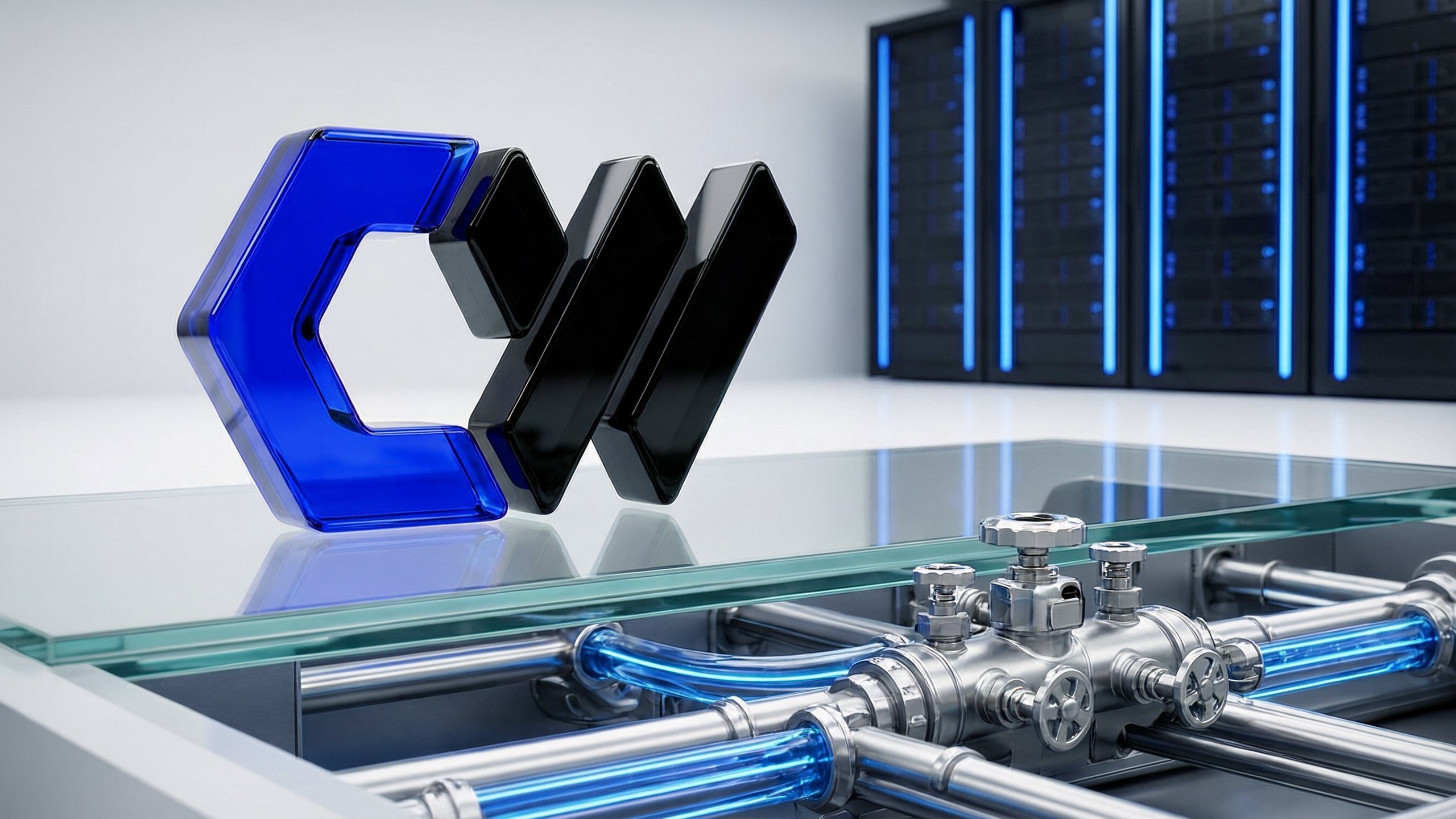
The post says the first CoreWeave deployments “had a clear floor, where @CoreySandersWA could watch Valvey, our liquid-cooling valve assembly, at work beneath.” It then says Mission Control “shows valve operations from deployment”, and links to the Mission Control page.
The video is an interview recorded at a CoreWeave booth. Sanders calls himself “a hardware geek at heart”. He says the first deployments had “this clear floor so you could see Valvey”, and that CoreWeave won’t do it in every data centre it deploys. So the reveal is a transparent floor panel over the valve assembly at early sites. The post doesn’t say which site, or which generation of NVIDIA hardware sat above it.
How a liquid-cooled rack gets its heat out
Liquid cooling swaps fans for coolant. A cold plate sits on each chip, the coolant picks up the heat, and a closed loop carries it away. Google puts the physics plainly: water moves about 4,000 times more heat per unit of volume than air for the same temperature change. At rack powers well over 100 kW, that gap decides what’s possible. NVIDIA’s GB200 NVL72 design needs about 120 kW of cooling per rack, and Microsoft quotes about 136 kW for its GB300 racks.
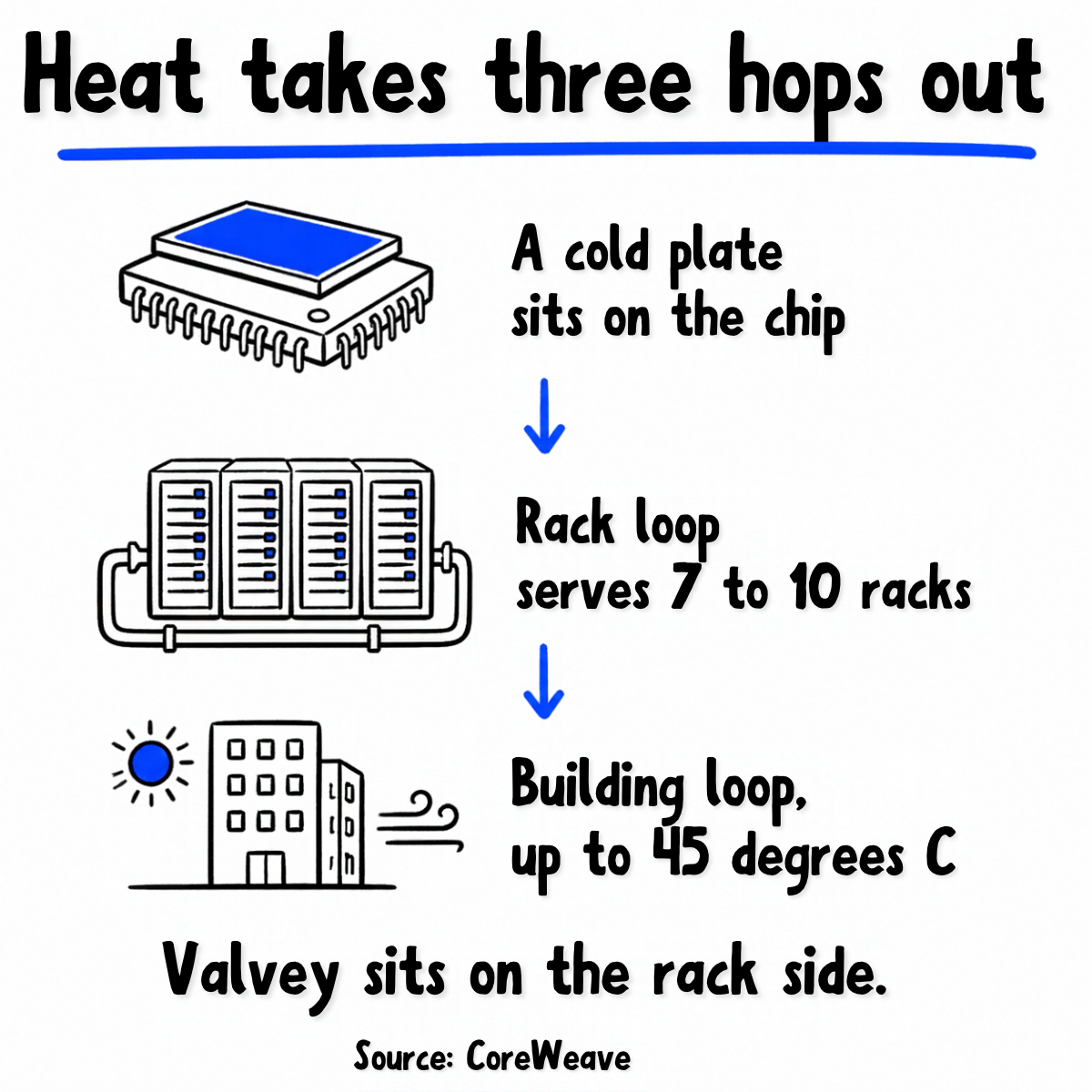
Sanders walked through the layers on theCUBE in June. A primary loop in the building can run as warm as 45°C with Vera Rubin, which means outside air and simple heat exchangers can do the cooling without compressors. A secondary loop serves the racks. With Vera Rubin it now serves “seven to eight to 10 racks” through an end-of-row cooling distribution unit, or CDU, a much bigger heat exchanger. NVIDIA’s own design targets the same 45°C supply temperature, and Jensen Huang said at CES in January that at 45°C a data centre doesn’t need a chiller.
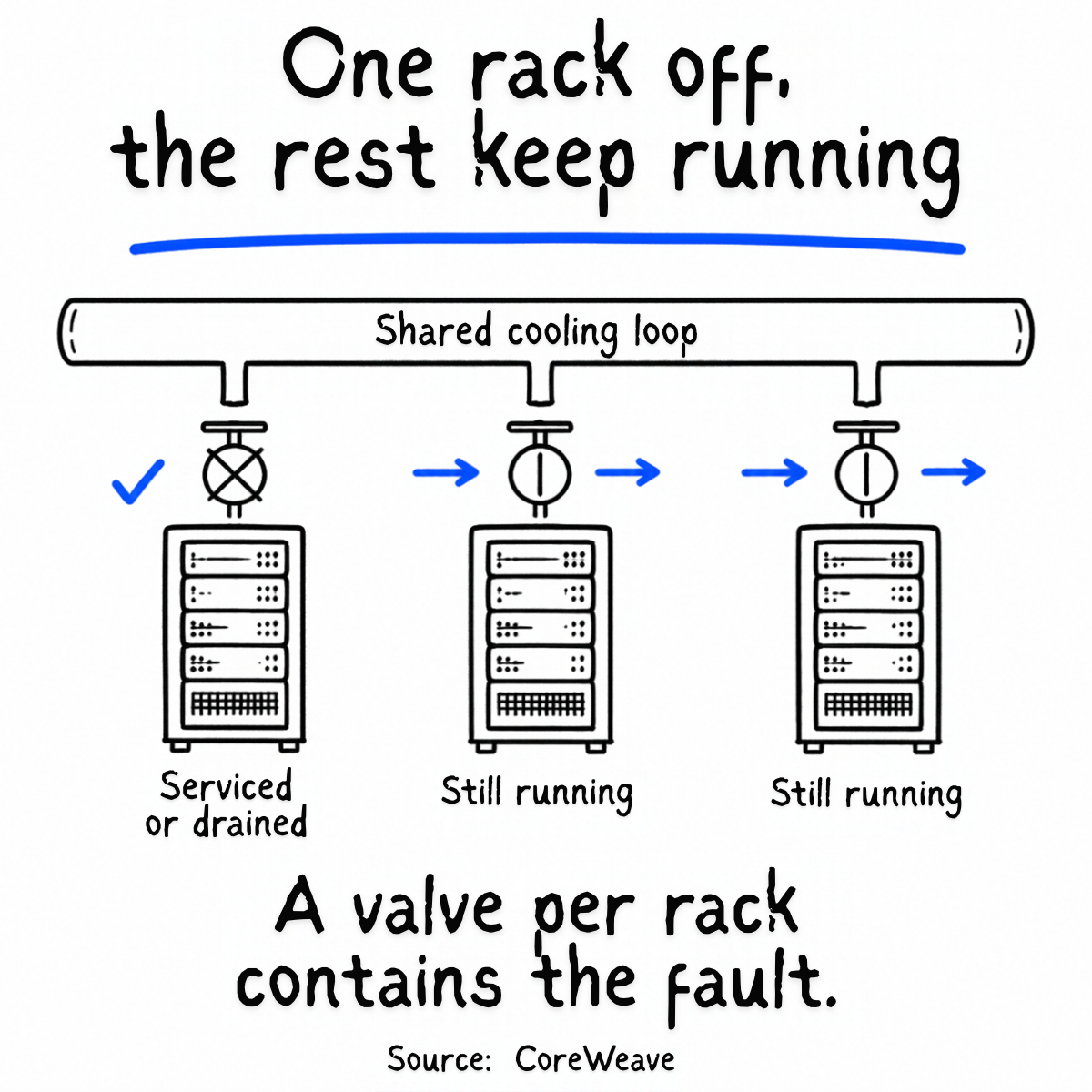
That layout saves energy and plant, and it creates a problem. Racks that once had their own cooling now share one loop, and Sanders is blunt about what that means: the servers “will do different things, have different temperatures and need service, might break at a different time”, all tied together on one critical secondary loop.
What Valvey does
CoreWeave’s answer is Valvey. In its June deep dive on Vera Rubin NVL72, CoreWeave describes it as a “patent-pending programmable per-rack liquid-cooling valve assembly” that turns cooling from a passive mechanical system into “a software-defined control surface”. It monitors and controls flow rate, temperature, pressure and leak detection in the rack’s loop, and it’s “the single point through which every cooling decision is executed”.
When something upstream wants to tune cooling, isolate a rack for maintenance or trigger an emergency shutdown, the action runs through Valvey automatically. The payoff shows up on shared loops. Where several racks hang off a remote CDU, Valvey gives per-rack isolation: one rack can be serviced or drained without disrupting its neighbours. CoreWeave says that contains failures faster and gives customers higher goodput as the fleet grows.
Sanders’s plain-English version is “a bunch of pipes kind of similar to what you have in your house, in your basement”, only much bigger, with sensors and valves all “automatically controlled in real time”. He says response times are in milliseconds, so the system can send more fluid to a GPU as it ramps up.
7 to 10
Racks on each end-of-row CDU with Vera Rubin, per Sanders
45°C
Top primary-loop temperature Sanders describes for Vera Rubin
Milliseconds
Valve response time, in Sanders’s words
CoreWeave has also extended the same control to the network. A later post on liquid-cooled switching says Valvey and Racky now manage the Spectrum-6 SPX switch rack as well, so NVIDIA’s SN6600-LD, a fully liquid-cooled 102.4 Tb/s Ethernet switch, sits in the same thermal loop as the Vera Rubin racks.
Where Valvey sits: Racky, RLCC and Mission Control
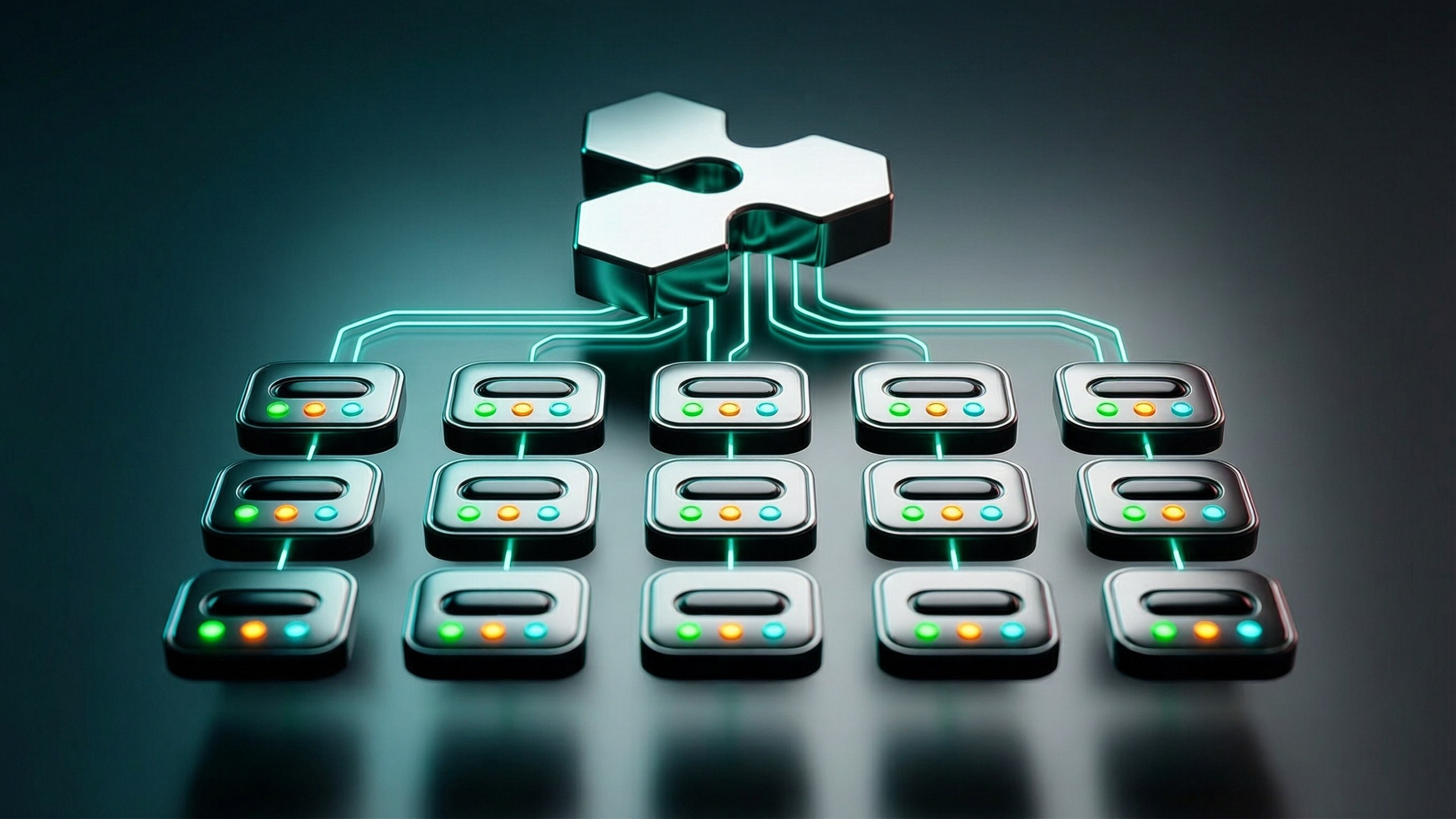
Valvey isn’t standalone. CoreWeave describes a three-part rack stack under Mission Control, and its own summary is the cleanest one: “Valvey executes cooling actions, RLCC orchestrates workflows, and Racky is the per-rack control point that ties it all together.”
| Layer | What it does |
|---|---|
| Mission Control | The operating layer across the fleet: telemetry, node lifecycle, and automatic replacement of unhealthy nodes. |
| RLCC (Rack Lifecycle Controller) | Treats a whole rack as one programmable resource and orchestrates firmware, configuration, health monitoring and recovery. |
| Racky | The rack manager at the top of the rack. Aggregates power, cooling and environmental sensors, and controls valves and power functions. |
| Valvey | The per-rack valve assembly. Executes cooling actions: flow, temperature, pressure, leak detection, isolation and emergency shutdown. |
Sanders adds the building-level view. Racky takes in telemetry from the GPUs, the power systems, the leak sensors and the building management system, and it runs locally in the pod so it stays self-contained. He says that’s what lets CoreWeave oversubscribe a building: plan around the fact that not every GPU is busy at the same moment.
What Mission Control shows
Mission Control is CoreWeave’s name for its operating layer. Its page describes operational intelligence built into CoreWeave Cloud: the Mission Control Agent, a hosted read-only MCP server, GPU straggler detection, Telemetry Relay for forwarding metrics, logs and audit events, and lifecycle controllers that replace unhealthy nodes automatically. It’s included as part of CoreWeave Cloud.
The line the post leans on comes from CoreWeave’s 2 October announcement, the day the Mission Control MCP server went generally available. CoreWeave says that because it operates the infrastructure, it can expose chip, chassis, rack, network fabric, cooling and hardware-verification telemetry “from deployment, without additional configuration or charge”. It names fan speeds, valve operations, system event logs and fabric link faults. Racky and Valvey, it adds, are part of automation that detects and fixes faults “whether or not you open a dashboard”.
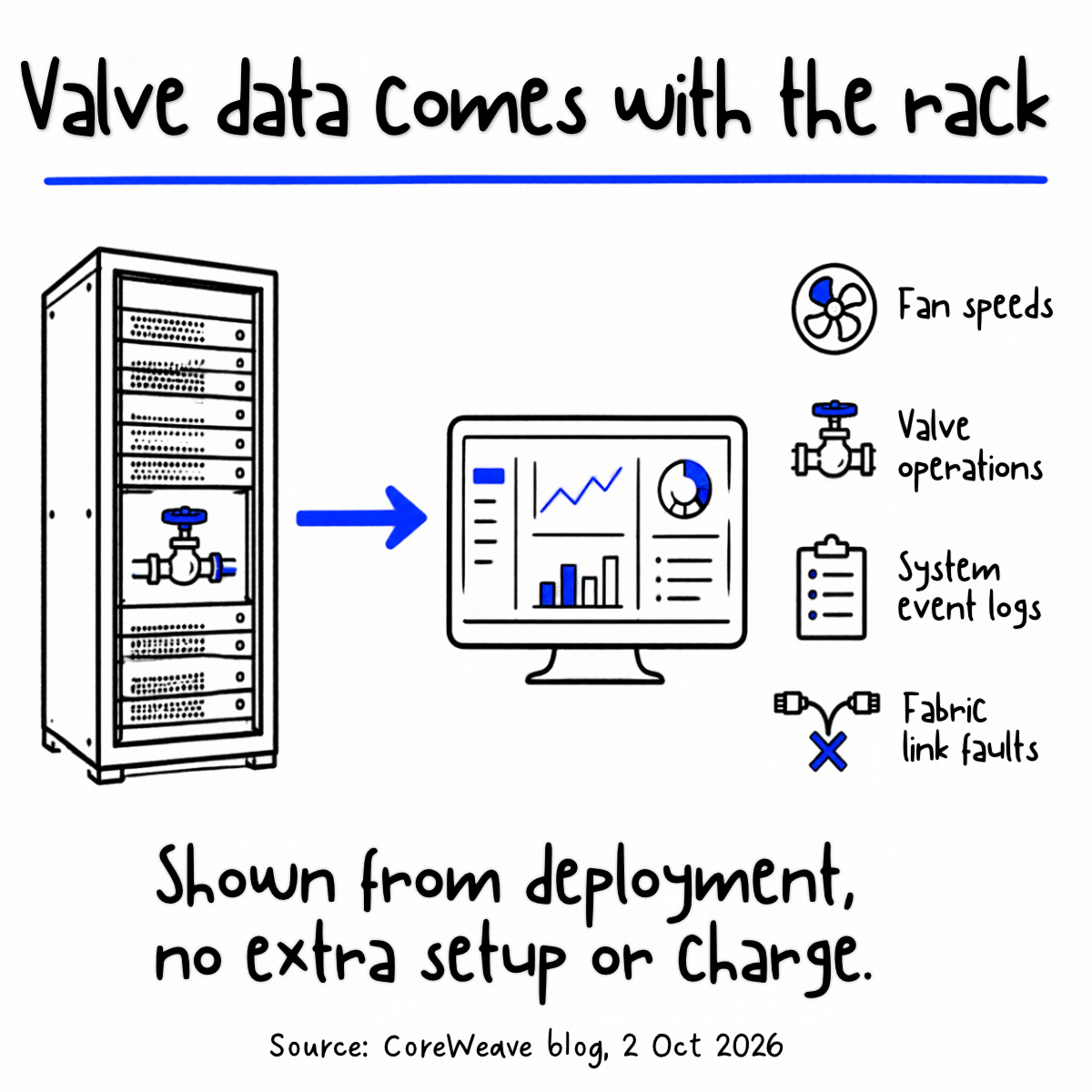
Customers can reach that data three ways: dashboards in the console, Telemetry Relay into their own observability tools, or the MCP server, which connects clients such as Claude Code and Cursor. CoreWeave’s docs say most MCP tools are read-only, that it can enable limited write tools for an organisation, and that an agent sees only what its token can see.
One detail for the careful reader. CoreWeave’s hardware observability docs list GPU chip metrics and server metrics such as fan speed and temperature. Valve operations appear in the announcement’s list, not on that docs page.
How the peers cool their racks
Every big AI operator has the same three problems: get heat off the chip, stop racks taking each other down, and know what the plumbing is doing. Here’s what each one has published.
| Operator | Rack cooling | Control and scale |
|---|---|---|
| CoreWeave | Direct-to-chip liquid cooling, an end-of-row CDU serving 7 to 10 racks, and a Valvey valve assembly on each rack. | Vera Rubin NVL72 racks are 100% liquid-cooled. Earlier GB200 NVL72 racks ran 85% liquid and 15% air, up to 130 kW per rack. |
| In-row CDUs with redundant pumps and heat exchangers that isolate the rack loop from the facility loop (Project Deschutes). | About 99.999% fleet-wide CDU availability since 2020, across more than 2,000 TPU pods. The published Deschutes spec is a 2 MW CDU. | |
| Microsoft | Closed-loop direct-to-chip cooling. GB300 NVL72 racks use a custom heat exchanger unit and an embedded controller that watches power, temperature, coolant flow and leak sensors. | About 136 kW per GB300 rack. Fairwater runs about 140 kW per rack and 1,360 kW per row. |
| AWS | A custom In-Row Heat Exchanger and a custom CDU, direct-to-chip, in a closed loop. | Designed in 11 months. AWS expects 9% less water use than evaporative air-cooled sites once fully operational. |
| Oracle | Direct-to-chip, closed-loop, non-evaporative cooling in new AI sites in New Mexico, Michigan, Wisconsin and Texas. | In Oracle’s words: “The heat leaves the building; cooling liquid does not.” |
| HPE (vendor build) | An in-row CDU rated 1.3 MW, up to eight racks per CDU, for GB200 NVL72. | 132 kW nominal thermal design power per rack. |
Two things stand out. The CDU is the common unit everywhere, and CoreWeave’s 7 to 10 racks per CDU sits right beside HPE’s eight. What differs is what’s on the rack side of it. Microsoft’s embedded rack controller is the closest match to Racky. Of the sources I read, CoreWeave is the one that describes valves as a programmable, per-rack part of the product and lists valve operations as customer-visible telemetry.
The direction is shared, too. NVIDIA says its Vera Rubin NVL72 racks are designed for 45°C inlet water and 100% liquid cooling, and that they’re running at CoreWeave, Google Cloud, Microsoft Azure, Oracle Cloud Infrastructure and Nebius.
Why it matters now
US$3.66B
Q3 revenue, up 168% on a year earlier
US$132.5B
Revenue backlog at 30 September
1.7 GW
Active power, with more than 4.6 GW contracted
Those are the numbers behind the valves. CoreWeave reported on 10 November that it added more than 200 MW of active power in the quarter to pass 1.7 GW, doubling its active footprint since the start of the year. Vera Rubin racks are liquid-cooled end to end, so the plumbing grows with the revenue.
Vera Rubin NVL72 went from CoreWeave’s first validated rack on 1 June to customer availability on 30 September, with Cognition the first customer running production workloads on it. My read: the clear floor is theatre, but the control layer under it is the product. Per-rack isolation is what lets an operator keep a shared loop running while one rack gets serviced, and a rack that’s offline for repairs isn’t earning.
What CoreWeave has and hasn’t said
- Confirmed by CoreWeave: Valvey is a patent-pending, per-rack, programmable valve assembly inside Mission Control, and it handles flow, temperature, pressure, leak detection, isolation and emergency shutdown.
- Confirmed on video by Sanders: the first deployments had a clear floor over Valvey, and it won’t be in every data centre.
- Not stated: the site, the hardware generation and the number of racks that had the clear floor.
- Not published: valve counts, flow rates and pressure limits. “Milliseconds” is Sanders’s word, not a spec with test conditions.
- Not shown: Mission Control itself. The clip is an interview and doesn’t show the valve operations view the post describes.
What I read for this piece
I read CoreWeave’s post and watched and transcribed the 44-second clip, then read CoreWeave’s Vera Rubin deep dive, its liquid-cooled switching post, its Mission Control announcement and page, its hardware observability and MCP docs, the SiliconANGLE theCUBE interview with Sanders and Peter Salanki, and CoreWeave’s Q3 release. For peers I read the published pages from Google, the Open Compute Project, Microsoft, AWS, Oracle, HPE and NVIDIA listed below.
Sources
- CoreWeave on X, 25 November 2026
- CoreWeave: A deep dive on CoreWeave innovations for NVIDIA Vera Rubin NVL72
- CoreWeave: Liquid-cooled switching for AI networking
- CoreWeave: Mission Control MCP and Agent, 2 October 2026
- CoreWeave: Mission Control
- CoreWeave docs: Hardware observability
- CoreWeave docs: Mission Control MCP
- SiliconANGLE theCUBE: Corey Sanders and Peter Salanki on Vera Rubin, Valvey and Racky, June 2026
- CoreWeave: Vera Rubin NVL72 bring-up, 1 June 2026
- CoreWeave: Vera Rubin NVL72 availability, 30 September 2026
- CoreWeave: Third quarter 2026 results, 10 November 2026
- CoreWeave: Data center operations built for AI
- Google Cloud: Enabling 1 MW IT racks and liquid cooling
- Open Compute Project: Project Deschutes specification
- Microsoft: The architecture behind the Azure AI superfactory
- Microsoft: NVIDIA GB300 NVL72 on Azure
- Amazon: How AWS delivered liquid cooling in 11 months
- AWS: Data centers
- Oracle: Closed-loop cooling in AI data centers
- HPE: NVIDIA GB200 NVL72 QuickSpecs
- NVIDIA: GB200 NVL72 designs contributed to OCP
- NVIDIA: Inside the Vera Rubin platform
- NVIDIA: Vera Rubin driving performance per watt, 21 July 2026
- Facilities Dive: No chillers needed for Vera Rubin server racks, 9 January 2026
Disclosure: I’m an OpenAI, Firecrawl and Devin ambassador.
Discover more from Sulat AI & Tech News
Subscribe to get the latest posts sent to your email.