Australia’s Parliament passed the Online Safety Amendment (Digital Duty of Care) Bill 2026 on 25 November, giving online platforms a legal duty to keep users safe, fines of up to 5% of global revenue and, for the first time in Australian law, a right for individuals to sue them. The duty starts after a 12-month transition.
The Senate passed the bill on Wednesday, a day after Communications Minister Anika Wells announced a deal with the Greens, ABC News reports. The Parliament’s bill page shows the Senate agreed 42 Government amendments and 10 Greens amendments at third reading. The Coalition opposed the bill, and Wells said it’s the first online safety law in Australia to pass without bipartisan support, according to The Conversation.
5%
of global revenue is the new fine ceiling
12 months
before the duty starts
182
submissions went to the Senate committee that reviewed the bill
What the duty requires
The core obligation is that the person responsible for an online service must ensure, as far as is reasonably practicable, a safe online environment. Rob Nicholls, a senior research associate at the University of Sydney, writes in The Conversation that the phrase comes from workplace health and safety law: platforms have to find the risks their services create and reduce them, instead of waiting for harmful content to be reported. The duty replaces the industry codes, which Wells described as “drafted by big tech for big tech”, and the eSafety Commissioner’s Basic Online Safety Expectations.
Parliament’s own bill summary says the bill amends the Online Safety Act 2021. Some reports, including Silicon Republic’s, say it replaces that Act.
- Risk assessments. Platforms complete a written risk assessment every year, keep it for six years and hand it to the eSafety Commissioner on request, Nicholls writes. Digital Trends reports they must also tell the regulator before significant changes that could add new risks.
- Named risks. The assessments cover addictive design such as endless scroll and popularity meters, The Next Web reports. Digital Trends adds algorithmic recommendations, AI-generated text and images, and the ability to livestream incognito from smart glasses, a risk Wells called out when she introduced the bill.
- Feed choice. Social media platforms must offer a switch to turn off algorithmic feeds and keep it easy to find, The Next Web reports.
- Children. Under-18s are shielded from pornography and from material that promotes disordered eating, dangerous stunts or abuse. For under-16s, platforms must avoid design features with “negative behavioural impacts”, and services where children could meet pornography must offer at least two age assurance options, according to Digital Trends. AI chatbots are barred from building emotional intimacy with children, The Next Web reports.
- Takedowns. The eSafety Commissioner can issue removal notices for nudify apps and websites, and the required response to cyberbullying and abuse complaints drops to 24 hours, according to the Department of Infrastructure. Digital Trends says app stores and search engines must remove the pathways that lead to nudify services.
- Researcher access. Once the duty is in force, eSafety can give approved university researchers access to platform data, including the algorithms that decide what users see, Digital Trends reports.
The law covers more than social media. Digital Trends lists search engines, app stores, hosting tools and AI services that generate content. Lawful private conversations between consenting adults are left alone, but group chats with hundreds or thousands of members don’t count as private. Low-risk small businesses are exempt through rules, not through the bill itself. Wells said “a low-risk website for a café or bookkeeper is unlikely to cause harm to its users”, as Australasian Lawyer quotes her from the Australian Financial Review.
If you build it, you should be responsible for its risks.
Anika Wells, Communications Minister, to reporters in Canberra on 24 November, as reported by The Next Web
What the Greens won
The bill the government introduced on 15 October carried a maximum penalty of A$109.2 million, according to the Department of Infrastructure. Labor needed Greens votes in the Senate, and the deal Wells announced on 24 November changed the penalties, who can enforce the duty and how complaints travel. Wells outlined seven changes; the main ones, per The Conversation, are below.
| Change | Before the deal | After the deal |
|---|---|---|
| Fine | Up to A$109.2 million | A$109 million, with an alternative penalty of up to 5% of global revenue. The Greens had sought 10% |
| Enforcement | Led by the eSafety Commissioner | Individuals and groups can also sue platforms that breach the duty |
| Complaints | Platform processes and the regulator | A rule-making power for an external dispute pathway, with a tech platform ombudsman that doesn’t exist yet |
| Addictive design | Not a named risk | A named risk platforms must assess |
| “Hostile attitudes to women” | Definition under challenge | Definition clarified; Wells says it targets content promoting hatred, violence and threats, not disagreement with feminism |
The private right of action changes who enforces the law. Nicholls notes that suing platforms has been hard: mining magnate Andrew Forrest’s case against Meta over scam advertisements had to be pursued in a US court. Wells said she expects the new right to be used rarely. Nicholls writes that much depends on how courts treat causation and whether litigation funders see class actions against platforms as viable.
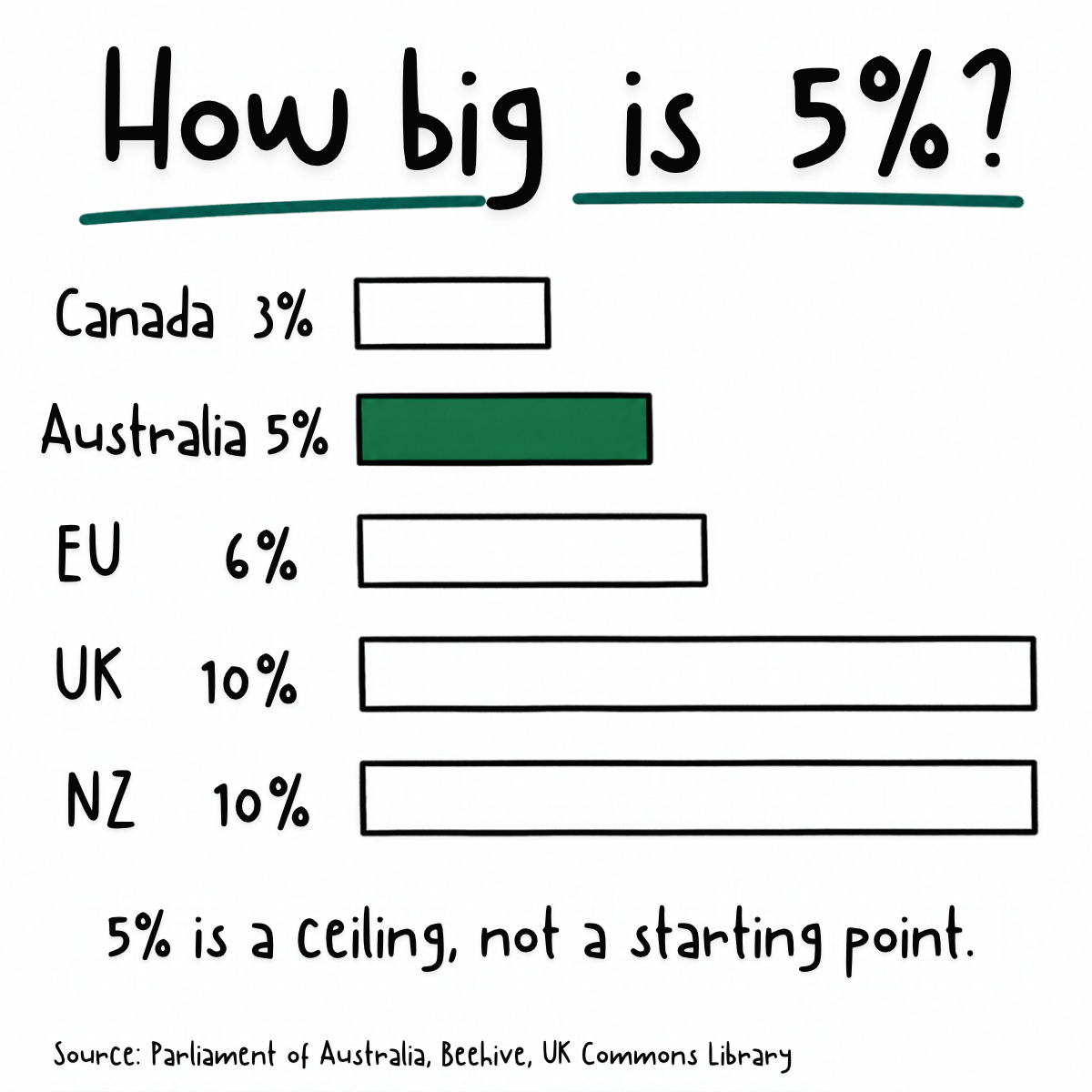
People get three steps before the law’s harshest tools come into play: the platform’s own complaints process, then the planned ombudsman, then the courts. The Greens call the middle step a pathway to an independent ombudsman for big tech. Digital Trends reports the Greens won the right to sue and the larger penalty in the same deal.
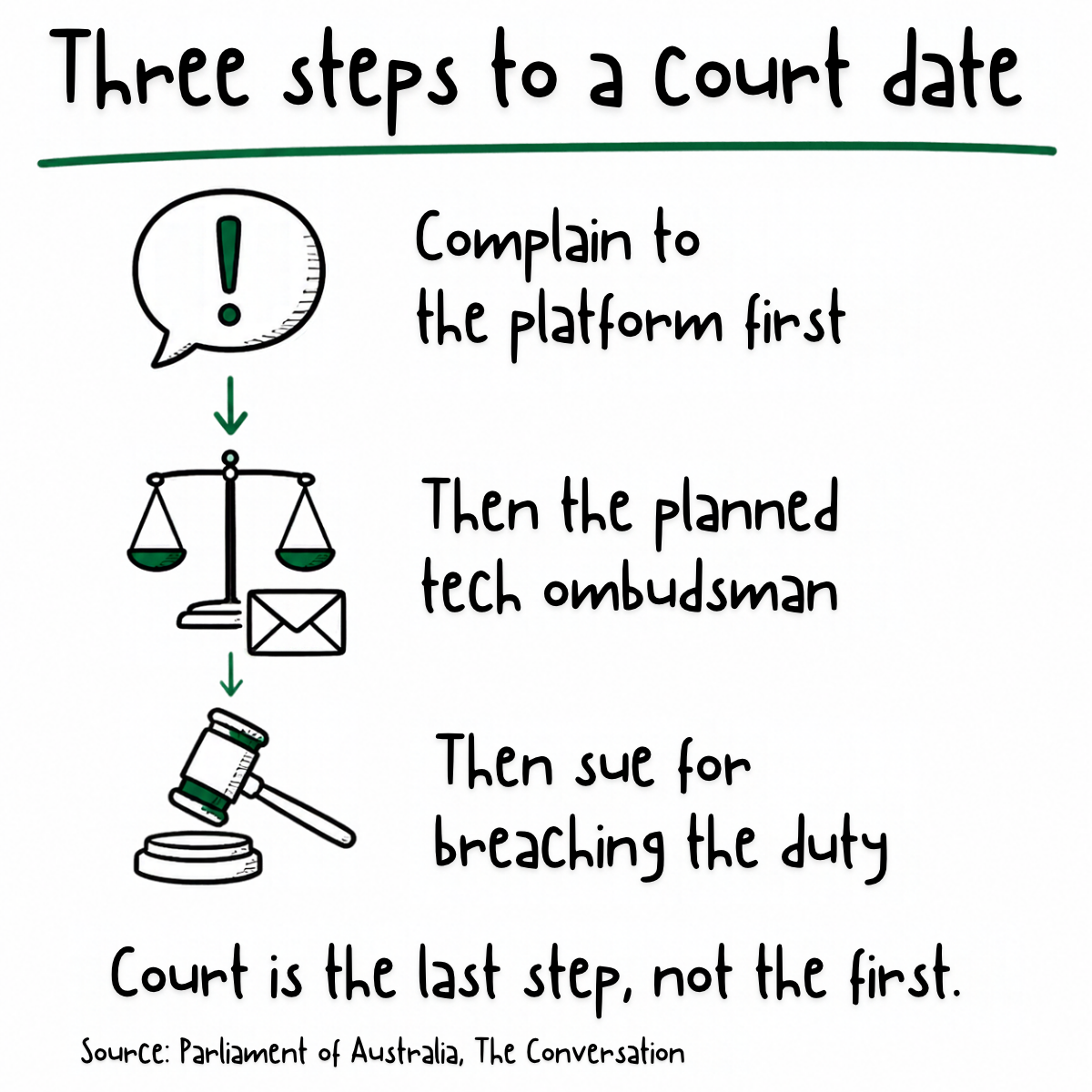
Wells said the 5% figure is a ceiling, and that courts elsewhere have rarely imposed maximum penalties. She put it between Canada’s 3% and the EU’s 6%.
Who backs the law and who doesn’t
Prime Minister Anthony Albanese told Parliament the law is a “powerful instrument to protect our children and our society from online harms by placing the onus on the tech platforms to ensure a safer online environment”, The Record reports. After the vote Wells called it “a landmark safety reform in the vein of compulsory seatbelts”, per The Next Web. Greens communications spokesperson Sarah Hanson-Young said: “My message to Big Tech companies is it’s time to make your platforms safe or we will see you in court.” (Greens statement). A September Australia Institute poll found 93% of 1,042 respondents want platforms legally required to provide a safe online environment, ACS Information Age reports.
The Coalition says the law goes too far. Shadow industry minister Andrew Hastie told the ABC it would lead to “a massive imposition on free speech and political communication”, The Guardian reports. Opposition communications spokesperson Sarah Henderson called it “policy on the run, driven by an insidious agenda to shut down lawful speech and control political debate”, per Time. Wells answered that “this is not about what you say online. It’s about what the platforms do or fail to do online.”
The US government objected before the vote. In a 22 September submission, the US Embassy in Canberra said the framework risked platforms “defaulting to pre-emptive censorship” and asked Australia to “withdraw any plans to mandate that platforms algorithmically suppress content”. US ambassador David Brat wrote that “vaguely defined ‘harms’, backed by penalties of up to 5 per cent of global revenue, will push platforms to censor lawful speech”, as Australasian Lawyer quotes the Financial Review. Wells met Brat on Tuesday and described the conversation as friendly, with differences still being worked through, The Next Web reports.
Industry groups split on the detail. The Tech Council of Australia, whose members include Google, Microsoft and LinkedIn, told The Guardian it supports the legislation but that “a private right of action is a complex undertaking with significant consequences”, per Time. Google, Meta and Snapchat declined to comment to Reuters on the 5% fine, and the Digital Industry Group declined because it hadn’t seen the revised draft, according to The Straits Times. At a Senate hearing earlier in November, Mi3 reports, Meta said it runs more than 22 recommender systems and that individuals could struggle to obtain evidence available to regulators, Alphabet warned the bill’s age checks could restrict under-18s’ access to email, messaging and private file storage, and Snap’s Ben Au said the companies’ asks were “adding scaffolding”, not loopholes.
How the law compares
Australia’s 5% ceiling is lower than the 10% in the UK’s Act and in New Zealand’s bill, and higher than the 3% in Canada’s bill.
| Place | Law and status | Fine ceiling | Main focus |
|---|---|---|---|
| Australia | Digital Duty of Care. Passed 25 November 2026; the duty starts after 12 months | A$109 million or up to 5% of global revenue | A safety duty on covered services for all users, stricter for under-18s, plus a right to sue |
| UK | Online Safety Act 2023, enforced by Ofcom | £18 million or 10% of qualifying worldwide revenue, whichever is greater | Illegal content and child safety duties, with age assurance |
| EU | Digital Services Act, enforced by the Commission on the biggest platforms | Up to 6% of worldwide annual turnover | Risk duties on very large platforms and search engines |
| Canada | Bill C-34, the Safe Social Media Act. Second reading passed 29 October 2026; now at committee | Up to 3% of global revenue or C$10 million, per Liberal MPs in debate | Duties to act responsibly and protect children, 24-hour removal of two content types, and no accounts for under-16s on some services |
| New Zealand | Online Safety (Minimum Age and Child Safety Risk Assessment) Bill. Introduced 24 August 2026 | The greater of NZ$40 million or 10% of global turnover | Under-16 account ban on high-risk platforms, plus annual child safety risk assessments |
| US | Not law. The House passed the KIDS Act on 29 June 2026; a Senate committee advanced S. 1748 on 5 August | Not applicable | The House bill has no duty of care section; S. 1748 has one |
The UK’s regulator has started with small targets. The fines Ofcom has published run from £80,000 to £950,000 and have landed on pornography sites and a suicide forum, according to the House of Commons Library briefing and Ofcom’s October bulletin. Ofcom opened an investigation into TikTok on 16 July. In the EU, the Commission fined X €120 million in December 2025 under the Digital Services Act, and on 17 November it preliminarily found Temu in breach of the Act’s duty to tackle illegal products.
The US has no equivalent in law. The Record reports that a US duty of care bill for large platforms has stalled in Congress, and the Congressional Research Service says the House-passed KIDS Act dropped the duty of care that the Senate committee’s version keeps.
What it means in New Zealand
New Zealand’s government introduced its own bill on 24 August. The bill bans under-16s from high-risk social media platforms and social AI companions, requires platforms to assess and report on risks to all children under 18, and puts a regulator inside the Department of Internal Affairs, according to the Beehive release. Law firm Simpson Grierson says it closely follows Australia’s under-16 law and adds the ongoing risk assessments. The Act would start six months after Royal assent.
The two approaches differ in reach. Australia’s duty protects all users and gives them a way to sue. New Zealand’s bill is built around children and relies on the regulator and penalties. Parliament’s Education and Workforce Committee, in its October inquiry report, recommended increasing platforms’ civil and regulatory liability for harm from the content they host and their design, and setting up an independent online safety regulator.
Australia’s under-16 social media ban, in force since December 2025, is the model New Zealand’s bill follows. The Australian Government says it led to more than 5 million account deletions, per Jurist. MinterEllison’s August note on the New Zealand bill says early evidence suggests the Australian Act hasn’t achieved its objectives, with use of TikTok, Instagram and Snapchat among 13 to 15-year-olds back close to pre-ban levels in news reporting and VPN use cited as a reason.
What isn’t settled
The rules that carry the detail haven’t been written. Nicholls says the dispute resolution scheme, the small-business exemption and the treatment of addictive design all depend on rules still to come and on the eSafety Commissioner’s judgement.
Aashish Srivastava, a senior lecturer at Monash Business School, says the 5% penalty “should strengthen deterrence for very large platforms”, but that the law’s practical effect “will depend on how the legislation defines breach, causation, recoverable harm and available remedies”, as ACS Information Age quotes him. The Australian Computer Society’s chief executive, Prins Ralston, says platforms will need qualified people to test their own safety claims and that “twelve months isn’t long to find them”.
The Coalition’s opposition leaves the law open to being unwound, or under-resourced, after a change of government, Nicholls writes. Meta, Google and Snap have given no public view on the final text.
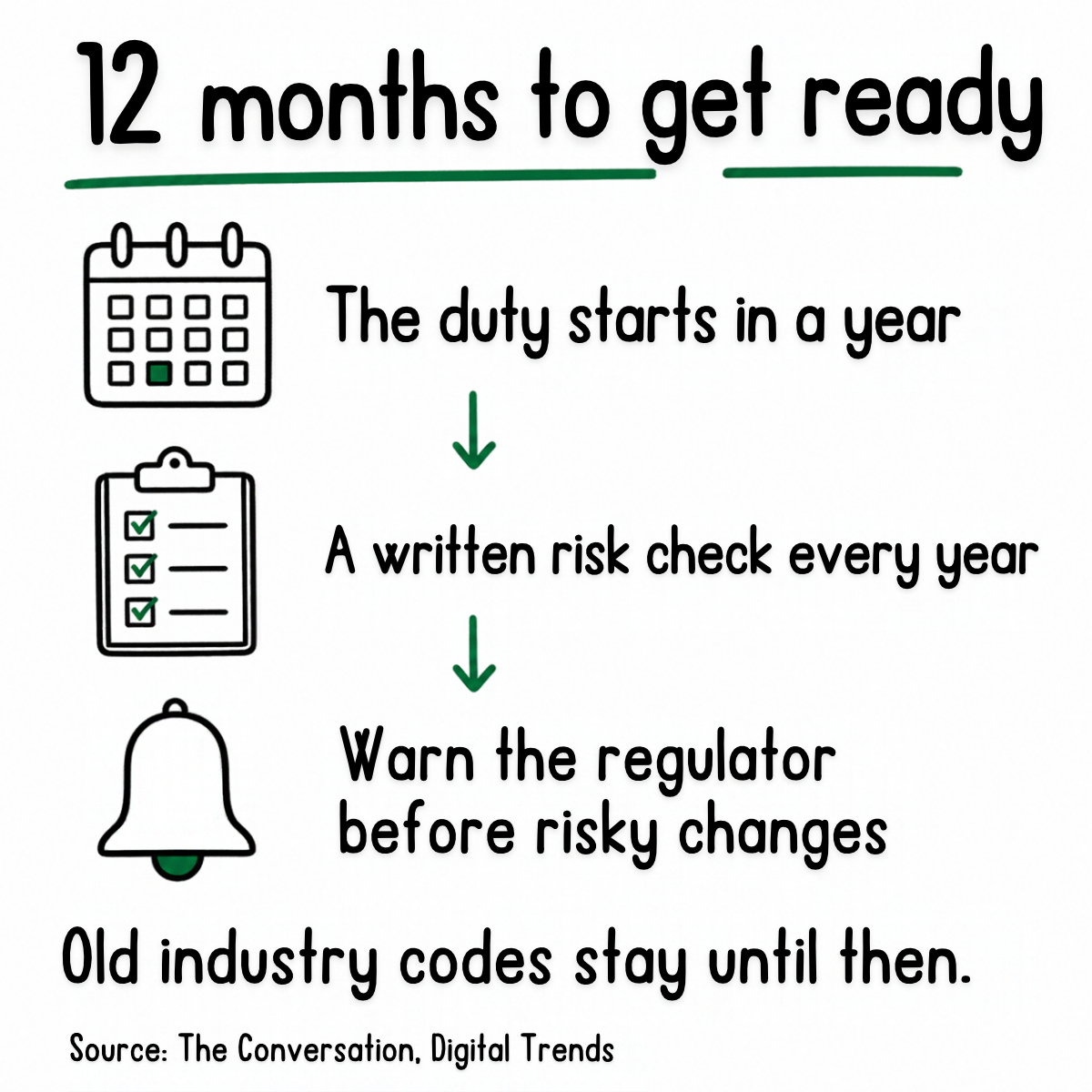
The duty starts in 12 months. Until then the existing industry codes stay in force, Digital Trends reports.
Discover more from Sulat AI & Tech News
Subscribe to get the latest posts sent to your email.