The FCC has authorised SpaceX to deploy up to 1,000,000 satellites to run data centres in orbit. The agency calls it “the first authorization in U.S. history for a constellation of data centers in space”. The order, DA 26-1273, was released on 25 November, US time, and it is narrower than the headline. It licenses the satellites’ backup radio links, it clears the debris plan only below 600 km, and it sets milestones that run to 2040.
I read the full order, the FCC press release, SpaceX’s filings and its Starmind page. Several things the press release says are not what the order says.
What the FCC actually approved
The Space Bureau granted the application in part and deferred part of it, with conditions. The Chief of the Space Bureau signed it under delegated authority, so this was not a vote of the commissioners. It took effect on release. SpaceX filed the application (call sign S00798) on 30 January 2026, and the FCC accepted it for filing on 4 February.
The grant covers 1,000,000 non-geostationary satellites in shells that are each 50 km thick, between 500 and 1,002 km above Earth. SpaceX had asked for shells up to 2,000 km. The inclinations are 30 degrees and sun-synchronous.
What the FCC licensed is small. It covers radio backup and emergency telemetry, tracking and command in the Ka band: 18.8 to 19.3 GHz down and 28.6 to 29.1 GHz up, on an unprotected, non-interference basis. The order says plainly that “Starmind will rely on optical links for communications”. Those lasers fall outside the FCC’s jurisdiction. In a 16 September letter, SpaceX told the FCC its optical links are available more than 99 per cent of the time on Starlink’s data, and that it would use Ka band as a “last resort” and for at most 100 channels of 5 MHz.
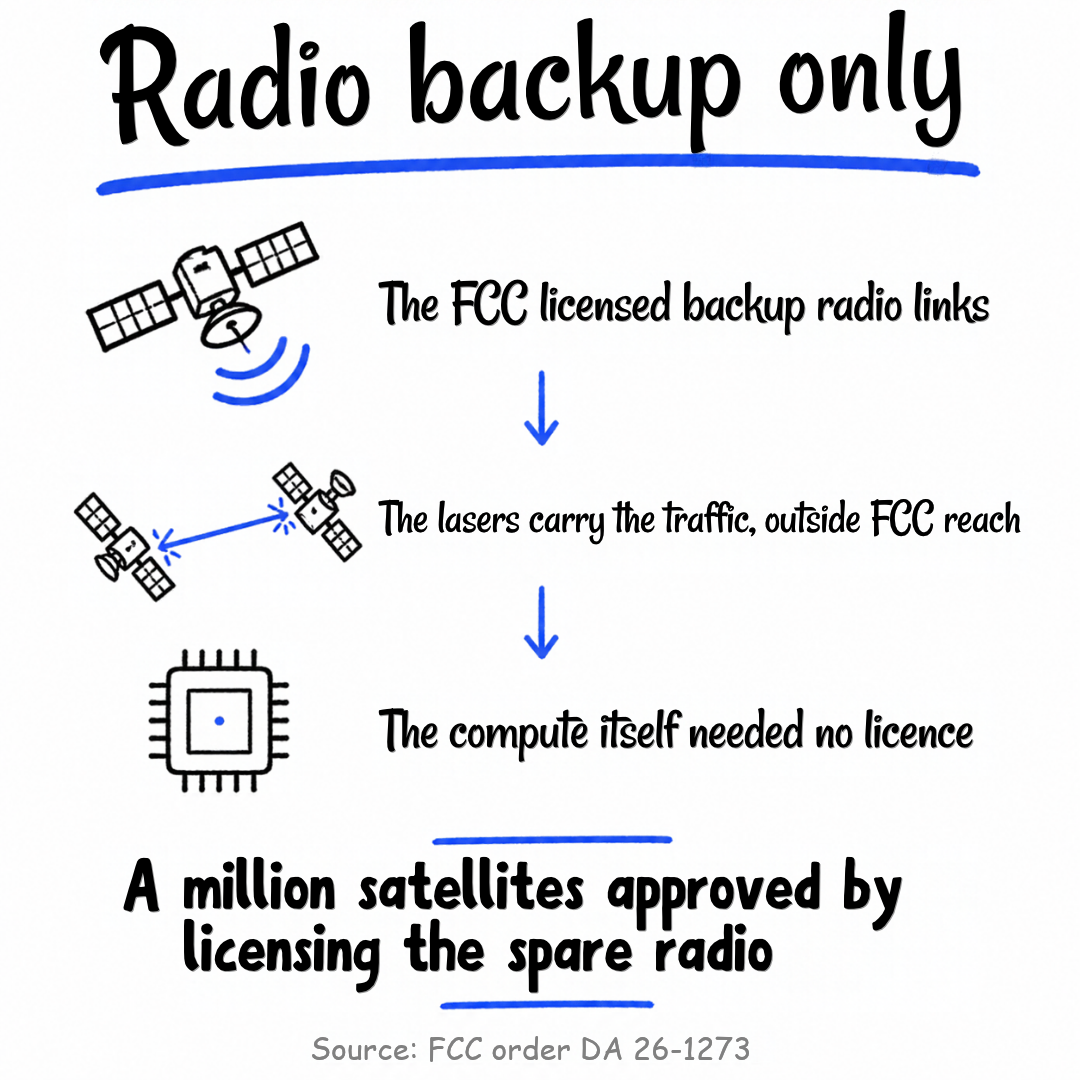
So the licence is about the spare radio, not the compute or the lasers. The FCC also waived the U.S. Table of Frequency Allocations on its own motion to make the Ka-band use fit. It set conditions: SpaceX must stop on documented harmful interference, coordinate with federal users through the NTIA before using the 18.8 to 19.3 GHz band, and give a 24-hour contact two weeks ahead.
The milestones that keep the licence alive
The authorisation is null and void if SpaceX misses a milestone. It needs one satellite in orbit by 25 November 2033, 10 per cent (100,000) by 25 November 2035, half (500,000) by 25 November 2038 and the full million by 25 November 2040. The FCC replaced the old milestone rule with the new Space Modernization milestones it adopted in July (FCC 26-47). It also waived the Schedule S software limit, the processing round rules and the surety bond.
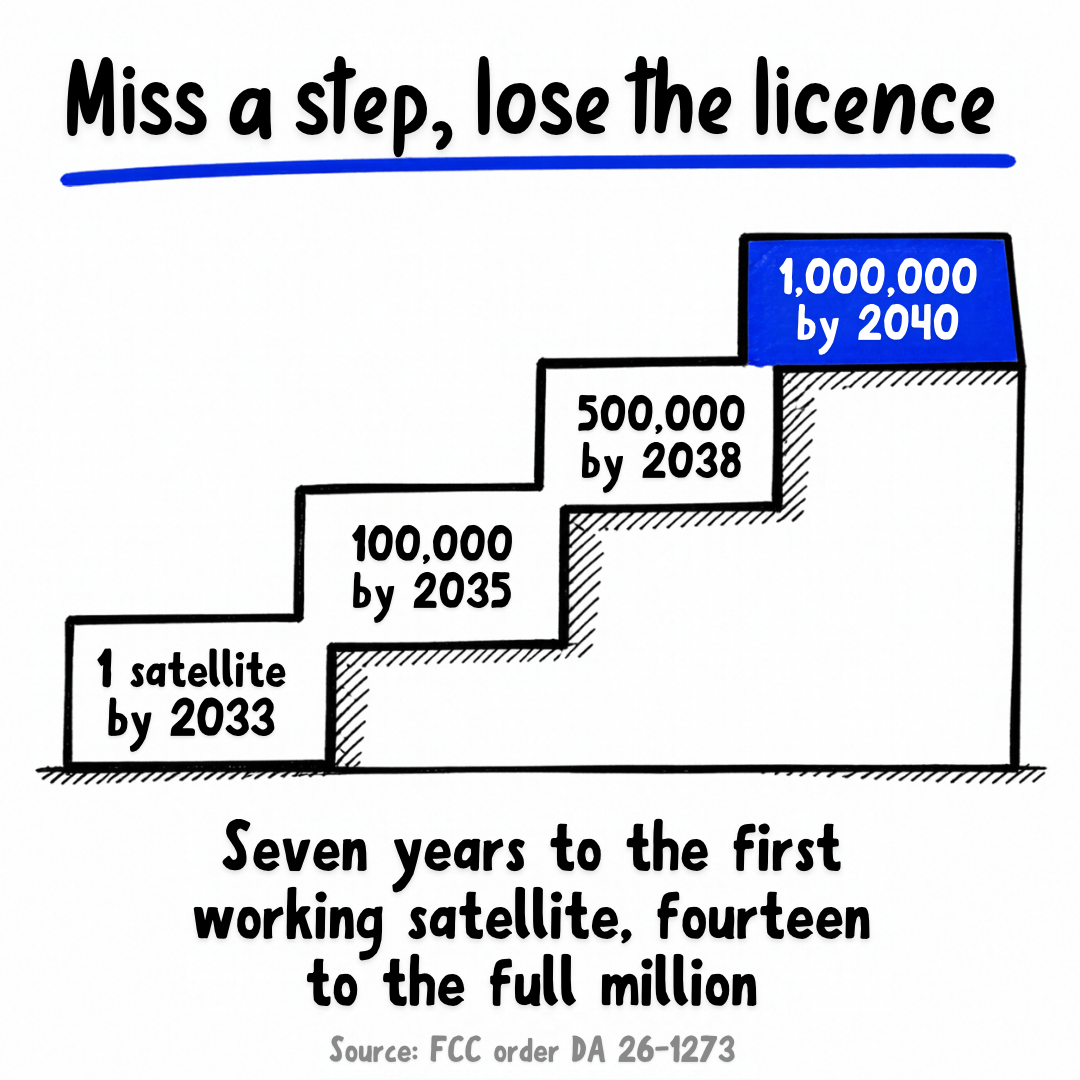
The licence term is 15 years. It starts when SpaceX certifies that the first satellite is operating, which it must do within five business days. SpaceX has 30 days from release, until 25 December, to decline the grant as conditioned. If it says nothing, that counts as acceptance.
The 2033 date is far later than SpaceX’s own talk. Space.com reports the first Starmind launch is targeted for the third quarter of 2027 on Starship, and Reuters reported demonstrations by late 2027, ahead of the “as early as 2028” in SpaceX’s IPO filing. The milestone is a floor set seven years out. It is not a forecast.
The 600 km line
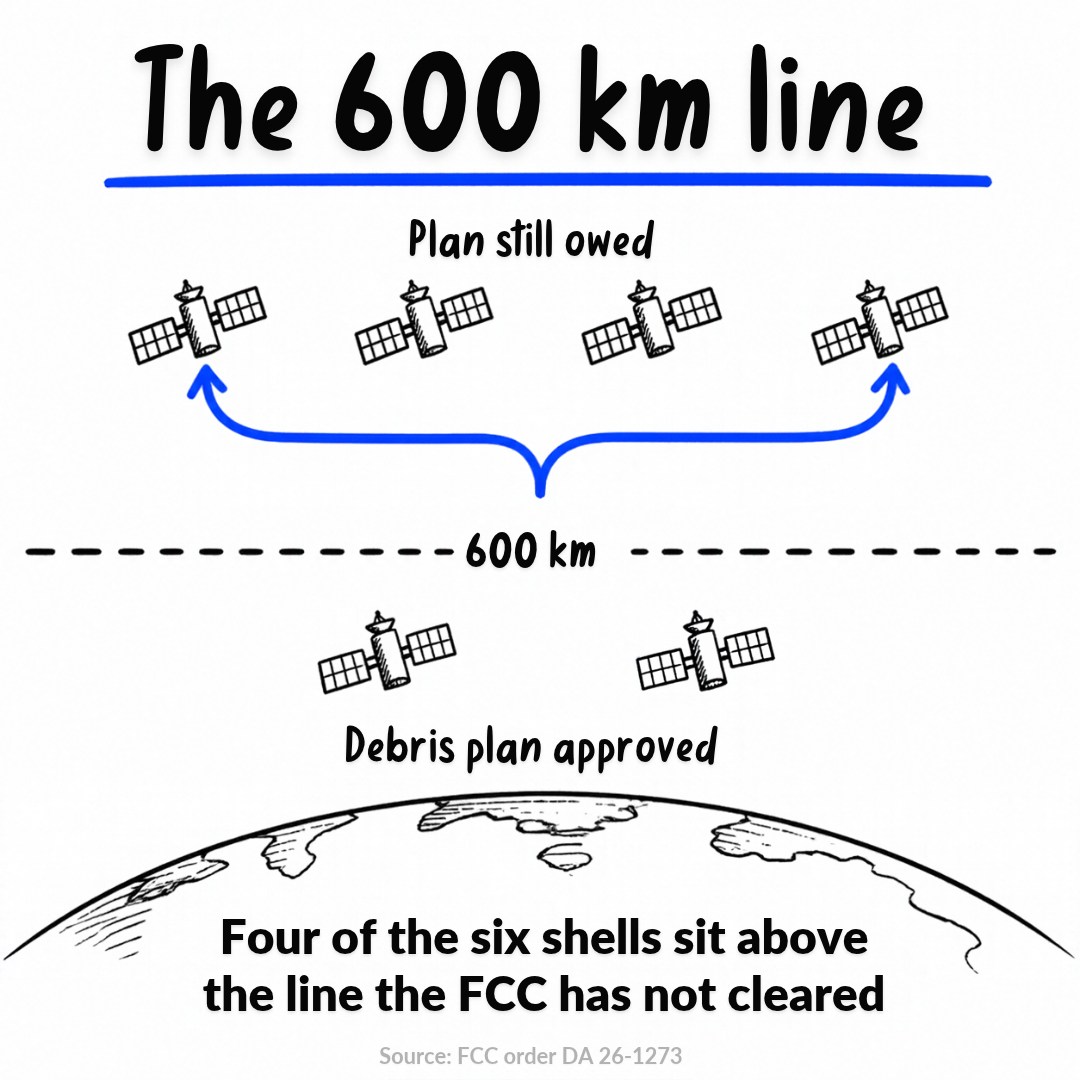
The FCC press release says the system “operates consistent with the FCC’s orbital debris rules”. The order is more careful. It finds SpaceX’s debris plan compliant only for satellites below 600 km, and it requires a final plan, filed as a modification, before SpaceX deploys anything above that altitude.
That matters because most of the constellation sits higher. Of the six nominal shells, two are below 600 km (550 to 568 km and 565 to 585 km). Four are above it: 686 to 718 km, 707 to 744 km, 946 to 978 km and 967 to 1,002 km. SpaceX has asked to dispose of satellites above 600 km into Earth disposal or heliocentric orbits instead of reentering within five years. The FCC deferred that waiver, and SpaceX must justify it before deploying any satellite that won’t reenter.
SpaceX has made commitments. It will deploy low first and test before raising satellites, aim reentries at the ocean, design for full demise and run a controlled deorbit. Its letter puts a propulsive deorbit from 585 km at under 60 days, and it promises to share ephemeris data. It must also file reports each 1 January and 1 July on conjunctions, manoeuvres, satellites removed or reentered, and deployments with orbital parameters.
The scale is the problem. Ars Technica puts the grant at roughly a 50-fold increase in satellites in orbit, and Space.com counts about 28,000 launched since 1957. KeepTrack lists 11,203 Starlink satellites in orbit as of 24 November. Each Starmind satellite has about a five-year life, so a constellation that size needs constant replacement.
Who objected, and how the FCC answered
The application drew a “substantial number of comments from the public”, about 1,500 by the American Astronomical Society’s count. The FCC denied petitions to deny from Kuiper Systems (Amazon Leo), Viasat and the AAS. Secure World Foundation, Dark Sky International, the Square Kilometre Array Observatory, WISPA and the Center for Space Environmentalism also commented, and NASA sent a letter questioning the milestones.
Amazon argued in its 6 March petition that deploying the constellation “would take centuries, even assuming the availability of all global launch capacity to do so”. It called the filing “a lofty ambition rather than a real plan” and “a speculative placeholder rather than a complete application”. At a five-year satellite life, Amazon said, SpaceX would need 200,000 replacements a year, more than 44 times global satellite launch output in 2025. Amazon also said the plan “risks real harm”. Both can’t be fully true: either the constellation is a placeholder, or it will fill the sky. Amazon is also a rival, with 3,232 satellites licensed and about 388 in orbit by Orbital Radar’s count. I covered its launch pace in our report on the Vulcan launch.
In many cases, the comments seek to substitute the government’s judgment regarding the viability of business endeavors for that of the applicant and private enterprise. We decline to do so.
FCC order DA 26-1273, paragraph 18
On numbers, the Bureau wrote that the Commission’s rules “do not place limits on the number of space stations” and that it “declines to invent a de facto rule”.
The astronomers got less. The AAS warned of tens of thousands of sunlit satellites visible at once, “crawling grids” to the naked eye, an infrared signature from waste heat and saturation of the Rubin Observatory. The FCC held the infrared concern outside the scope of a radio licence. It routed astronomy through NTIA coordination with NASA, NOAA and federal astronomy bodies, and noted SpaceX’s commitment to coordinate with the National Science Foundation. It declined extra conditions, citing its July grant to Reflect Orbital (DA-26-706). It rejected the Square Kilometre Array Observatory’s radio-reflection claim as unsupported.
There was no environmental review either. The order follows the FCC’s October NEPA Order (FCC 26-64), which treats space-based operations as not “major federal actions”. Launch emissions belong to the FAA, and the order calls atmospheric effects of reentry “speculative”.
FCC Chairman Brendan Carr announced the decision on X, writing that “the Starmind & competitor constellations will use solar power to extend America’s lead in Super Intelligence”. Elon Musk replied: “Much appreciated. This will be a great asset to America and the world.” The FCC’s release adds that Carr sees the grant as opening “a bold new frontier for the computing infrastructure needed to power America’s leadership and growth”. It also says the agency “is continuing to review additional orbital data center proposals and intends to issue decisions on each expeditiously”.
What a Starmind satellite is
SpaceX’s Starmind page describes a satellite about 30 m tall with a 75 m wingspan, in a sun-synchronous orbit, with laser links to Starlink. It quotes a compute payload of up to 250 kW peak and 175 kW average, at 75 kW per tonne. The FCC filing sets a different envelope: a solar array under 1,500 m², a radiator under 200 m², a bus under 21 m² and a mass under 4,000 kg. SpaceX plans a Gigasat Factory in Bastrop, Texas, and says thousands of AI satellites could start “as soon as late 2027”. It describes the platform as chip-vendor agnostic.
Nvidia’s 24 August press release says the first-generation Starmind satellite is based on an optimised Vera Rubin NVL72 system. The money for that hardware is already moving: Apollo and Goldman Sachs are behind US$44bn of notes for Vera Rubin chips leased to SpaceX, which I covered in our GPU financing report. Those chips are due in the first half of 2027.
Getting a million satellites up is a launch problem first. Space.com puts Starship at no more than 60 V3 Starlink satellites per launch, which means about 1,700 launches for 100,000 next-generation satellites. It deployed 26 satellites on its most recent two test flights. Starship flies from Starbase, and its air permit is a separate story.
The rivals already in the queue
SpaceX is not alone, and the FCC says other proposals are under review. SpaceX also asked the FCC to apply Amazon’s arguments against its own plan to Blue Origin’s application, and Viasat attacked Starcloud’s.
| Player | Scale and orbit | Status |
|---|---|---|
| SpaceX Starmind | Up to 1,000,000; 500 to 1,002 km | Granted in part, 25 November 2026 |
| Orbital Compute Inc. | Up to 100,000 | FCC application filed 24 June 2026 |
| Starcloud | Up to 88,000; 600 to 850 km, sun-synchronous | FCC application filed 4 February 2026; US$170m Series A in March at a US$1.1bn valuation (Quartz); Starcloud-1 launched in November 2025 with an Nvidia H100 |
| Blue Origin | Up to 51,600; 500 to 1,800 km, sun-synchronous | FCC application filed March 2026, tied to its TeraWave network |
| Cowboy Space (formerly Aetherflux) | Up to 20,000, called Stampede | FCC application filed |
| Google Project Suncatcher | Satellites with about a rack of compute each | New Glenn launch agreement announced 19 November, target first quarter 2029 |
| Zhejiang Lab “Three-Body” | About 100 by 2027, about 1,000 by 2032 | Reported plan |
| Kepler | 10 relay satellites with compute | Launched January 2026 |
Does the economics work?
The order says nothing about cost, and SpaceX hasn’t published a price for Starmind compute. The best outside estimate I found is BCG’s, as reported by Electronics360: a gigawatt-scale orbital data centre at US$51bn to US$170bn, against US$16bn to US$38bn on the ground. That is roughly 2.5 to 3 times the cost, possibly narrowing to about 1.5 times in a decade.
The scale gives a sense of the ambition. If every satellite ran at the quoted 175 kW average, a million of them would draw about 175 GW. That is my arithmetic, not a SpaceX figure, and it assumes the full constellation flies. TechCrunch lists manufacturing cost, launch cost, cooling and chip financing as the open challenges. None of them is decided by this licence.
What happens next
- SpaceX has until 25 December to decline the grant as conditioned. Silence is acceptance.
- Before anything flies above 600 km, SpaceX must file a modification with a final debris plan, and the FCC must accept it.
- The first launch is targeted for late 2027, and the licence clock starts when SpaceX certifies the first operating satellite.
- Semi-annual reports begin on 1 January and 1 July, and they will show how many satellites actually fly.
- The FCC says it will decide the other orbital data centre applications “expeditiously”, so Blue Origin’s and Starcloud’s cases are next.
The grant clears a regulatory hurdle, and the rest is engineering and money. The order gives SpaceX a licence for the radio it hopes never to use, a debris plan for the two lowest shells and a deadline in 2033. It doesn’t tell anyone whether orbital compute can beat the ground on cost.
Discover more from Sulat AI & Tech News
Subscribe to get the latest posts sent to your email.