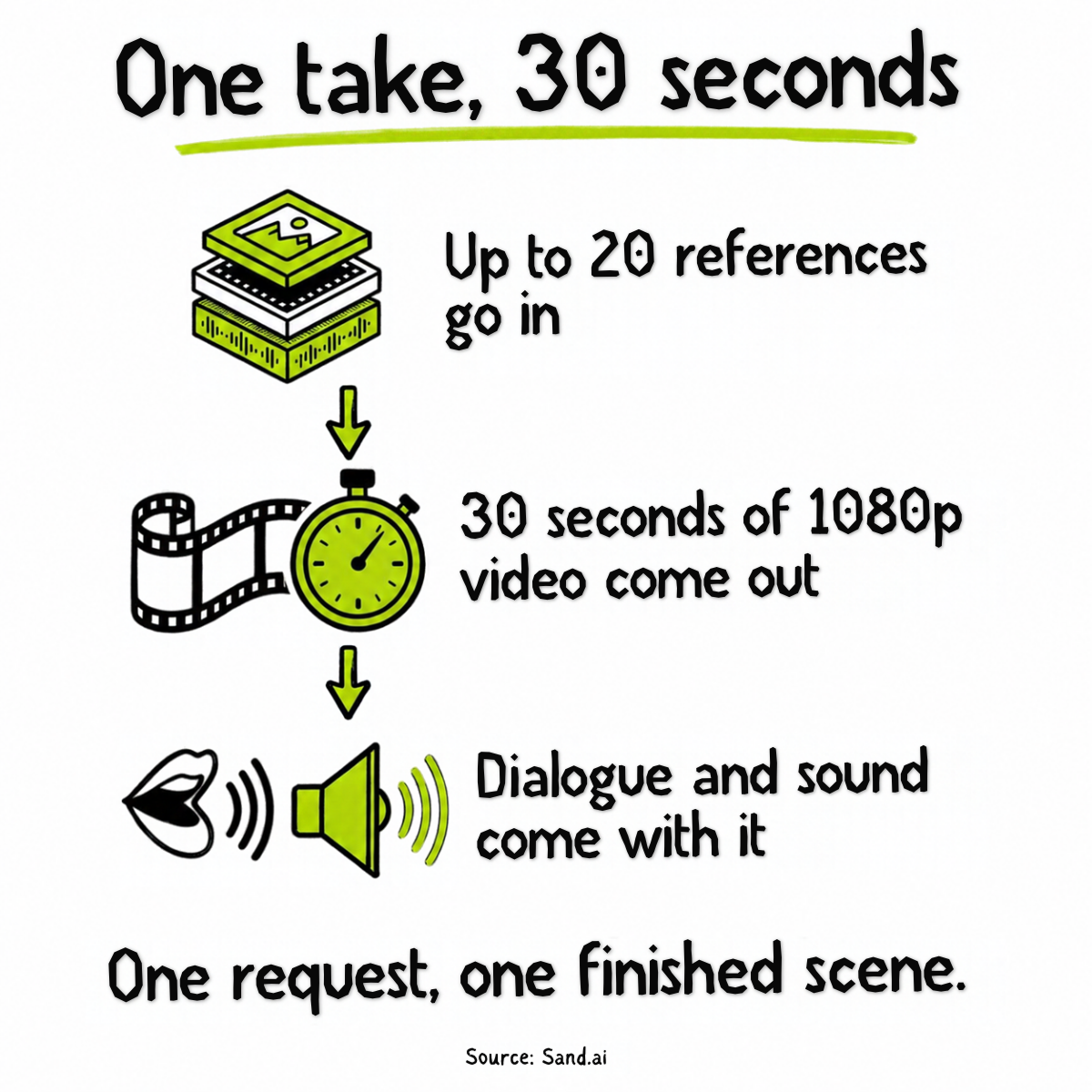
Higgsfield says MAGI-2, a video model from Sand.ai, is live on its platform. The company posted on X on 25 November (US time) that the model is “live, exclusively on Higgsfield” and called it the largest near-SOTA video model you can try for free. The post lists three numbers: US$0.08 per second of generation, 480B parameters with about 28B active at a time, and clips of up to 30 seconds at 1080p with up to 20 references. It closes with a Black Friday pitch of up to 70% off. Here’s what the model is, what it costs, how it ranks, and where Higgsfield’s wording runs ahead of the published facts.
- What Higgsfield posted
- What MAGI-2 is
- What it costs
- How it ranks
- Where the claims don’t line up
- Limits Sand.ai lists
- How it sits against Seedance 2.5, Wan 3.0 and Kling 4.0
- If you want to try it
What Higgsfield posted
The post carries a 46-second video, and its text makes five claims: the model is live, it’s exclusive to Higgsfield, it’s “near-SOTA”, it’s free to try, and it’s cheap. Three of those hold up as stated. The other two need a footnote, and I get to them below.
What MAGI-2 is
Sand.ai released MAGI-2 on 24 November. It’s the full-size follow-up to MAGI-2 Preview, which came out in August with about 114B parameters in total and about 6B active. The flagship has 480B in total and about 28B active, and Sand.ai trained it on roughly 4 trillion tokens, about three times the Preview’s data.
Sand.ai says it reached that scale with a design called Multi-Head Latent MoE. Each token is split into separate heads, each with its own router and experts, so the experts a token needs sit on the same GPU and the network traffic between GPUs stays predictable. Video, audio and text tokens run through one transformer, which means the sound is generated with the picture instead of being added afterwards. That covers dialogue with lip-sync, foley, ambient sound and music.
| Spec | MAGI-2 |
|---|---|
| Size | 480B total, about 28B active (Sand.ai) |
| Training data | About 4 trillion tokens |
| Clip length | 4 to 30 seconds on Higgsfield, up to 30 seconds per Sand.ai |
| Output | 1080p at 25 fps, six aspect ratios, sound included |
| References per request | Up to 20: 10 images, 5 videos and 5 audio clips |
| Controls | Start and end frames, timed shot cuts, targeted editing of existing video |
| Weights | Not released for the flagship; the August Preview is downloadable |
On Artificial Analysis Video Arena v2.1, Sand.ai reports a 4-task average Elo of 1150.3 for MAGI-2, up 151.8 points from the Preview’s 998.5. That’s Sand.ai’s number about its own model, and I haven’t found an independent run of it.
What it costs
Higgsfield’s web app runs MAGI-2 at 2.5 credits per second. The API charges US$0.08 per second, and Sand.ai’s own API lists the same rate. MAGI-2 renders at 1080p only, so a shorter clip is the one way to spend less.
US$0.08
Per second of 1080p video through either API, sound included
US$2.40
A 30-second clip through the API
75
Credits for the same clip in the web app, about US$3.69 on the US$59 Plus plan
Higgsfield’s pricing page showed a Black Friday sale of up to 70% off when I looked, with Plus at US$30 a month on yearly billing. The post’s “for free” line is the one claim I couldn’t match to a page. The plan table I checked lists free generations for Genjutsu and Soul but none for MAGI-2, and the Free plan carries no monthly credits. Higgsfield’s post doesn’t say what the free access covers.
How it ranks
Higgsfield backs “near-SOTA” with its own Video Arena, where professional directors, animators and designers pick between two unlabelled clips made from the same prompt. MAGI-2 came second of six models, with a score of 1146 and a 60.5% overall win rate. It beat Seedance 2.0 in 71% of matchups, Wan 3.0 in 79%, and Kling 4.0 and MiniMax H3 in 83% each. The one model ahead of it, Seedance 2.5, won 61% of their matchups.
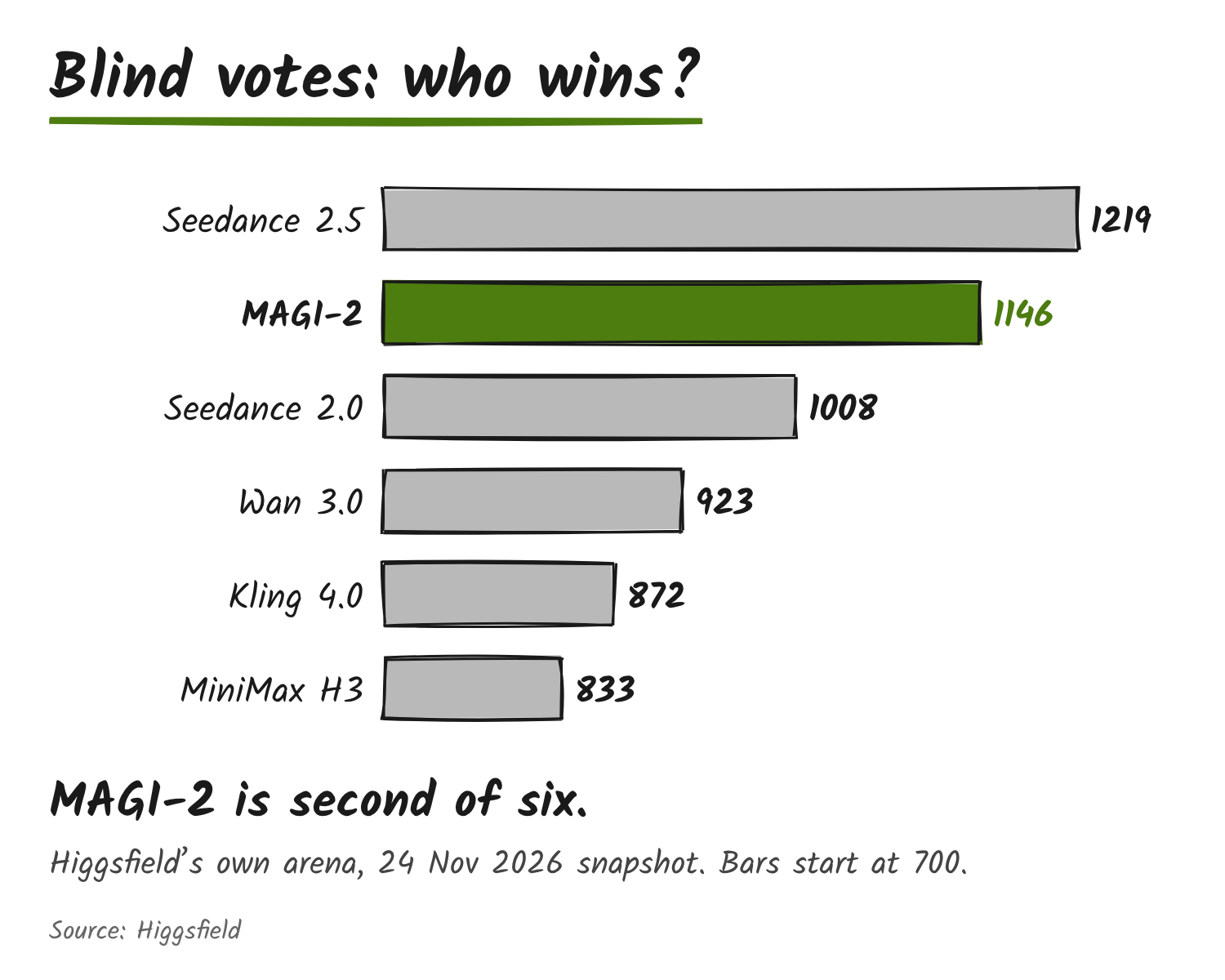
Higgsfield runs that arena, and the snapshot is from 24 November, so the order is Higgsfield’s own result. Higgsfield also says MAGI-2 costs less per second than Seedance 2.0, Wan 3.0 and Kling 4.0 on its platform, and that only MiniMax H3 is slightly cheaper while ranking last.
Where the claims don’t line up
Size. Higgsfield’s announcement calls MAGI-2 a 400B model. Sand.ai’s post says 480B, and Higgsfield’s own access guide repeats Sand.ai’s 480B figure.
Exclusivity. The headline says exclusively on Higgsfield. Sand.ai also lists MAGI-2 on its own API platform at the same US$0.08 a second, and its site links to VidMuse as an official partner. Higgsfield’s own access guide lists all three routes.
Open weights. Higgsfield titles its announcement “Open Weights” and says the weights are coming soon. Sand.ai says it will open-source MAGI-2 and publish a technical report, with no date and no licence named. The weights you can download today belong to the August Preview, which has 114B parameters and about 6B active.
Most references. Higgsfield pitches the model as the largest open-source omni-reference model to date. Twenty references per request is fewer than Seedance 2.5 takes, as the peers section shows.
Limits Sand.ai lists
Sand.ai names its own gaps. Extreme high-speed motion can produce trajectory or continuity artifacts, medium and wide 2D animation can look overly smooth, and complex soundscapes lack layering and physical realism.
It also reports a trade-off from post-training. Tuning on several thousand curated clips lifted visual polish, but the visual reasoning, implicit storytelling and cross-lingual behaviour seen in the pre-trained model became harder to elicit. Sand.ai compares that to the alignment tax in language models and says polish “is no longer the only metric that matters”.
Access has limits too. Higgsfield runs one MAGI-2 job at a time per account, on the web and the API, and raising that takes an Enterprise plan. Sand.ai’s API says top-ups aren’t supported yet, with the date to be announced on its X account.
How it sits against Seedance 2.5, Wan 3.0 and Kling 4.0
MAGI-2 joins a crowded field of 30-second models. ByteDance launched Seedance 2.5 on 31 July with 30-second clips and a bigger reference allowance: up to 30 images, 10 video clips and 10 audio clips in one request, against MAGI-2’s 10, 5 and 5. It also supports timestamp-level editing and up to two extensions.
| Model | Higgsfield arena score | MAGI-2 head-to-head | Higgsfield API, 1080p per second |
|---|---|---|---|
| Seedance 2.5 | 1219 | Beats MAGI-2 in 61% of matchups | US$0.6518 |
| MAGI-2 | 1146 | – | US$0.08 |
| Seedance 2.0 | 1008 | MAGI-2 wins 71% | US$0.4293 |
| Wan 3.0 | 923 | MAGI-2 wins 79% | US$0.15 |
| Kling 4.0 | 872 | MAGI-2 wins 83% | US$0.1879 |
| MiniMax H3 | 833 | MAGI-2 wins 83% | – |
On price, MAGI-2 at US$0.08 is the cheapest 1080p rate in that list by a wide margin. On rank, it’s second to a model that costs about eight times as much per second. That pairing is the real pitch, and Higgsfield’s own arena supports it.
If you want to try it
Start with a short clip and a long, structured prompt. Higgsfield’s two 30-second demos both use prompts that run to sections: scene context, the reference list, camera path, timed action, audio and constraints. One holds a single take with no cuts across 745 frames, and the other keeps two characters consistent from three references through a cut and a crowd. The prompts are on Higgsfield’s announcement page, and each can be copied and rerun.
For a cost check, a 4-second test is US$0.32 through the API and 10 credits in the web app. Rerun the one you like at 30 seconds only after the short one reads right, because every second is billed whether or not you keep it.
Sources
- Higgsfield on X, 25 November 2026
- Sand.ai: A 480B Frontier Video Generation Model, 24 November 2026
- Higgsfield: Announcing MAGI-2
- Higgsfield: Best ways to access MAGI-2
- Higgsfield: pricing plans
- ByteDance Seed: Introducing Seedance 2.5, 31 July 2026
- Sume: Higgsfield pricing 2026, 17 November 2026
Discover more from Sulat AI & Tech News
Subscribe to get the latest posts sent to your email.