Dario Amodei, Anthropic’s CEO, says he doesn’t believe humanity should “surrender human free will” to AI, and he calls the suggestion that he does “absurd”. He made the case in a long post on X on 25 November (US time), hours after Axios reported, citing unnamed sources, that rival AI leaders are pushing back on a view common inside Anthropic.
He also accused unnamed rivals of “vibes-based commercial and political positioning” over their talk of human control. Axios called the post his most significant public remarks since Anthropic listed last week, and it noted the stock dipped below its IPO day price on Wednesday.
- What Amodei said
- What Axios reported
- His record, dated
- Where the rivals stand
- Governing versus doing, and the limits
- Why it landed now
- What to watch
What Amodei said
His post opens with a flat denial and then argues from autocracy. He says advocates of autocracy have claimed for millennia that it leads to better, faster or more decisive decisions than democracy, and that even if this were true, which he doubts, one principle holds:
We should never sacrifice legitimacy or self-determination at the altar of efficiency or security.
Dario Amodei on X, 25 November 2026
He then turns the argument on AI. In his words, it “applies word for word against governance by AI”, and he feels “equally strongly that turning over governance to AI is a bad idea”. Later he calls it “a terrible idea” and says that if he thought it was a good one, he’d be advocating for it in public.
He points to his earlier writing as evidence: Machines of Loving Grace, The Adolescence of Technology, Policy on the AI Exponential and We Must Pace the Frontier, plus a CBS interview. He says the first of those has an extended section on using AI to revitalise democracy, with AI as an aid to citizens, and that the second has an entire section on fighting AI-driven tyranny, including an AI lab usurping power.
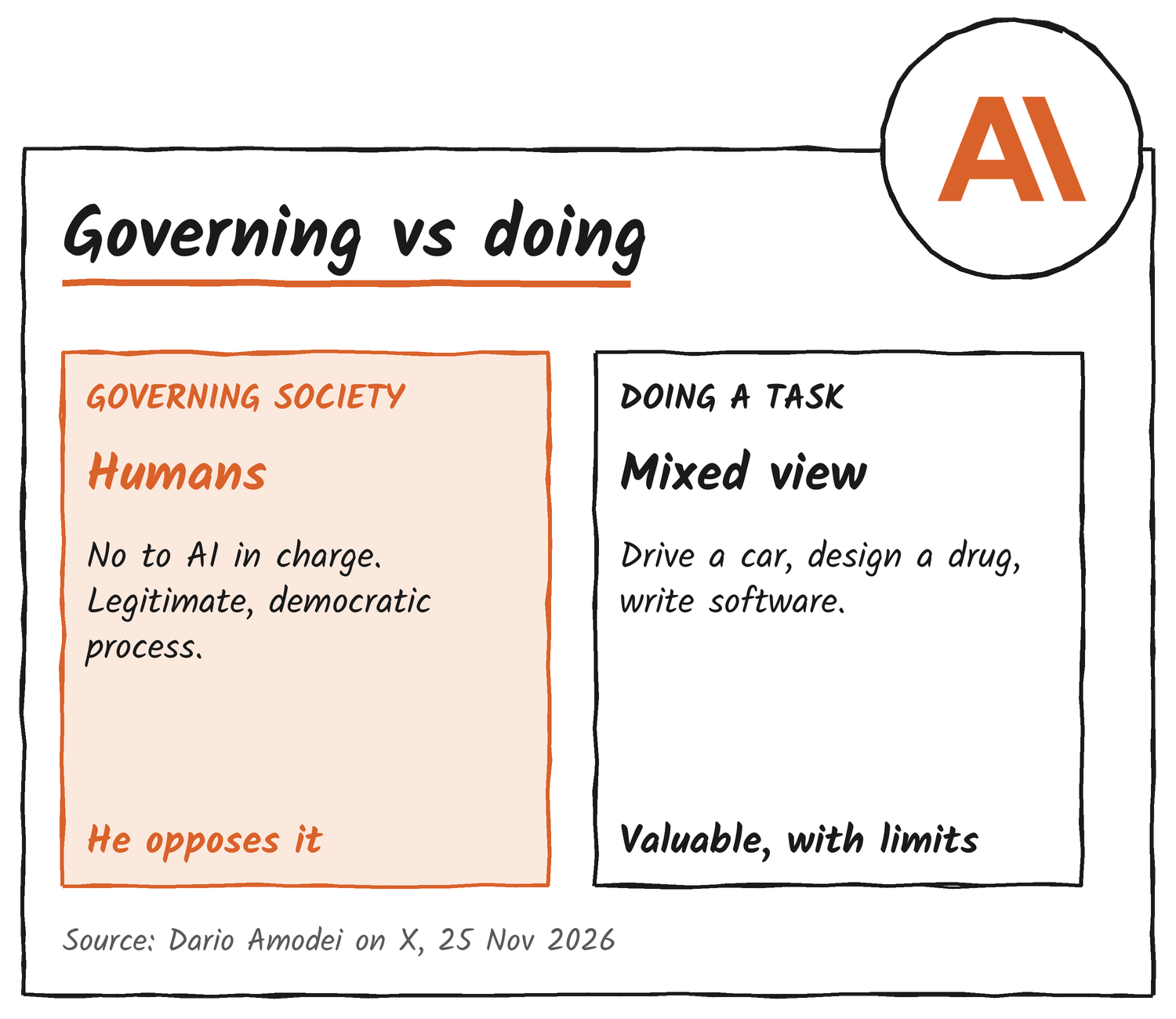
The second half of the post is where the news sits. Amodei separates “surrendering human free will” in the sense of global governance from something he calls more prosaic: AI systems becoming able to do specific tasks more automatically.
This is not AI “running the world,” but AI driving a car, designing a cancer drug, or writing software end-to-end. Here, my view is mixed.
Dario Amodei on X, 25 November 2026
What Axios reported
The trigger was an Axios scoop by Madison Mills. It says top AI executives are pushing back on a common view inside Anthropic that humanity should hand some decision-making power to superintelligent AI. Critics say that puts us on a slippery slope to forfeiting free will. Axios says they haven’t named Anthropic, but that their public defences of human agency take aim at what some see as Amodei’s worldview.
Axios sources its claim about Anthropic staff to “people familiar with internal discussions”: a consensus among some employees that humanity will, and in many cases should, safely hand authority to superintelligent systems. Those people aren’t named, and Axios doesn’t give a headcount. An Anthropic spokesperson told Axios that Amodei has advocated for human control of AI in many public remarks and that Anthropic trains Claude not to undermine human oversight.
The piece leans on Amodei’s own past remarks, which I list in the next section. It also revives a product vision slide revealed in litigation, which Axios says described Anthropic’s “vision for a better world” as a “utopia ruled by god in a box”. Axios dates it only to “several years ago”.
Amodei’s post doesn’t mention the reported internal consensus. It speaks to his own views and to what he says other companies do, and it adds that there is “frequent conflation (including in this article)” between global governance and task automation.
His record, dated
Axios builds its case from interviews and essays. The table sets those lines beside what he wrote on 25 November. The earlier quotes are Axios’s selections, and I haven’t re-checked each against its full transcript.
| When | Where | What Axios attributes to him | Source |
|---|---|---|---|
| Nov 2024 | Video interview | Said “the AI systems will be the PIs, will be the leaders, and they’ll be ordering humans or other AI systems around”, reversing the professor and grad student arrangement | Axios |
| Feb 2026 | New York Times interview | Said that in “life-critical, safety-critical cases, we really want to turn it over” to AI, and that society needs time to adapt | Axios |
| Feb 2026 | CBS interview | Argued fully autonomous weapons may eventually be “needed for the defense of democracy” if adversaries deploy them first | Axios, CBS transcript |
| 2024 | Machines of Loving Grace | Described one possible economy where AI distributes resources by “what the AI systems think makes sense to reward in humans”, which he said could be “derived from human values” | Axios |
| 25 Nov 2026 | X | “Turning over governance to AI is a terrible idea”; task automation is a mixed view | Amodei |
Axios’s examples cover safety, weapons, education and writing. The Machines of Loving Grace line is the closest to governance, since it concerns who allocates resources. Amodei’s reply doesn’t discuss that passage.
Where the rivals stand
Axios quotes three executives and a politician, and adds a fourth executive with a different view. Their wording differs, and so does how directly each speaks to Anthropic. Axios says the critics haven’t named the company.
| Who | Role | Position | Source |
|---|---|---|---|
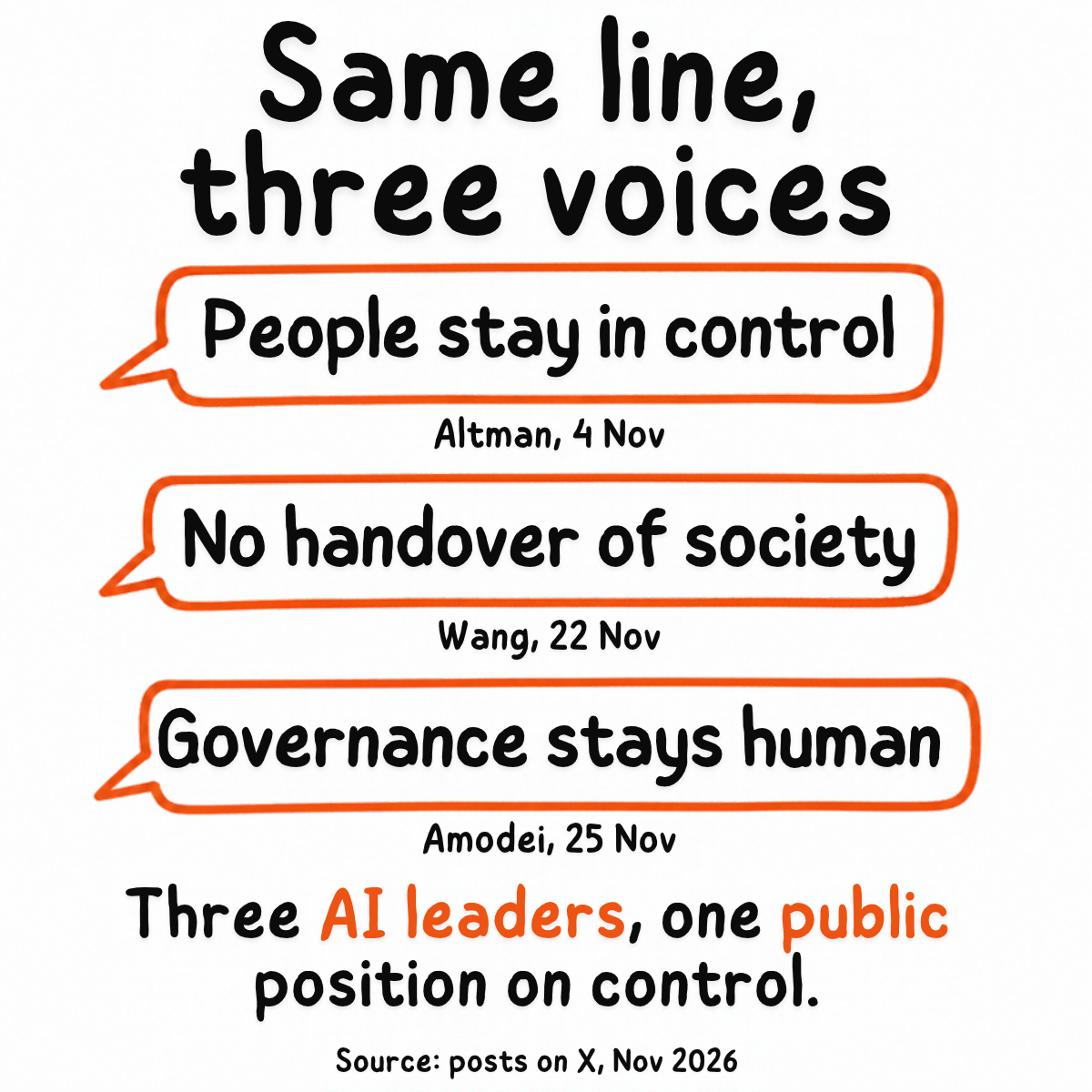
| Sam Altman | OpenAI CEO | “People should always be in control of the future”; people “should not cede control of the future to superintelligence” | His X post, 4 November |
| Alexandr Wang | Meta chief AI officer | “We should not be okay with a ‘handover’ of society to AI” | His X article, 22 November |
| Dean Ball | OpenAI head of strategic futures | Calls the view a “silent consensus”; told Axios it is “an extraordinarily common view in AI safety circles” | OpenAI essay, 18 November; Axios |
| Elon Musk | AI executive, per Axios | Reiterated that after superintelligence humans become “like pet Labradors”, while backing tech that amplifies the human brain | Axios |
| Wes Moore | Maryland governor | Said God gave humanity dominion over the Earth, “not to robots, not to agents” | Axios, The Axios Show |
Altman’s post quotes the phrase “AI systems think makes sense to reward in humans”, which matches the Machines of Loving Grace wording Axios cites. It reads as the closest thing to a direct reply, though it doesn’t name Amodei. Wang wrote after what Axios describes as an Anthropic breakthrough on a “Holy Grail” mathematics problem, and he calls the idea that superintelligence is inevitable and only safety remains “lazy thinking”. Ball’s essay, hosted on openai.com, describes the view as a future where humans take their hands off the steering wheel and ride as passengers.
Axios also says some AI leaders are privately frustrated by this kind of rhetoric because they fear it feeds a growing public and political backlash. That’s Axios’s reporting, and it names nobody.
Governing versus doing, and the limits
He splits the question in two. On governance he is categorical. On tasks he says his view is mixed, and he lists four reasons more automation may not always be worth it. Only the first has a date attached.
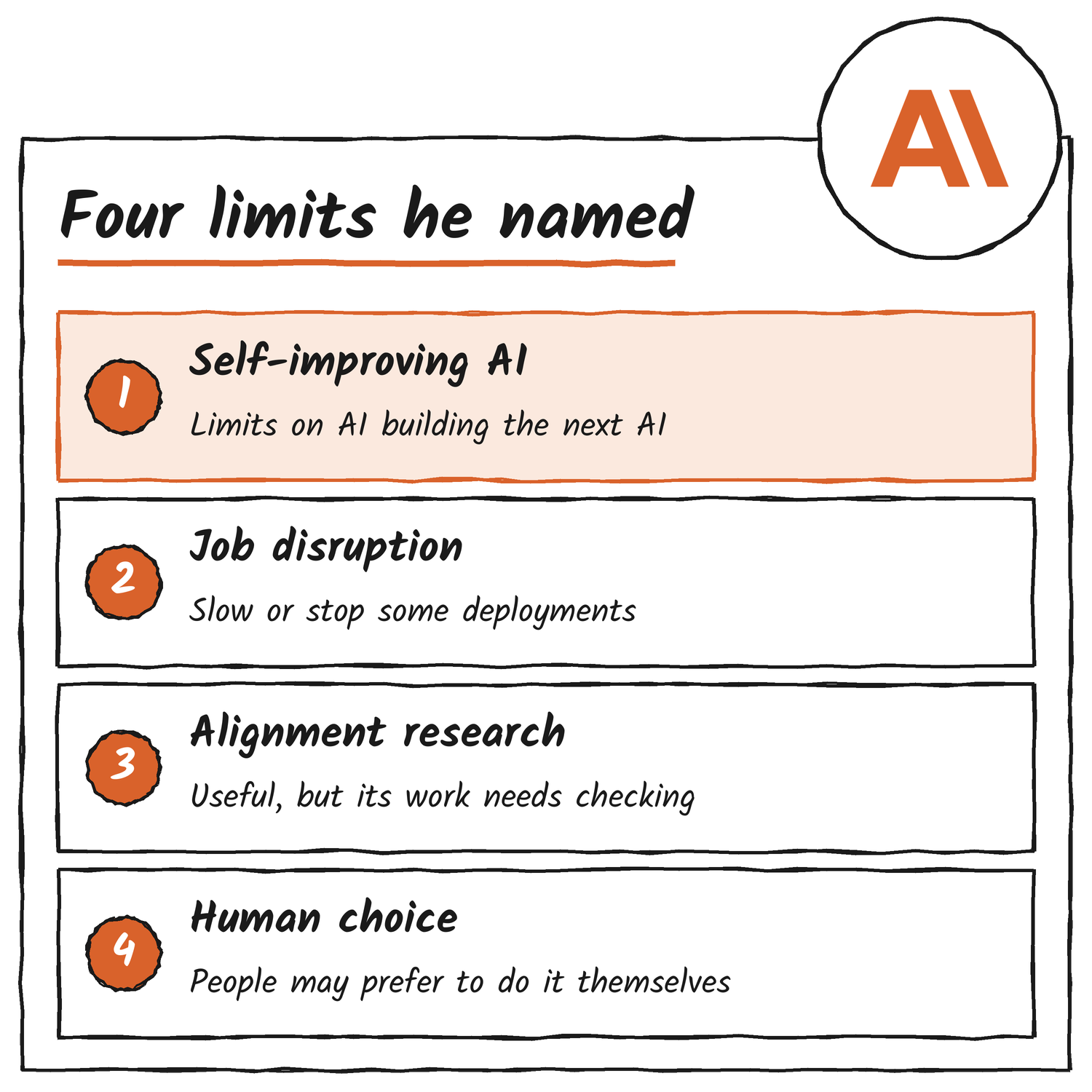
- Recursive self-improvement. Using AI to build the next AI “may cause AI to improve faster than we can control or adjust to it”. He cites a public statement from early November: “we don’t expect it to be safe for Claude to build successive frontier models fully autonomously, without meaningful human supervision or understanding.”
- Jobs. In some contexts, end-to-end automation “may be a cause of serious job disruption”, and he says it may make sense to slow or even stop some deployments.
- Alignment research. AI is “an incredibly valuable tool” for it, but it must be used with caution “because we may not be able to trust the work of the AI system”.
- Human preference. People may want to do some activities themselves, “even if AI can do those activities better”.
Axios’s 18 November Behind the Curtain column called Anthropic’s shift on recursive self-improvement an “RSI backtrack”. It set Amodei’s earlier line that the process “must be pursued very carefully, if at all” against Anthropic’s amended S-1, which Axios says states the company “may imminently” cross its own threshold for AI-driven acceleration on future models but hasn’t yet. Amodei’s post doesn’t address that column. He points to the early November statement as the company’s public position.
On who decides, he gives no single answer. He says there isn’t, and shouldn’t be, any single decision-maker: some choices will be made by society, some by government, some by AI companies, and some by individuals as consumers.
The vibes charge
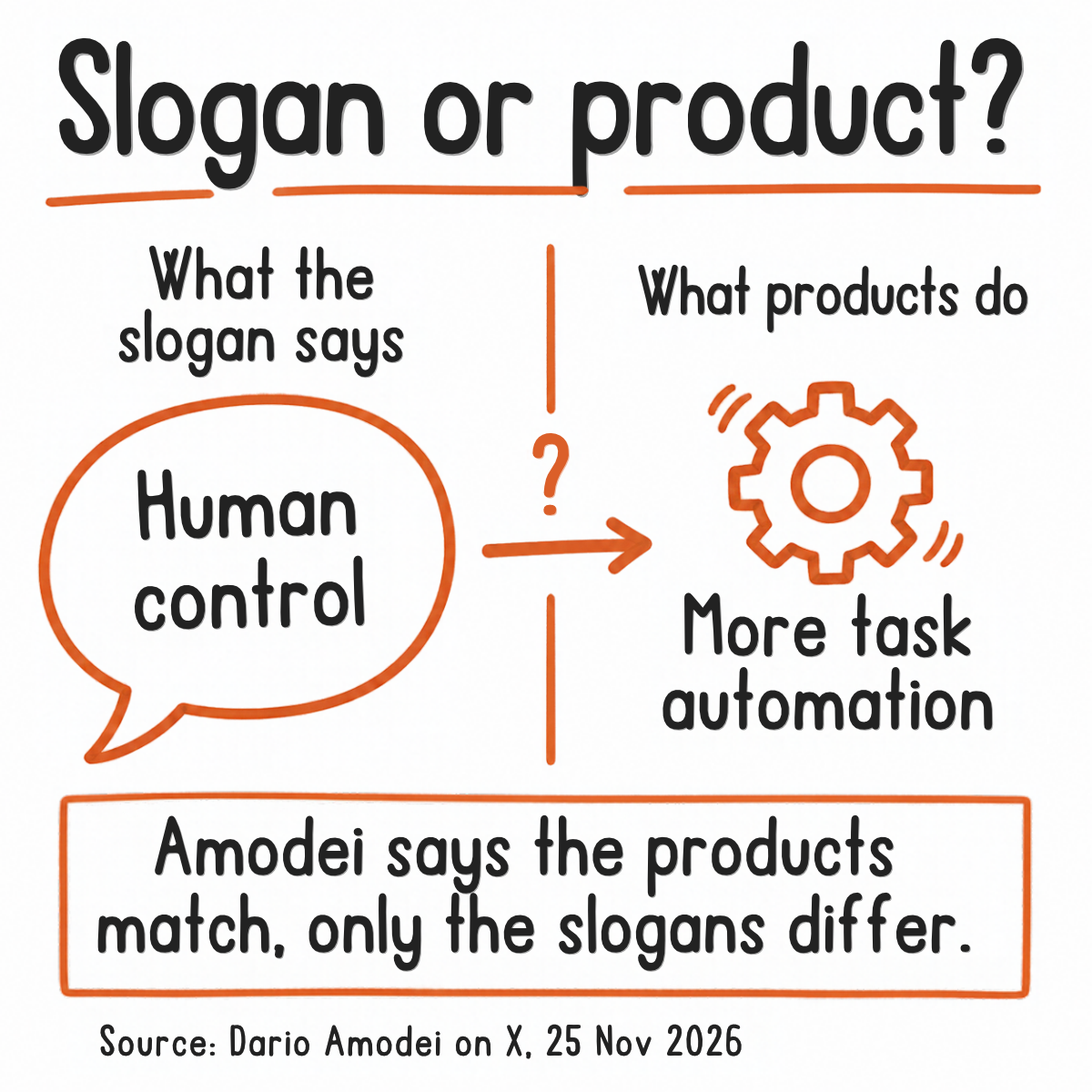
The sharpest passage is aimed at competitors. He says he doesn’t think other AI leaders have significantly different views from his on which tasks should be automated, and that their products don’t differ materially in orientation towards automation. Every company, he writes, is releasing models more capable of task automation and says it understands the risks.
What is happening is that there’s a sort of vibes-based commercial and political positioning that some AI CEOs are engaging in, where they repeat slogans like “human control and agency,” or “AI should be just a tool,” without actually doing anything different in their products or taking seriously the difficult questions that lie behind these slogans.
Dario Amodei on X, 25 November 2026
He names no company or executive, and I haven’t tested his claim about rival products. He does offer one piece of evidence of his own. He says it’s “fairly absurd” to cite his autonomous weapons remark as differing from other labs when he was “willing to risk Anthropic’s future as a company” to refuse to let Anthropic’s existing models be used for autonomous weapons, “even in the face of legal sanctions”, and that no other AI company did the same. That’s his account, not something I’ve independently confirmed. He also says that “if anything, Anthropic has been the most vocal and the most proactive about acknowledging these downsides”.
Why it landed now
Anthropic listed on 19 November, and this was Amodei’s first major public statement of substance since, according to Axios. The listing priced at US$83 a share, according to the Wall Street Journal, and opened at US$111.50, according to ABC News. I covered the first week in the debut piece.
US$83
IPO price per share (WSJ)
US$111.50
Price at the open on 19 November (ABC News)
Wednesday
Axios: the stock dipped below its IPO day price

Shareholders now own a company whose chief executive has had to publicly deny that he wants humans to cede control. That sits beside a story I ran on Monday about a Wall Street Journal profile of Amodei and his sister Daniela, which reported he floated video games as a fix for AI joblessness while at OpenAI. The two threads share a theme: how Amodei talks about humans and the machines they build.

Axios reports Wes Moore, a potential 2028 Democratic presidential contender, took the human-dominion line on its show this week. Talk of surrendering control is now landing in a political setting, not only a technical one.
What to watch
I’m watching three things. One is whether any rival names Anthropic. Amodei answered a charge nobody has made by name, and Axios says critics haven’t called out the company directly. Another is whether Anthropic says anything about the internal consensus Axios’s sources describe, which the post leaves alone. The last is whether the self-improvement limit becomes a concrete commitment from Anthropic, since the post gives a principle and no mechanism.
In short, Amodei has put in writing that he opposes AI governing society, and that his objections to full task automation are specific: self-improving AI, jobs, trust in AI research and human choice. Axios says some people inside his company hold the view he is rejecting. Those sources haven’t put their names to it.
What I read for this piece
I read Amodei’s post in full, both Axios articles in full, Altman’s 4 November post, Wang’s 22 November X article and the openings of Ball’s essay. I didn’t read the interview transcripts behind Axios’s earlier quotes, so those rows carry its wording. I haven’t seen the amended S-1 text itself, only Axios’s description of it.
Sources
- Dario Amodei on X, 25 November 2026
- Axios: Scoop: AI leaders clash over surrendering human free will, Madison Mills, 25 November 2026
- Axios: Anthropic CEO pushes back on Axios reporting on AI and free will, Madison Mills, 25 November 2026
- Axios: Behind the Curtain: Anthropic contradictions, 18 November 2026
- Sam Altman on X, 4 November 2026
- Alexandr Wang on X: Superintelligence is Arriving, 22 November 2026
- OpenAI: The Silent Consensus, 18 November 2026
- Dario Amodei: Machines of Loving Grace
- Dario Amodei: We Must Pace the Frontier
- CBS News: Anthropic CEO Dario Amodei, full transcript, February 2026
Disclosure: I’m an OpenAI, Firecrawl and Devin ambassador.
Discover more from Sulat AI & Tech News
Subscribe to get the latest posts sent to your email.