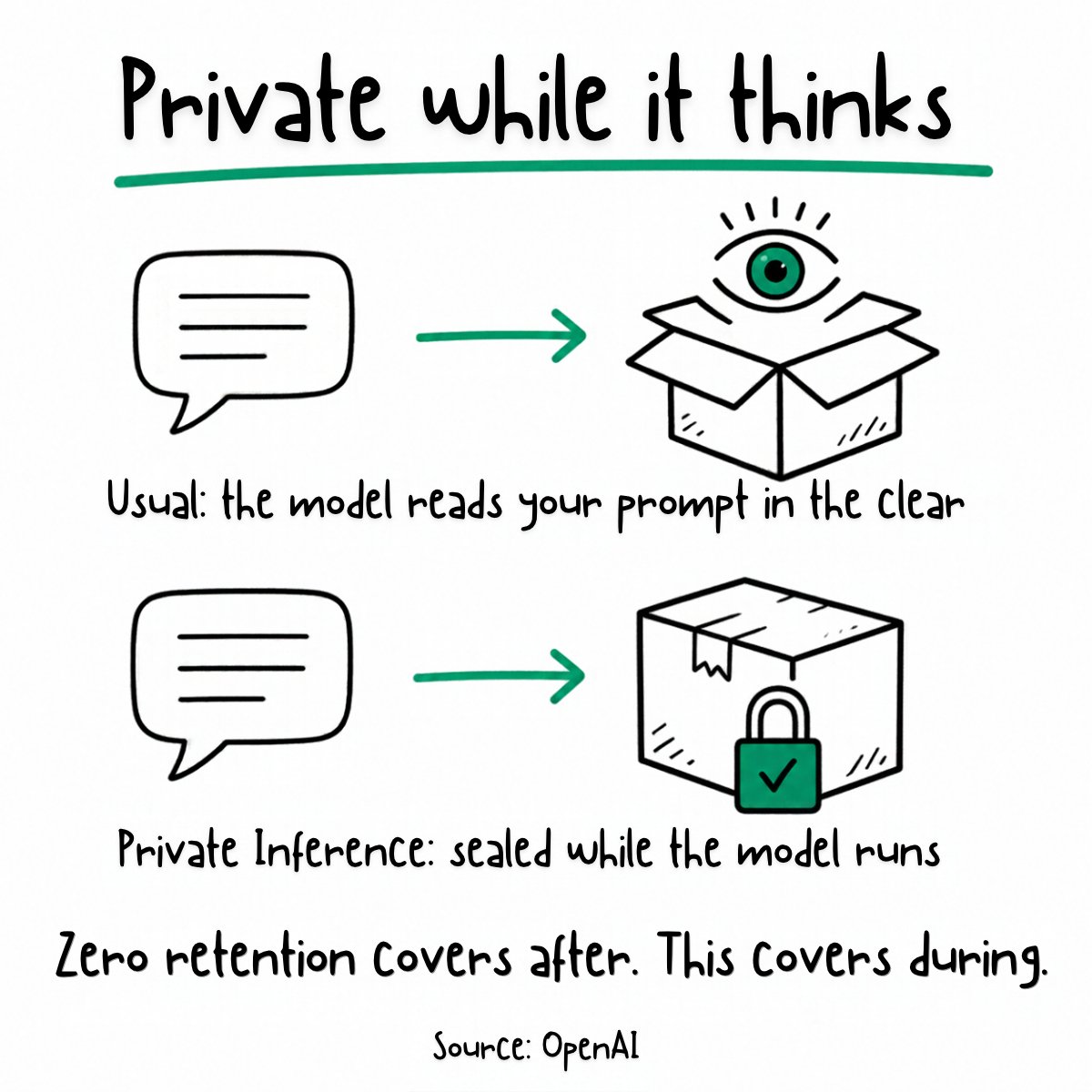
OpenAI has started testing Private Inference with a small group of customers. It’s the part of OpenAI Private Intelligence meant to keep a prompt private while the model is running on it, and Sam Altman said so on X on 25 November (US time). He asked interested businesses to contact @shekar4x.
Altman added a second line in brackets that matters just as much. ZDR with Private Safety Processing, he said, lets OpenAI run automated safety reviews without giving its own staff access to the underlying content. Put together, the two features cover a prompt before, during and after the answer. Here’s how each one works, where they sit against Anthropic, Apple, Cohere, Microsoft and Google, and what to do if you want in.
- What Altman said
- What Private Inference is
- How Private Safety Processing works
- ZDR, PSP and Private Inference side by side
- How the peers handle it
- Why now
- How to ask for access
What Altman said
The post makes three claims. Private Inference is now in testing with a small group of customers. Stronger privacy protections will make frontier AI “useful for a lot more work”. And business privacy is, in his words, “important for a healthy ecosystem”. He gives one contact, @shekar4x, and nothing else about who is in the group or how long testing runs.
Start with the status. OpenAI’s own Private Intelligence page labels Private Inference “Alpha” and “API Preview”. That matches what the company said at DevDay on 29 September, when it announced Private Intelligence and described Private Inference as coming this fall. Altman’s post is the first public sign that it has reached customers.
What Private Inference is
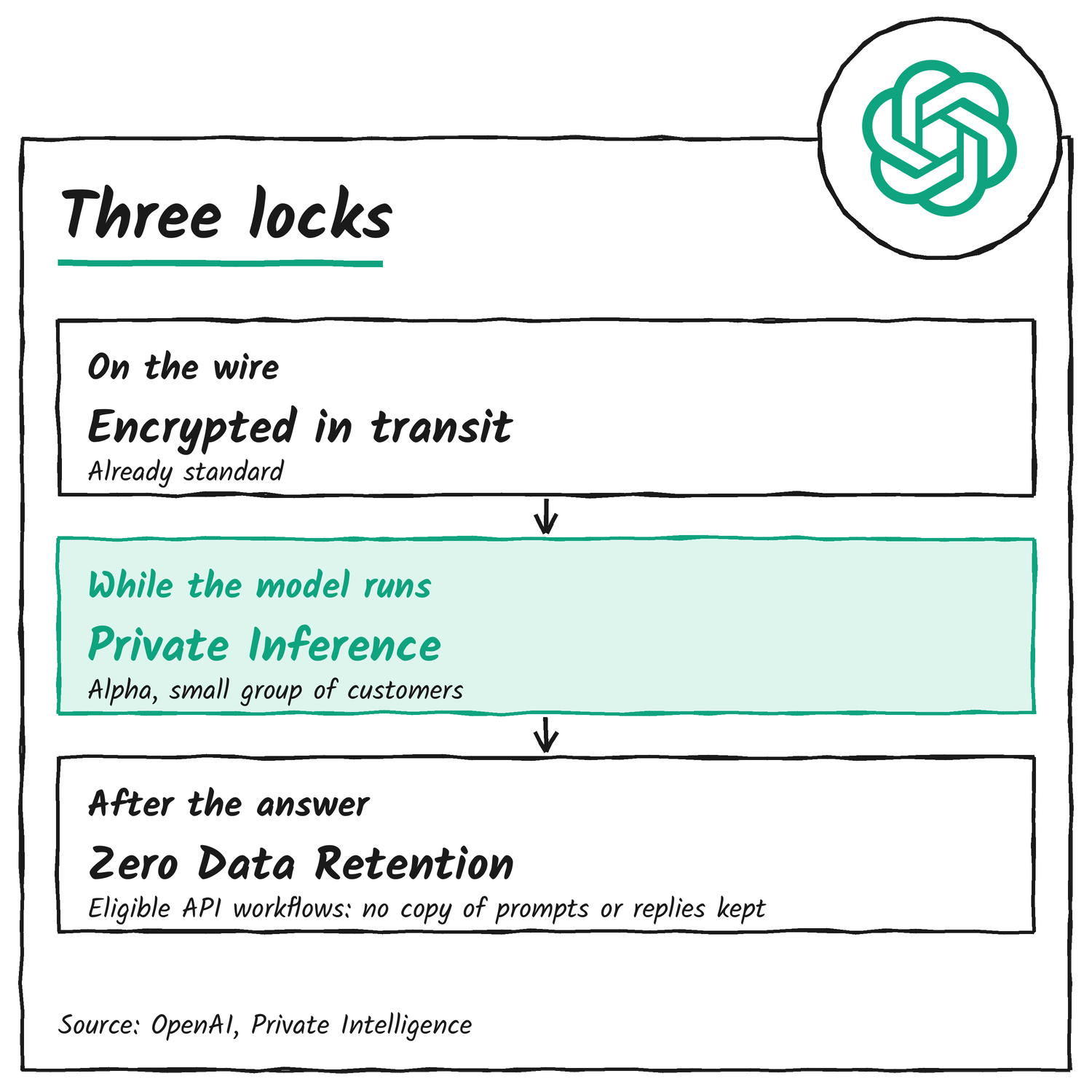
OpenAI describes Private Inference as confidential computing plus strict, verifiable controls. Confidential computing runs a workload inside a hardware-protected enclave, often called a trusted execution environment, so that the data stays encrypted even from the machine’s own operator while it’s being processed. That’s the gap Private Inference targets. Data is already encrypted on the wire and at rest in most setups, but it has usually been readable in memory while a model works on it.
In confidential computing, “verifiable” usually means attestation: the hardware signs a statement about what code is running, and the customer checks it before sending data. OpenAI’s public page gives the headline claim, and the test group is the first to use it.
Alpha
Status of Private Inference on OpenAI’s page, labelled API Preview
29 Sep
Private Intelligence announced at DevDay 2026
22 Sep
ZDR with Private Safety Processing began rolling out in phases
Private Inference is one of two parts under the Private Intelligence name. The other part, ZDR with Private Safety Processing, is already rolling out, and it explains Altman’s bracketed line.
How Private Safety Processing works
Zero data retention, or ZDR, means that for eligible API workflows OpenAI doesn’t keep prompts or responses. OpenAI’s ZDR page carries one footnote: apparent child sexual abuse material images are still retained so the company can meet its legal reporting duties. The trade-off with ZDR has always been safety monitoring, because a provider that keeps nothing can’t look back at flagged traffic. Private Safety Processing, or PSP, is OpenAI’s answer, and the developer documentation lays out the mechanics.
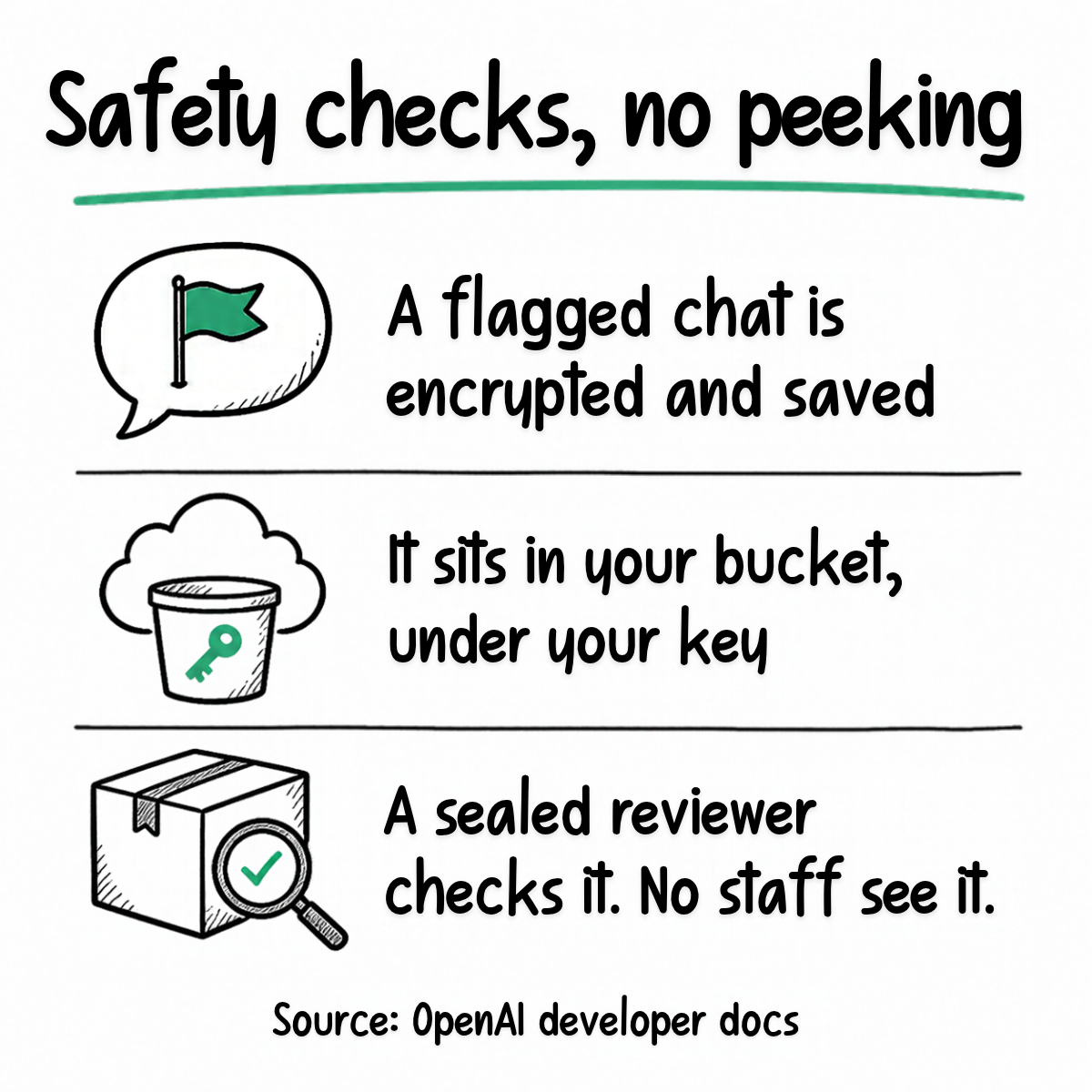
- A classifier flags a request, or an approved sampling policy picks it.
- The record is encrypted and written to storage the customer controls: AWS S3, Azure Blob, Google Cloud Storage or Oracle Cloud. It carries a 30-day time to live.
- OpenAI keeps only an index and a pointer to the record.
- A hardware-attested Safety Review Runtime, with human access disabled, is the only OpenAI workload that can decrypt the record.
- Only bounded safety signals and metadata leave in plaintext.
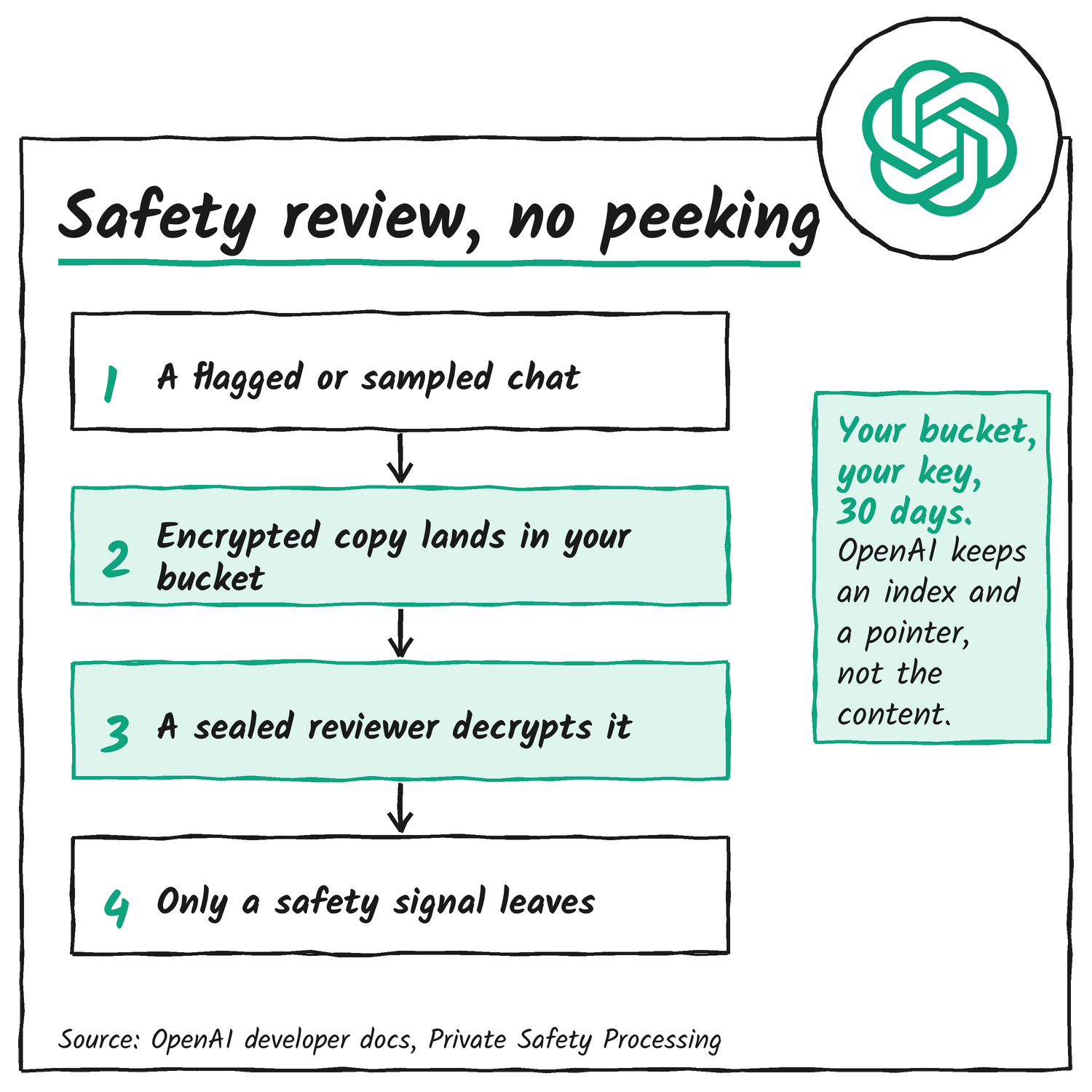
The encryption has two layers. OpenAI applies an inner layer with HPKE, a public-key encryption standard. The customer can add an outer layer with their own external key management, which OpenAI recommends. Records are never used for training and are never shared with other OpenAI groups or partners, according to the documentation.
PSP is switched on per project, and the customer takes on some work. They register and validate the storage, keep records for at least 30 days, maintain access to the storage and keys, fix configuration problems and respond to safety notices.
ZDR, PSP and Private Inference side by side
The three get mixed up in conversation, so here they are in one table. They answer different questions about the same prompt.
| Feature | The question it answers | What it does | Status |
|---|---|---|---|
| ZDR | Does OpenAI keep my data after the answer? | Prompts and responses aren’t retained for eligible API workflows | Available to eligible API customers |
| Private Safety Processing | How does safety review happen if nothing is kept? | Flagged or sampled records go to the customer’s own encrypted storage, and only a sealed runtime reads them | Rolling out in phases since 22 September |
| Private Inference | Can anyone see my prompt while the model runs? | Confidential computing with verifiable controls | Alpha, in testing with a small group |
I covered the ZDR side of the market earlier this month. Anthropic’s version moves the safety records into the customer’s bucket too, which I wrote up in the piece below, and OpenAI’s own regional-processing rules for GPT-6 Luna, which require active ZDR, are in an earlier article.

How the peers handle it
Confidential inference isn’t new, and OpenAI isn’t first to ship a version of it. The table lists what each provider has published, with the date where I could find one.
| Provider | Offering | Approach | Status |
|---|---|---|---|
| OpenAI | Private Inference, plus ZDR with PSP | Confidential computing with verifiable controls; safety records in the customer’s storage | Alpha, small group |
| Anthropic | Enterprise Frontier Safeguards | Safety records in the customer’s bucket, with keys that expire within 30 days. It isn’t confidential computing | Public beta since 23 November (US) |
| Apple | Private Cloud Compute | Stateless processing with verifiable transparency; expanded to Google Cloud on 8 June 2026 using NVIDIA confidential-computing GPUs, Intel TDX and Google’s Titan chip | Live in Apple Intelligence |
| Cohere | Model Vault Confidential Computing | Azure H100 GPUs with remote attestation | Public beta since 22 October 2026 |
| Microsoft Azure | Confidential GPU VMs (NCCads H100 v5); Azure OpenAI Whisper confidential inferencing | Confidential GPUs for your own models; a confidential speech service | VMs available; Whisper in private preview |
| Google Cloud | Confidential G4 VMs and Prompt Encryption SDKs | Confidential GPU instances plus client-side prompt encryption | Announced |
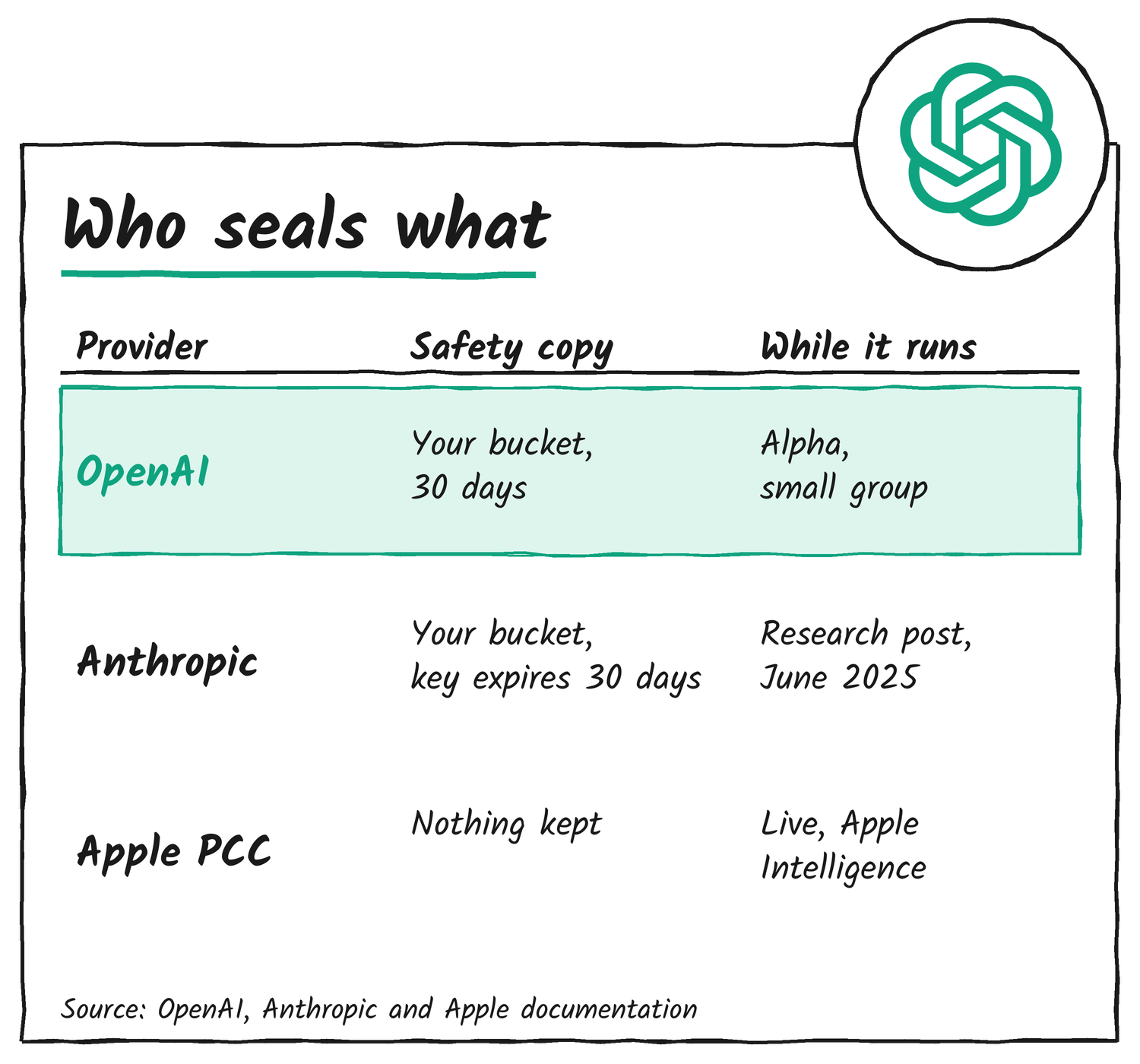
The table splits into two camps. Apple, Cohere, Microsoft and Google protect the data in use with confidential hardware. Anthropic’s Enterprise Frontier Safeguards focus on retention and control of the monitoring copy instead, though Anthropic published a confidential-inference research post in June 2025. OpenAI’s pitch pairs both: a retention story in ZDR and PSP, and a data-in-use story in Private Inference.
Apple is the reference point for the pitch. Its Private Cloud Compute is stateless and publishes its software for inspection, which I broke down when it launched.

Much of the hardware is shared. NVIDIA announced an expansion of its confidential-computing programme on 21 October 2026, and Cohere’s beta, Apple’s Google Cloud setup and Azure’s GPU VMs all run on NVIDIA GPUs. Vercel’s recent move to audit provider zero-data-retention claims, which I covered last week, comes from the same pressure: customers want to verify, not take a promise.
Why now
VentureBeat’s report on the Private Intelligence launch says it arrives as data-leakage and intellectual-property worries become more concrete for enterprise customers. That fits Altman’s wording. His line that stronger privacy makes frontier AI “useful for a lot more work” is a sales argument about regulated and sensitive workloads, the ones that stay off AI services because the data can’t leave the building.
OpenAI’s page also frames privacy as part of the products, with a “privacy by product” section that covers ChatGPT, Codex and the API. Private Inference sits at the API end, aimed at teams that want to run sensitive work through a frontier model.
How to ask for access
There are two routes. Altman’s post points to @shekar4x, and OpenAI has an interest form for Private Intelligence on its site. For a wider conversation about enterprise terms there’s the sales contact page. OpenAI’s trust portal is where its security documents live.
Private Inference is in alpha. The framing is the right one: protect the prompt before, during and after the model sees it. ZDR with Private Safety Processing is the part you can set up today, and Private Inference is the part to register interest in.
What I read for this piece
I read Altman’s post, OpenAI’s Private Intelligence page and its privacy-by-product page, the Private Safety Processing documentation and the ZDR announcement, the DevDay 2026 recap, VentureBeat’s launch report, and the published pages for Anthropic, Apple, Cohere, Microsoft, Google and NVIDIA listed below.
Sources
- Sam Altman on X, 25 November 2026
- OpenAI: Private Intelligence
- OpenAI: Privacy by product
- OpenAI developers: Private Safety Processing
- OpenAI: Offering zero data retention for frontier models
- OpenAI: DevDay 2026 recap
- VentureBeat: OpenAI’s new Private Intelligence targets a growing enterprise concern
- Anthropic: Enterprise Frontier Safeguards
- Anthropic: Confidential inference and trusted VMs, June 2025
- Apple Security Research: Expanding Private Cloud Compute
- Cohere: Confidential computing on Model Vault
- Microsoft Learn: Confidential AI on Azure
- Microsoft: Azure AI confidential inferencing technical deep dive
- Google Cloud: Verifiable trust in the AI era
- NVIDIA: Confidential computing for model builders
Disclosure: I’m an OpenAI, Firecrawl and Devin ambassador.
Discover more from Sulat AI & Tech News
Subscribe to get the latest posts sent to your email.