1Password says an attacker got into an employee’s corporate GitHub account, used it to push malicious code to backend services, and downloaded account records for a subset of its customers. The records include names, sign-in email addresses, account and user IDs, and tokens from some emailed invitation and recovery links. The company published its account on 25 November, US time, six days after it began investigating on 19 November.
Vault contents weren’t taken, 1Password says, and neither were the keys that protect them. The attacker also copied source code from private repositories and reached the CI/CD system that builds and ships the software. 1Password hasn’t said how many customers are affected or how the GitHub account was compromised.
- What happened
- What was copied
- The tokens in invitation and recovery links
- What wasn’t affected, and why the vault design matters
- The way in was the code pipeline
- How it compares with LastPass, Okta, Todoist and Bitrise
- What customers should do
- What 1Password hasn’t said
What happened
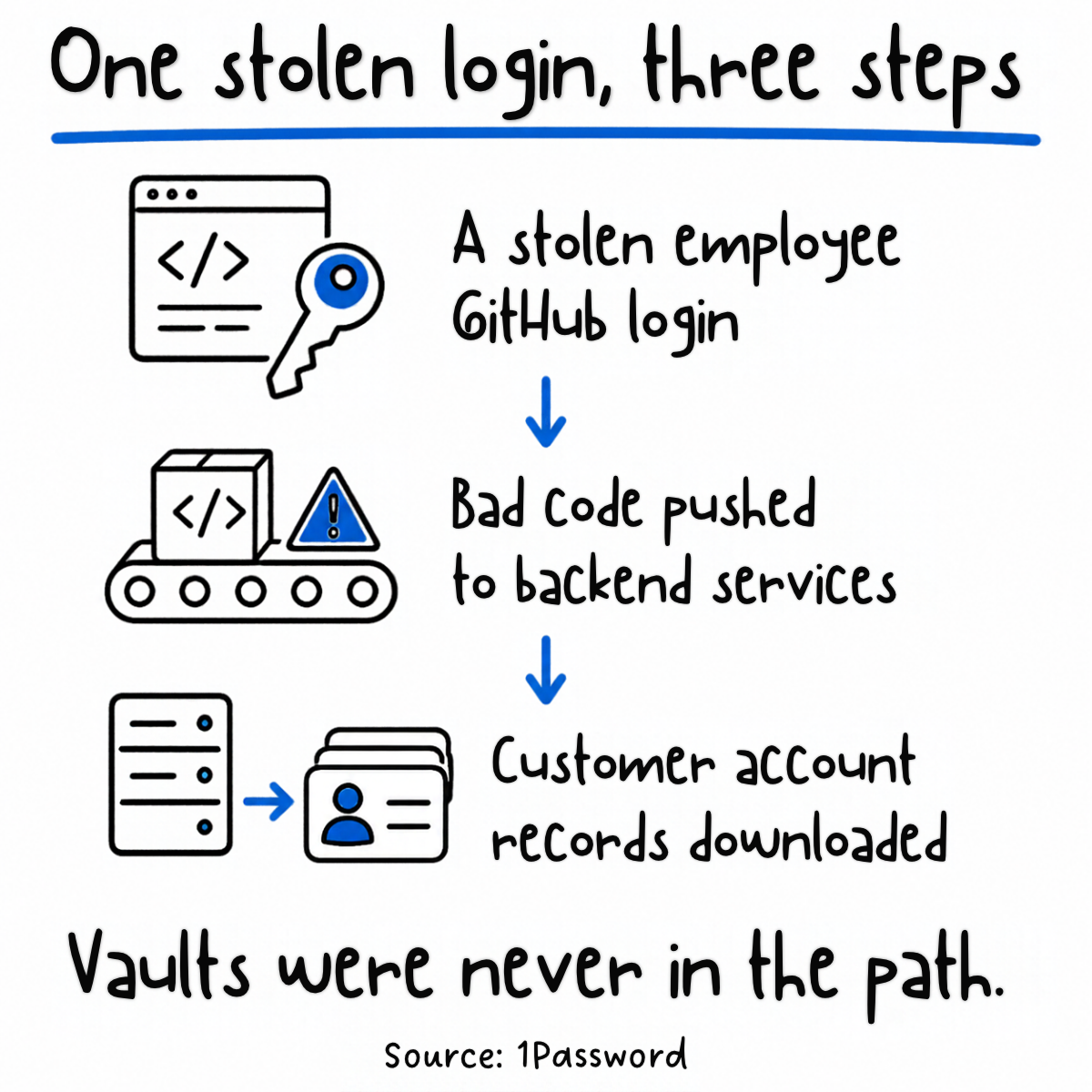
According to 1Password’s post, the company “began investigating indications that an attacker gained access to an employee’s corporate GitHub account” on 19 November 2026. The post describes what came next in one sentence: “The actor used the account to access source code and push malicious code to backend services, which downloaded administrative data pertaining to our customers.”
That makes three steps: a compromised developer account, code pushed to production services, and the services themselves doing the downloading. The attacker didn’t have to break into a database from outside. The company’s own backend ran the collection.
The company’s X post says it took “immediate steps to contain the incident”. The blog post says it disabled the GitHub account, revoked the stolen token and removed the access the attacker created.
| When | What happened |
|---|---|
| 19 November 2026 | 1Password begins investigating signs that an attacker had access to an employee’s corporate GitHub account |
| 19 to 25 November | The company disables the account, revokes the stolen token, rotates or revokes exposed credentials, lengthens invitation and recovery codes and brings in outside experts; the post doesn’t date each step |
| 25 November, US time | 1Password publishes its blog post and an X post, and says its apps and services are working normally |
What was copied
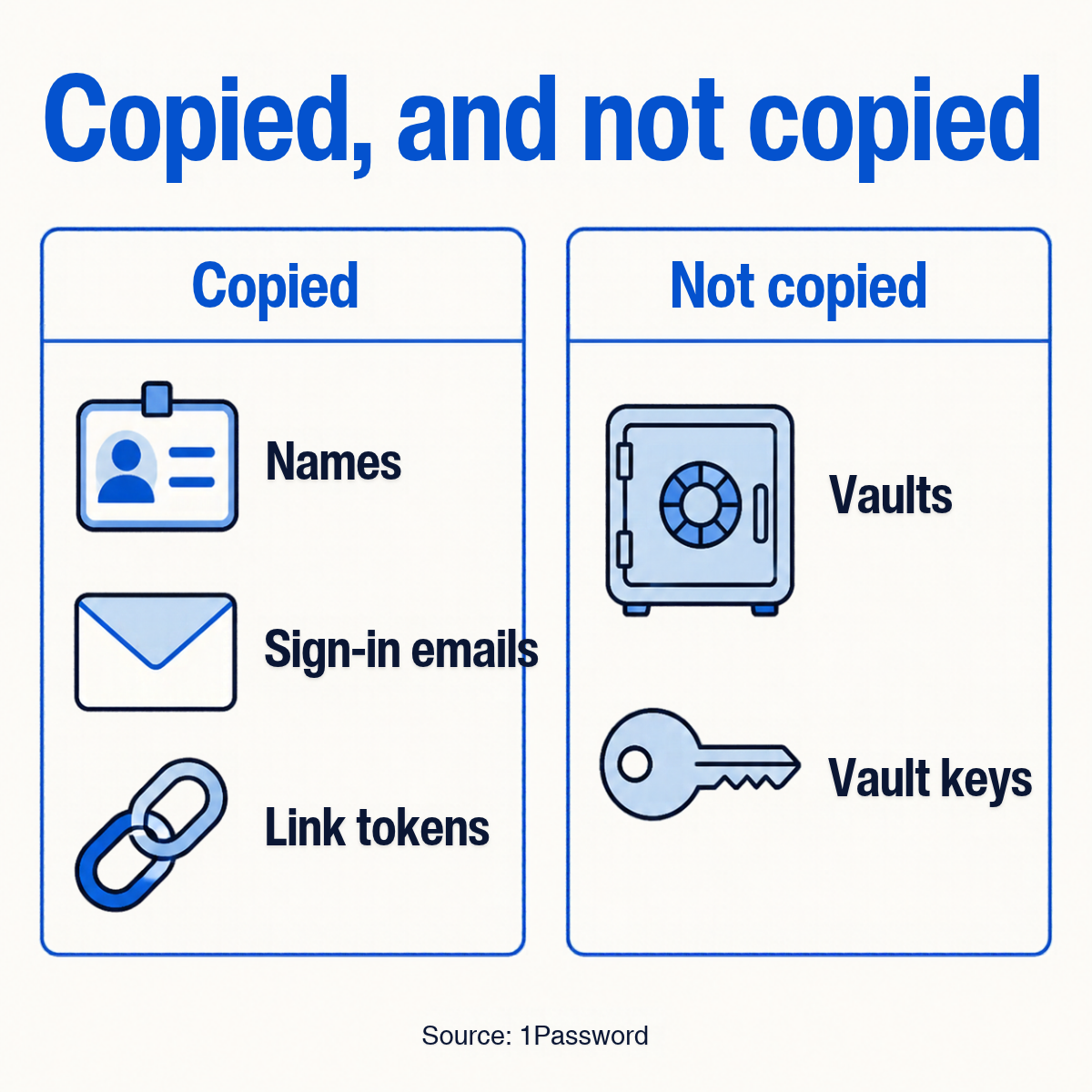
The attacker downloaded account records for a subset of users. 1Password lists six kinds of data and says what it thinks each is worth to an attacker.
| Data copied | What 1Password says about it |
|---|---|
| Names and sign-in email addresses | The names and addresses customers use to sign in to 1Password |
| Account and user identifiers, account creation and last sign-in times | Listed without comment |
| Public keys | “Public by design, this has no impact to user security” |
| Secure Remote Password (SRP) parameters | They “cannot be used to access your account” |
| Tokens in some emailed invitation, provisioning and recovery links | Work only together with an SSO sign-in or an emailed code; see the next section |
| Other non-secret account metadata | Internal details such as version and file numeric identifiers |
Two more things were taken that aren’t customer records. The attacker copied source code from private repositories, which 1Password says “is not customer data, and contains no user secrets”. The attacker also gained access to the CI/CD system, which the company says holds “infrastructure related secrets in order for our product to work”. It has triggered a rotation of every credential that may have been exposed and says there’s no impact on its services, availability or product security.
6 days
from 1Password starting its investigation to publishing its account
6 to 10
characters in invitation and recovery codes, after 1Password lengthened them
3
vendors that disclosed credential-based intrusions between 13 and 25 November: Bitrise, 1Password and Todoist
£1.2 million
the UK data regulator’s fine on LastPass over its 2022 breach
The tokens in invitation and recovery links
The tokens are the one item on the list an attacker could try to use. When 1Password emails a customer an invitation or an account recovery link, the link carries a token. A provisioning invitation is the kind used with the SCIM Bridge or Hosted Provisioning, which companies use to add staff to 1Password from their identity provider. 1Password says a small number of users were in that state during the incident and have been told directly.
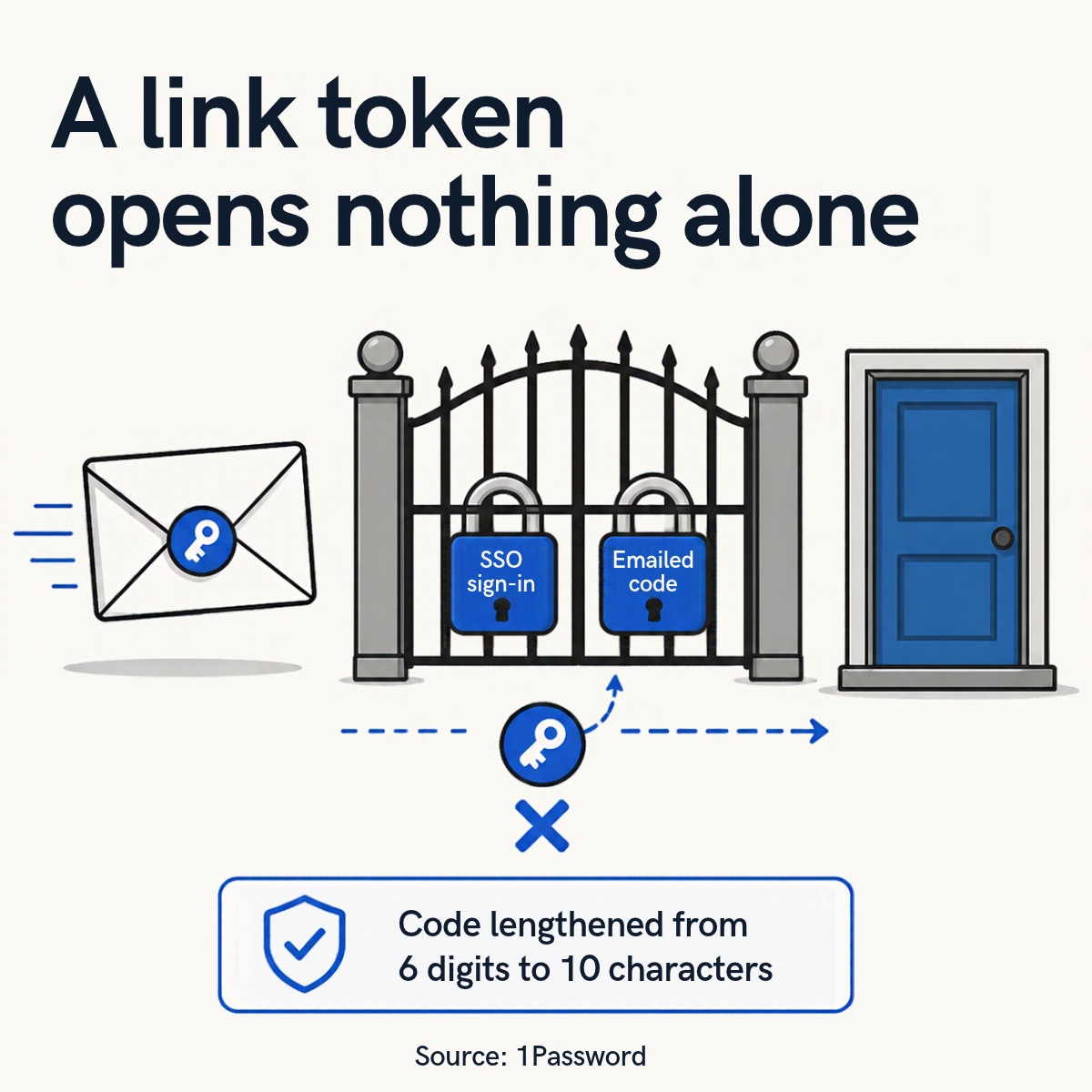
The token completes the invitation or recovery “only when combined with an SSO sign-in or a six digit code sent to the user’s registered email address”, the post says, and “is not able to get access to the account by itself”. As a precaution 1Password has lengthened that code from six numeric digits to ten alphanumeric ones, which it says makes brute-force guessing “practically impossible”. It also says it has “validated no internal evidence of user account takeovers or compromise using any exposed account provisioning tokens.”
The arithmetic backs the change. Six digits give one million possible codes. Counting only lowercase letters and digits, ten characters give about 3.7 quadrillion.
What 1Password says it will never ask you for
1Password says it “will never contact you to ask for your account password or Secret Key”. It says to enter them only in the official 1Password app or on its official website, and only after you’ve opened the app or typed the address yourself. A Secret Key is only needed the first time you sign in on a new device or browser. To report something suspicious, email [email protected].
What wasn’t affected, and why the vault design matters
1Password lists four things that weren’t touched: vaults and the items in them, the keys that protect vaults, account recovery keys, and its apps and browser extensions. It says it doesn’t store customers’ account passwords or Secret Keys at all. “Your vault secrets are encrypted with keys that only you hold, so we can’t access them, and neither can an attacker who gets into our servers,” the post says.
That design is why the records on the “copied” list are the ones that matter. SRP is the protocol that lets 1Password check a sign-in without receiving the password, which is why the company can say the SRP parameters it lost don’t unlock accounts. 1Password has explained SRP in its own developer post.
The company says it has engaged independent cybersecurity experts to validate its containment and remediation work. The post doesn’t include their findings.
The way in was the code pipeline
The part of the account that applies beyond password managers is the route. One employee’s GitHub account was enough to push code to production services, and the CI/CD system held infrastructure secrets. The post doesn’t say whether that push needed a second reviewer, what branch protections were on, or whether the stolen token was tied to a hardware key.
1Password had written about this exact dynamic three weeks earlier. In a 5 November post on credential harvesting, it said: “While a vulnerability may let attackers into an environment, credentials often determine how fast and how far they can move laterally within an environment.” That post is about AI-assisted attacks on developer workflows, and the November incident post doesn’t say AI was involved. I covered the company’s developer account making the same argument in 1Password reads Google’s AI-attack report as a speed problem for long-lived credentials, and its five-step guide in 1Password publishes a five-step credential checklist for developers and AI agents.
The company’s response list is mostly about the pipeline: it has “tightened internal GitHub, CI/CD, and endpoint controls, and added new detections for this kind of attack.” It doesn’t name the controls.
How it compares with LastPass, Okta, Todoist and Bitrise
Four other incidents frame this one. Three are from the past fortnight, and two involve the same two-step pattern of a stolen developer credential followed by production access. The facts below come from each company’s own account, or from the UK regulator in LastPass’s case.
| Incident | How the attacker got in | What was taken | Vault or core secrets |
|---|---|---|---|
| 1Password, November 2026 | An employee’s corporate GitHub account, then malicious code pushed to backend services | Account records for a subset of users, private source code, CI/CD access | Vaults and keys not affected, per 1Password |
| Todoist, 22 to 23 November 2026 | A stolen credential for its version control system, used to change automated workflows in three repositories, then an employee account | Emails and legacy salted SHA1 password hashes for about 6% of users; API and Slack tokens for about 0.003% | No application code changes found, per Todoist |
| Bitrise, 13 November 2026 | An internal testing bot account with a valid username and password and no two-factor authentication | Files in 15 customer workspaces, plus Bitrise’s own credentials and some repositories | Bitrise took the platform offline; it says customer secret stores weren’t accessed |
| Okta, 28 September to 17 October 2023 | A service account whose credentials were saved in an employee’s personal Google profile | Support files for 134 customers, some holding session tokens | 1Password was one target and says no user data was accessed |
| LastPass, August to October 2022 | A developer’s laptop, then a senior DevOps engineer’s home computer with a keylogger | Customer metadata and backups of every customer’s vault data | Vault data was encrypted; the ICO fined LastPass £1,228,283 on 20 November 2025 |
The sharpest contrast is LastPass. In 2022 an attacker used source code taken from a developer’s laptop to target a senior engineer, and walked away with backups of all customer vault data. The vaults stayed encrypted, and the UK Information Commissioner’s Office still fined LastPass £1,228,283 for failing to secure the backup database, saying the breach affected up to 1.6 million UK users. 1Password says no vault data was copied here. That’s the difference between the two stories, and it’s 1Password’s own claim, not an outside finding.
1Password has been on the receiving end of this pattern before. On 29 September 2023 it detected suspicious activity on its Okta instance, which was later traced to Okta’s support-system breach; a session token inside a support file let the attacker act as a 1Password IT employee. The company said then that it found “no compromise of user data or other sensitive systems”.
Todoist’s account opens the same way as 1Password’s: a stolen credential for the code host. Todoist says the attacker started on 22 November, changed workflows in three repositories to collect more credentials, then took over an employee’s work account and reached production databases on 23 November. It published its account on 24 November. Bitrise’s entry point was a bot account without two-factor authentication. Neither company links its incident to 1Password’s, and 1Password’s post names no other company.
What customers should do
1Password says nobody needs to change anything in their account. Its one request is caution about phishing: unexpected emails, texts or calls that mention 1Password, invitations or account recovery attempts you didn’t start.
The reason is on the “copied” list. An attacker holding names, sign-in email addresses and last sign-in times can write a more convincing fake invitation or recovery email than one working from a bare address list. The practical rule that follows from 1Password’s guidance is to open the app yourself and ignore the link in the email.
Companies that use SCIM Bridge or Hosted Provisioning are the group with a specific exposure, since the tokens in provisioning invitations were copied. 1Password says it has notified the small number of users who had one pending. It hasn’t said how it will tell the rest of the affected customers.
What 1Password hasn’t said
- How many customers are in the “subset”, and whether it will notify all of them.
- How the employee’s GitHub account was compromised, and who the attacker is.
- Which backend services received the malicious code, and how long the code ran before the investigation began.
- What the independent experts found, and whether 1Password will publish their report.
- Whether anything has been demanded or published by the attacker.
1Password says it will keep its post current and update it “if we find anything that changes what we’ve said”. Its blog post and X account are where the next details will appear.
Sources: 1Password incident post, 1Password on X, Todoist security incident, Bitrise security incident, Okta root cause analysis, 1Password and the Okta incident, LastPass March 2023 update, ICO on LastPass.
Discover more from Sulat AI & Tech News
Subscribe to get the latest posts sent to your email.