
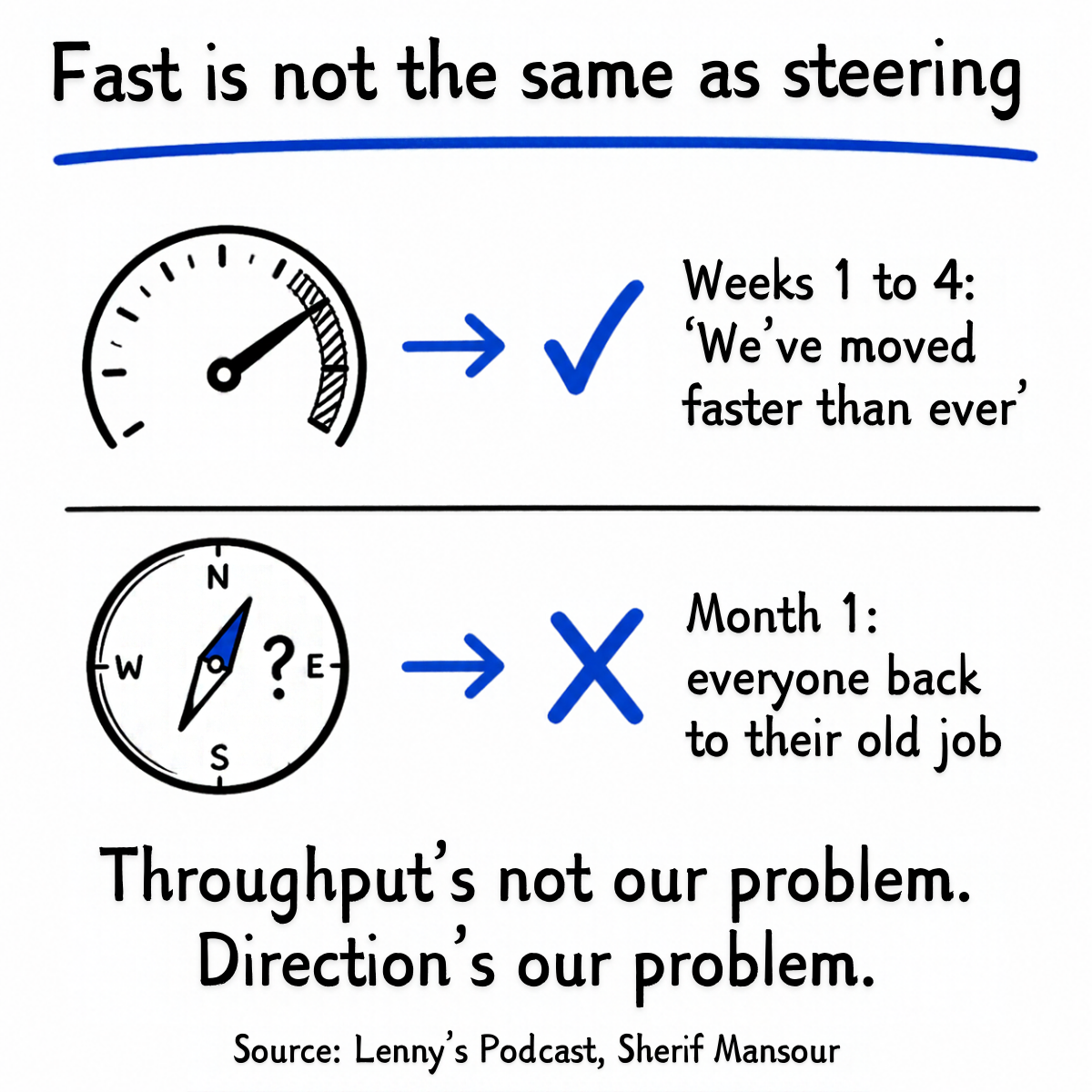
Atlassian moved some of its product managers and designers into squads where everyone was an AI builder, and about a month later, in the words of its Head of AI and Product Craft, “everyone’s gone back to doing their traditional jobs.” Sherif Mansour told the story on Lenny’s Podcast, and Lenny Rachitsky shared the clip on X on 24 November, US time.
The best part is the sequence. In the first few weeks, one PM on those teams told Mansour: “It’s unbelievable, man. We’ve moved faster than ever before.” Then came the verdict, which Mansour says “sounds so obvious in hindsight”: “Throughput’s not our problem. Direction’s our problem.”
What Atlassian tried
Mansour’s account starts with a story he says was everywhere a year ago: everyone is becoming an AI builder. Atlassian “moved some of our product managers and designers to a team, a few teams that ran these experiments,” where “there was no PM or designer, but they came from different crafts.” At SaaStr he put the number at about ten hand-picked teams.
Early on, the PM he checked in with said “you’re constantly building. It’s so good.” About a month later that PM came back and told him everyone had returned to their old roles. Mansour wrote an internal post called “Direct the ship, don’t row it”, and says a lot of PMs came to him asking whether they should be coding.
I couldn’t find any published metrics from the experiment. The PM isn’t named, the teams aren’t listed, and Atlassian hasn’t said what they built or how fast. Everything here is Mansour’s account, told at SaaStr and again on the podcast.
Why one steerer felt like forty
The arithmetic is the funny bit if you like spreadsheets. On paper, Mansour said at SaaStr, a team has one PM and designer for every ten engineers. With AI, engineers ship far more, so the same team feels like one to 30 or one to 40. He added that platform teams run at about one to 20.
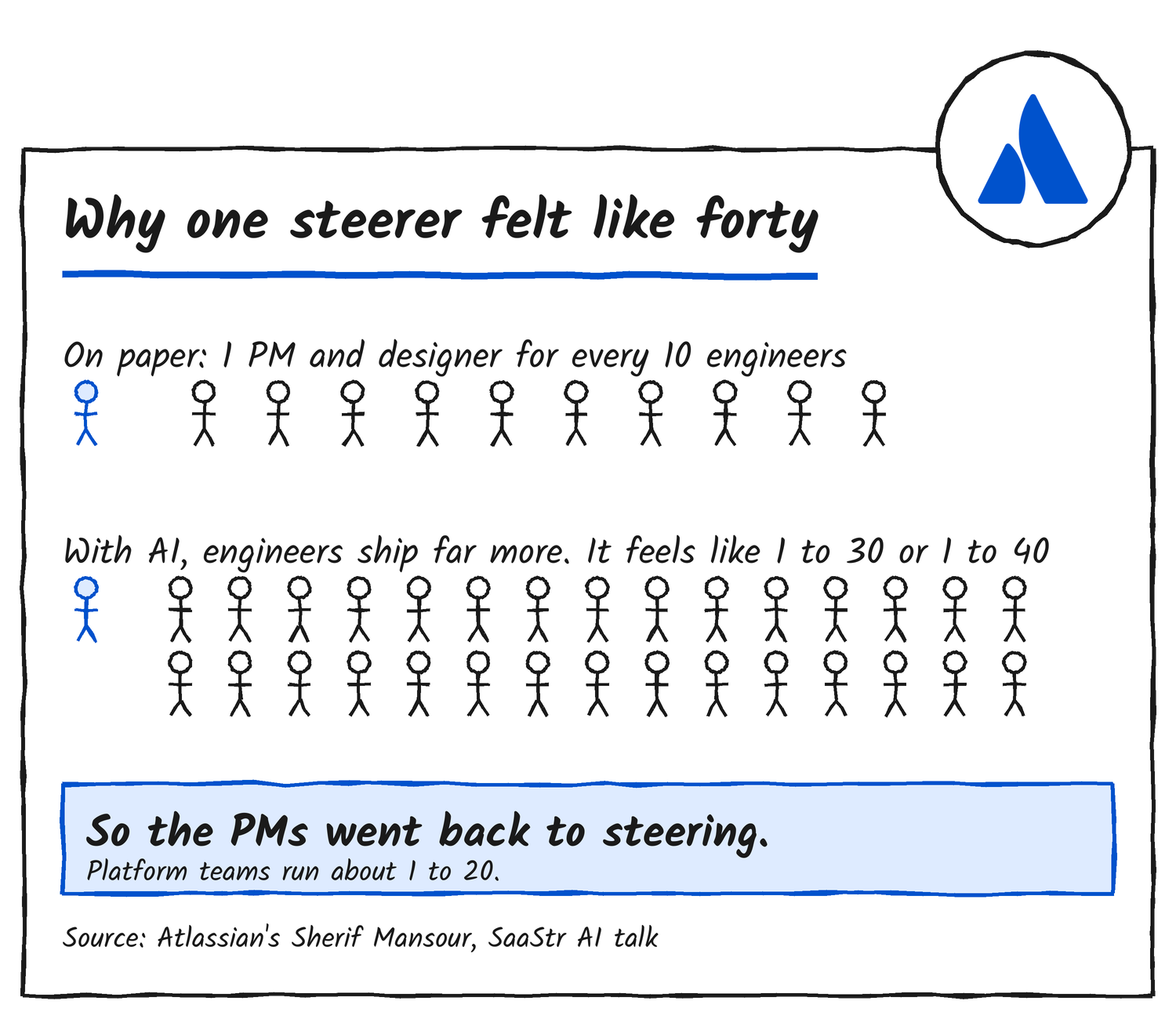
On the podcast he put it more bluntly: “In a company where you have the luxury of hundreds, thousands, tens of thousands of engineers, your problem is your direction, not how quick you can pump things out.” He compared it with the Balsamiq mock-up era, when everyone could make a mock-up, and the artist-type PMs ended up making better ones than the rest.
PMs are some of the worst solution designers in the world. Because you have access to the tool doesn’t mean you’re an expert at the domain that you have access to.
Sherif Mansour, Head of AI and Product Craft at Atlassian, on Lenny’s Podcast
That is a Head of AI and Product Craft describing product managers. He isn’t against builders, though. For zero-to-one projects, “even in large organizations, you should put an AI builder type onto it. I’m fully convinced of that.” His next sentence is the catch: “most organizations that have access to developers, this is not their problem.”
What Lenny’s hiring data adds
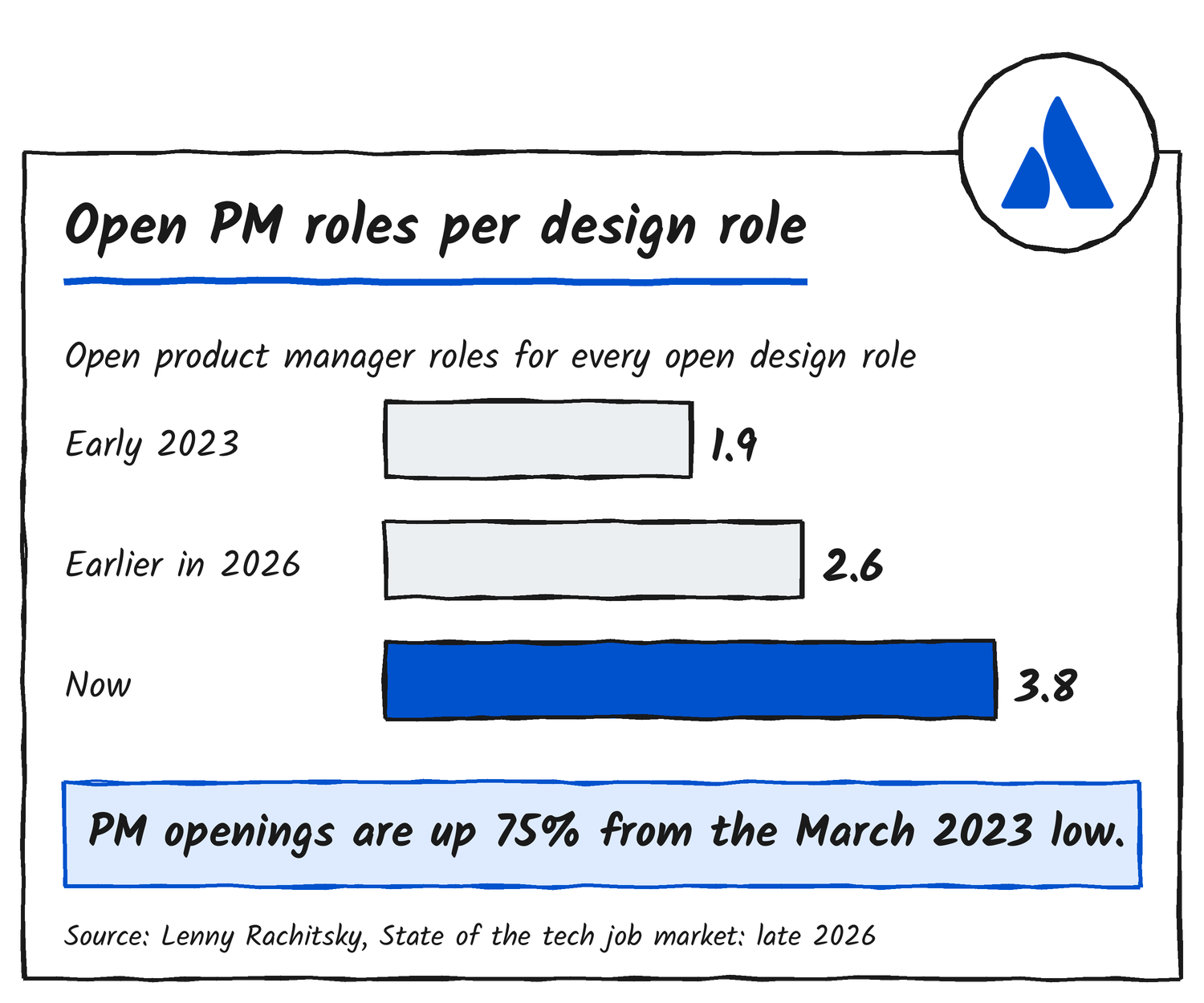
In the same episode, Lenny told Mansour about a state of the tech job market report he was about to publish. PMs, he said, “seem to be benefiting most in the AI era”, with the most open roles of any function. Engineering openings are slowing, design is “very flat”, and user research is “really not great”, with 108 open roles globally at tech companies.
About a month
how long the all-builder teams lasted, per Mansour
1.9 to 3.8
open PM roles per open design role, early 2023 to now
75%
rise in PM openings from the March 2023 low
108
open user research roles globally at tech companies, per Lenny
Atlassian’s year, for context
Atlassian wasn’t a bystander to the AI-era squeeze on software companies this year. I’m not saying the experiment and the cuts are linked; the company hasn’t said so. The dates sit side by side because they are part of the picture.
| When | What happened |
|---|---|
| March 2026 | Atlassian cut about 1,600 jobs, roughly 10% of its workforce, to focus on enterprise sales and what it called the “AI era” (Business Insider, The Guardian) |
| 5 November 2026 | First-quarter fiscal 2027 revenue rose 24% to US$1.77 billion and cloud revenue grew 31%, but full-year growth guidance of about 13.75% sent shares down by double digits, 17% in SiliconANGLE’s report |
| Late November 2026 | Mansour tells Lenny’s Podcast that PM hiring is rising while other roles plateau, and that Atlassian’s AI builder squads went back to their old roles |
The other end of the team
Mansour’s other argument is about juniors. Many organisations, he says, assume AI can now do what junior employees used to do. He says the opposite: juniors bring “no fear” and a willingness to “try anything to try to make it work because they haven’t done anything any other way.” His 12-year-old son vibe codes his own games, he told Lenny, and “thinks that’s normal.”
Asked for evidence, he said Atlassian has numbers, internally and with customers: “Something like almost 30, I think it’s 38 percent.” That is how much more likely juniors are to adopt new tools than seniors, according to Mansour, who said he’d posted a blog about it. Seniors, he added, get more quality and better productivity out of the tools they do use.
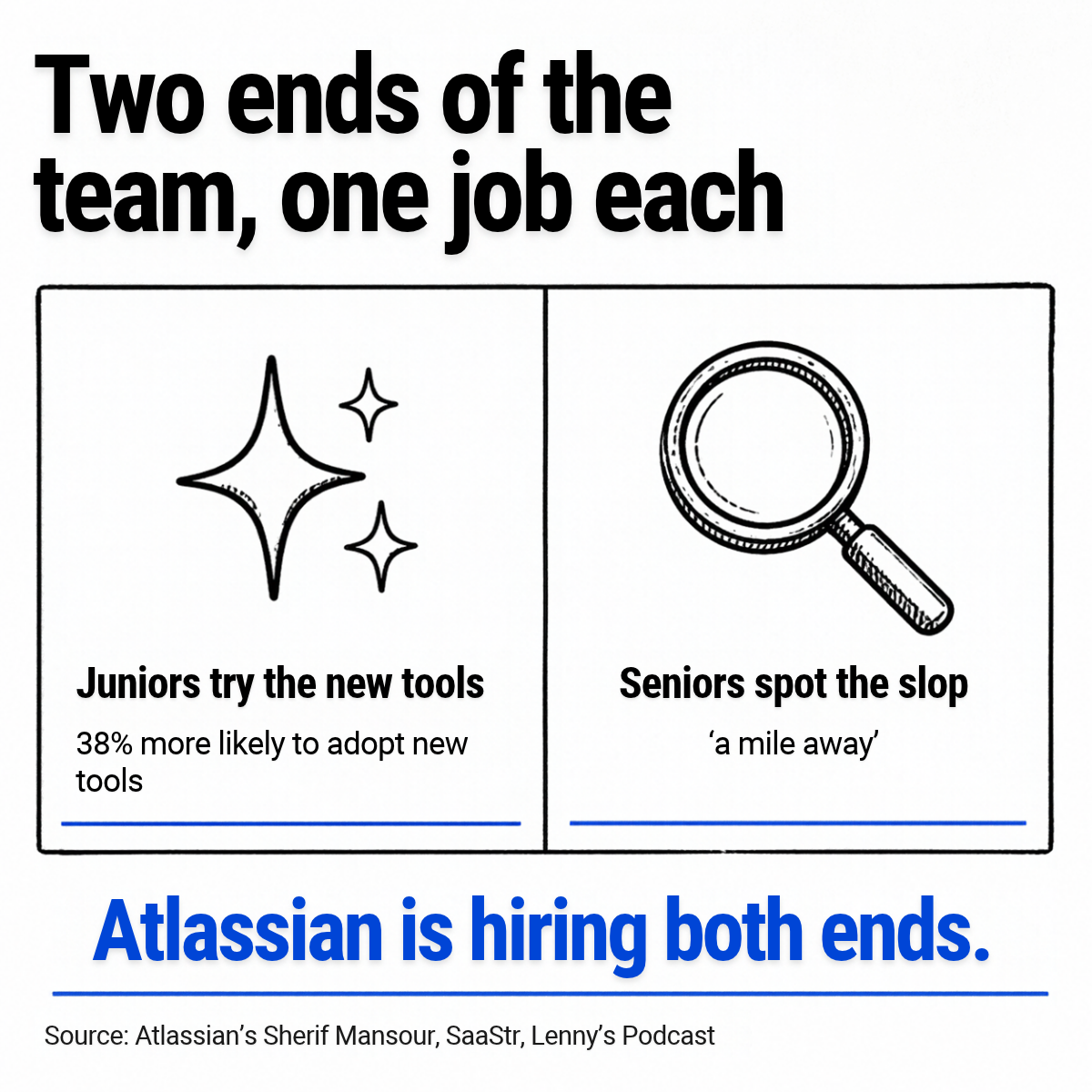
The catch is that juniors “are not great at identifying AI slop because they don’t have the domain expertise,” Mansour said, while seniors “can pick AI slop a mile away because they know the domain really well.” Atlassian’s AI Builder Weeks show it: everyone stops for a week to tinker with AI, and the younger people show off demos and tools while the seniors go looking for evals and quality problems.
The sponsor read
Shortly after the slop segment, the episode breaks for an ad. “This season’s supporting sponsor is DX,” Lenny says, and the read says hundreds of enterprises, including Snowflake, Sony and BNY, “use the DX platform to measure AI’s impact on developer productivity.” Atlassian completed its acquisition of DX in November 2025, so the guest’s employer owns the sponsor.
I don’t know who booked what, and nothing in the episode suggests anything improper. It’s just a good coincidence: a sponsor selling a way to measure productivity, in an episode where Atlassian’s Head of AI explains that productivity was never the bottleneck.
How the other builder bets compare
Atlassian isn’t the only company testing the idea. LinkedIn took a different route, and Lenny covered it in a newsletter interview with LinkedIn’s Tomer Cohen.
| Who | What they did | Where it stands |
|---|---|---|
| Atlassian | About ten hand-picked squads with no PM or designer role | Everyone back in their traditional roles after about a month, per Mansour; he still backs AI builders for zero-to-one work |
| Ended its associate PM programme; new hires from January join an associate product builder programme that teaches them to code, design and do PM (Business Insider, December 2025) | Early; I found no published results | |
| The hiring market | Open PM roles per open design role went from 1.9 in early 2023 to 3.8 now (Lenny Rachitsky) | PMs “seem to be benefiting most”, per Lenny; user research is the weakest function |
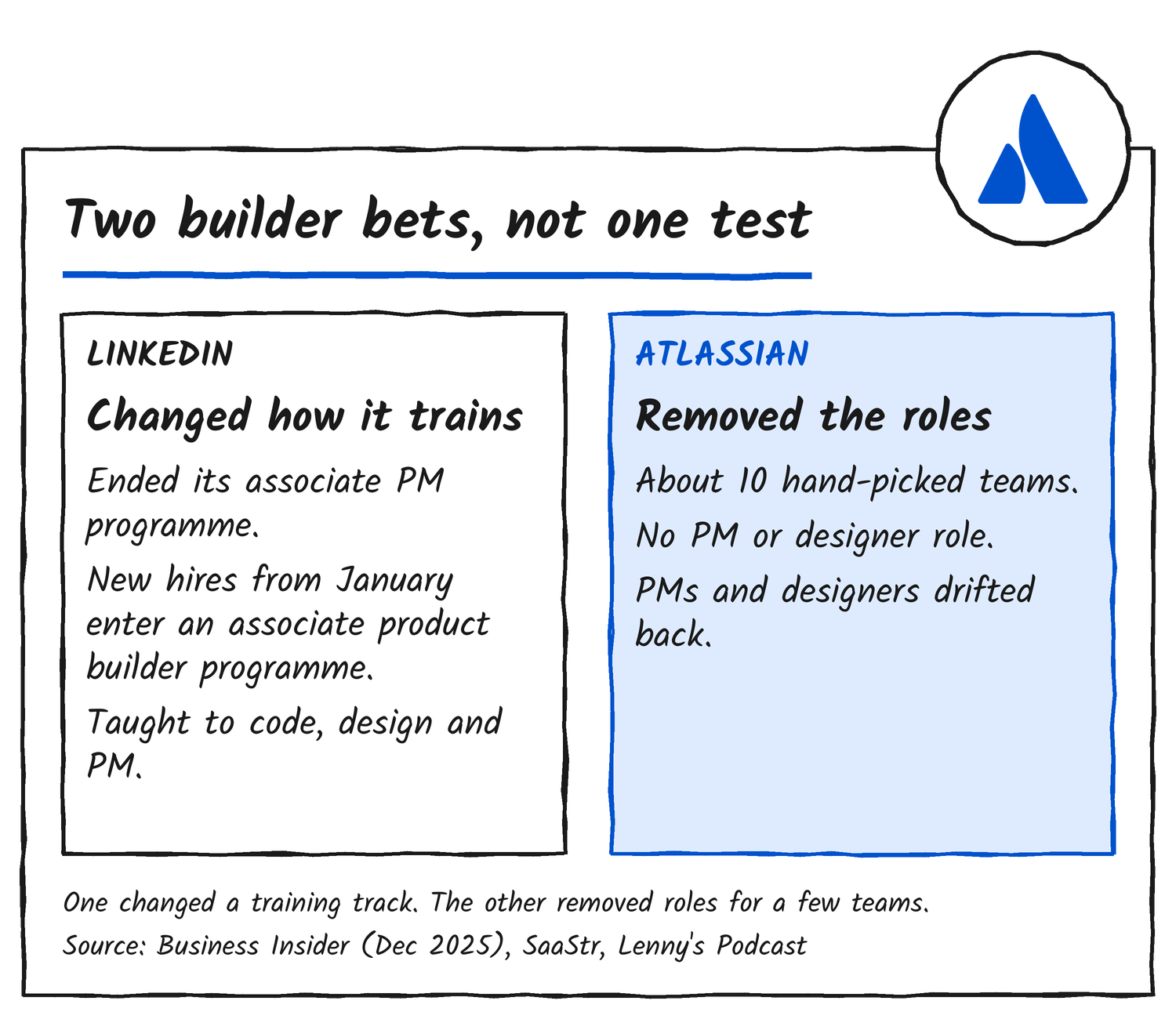
The two bets aren’t one test. LinkedIn changed how it trains new hires. Atlassian removed the roles from a few working teams and watched. One result tells us little about the other.
Everyone’s circle got bigger
Mansour’s reading of the whole thing is that the roles didn’t merge. They grew.
Everyone’s circles are getting bigger. Think of it as a Venn diagram, but the circles aren’t overlapping. They’re all equally getting bigger. So if they’re equally getting bigger, then they’re not compressing.
Sherif Mansour on Lenny’s Podcast
On that view the specialisations stay, because they are what improve “the quality and taste” of what each craft produces. A team of rowers can all be very fast, and somebody still has to hold the wheel.
What we don’t know
- How many people were on the squads, which teams they were, and what they built.
- Whether Atlassian measured output, quality or morale, and whether it will publish any of it.
- Whether Atlassian will rerun the experiment with a different mix of roles.
- How LinkedIn’s first associate product builder cohort looks after a year.
Discover more from Sulat AI & Tech News
Subscribe to get the latest posts sent to your email.