
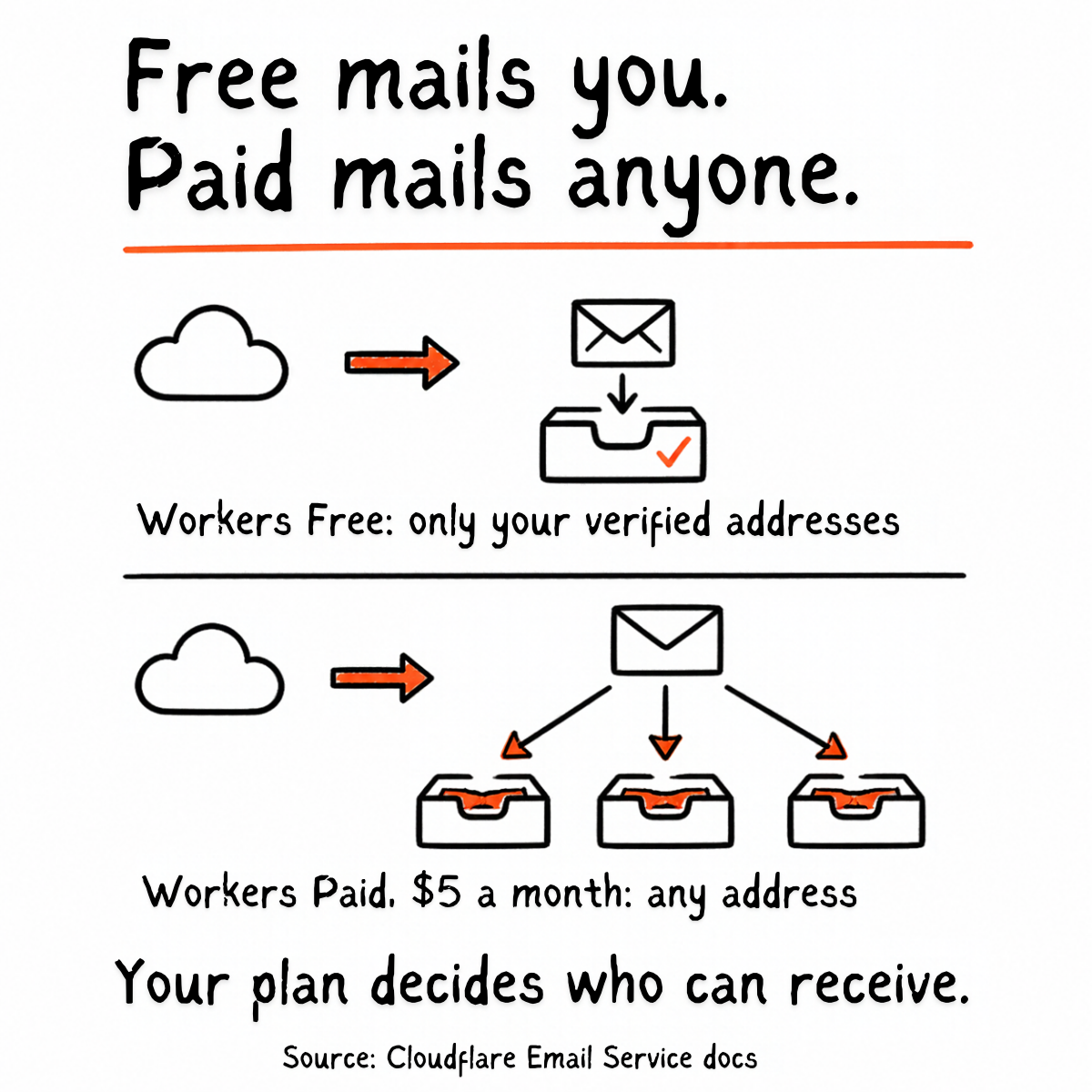
Cloudflare says Email Sending now works on the Workers Free plan, but only for mail to the verified destination addresses in your own account. That covers alerts, reports and test mail to you and your team. It doesn’t cover receipts, password resets or anything else addressed to a customer, which still needs Workers Paid at US$5 a month.
The @CFchangelog post on 25 November reads as if free sending has arrived for everyone. I read Cloudflare’s changelog entry (dated 24 November), its pricing and limits pages and its SMTP and domain docs, and the narrower reading is the right one. I also checked something the headline hides: sending to verified addresses already worked on Free through Email Routing, which the docs now call a “legacy path”. What’s new is the proper Email Sending route and its analytics. I set it beside Resend, Amazon SES, Postmark, Mailgun and SendGrid below.
US$0
to send to verified addresses in your account, on every plan
US$5
a month on Workers Paid, the price of mailing anyone else
3,000
outbound emails a month included on Paid, then US$0.35 per 1,000
Beta
Email Sending’s label in Cloudflare’s docs index
- What Cloudflare changed
- The catch: your own addresses only
- What already worked before
- Pricing and limits
- How you send, and what to set up
- How Resend, SES and the rest compare
- How Email Service got here
- What Cloudflare hasn’t published
- Who should use it
What Cloudflare changed
Cloudflare’s changelog entry opens with one sentence: “Email Sending is now available on the Workers Free plan for sending to the verified destination addresses in your account.” It says you can onboard sending domains and send for free to those addresses while you build and test, then move to Workers Paid when you need to reach arbitrary recipients. The Workers binding, the REST API and SMTP all work. The entry names alerts, reports and notifications to your own team as the use case.
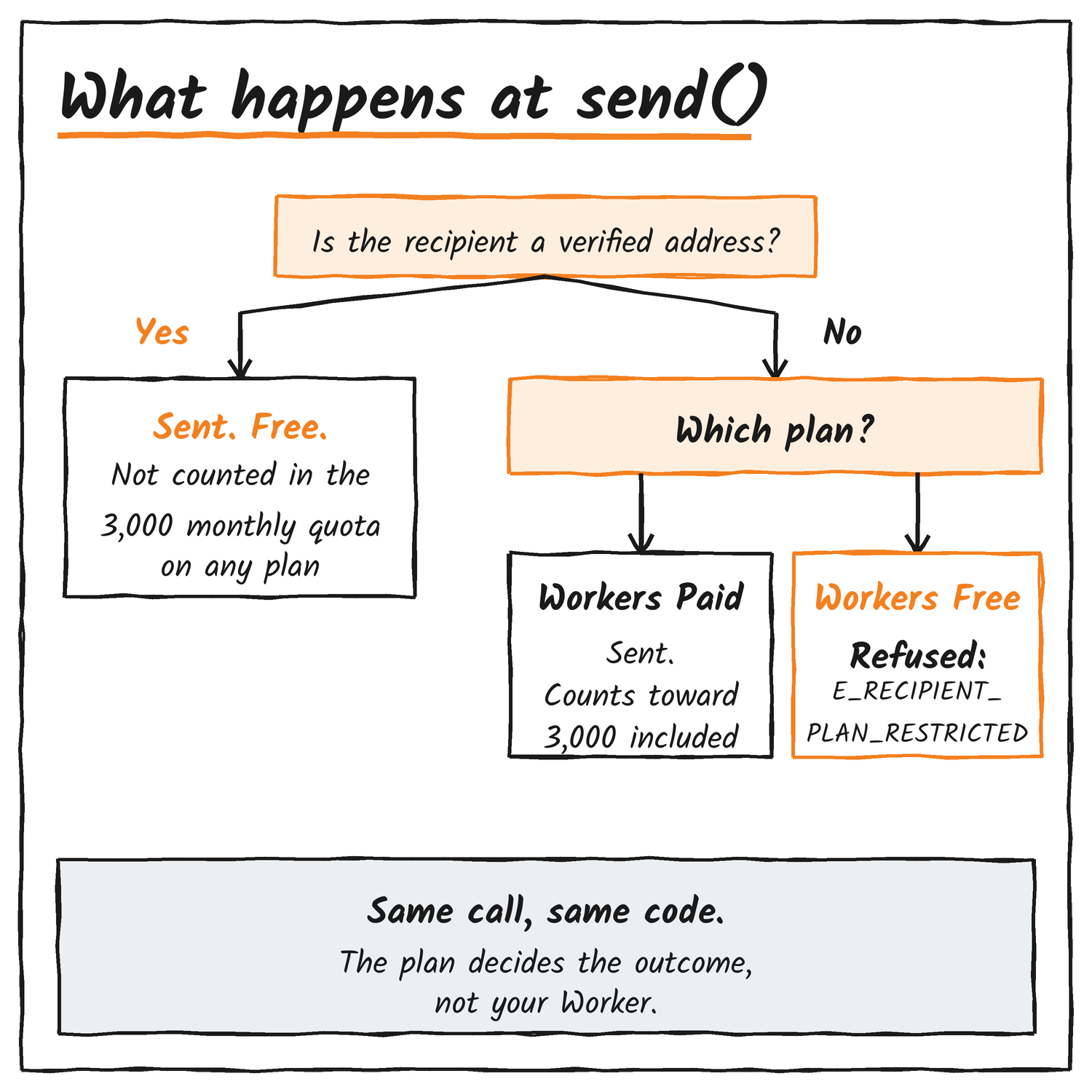
Two details matter more than the headline. First, the entry says “Sends to verified destination addresses are free on every plan. They do not count toward the monthly quota or the daily sending limits.” Second, a Free account that tries to mail anyone else gets an error. The changelog’s own code sample catches E_RECIPIENT_PLAN_RESTRICTED and returns a 403, so the restriction is enforced at send time and isn’t a soft warning.
The catch: your own addresses only
“Verified destination address” has a specific meaning. It’s an address you’ve added to your Cloudflare account and confirmed, the same list Email Routing uses to forward mail. Cloudflare’s limits page allows up to 200 of them per account. In practice that means your inbox, your teammates’ inboxes and a handful of test mailboxes.
That makes the plan fit some jobs and rule out others. I’ve sorted them below by what the limits page and changelog allow.
| Job | Works on Free? | Why |
|---|---|---|
| Deploy or uptime alert to your team | Yes | Recipients are verified addresses in your account |
| Daily report to yourself | Yes | Same |
| Testing templates during development | Yes | Send to your own test mailboxes, free and outside the quota |
| Password reset to a user | No | The user isn’t a verified destination; send is refused with E_RECIPIENT_PLAN_RESTRICTED |
| Receipt or invoice to a customer | No | Same |
| Newsletter or marketing mail | No | Same, and Email Sending is built for transactional mail |
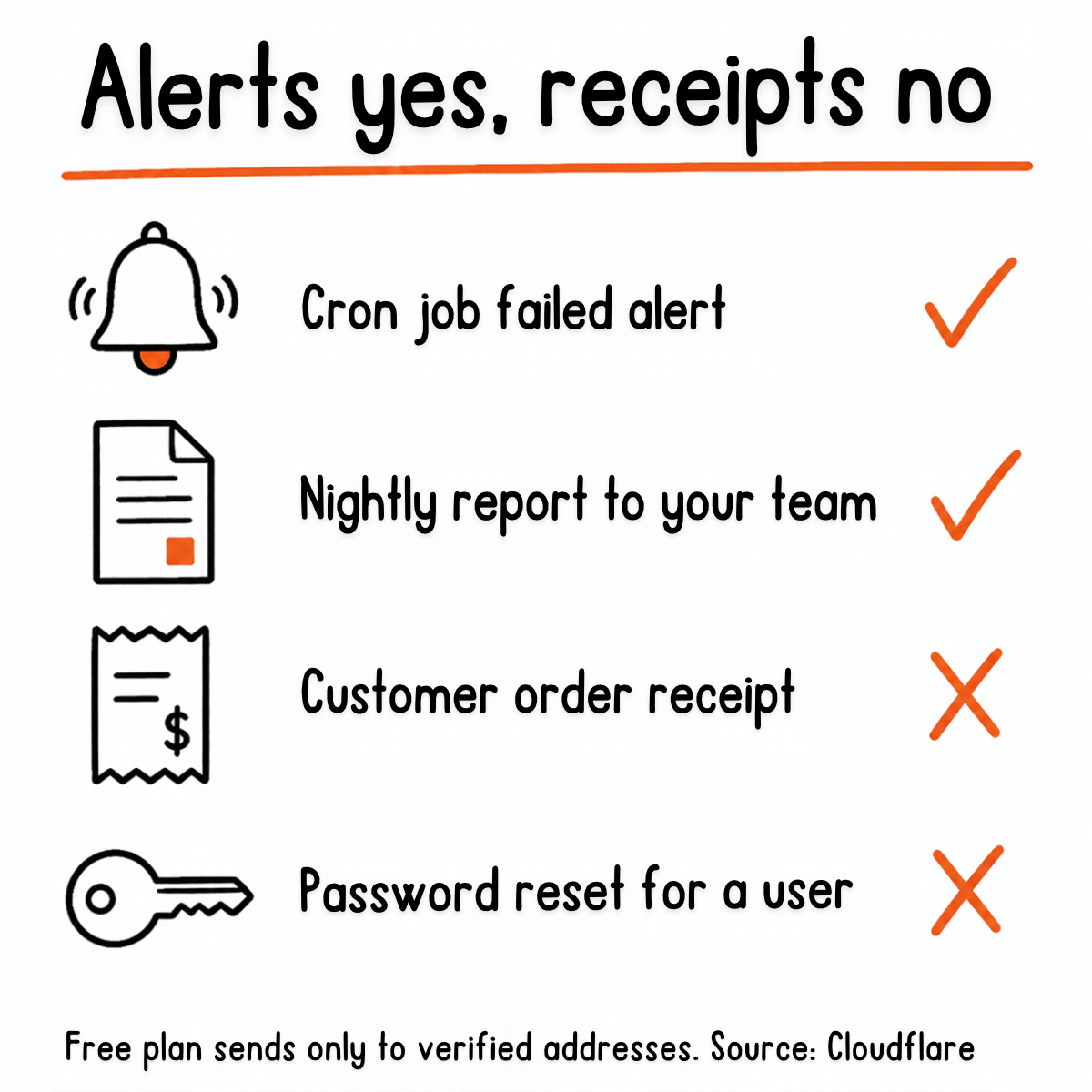
One secondary write-up I read claimed that password resets and receipts are free on Workers Free. Cloudflare’s own pages say the opposite, so ignore that claim. If your app mails real users, you’re on Workers Paid.
What already worked before
The changelog reads like a new capability, but Cloudflare’s limits page says domains that only use Email Routing can already send to verified destination addresses, and it labels that the “legacy path”. So a Free account could already do a version of this. What changes now is that a Free account can onboard a sending domain and use the full Email Sending path, with the same binding, API and SMTP options a paying customer gets.
The changelog’s second section covers the visible difference. Verified sends now count as Email Sending traffic:
- They appear in the Activity log and in Email Sending analytics, and no longer in Email Routing analytics.
- They fire
message.deliveredandmessage.bouncedevents. - The GraphQL Analytics API has a new
isVerifiedRecipientfield, so you can split verified sends from the rest. - Routing-only domains are unchanged.
If you build dashboards or alerts off Email Routing analytics, check them. Verified sends that used to show up there now show up somewhere else.
Pricing and limits
Cloudflare’s pricing page puts Email Sending inside the Workers plans. Free sends only to verified destinations. Workers Paid is US$5 a month, includes 3,000 outbound emails a month and charges US$0.35 per 1,000 after that. Hard bounces count toward the quota. Rejects at the API boundary, including blocks from the suppression list, don’t.
| Limit | Value |
|---|---|
| Recipients per email | 50 |
| Message size | 25 MiB |
| Header size | 16 KB |
| Sending domains per zone | 30 |
| Verified destination addresses per account | 200 |
| Routing rules per domain | 200 |
| Daily quota for a new account | “Conservative,” with no number published |
The daily quota is the vague one. Cloudflare says new accounts get a conservative daily quota and doesn’t publish it. Hitting it shows up as SMTP 451 4.7.1, E_DAILY_LIMIT_EXCEEDED or an HTTP 429. Verified sends sit outside it, but anyone planning real volume on Paid can’t size it from the docs.
The Workers platform around it is the other cost. Workers Free gives 100,000 requests a day and 10 ms of CPU per invocation. Paid is US$5 a month with 10 million requests and 30 million CPU milliseconds included.
How you send, and what to set up
There are three ways in, and the free tier supports all of them.
- Workers binding. Add a
send_emailbinding and callenv.EMAIL.send()from a Worker. - REST API. Post the message from any service with a Cloudflare API token.
- SMTP. Use
smtp.mx.cloudflare.neton port 465 with implicit TLS. There’s no STARTTLS on 587 and no port 25 relay. The username isapi_tokenand the password is a Cloudflare API token with the “Email Sending: Edit” permission. A session can carry up to 50 recipients.
The port 465 detail trips up older software. Plenty of legacy apps and plugins only speak STARTTLS on 587, and they won’t connect.
Onboarding a domain means picking one that’s already in your Cloudflare account. Cloudflare then adds an MX record, an SPF TXT record and a DKIM TXT record on the cf-bounce subdomain, plus a DMARC TXT record at _dmarc. That’s four DNS records you didn’t write by hand, which is a convenience of owning the DNS. It also means a domain whose DNS lives elsewhere has to move first.
How Resend, SES and the rest compare
The honest comparison for Cloudflare’s free tier isn’t the other free tiers. It’s the sandbox every big sender puts new accounts in, because Cloudflare’s rule is the same idea made permanent. Amazon SES starts new accounts in a sandbox that sends only to verified addresses or domains, capped at 200 messages in 24 hours and one a second, until you ask for production access. Cloudflare’s version is similar in what it allows, but there’s no request form: you leave it by paying US$5.
| Provider | Free tier | Paid entry point | Who a free account can mail |
|---|---|---|---|
| Cloudflare Email Sending | Free, unmetered, verified destinations only | US$5 a month with 3,000 included, then US$0.35 per 1,000 | Only verified addresses in your account |
| Resend | US$0: 3,000 a month, 100 a day, 3 domains | Pro US$20 for 50,000; US$35 for 100,000; US$0.90 per 1,000 over | Anyone |
| Amazon SES | Sandbox: 200 a day, 1 a second; new AWS accounts get up to US$200 in credits | US$0.10 per 1,000 (Essentials plan US$0.16, the default for new accounts from 21 July 2026) | Verified addresses or domains only, until production access |
| Postmark | 100 a month | Basic US$15 for 10,000; US$1.80 per 1,000 over | Anyone |
| Mailgun | 100 a day, 1 custom domain | Basic US$15 for 10,000 | Anyone, per its page |
| SendGrid | No free plan; 60-day trial at 100 a day | Paid plans | Anyone during the trial |
Cloudflare’s free tier is the most generous of the six in volume, since verified sends aren’t metered at all. It’s the narrowest in who you can mail. Resend’s free plan covers 3,000 emails a month to anyone, which is more useful if you have users and fewer than 100 emails a day.
What it costs once you pay
Once real users are involved, price becomes the question. I worked out the monthly sending cost at three volumes from the list prices above. These cover sending only. Workers charges beyond the included allowance, SES data transfer and any add-ons are left out.
| Emails a month | Cloudflare (Workers Paid) | Resend | Amazon SES (pay as you go) |
|---|---|---|---|
| 10,000 | US$7.45 | US$20 | US$1 |
| 50,000 | US$21.45 | US$20 | US$5 |
| 100,000 | US$38.95 | US$35 | US$10 |
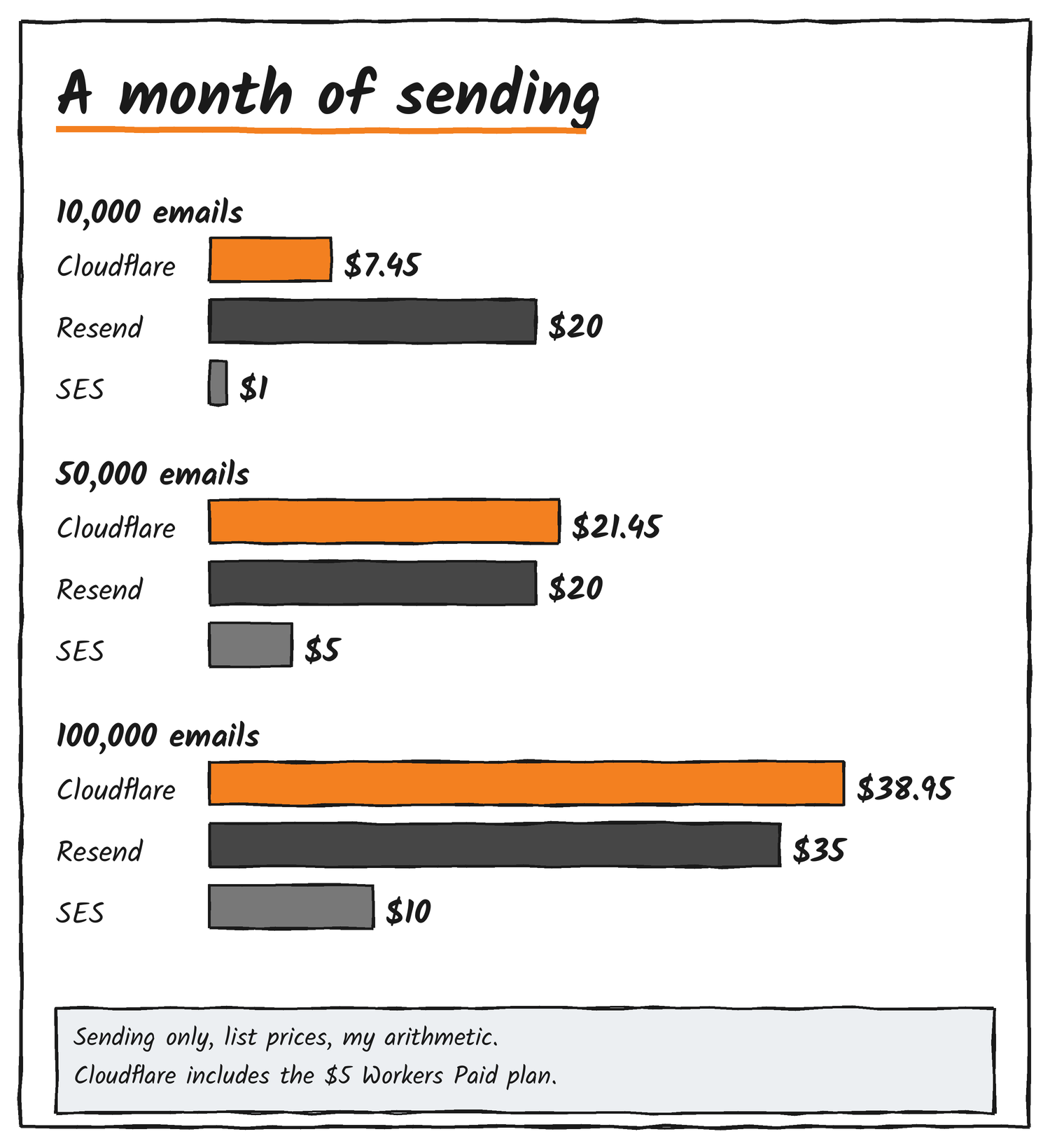
Cloudflare undercuts Resend at 10,000 a month, then costs a little more at 50,000 and 100,000. Amazon SES is the cheapest at every volume, by a wide margin. The price of that is setup: SES keeps new accounts in the sandbox until you request production access. These numbers say nothing about deliverability, which is how often mail reaches the inbox. None of these providers publishes a comparable figure, and I haven’t tested it.
For related coverage, I wrote up Resend’s Forge sending infrastructure and its Go email API earlier this month.
How Email Service got here
Cloudflare Email Service has two halves. Email Routing is the existing inbound half. Email Sending is the new outbound half, and the docs index still labels it Beta.
| Date | What happened |
|---|---|
| 25 September 2025 | Cloudflare announced the private beta of Email Service. It said then that “Email Sending will require a paid Workers subscription” |
| 16 April 2026 | Public beta, announced in Agents Week: a Workers binding, an Email MCP server, Wrangler commands, skills and an agentic inbox |
| 24 November 2026 | Changelog entry: Email Sending on Workers Free for verified destination addresses |
That first line is worth holding next to this week’s change. Cloudflare said in 2025 that sending would need a paid plan. Fourteen months later, it has a free route for a narrow slice of it. The reason Cloudflare gives is development and testing.
What Cloudflare hasn’t published
- The daily sending quota for a new account. The limits page says “conservative” and gives no figure.
- A date for general availability. The docs still say Beta, and Cloudflare hasn’t said whether pricing changes at GA.
- Any deliverability or inbox-placement figures for Email Sending, from Cloudflare or anyone else.
- What counts as a sending reputation on a shared pool, and whether Free-plan domains share one with paid ones.
- Why the plan restriction is by recipient and not by volume. The changelog describes the rule but not the reasoning.
I haven’t run a send myself, so everything above comes from Cloudflare’s published pages and the other providers’ public pricing, not from a hands-on test.
Who should use it
- Solo developers and small teams already on Cloudflare. Alerts and reports to your own inbox now cost nothing and don’t need a second vendor.
- Anyone prototyping an email flow. Build and test the whole send path on Free against your own mailboxes, then flip to Paid at launch without changing code.
- Apps that mail real users. Plan for Workers Paid from day one. If volume is large, price SES against it, since it’s far cheaper per message.
- Anyone relying on Email Routing analytics. Update your dashboards, because verified sends have moved to Email Sending analytics.
Terms used in this piece
- Transactional email
- Automatic mail triggered by something a person did, such as a receipt or password reset, as opposed to a newsletter.
- Verified destination address
- An address you’ve added to your Cloudflare account and confirmed by clicking a link sent to it.
- Workers binding
- A named connection from a Worker to a Cloudflare service, here
env.EMAIL. - SMTP
- The standard protocol for handing a message to a mail server.
- SPF, DKIM and DMARC
- DNS records that prove a message really comes from your domain, which receiving servers check before accepting it.
- Hard bounce
- A permanent delivery failure, such as an address that doesn’t exist.
- Suppression list
- A list of addresses a provider refuses to send to, usually after bounces or complaints.
- Sandbox
- A restricted starting mode for new sending accounts, limited to verified recipients and low volumes.
Cloudflare has opened a free door into Email Sending, and it opens onto your own mailbox only. The next thing to watch is whether Cloudflare publishes the daily quota and a GA date, because those two numbers decide whether Paid is a serious option for real customer mail.
Sources
- @CFchangelog on X, 25 November 2026
- Cloudflare changelog, entry of 24 November 2026
- Cloudflare Email Service docs, including the pricing, limits, SMTP and domain pages, read 25 November 2026
- Cloudflare blog: private beta announcement, 25 September 2025; “Email for agents” public beta, 16 April 2026
- Resend pricing, read 25 November 2026
- Amazon SES pricing and AWS SES sandbox documentation, read 25 November 2026
- Postmark pricing, Mailgun pricing and Twilio’s SendGrid free-plan retirement notice, read 25 November 2026
Discover more from Sulat AI & Tech News
Subscribe to get the latest posts sent to your email.