
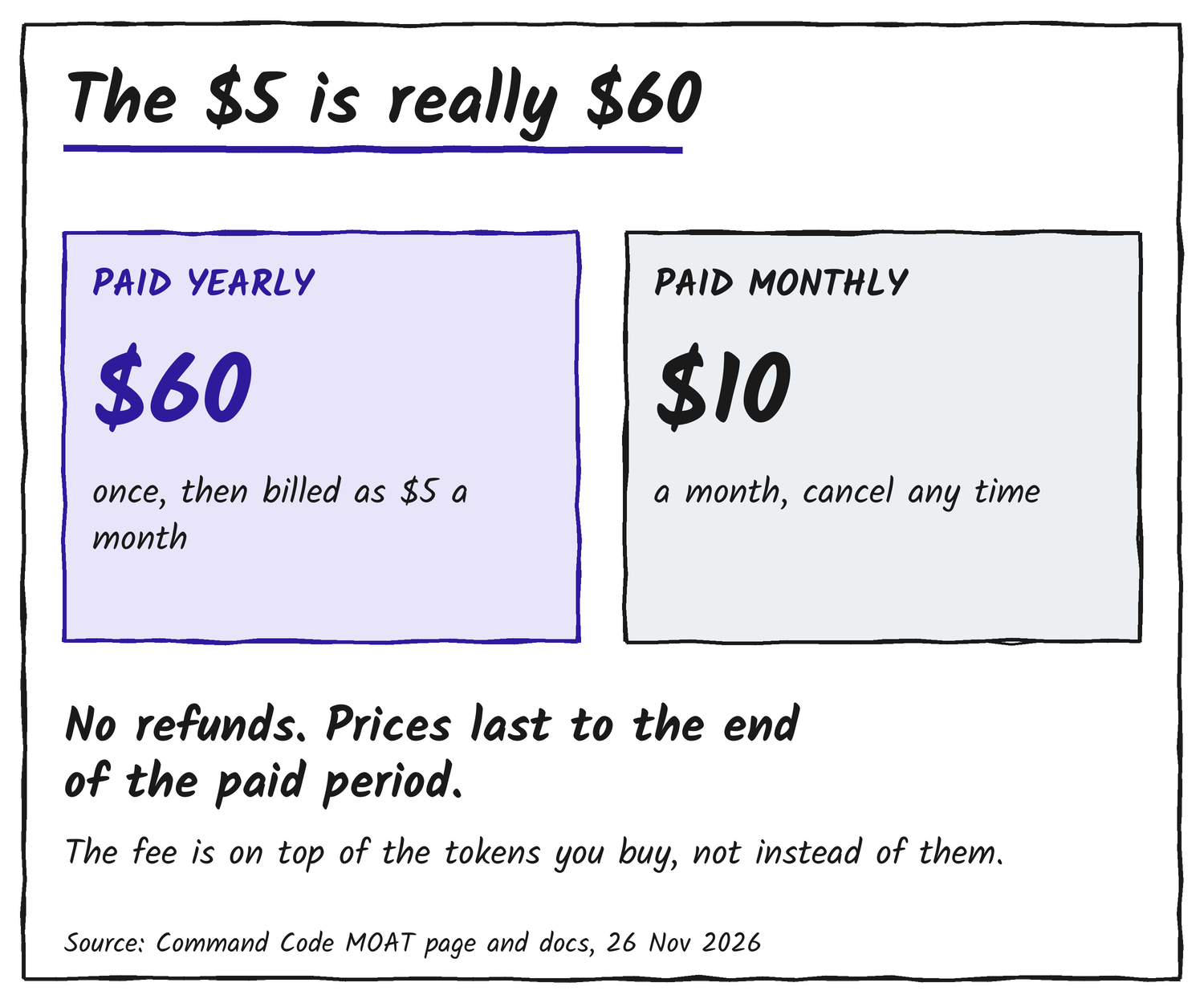
Command Code’s MOAT membership is $60 a year, not $5 a month, and it discounts eight of the 105 models on its price list. The discount is measured against each lab’s own list price. That matters, because the “OpenRouter” comparison Command Code draws beside it is just that same list price multiplied by 1.055.
I read Command Code’s MOAT docs, models page, pricing page, terms, zero-data-retention docs and launch post on the afternoon of 26 November 2026 (NZDT), a day after the company announced MOAT on X. I haven’t bought a membership or sent a request through the MOAT API, so I haven’t seen a bill. Everything below is what Command Code publishes plus arithmetic I did on it, and I label opinion as opinion.
- What MOAT is
- The $5 is $60
- Which models are cheaper
- Does it pay for itself?
- Other ways to buy the same tokens
- The fine print, and where the docs disagree
- Who is behind it
- What I make of it
- Who should join
What MOAT is
Command Code makes a coding agent of the same name. MOAT is a membership layered on its credits. Whenever your credits pay for a request, you pay the MOAT price for that model instead of list. Command Code pitches it as “the Costco of AI tokens” and says it buys in bulk, citing usage that “scales to hundreds of trillions of tokens”. I found no volume agreement or upstream contract published to check that against.
MOAT replaces OpenRouter. OpenRouter adds a 5% to 8% fee. MOAT gives you up to 70% off.
Command Code MOAT docs, read 26 November 2026
You aren’t locked into Command Code’s own agent. MOAT is reachable from any tool that speaks the OpenAI or Anthropic API formats, using your Command Code API key and a model ID from the MOAT table.
| Client format | Base URL |
|---|---|
| OpenAI compatible | https://api.commandcode.ai/inference/v1 |
| Anthropic compatible | https://api.commandcode.ai/inference |
Command Code also promises no 5-hour or weekly caps on credit-paid requests, a single price per model with no providers to choose between, and optional zero data retention. Two limits sit on the membership itself: it covers one personal account, and keys billed to an organisation pay list price.
The $5 is $60
The headline reads “$5/month”. The docs say it is “paid yearly”, and the pricing page gives the real shape: $10 a month, or $60 a year. So the $5 is the annual price divided by twelve. Cancelling is allowed at any time, but MOAT prices only last until your paid period ends and there are no refunds. If a payment fails, the discounts stay on for 24 hours while it retries.
Which models are cheaper
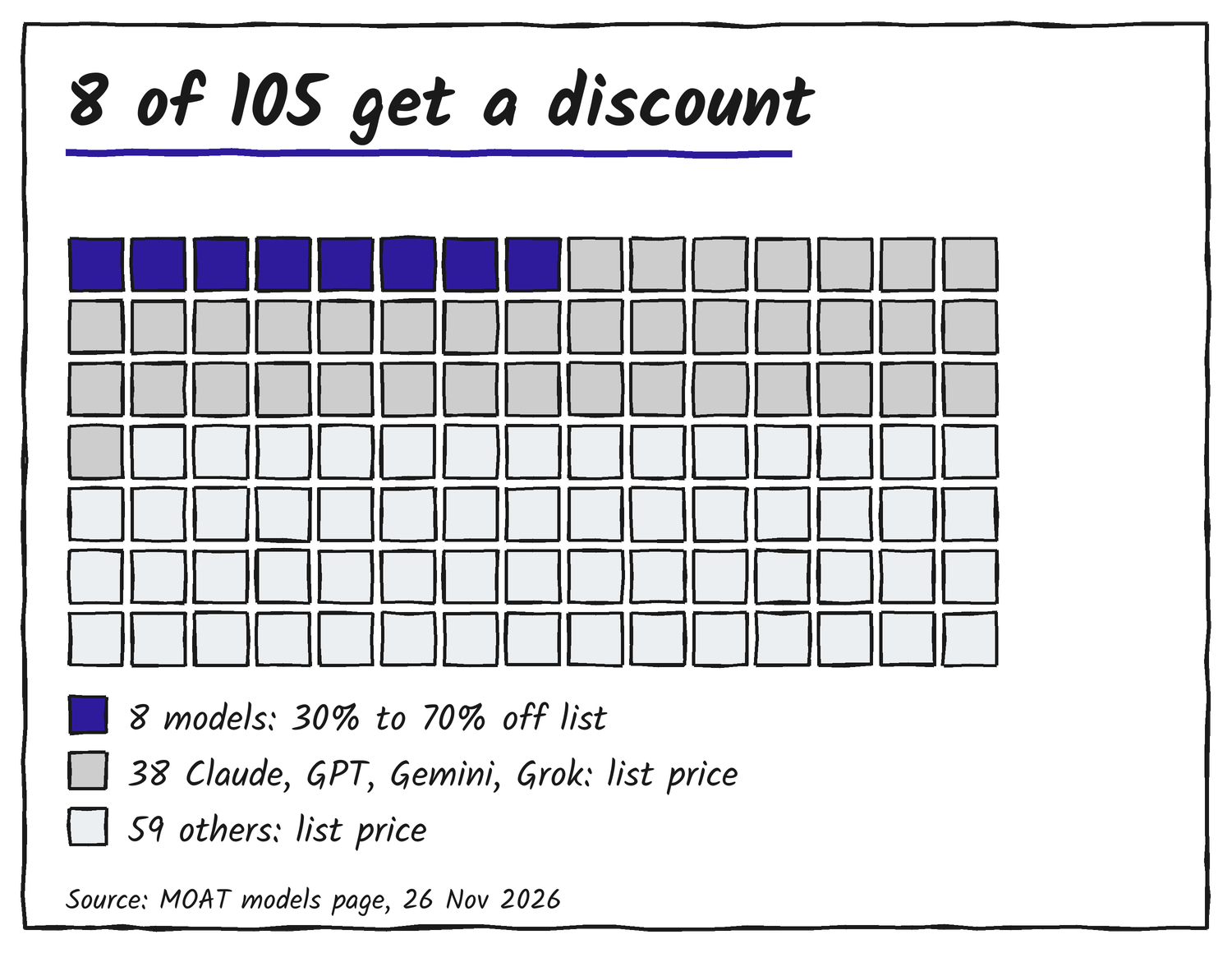
Command Code says members get “100+ open models of the highest quality at wholesale prices”. The models page tells a narrower story. It lists 105 models, eight of them discounted.1 The other 97 cost list price with no markup, and 38 of those are Claude, GPT, Gemini and Grok models that nobody is discounting. That leaves at most 67 models that are anything else, and the page doesn’t say which of them are open-weight, so “100+ open models” doesn’t hold.
| Model | Off list | MOAT, input / output | List, input / output |
|---|---|---|---|
| GLM-5.3 Flash | 70% | $0.045 / $0.15 | $0.15 / $0.50 |
| GLM-5.3 | 65% | $0.49 / $1.54 | $1.40 / $4.40 |
| DeepSeek V4.1 Flash | 60% | $0.06 / $0.24 off-peak, $0.12 / $0.48 peak | $0.15 / $0.60 off-peak, $0.30 / $1.20 peak |
| Ling 3.1 Flash 1019 | 60% | $0.12 / $0.36 | $0.30 / $0.90 |
| Ling 3.1 Flash | 50% | $0.15 / $0.45 | $0.30 / $0.90 |
| Kimi K3 | 40% | $1.80 / $9.00 | $3.00 / $15.00 |
| GLM-5.3 FlashX | 40% | $0.222 / $0.75 | $0.37 / $1.25 |
| Kimi K3.1 Pro | 30% | $1.40 / $7.00 | $2.00 / $10.00 |
Command Code also shows a “cache read” price, which is the cheap rate for tokens the model has already seen. Agents re-send their whole context on every turn, so cache reads dominate a coding session, and the discount applies to them too.
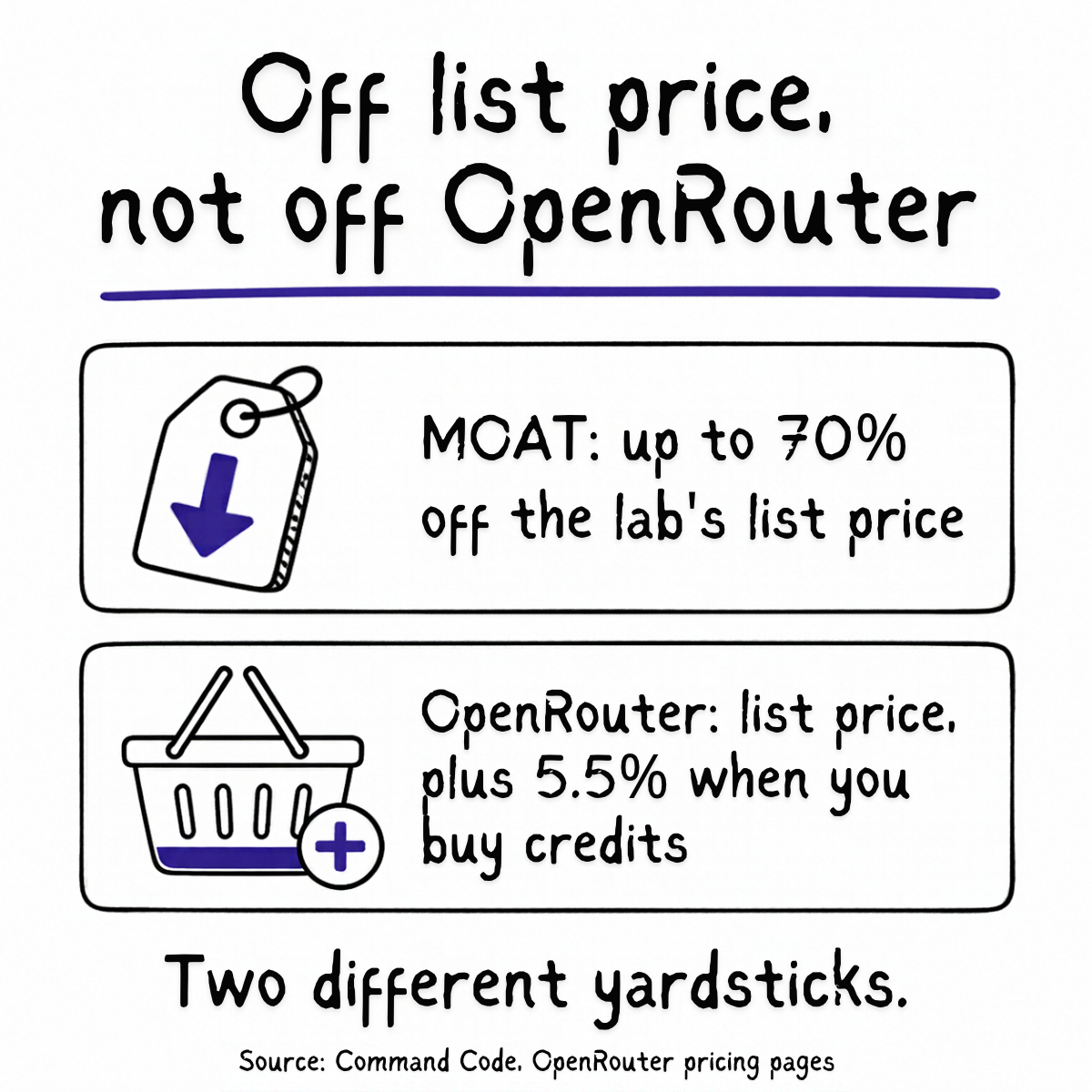
Take the “OpenRouter” column. On all 105 rows, the figure is the lab’s list price times 1.055: $0.15 becomes $0.158, $1.40 becomes $1.48. It isn’t a quote from OpenRouter. It is the lab’s price plus OpenRouter’s published 5.5% fee on credit purchases. That is a fair way to show what a card top-up costs on OpenRouter, but it means MOAT’s saving against the lab is the discount, and the saving against OpenRouter is the discount plus 5.5 points.
One more detail on DeepSeek. The 60% applies to both of its rates. DeepSeek charges double during weekday peak windows of 01:00 to 04:00 and 06:00 to 10:00 UTC, which is 2pm to 5pm and 7pm to 11pm in New Zealand, and MOAT follows the same schedule at half the price. I covered that peak-rate pattern when I checked the Radius gateway.

Does it pay for itself?
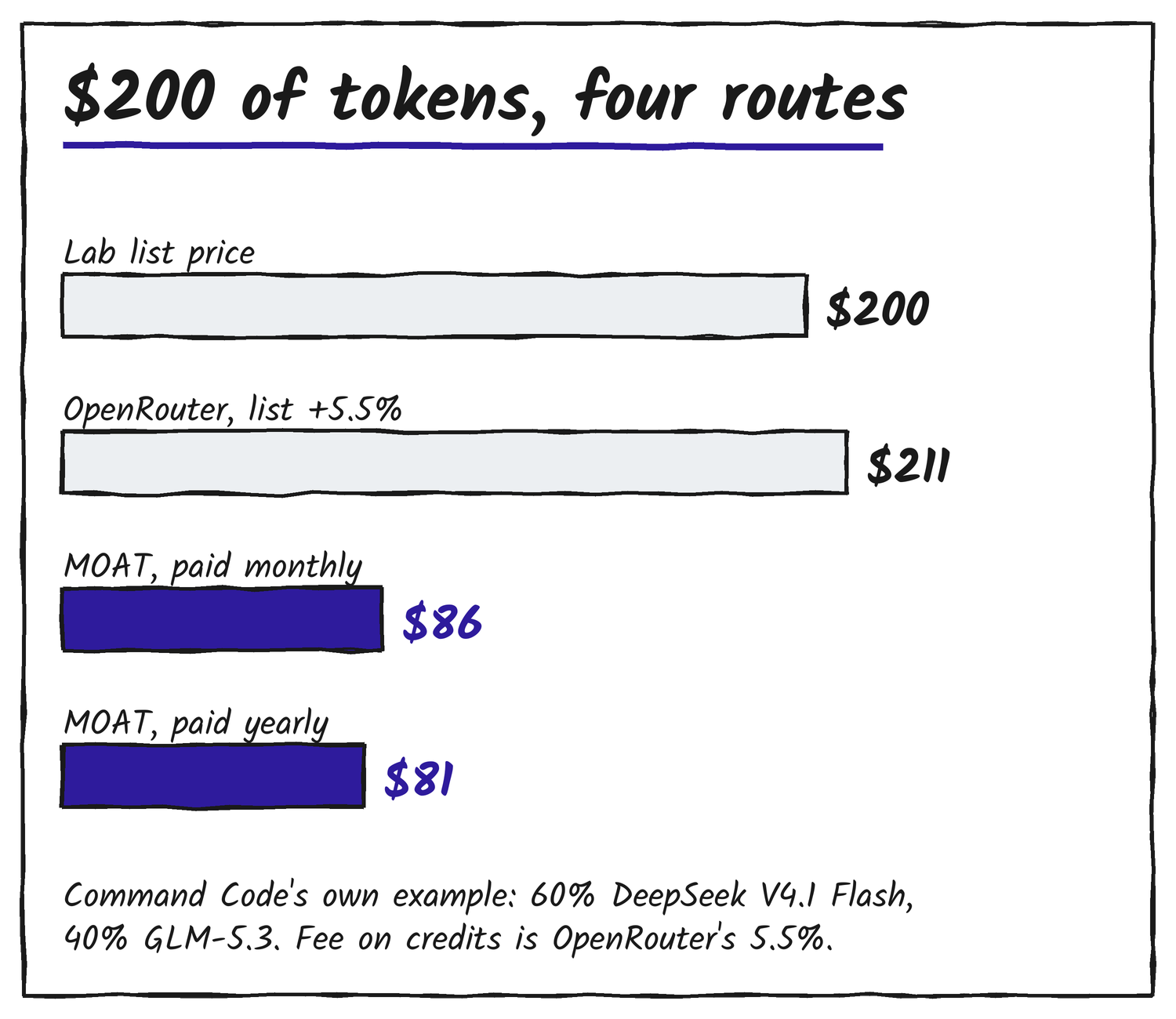
It does if you spend enough on the discounted models. Command Code’s own calculator assumes a mix of 60% DeepSeek V4.1 Flash and 40% GLM-5.3, which averages 62% off list. At that rate the saving is 62 cents on every list-price dollar, so the fee is covered once you pass about $8 of list-price spend a month on the annual plan, or about $16 if you pay $10 a month.2
| List-price tokens a month | OpenRouter, list +5.5% | MOAT, annual | MOAT, monthly |
|---|---|---|---|
| $20 | $21 | $13 | $18 |
| $50 | $53 | $24 | $29 |
| $200 | $211 | $81 | $86 |
| $500 | $528 | $195 | $200 |
| $2,000 | $2,110 | $765 | $770 |
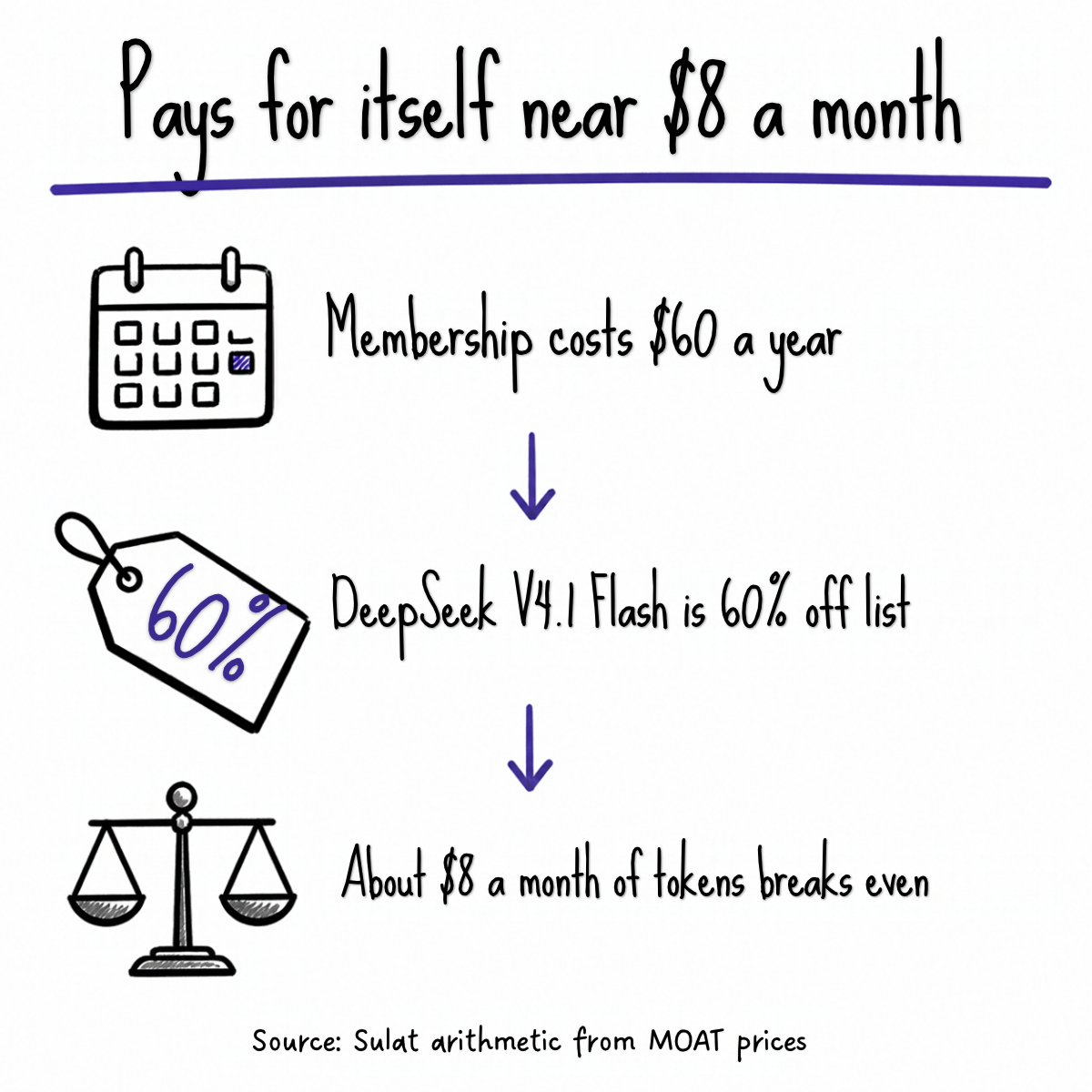
There’s a catch. If your credits mostly pay for Claude, Gemini, Grok or GPT, the discount is zero and the membership is $60 a year for nothing. The saving also depends on the 62% average holding. On Kimi K3.1 Pro alone, at 30% off, the saving is 30 cents on the dollar and the break-even rises to about $17 a month on the annual plan.
To see it on one session, I used the shape from my Radius check: 5 million cache-read tokens, 0.5 million fresh input and 0.2 million output on DeepSeek V4.1 Flash. I assumed MOAT’s peak cache-read price is 60% off DeepSeek’s $0.006, since the page lists only the peak input and output rates.
| Route | Cost for that session |
|---|---|
| Radius, any hour | $0.42 |
| DeepSeek direct, peak | $0.42 |
| DeepSeek direct, off-peak | $0.21 |
| OpenCode Console, any hour | about $0.17 |
| MOAT, peak | about $0.17 |
| MOAT, off-peak | about $0.08 |
So at DeepSeek’s peak, MOAT lands where OpenCode’s Console already sits, and off-peak it halves that. On GLM-5.3, MOAT’s $0.49 and $1.54 sit a little under OpenCode’s $0.56 and $1.76. The cheapest open-model route moved again this week. OpenCode’s price cut is the benchmark MOAT now has to beat.

Other ways to buy the same tokens
Each route earns its money in a different place. The table shows where, as each publishes it.
| Route | Token price | Fees | Notes |
|---|---|---|---|
| Command Code MOAT | List, or 30% to 70% off on 8 models | $60 a year or $10 a month | Personal accounts only, no refunds, no caps on credit-paid requests |
| OpenRouter | List | 5.5% on credit purchases ($0.80 minimum), 8% on Business, 5% crypto | Bring-your-own-key is free up to $25k a month, then 5% |
| Vercel AI Gateway | List | Payment processing fees on top-ups | Add-ons are metered |
| Cloudflare AI Gateway | List | 5% on Unified Billing credits | Core features free |
| OpenCode Console | Below list on some models | Card fee reported at 4.6% plus $0.31 | Pay as you go |
| Radius | List on verified rows | Processing fee on top-ups, size unpublished | Pi format only, alpha |
The more direct rival is Command Code’s own subscription. GOAT costs $10 a month and buys “up to $100 of credits”, with boosted allowances on particular models: $100 on DeepSeek V4.1 Flash, $70 on GLM-5.3. It carries rolling limits, though, of up to $20 in any five hours and $50 a week. MOAT credits have no such windows. So GOAT is cheaper per dollar of use until you hit a cap, and MOAT keeps working after it.
| Command Code option | Price | What it buys | Limits |
|---|---|---|---|
| GOAT | $10 a month | Up to $100 in credits, boosted per model | Up to $20 in 5 hours, $50 a week |
| Pro | $20 a month | Up to $110 in credits | Up to $22 in 5 hours, $55 a week |
| MOAT | $60 a year or $10 a month | Discounted prices when credits pay | None on credit-paid requests |
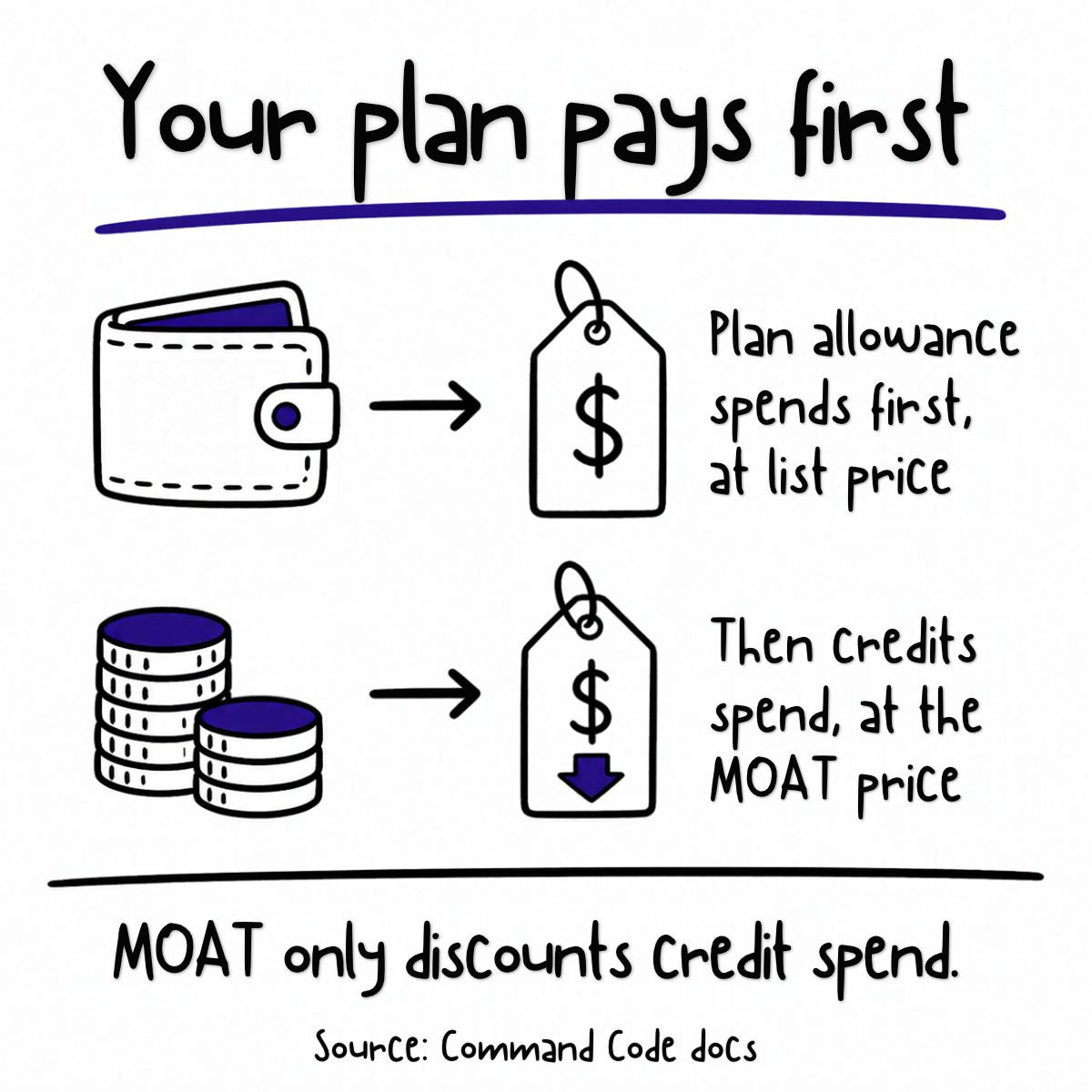
The two combine, but the plan goes first. A plan’s allowance pays first, at list price, and MOAT only prices the credits you buy after it runs out. Anyone on GOAT who stays inside the allowance gains nothing from MOAT.

The fine print, and where the docs disagree
I found three places where Command Code’s own pages disagree.
Credit expiry. The pricing docs promise “credits that never expire” and say top-up credits “roll over and never expire”. The terms, last updated on 29 October 2026, say “top-up credits” count as Additional Credits that “may be reduced, revoked, expired, or discontinued at any time” at the company’s sole discretion, and that unused credits “do not roll over to any subsequent period”. MOAT rewards you for buying credits, so which page governs is not a small question.
Discounts as deals. The terms say deals and discounts are time-bound and may be withdrawn at any time without notice. The MOAT page itself warns that “some discounts run for a limited time”, and tags MiniMax M3’s 50% as a deal. It doesn’t say which of the eight standing discounts count. The terms predate MOAT and never mention it.
Zero data retention. MOAT’s perks list “zero data retention models”. The ZDR docs make it an opt-in flag: CMD_ZDR=1 on the CLI or an x-cmd-zdr: 1 header on the API. If no zero-retention upstream can serve the model, the request fails with a 422 rather than falling back. On some models ZDR is included at the normal price, and on others the docs say it “can cost more”. Claude Fable 5 and 5.1 never qualify, because Anthropic keeps their prompts for 30 days. Whether the MOAT discount holds on the models where ZDR costs extra isn’t stated.
Two smaller things. The pricing page lists “+ processing fee” beside the monthly plans, while the MOAT docs say “there is no processing fee”. I couldn’t tell whether buying credits carries a card fee. And the promise of no usage limits sits beside a terms clause requiring you to follow the company’s “usage guidelines and limits”, which I didn’t find defined for credit-paid use.
Who is behind it
Command Code is a San Francisco startup led by founder and CEO Ahmad Awais. Its launch post says it raised a $5 million seed round led by PWV, Tom Preston-Werner’s fund, after PWV backed its pre-seed, with angels that include Cloudflare’s CTO and the chief executives of Supabase and Replit. The product is a coding agent that learns your “coding taste” from what you accept and reject, and it is built to run open models well. Awais’s own claim of “about 98 per cent cache hit rates” is the engine of the MOAT pitch: the more of each request that is cache reads, the more the cheap cache-read discount matters. I haven’t verified that figure.
The OpenRouter side of the comparison now belongs to Stripe. The deal closed on 10 November, and OpenRouter has pledged neutrality. Our report on the acquisition has the detail.

What I make of it
This section is analysis, not reporting.
First, MOAT is a discount club on a handful of cheap models, and the marketing sells it as something broader. The eight models are exactly the cheap open ones Command Code’s agent is tuned for, while the premium models that developers pay most for sit at list. A shopper who joins for Claude gets nothing. A shopper who joins for DeepSeek and GLM gets a lot.
Second, “wholesale” is a claim, not a fact I can check. Command Code says its volume buys it better rates, but it publishes neither the volume agreement nor the upstream price it pays. The discounts could be funded by margin, by promotion or by the membership itself. It also says its models are “benchmarked and quality tested by us”, and I found no benchmark, latency or uptime figure to read.
Third, a flat annual fee gates the whole thing, and every dollar of discount is spent inside Command Code’s account system. MOAT works from Claude Code, Cursor or Pi, so each of those users is a possible Command Code customer even if they never touch its agent. It’s a sensible move for Command Code. It’s also why you should read the credit terms before you prepay.
Who should join
My view: MOAT is worth the $60 if you pay for open-model tokens with credits, mostly on GLM-5.3, DeepSeek V4.1 Flash, Kimi K3 or the Ling models, and you spend more than about $8 a month of list value. It is a good fit for anyone who keeps hitting 5-hour and weekly caps on a plan, since credit-paid requests don’t have them. If you’re deciding between the plans, GOAT is cheaper until you hit its caps and MOAT is the route after.
Skip it if you mostly use Claude, Gemini, Grok or GPT, if you work in a team on organisation-billed keys, if you stay inside a plan’s allowance, or if you want a refund option. Pay monthly first if you’re unsure, and note that the monthly route costs double and gives the same discounts.
Three things would improve my verdict: a clear statement of whether purchased credits can expire, a list of which discounts are standing and which are deals, and published quality or uptime numbers for the discounted models. I’ll update this piece if Command Code provides any of them.
Sources
- Command Code’s announcement on X, 25 November 2026
- MOAT membership docs and MOAT models and prices, read 26 November 2026
- Command Code pricing and Pricing and limits, read 26 November 2026
- GOAT plan and Zero Data Retention docs, read 26 November 2026
- Command Code terms, last updated 29 October 2026
- Command Code launch post, for the seed round
- Our reporting on OpenRouter, OpenCode, Radius and Cloudflare AI Gateway, linked above
- Command Code’s docs table also shows MiniMax M3 at 50% off, flagged as a limited-time deal, and says 107 models. The separate models page lists MiniMax M3 at list, counts eight discounted models and says 105, which already includes the two free models, Flint and Glyph Cluster. I count from that page. ↩︎
- Command Code’s calculator says MOAT pays for itself from $9 a month on this mix. My arithmetic gives $8.06 ($5 divided by the 62% average discount). I can’t explain the gap, and it is small. ↩︎
Discover more from Sulat AI & Tech News
Subscribe to get the latest posts sent to your email.