OpenCode has added a second free stealth model, Seaglass Alpha Free, and its catalog entry is a copy of the first one’s. The file for seaglass-alpha-free differs from tidepool-alpha-free in three lines: the name, the release date and a date in a comment. Both take text only, have a 1,048,576-token window and a 131,072-token output cap, and cost nothing. OpenCode hasn’t said who makes either. The label “same operator” comes from the X post that spotted the copy, and it’s an inference, not something OpenCode has stated.
What OpenCode listed
OpenCode’s bot committed the entry to the models.dev catalog at 2:23pm NZ time on 26 November, under the title “opencode: add seaglass-alpha-free”. The description reads “Stealth reasoning model, free for a limited time”. It lists text input and text output, tool calling, and six reasoning effort levels from minimal to max. The context window is 1,048,576 tokens and a single reply can run to 131,072. Input, output and cached reads are all priced at zero, and the live Zen model list at opencode.ai now carries the ID too.
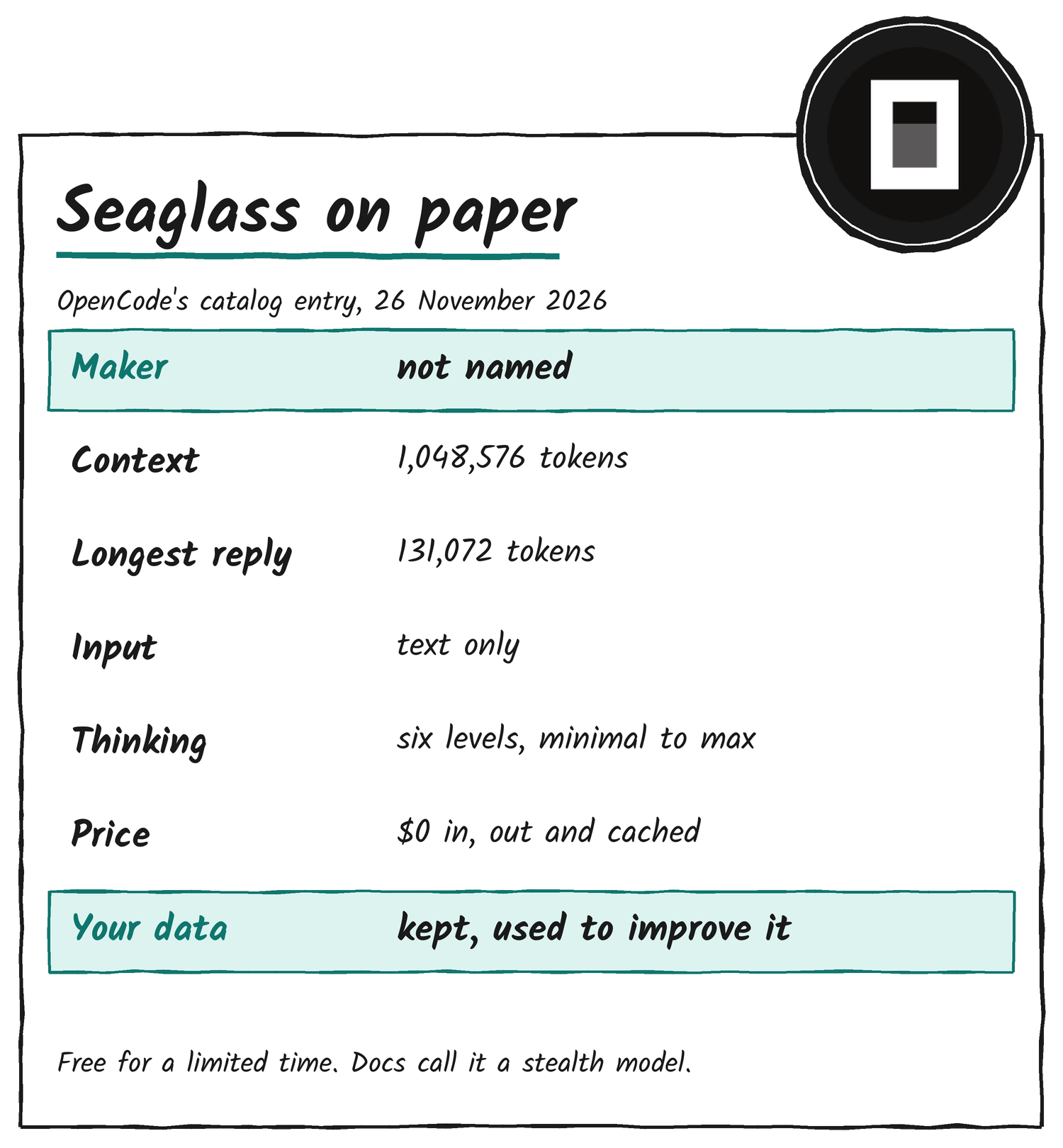
OpenCode’s docs call it “a stealth model that’s free on OpenCode for a limited time” and say the team is using the period “to collect feedback and improve the model”. They give no end date. The privacy table says that during the free period, collected data “is retained and used to improve the model”.
How much of the file is copied
I compared the two files in the models.dev repository. The Tidepool file was added by the same bot on 18 November, and its release date is 18 November. Diff them and three lines change: the name, the release date, and the date in the header comment, which reads 2026-11-18 on Tidepool and 2026-11-25 on Seaglass. The description, base URL, modalities, effort levels, limits and zero prices are character for character the same.
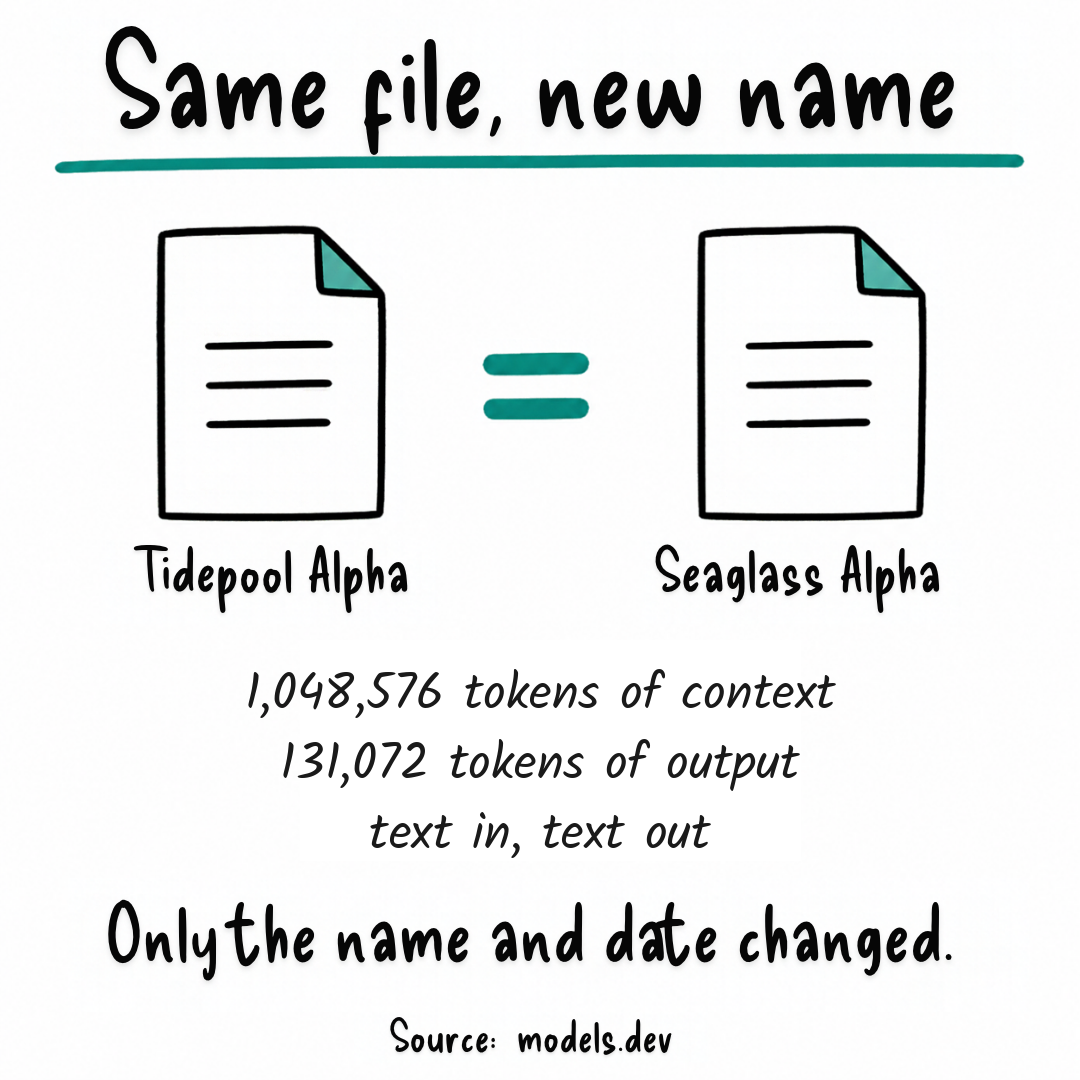
That header comment says the modalities, capabilities, effort levels and limits were “supplied by the operator” on those dates. It doesn’t say who the operator is, and I wouldn’t read it as a confession that one lab made both. Copying a template is the cheapest way to add a second entry, whoever’s model sits behind it. Matching limits are a clue, and so is the shared naming pattern. They aren’t a confirmation. Nobody has claimed either model, and I haven’t run Seaglass, so I can’t say how it codes.
Where Tidepool went
When I pulled the live Zen model list at about 4pm NZ time, it had Seaglass Alpha Free but no Tidepool Alpha Free. Models.dev and OpenCode’s docs pricing table still list Tidepool, so the model hasn’t been erased from the record. OpenCode hasn’t said whether Tidepool has been retired, hidden or swapped for Seaglass. The post that spotted the copy says Tidepool has gone unclaimed for a week, which fits the dates: it’s eight days since its 18 November release.
How long stealth models stay nameless
OpenCode has run anonymous free models before, and the wait for a name varies a lot. ArtificialWatch’s tracker, which runs to 10 November, shows Cat Jam named after 3 days, LL Alpha after 5, Ox Alpha and Crouton Alpha after 7, Space Bunny after 26 and Fledge Alpha after 33. I haven’t checked those figures against a second source. The two that are still anonymous are Tidepool, at 8 days, and Iceman Free, which models.dev shows was added on 6 November, so it’s at 20.
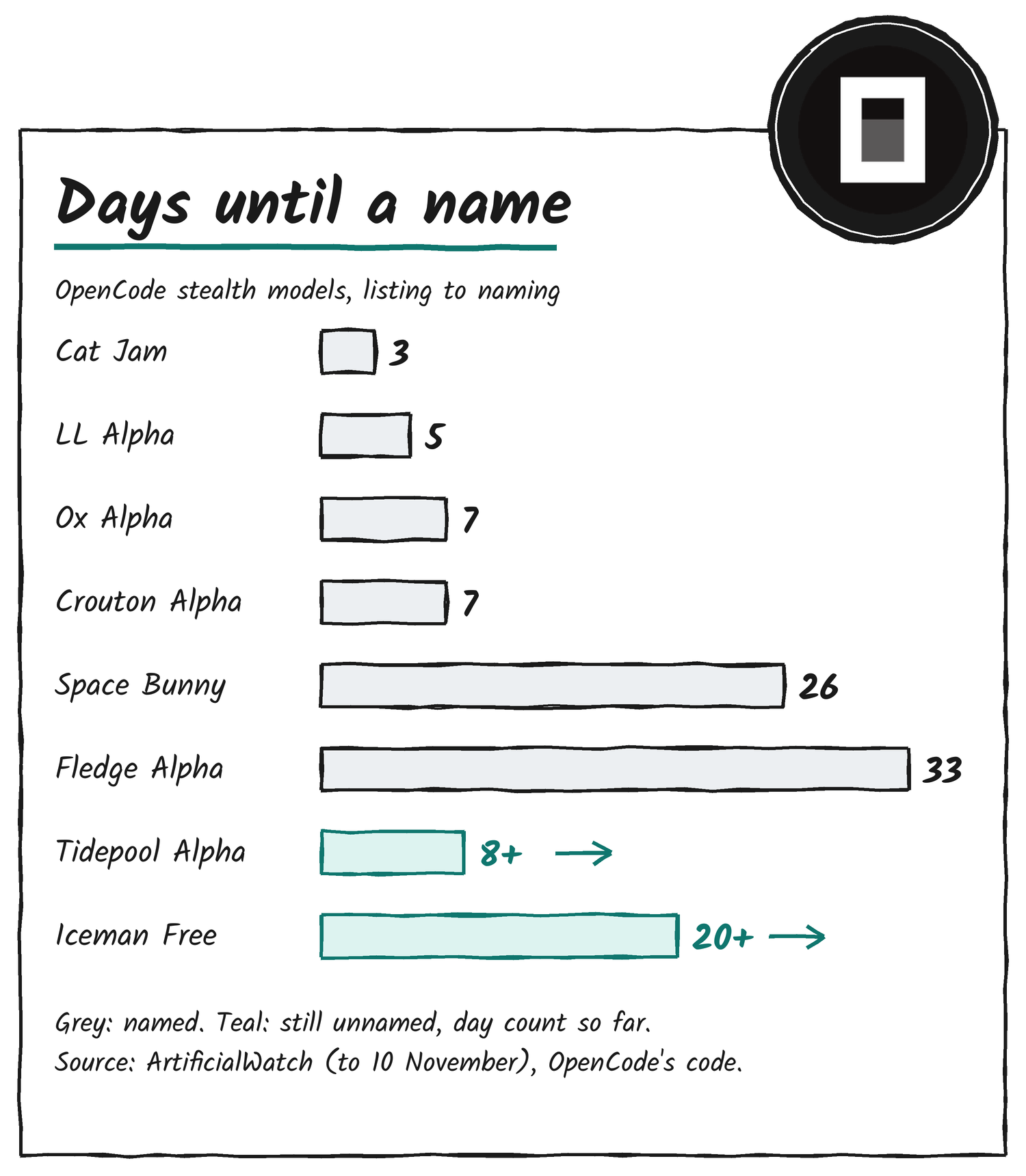
Past runs suggest a name may arrive within weeks. Nothing in OpenCode’s materials promises one.
The other anonymous free models
Seaglass is the fourth model OpenCode’s docs call a stealth model. The docs treat all four the same way, with one difference in the wording on data. This is how they line up.
| Model | Catalog release date | Context window | What the docs say about your data |
|---|---|---|---|
| Big Pickle | 17 October 2025 | 200,000 | During its free period, collected data “may be used” to improve the model |
| Iceman Free | 6 November 2026 | 262,144 | Retained and used to improve the model |
| Tidepool Alpha Free | 18 November 2026 | 1,048,576 | Retained and used to improve the model |
| Seaglass Alpha Free | 26 November 2026 | 1,048,576 | Retained and used to improve the model |
The Go plan’s HungerG is a separate case. That model is also unnamed, but its catalog entry matched a named model, StepFun’s Step 5 Preview, on context, output cap and inputs. Seaglass and Tidepool match each other and nothing else I could find.
Before you build on it
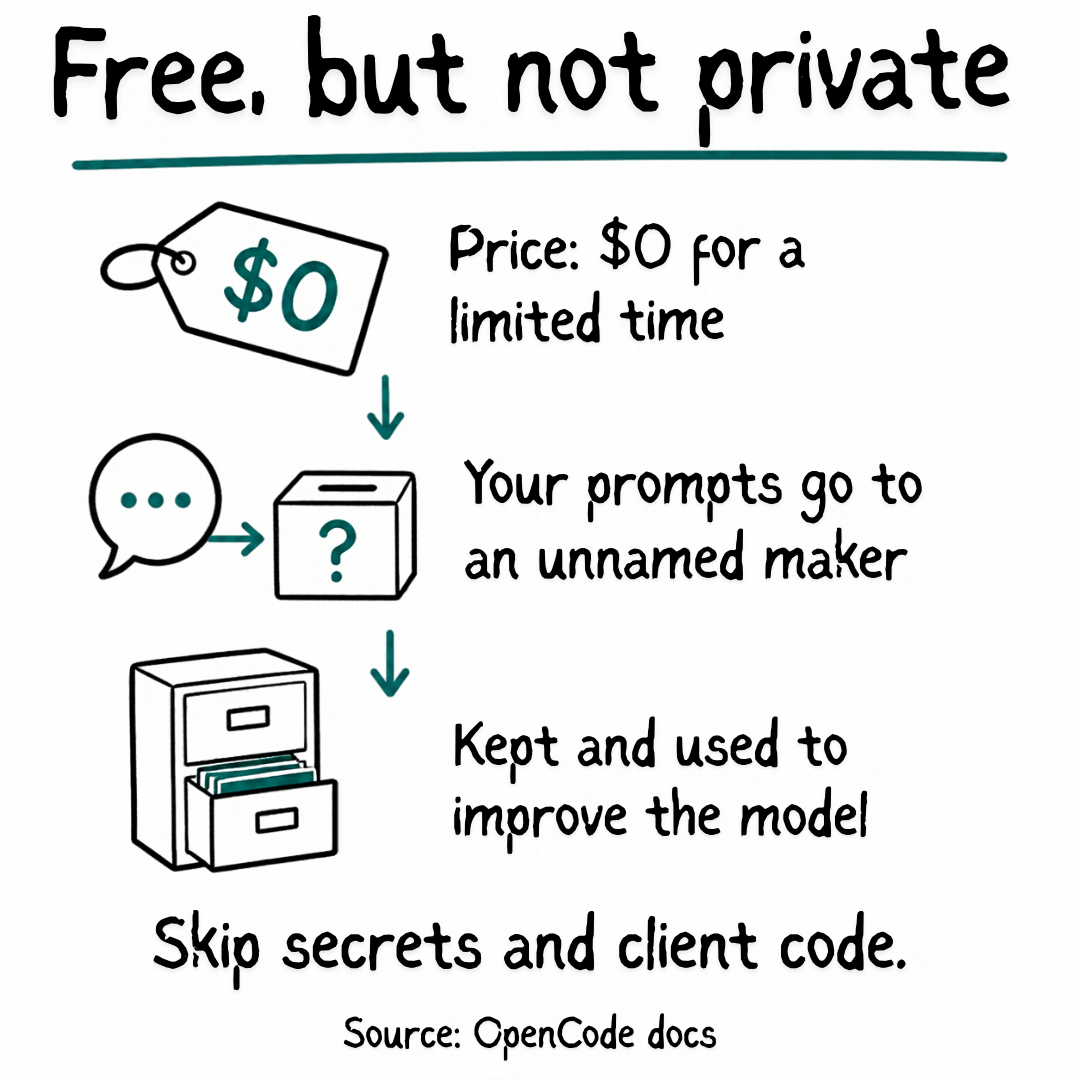
The price is zero, and your prompts are what OpenCode gets in return. OpenCode’s docs say the data is kept and used to improve the model, and the maker is unnamed, so there’s nobody to hold to terms you can read. Don’t send client code, credentials or anything under an NDA through it. The model takes text only, so screenshots and video need another route.
It also isn’t a safe default for unattended work. OpenCode 2.4 added automations, and a free model looks attractive for a nightly job. But Tidepool isn’t on the live list a week after its release, and Seaglass has no end date either. Keep a paid fallback in the config. If you do want to try it, the model ID and endpoint are these.
base URL: https://opencode.ai/inference/openai/v1
model ID: seaglass-alpha-free
Discover more from Sulat AI & Tech News
Subscribe to get the latest posts sent to your email.