
OpenCode has put a model with no named maker on its Go plan for free. HungerG Free, which OpenCode calls a stealth model, costs Go and Go Plus subscribers nothing this week. It takes up to 1,000,000 tokens of context and accepts images and video as well as text, and OpenCode’s post says it doesn’t train on your data. OpenCode hasn’t said who built it, and neither has Qoder, which is running its own free window. The catalog entry matches StepFun’s Step 5 Preview on context, output cap and input formats.
What OpenCode listed
The post reads: “HungerG (stealth model) is free for OpenCode Go subscribers this week. 1M context. Multi-modal. No training on data.” The live Go model list, which the Console reads from, backs the numbers. The entry has the ID hungerg-free and the description “Stealth reasoning model, free for a limited time.” It lists a 1,000,000-token context and input window, a 65,536-token output cap, text output, and input of text, images (JPEG, PNG, GIF, WebP) and video (MP4, QuickTime, Matroska). Both prices are zero. The Go page shows it as New and Limited time, with unlimited allowances on Go and Go Plus.
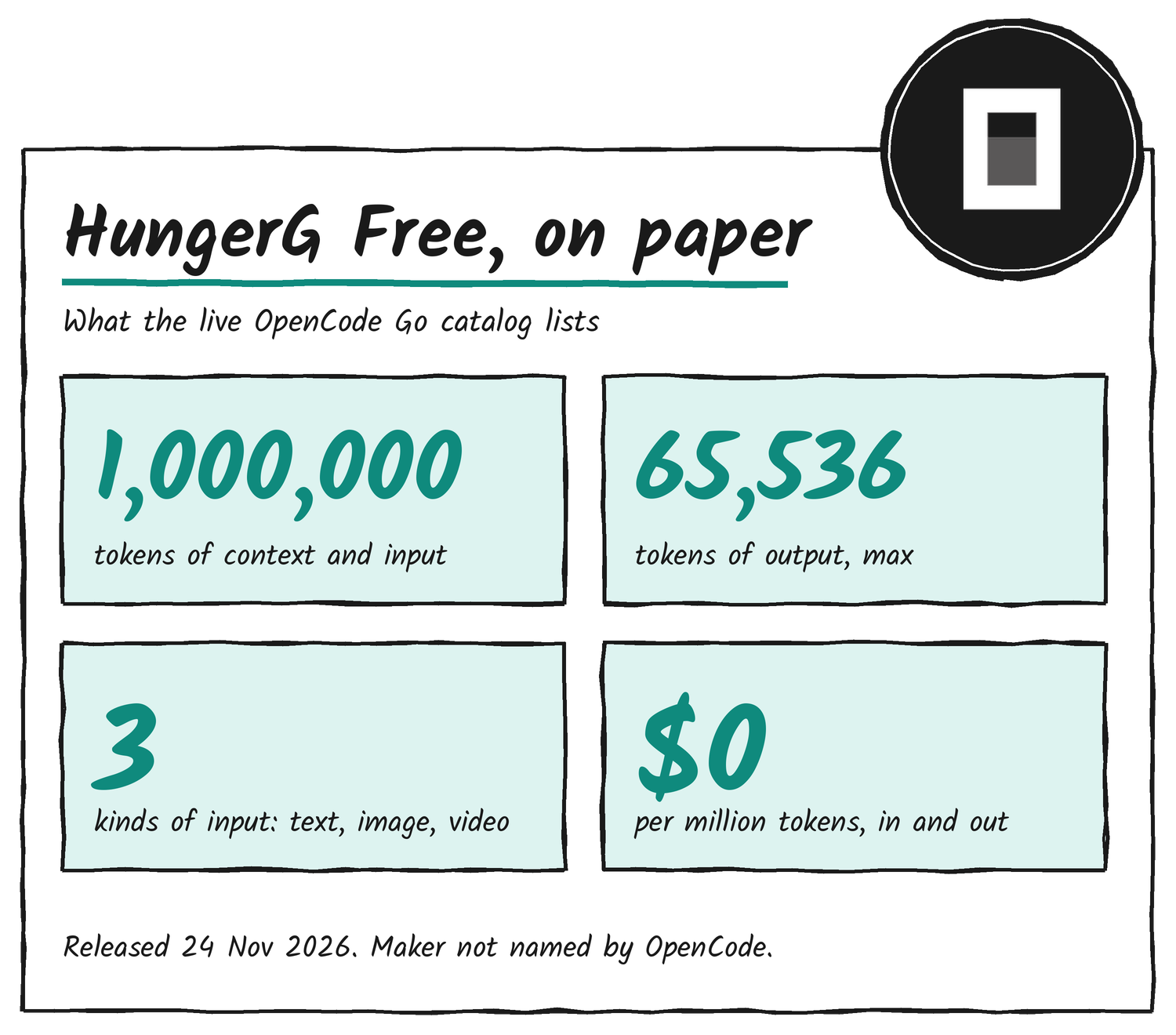
The post says “this week”. The catalog and the Go page say “limited time”. OpenCode hasn’t given an end date.
Who built it
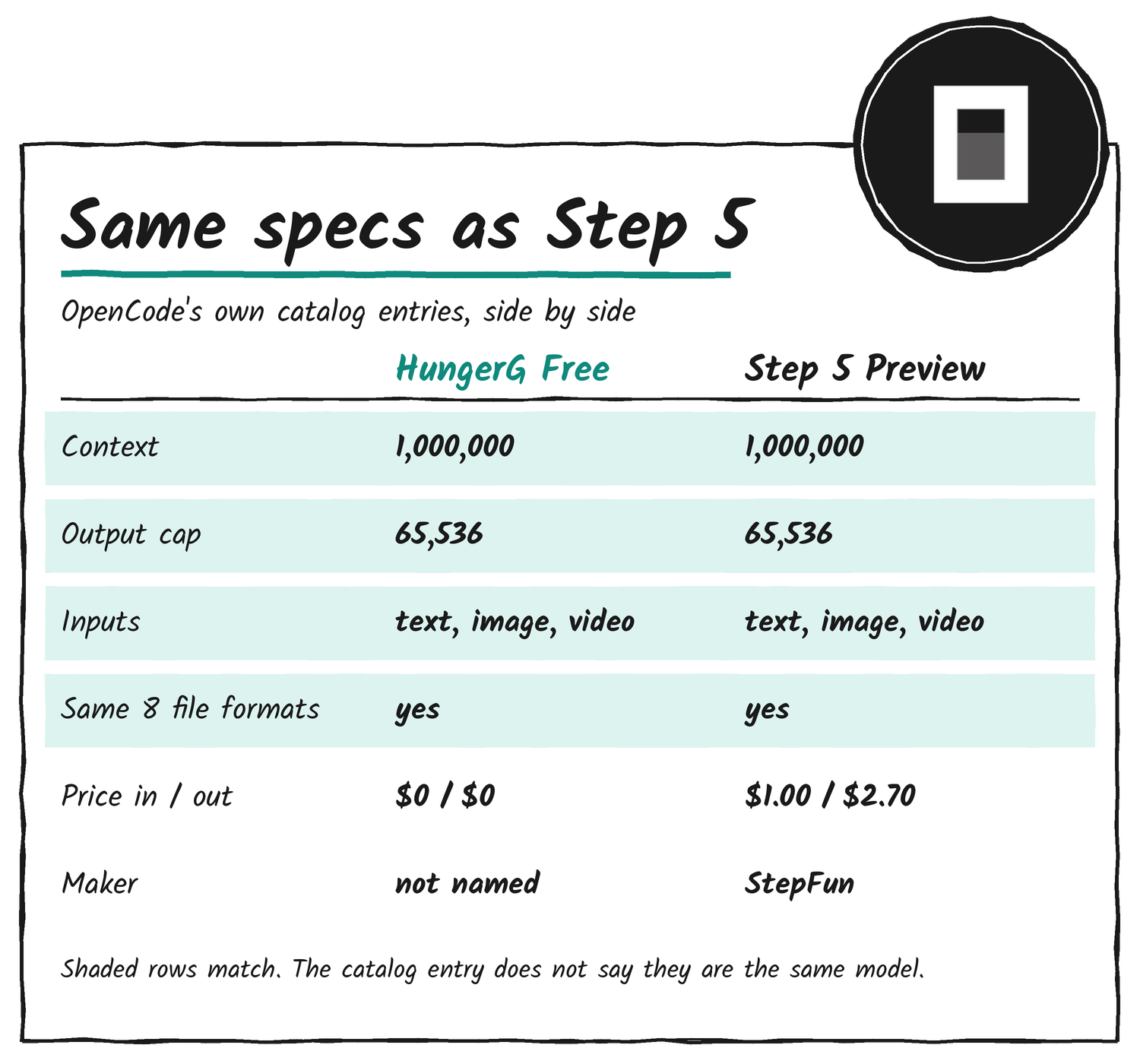
Neither OpenCode nor Qoder names a maker. Qoder’s event page calls HungerG “a stealth model whose identity has yet to be disclosed”. The clues are in OpenCode’s own catalog. A bot-opened pull request added the entry to the models.dev catalog on 23 November, which was 5:15am on the 24th in NZ, and a revert followed. A second pull request re-applied it with a release date of 24 November, and a maintainer merged that at 3:50pm NZ time, 13 minutes before the post.
On the first pull request, the repository’s review bot said the entry’s list of eight image and video formats is identical to the one in the Step 5 Preview file from StepFun, and that its context, input and output limits match too. It asked the author to confirm the underlying model. On the relaunch it flagged that the file cites no source for its limits, formats or pricing. I checked the live list. Step 5 Preview’s entry has the same context, input, output and eight formats, and Go prices it at US$1.00 in and US$2.70 out per million tokens, with a US$15 monthly limit on Go. I found no StepFun statement about a model called HungerG.
StepFun launched Step 5 Preview on 20 September as a sparse mixture-of-experts model with 600 billion parameters, 27 billion active per token, a 1M-token window and vision input. It released the open weights on 15 October. On StepFun’s own chart, Step 5 Preview at its high reasoning setting scores 67.7 on DeepSWE v1.1, against 67.5 for Kimi K3 and 66.9 for GLM-5.3, and 33.3 on Terminal-Bench 4.0, against 41.9 for GLM-5.3. The rivals ran at max effort, so the comparison isn’t like for like. Those are Step 5 Preview’s numbers. Nobody has published scores for HungerG, and I haven’t run it, so I can’t say how it codes.
How to get at it
- Have a Go plan. Go is US$10 a month, Go Plus is US$40, and Go Teams is US$20 per member. OpenCode’s post says the offer is for Go subscribers.
- In OpenCode 2.4, run
/connectand pick OpenCode. The 2.4.0 changelog says that one entry now includes the Go models. - Run
/modelsand choose HungerG Free.
Outside OpenCode, Go’s model list serves it over chat completions. Go’s FAQ says Claude Code, Codex, Hermes and Pi have been validated, and that a client has to send a session ID.
base URL: https://opencode.ai/inference/go/openai/v1
model ID: hungerg-free
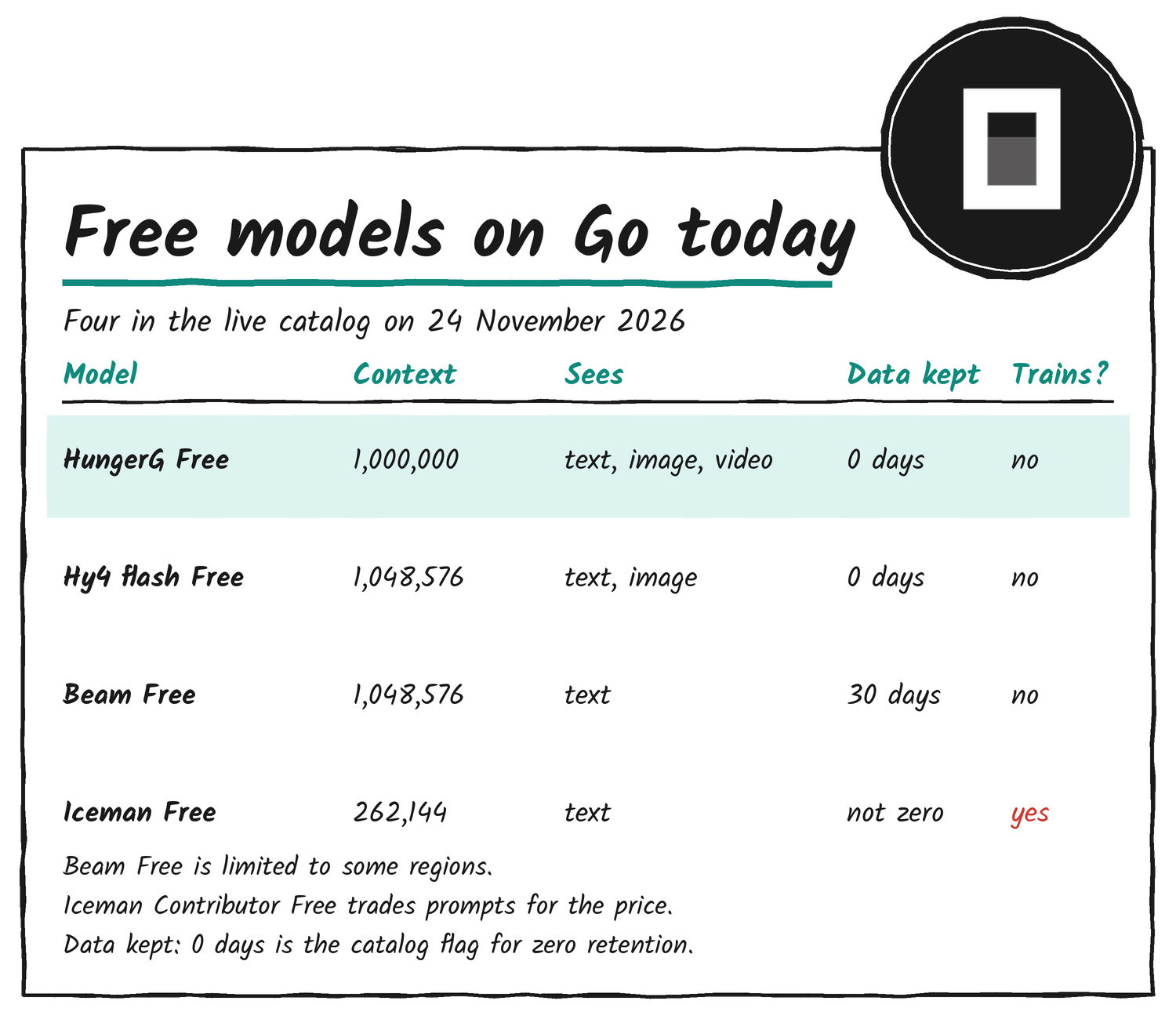
On data, the post says “No training on data”. The catalog flags the model as not trained on and as zero data retention, the same two flags Step 5 Preview carries. The privacy table on OpenCode’s Go docs page doesn’t list HungerG yet, so the post and the catalog flags are the only sources. Go blocks paid endpoints that train on requests by default, and the free list shows why that matters: Iceman Contributor Free is free in exchange for permission to train on your prompts.
The other free options
Qoder, the agentic IDE maker, is running a parallel promotion on the same model. HungerG is free there from 24:00 on 23 November to 24:00 on 30 November, Singapore time, which is 5am on 24 November to 5am on 1 December in NZ. Qoder says calls use no credits at any thinking level from Low to Max and have no daily limit.
| Where | Who gets it | When it ends |
|---|---|---|
| OpenCode Go | Go and Go Plus subscribers, with unlimited allowances | “This week” in the post, “limited time” in the catalog |
| Qoder International | Individual users on any plan, in Qoder and Qoder IDE only. Teams and Enterprise are excluded | 5am NZ time on 1 December, and Qoder says it can adjust the rules or period |
Go has three other free models today. Tencent’s Hy4 flash Free has a 1,048,576-token window and takes images. Beam Free also has 1,048,576 tokens, takes text only, and isn’t available in some regions. Iceman Contributor Free has 262,144 tokens, takes text and trains on prompts. HungerG is the only free model on the list that accepts video.
Free stealth models rotate through OpenCode’s catalog. Crouton Alpha Free was on Go’s docs page earlier this month and isn’t in today’s catalog. The review bot’s notes put the release of Tidepool Alpha Free, in OpenCode’s main catalog, at 18 November. That raises the stakes now that 2.4.0 has automations. A free model is cheap fuel for an unattended nightly job, but a model that can leave the list makes a poor default for one. OpenCode’s 60% price cut on GLM 5.3 and DeepSeek V4.1 Flash covers the paid side, and the OpenCode 2.0 explainer covers the service that sits underneath.
Before you build on it
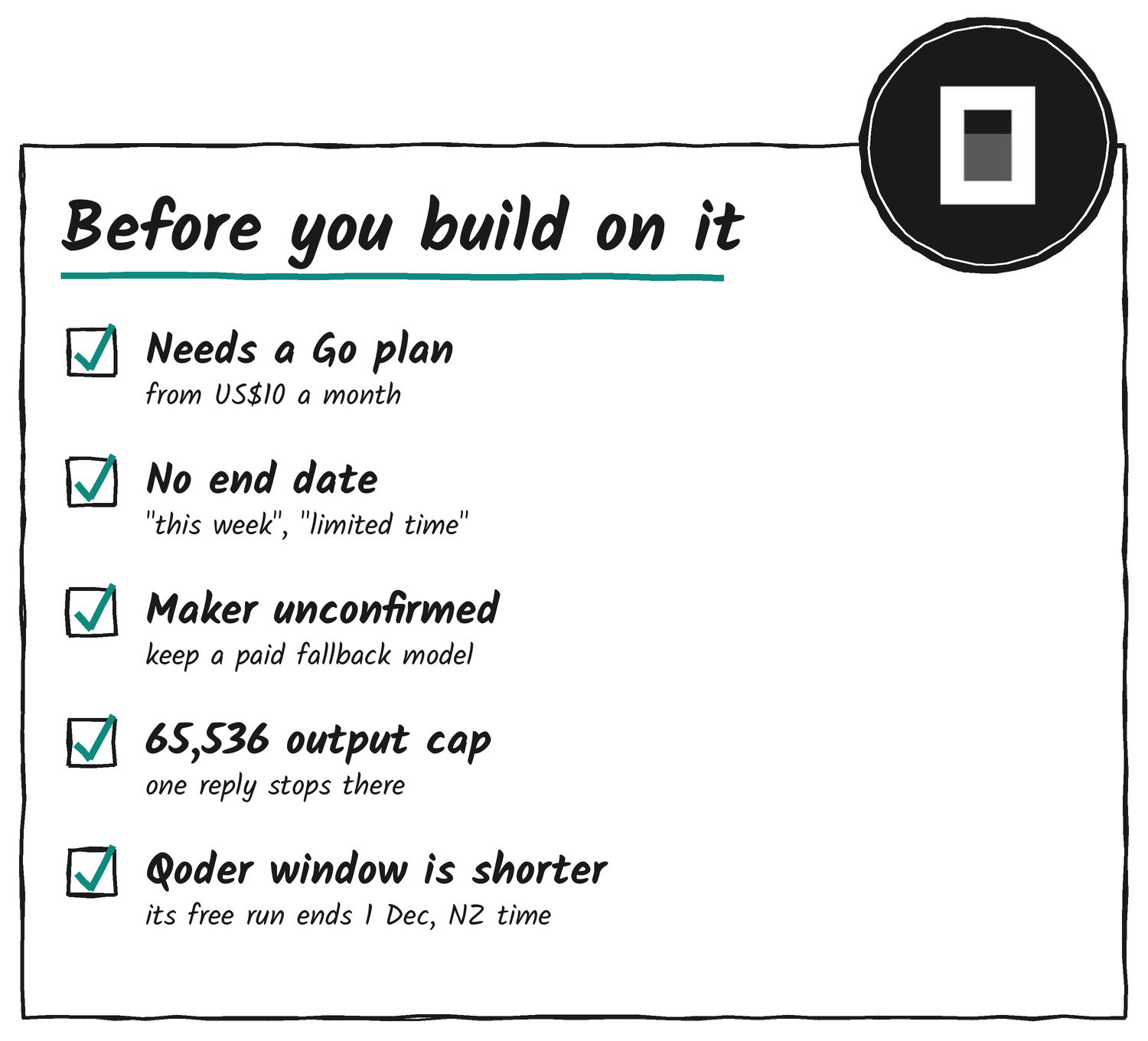
Keep a paid fallback. The end date is unannounced, so a config that points only at hungerg-free breaks the day it goes. Don’t assume a maker. The matching specs are a clue, not a confirmation, and the model’s behaviour and terms can differ from Step 5 Preview’s. Mind the output cap. The entry caps a single reply at 65,536 tokens, which is well short of the 1,000,000-token window. Check the privacy table. The no-training claim comes from the post and the catalog flags until OpenCode adds the row to its docs.
Discover more from Sulat AI & Tech News
Subscribe to get the latest posts sent to your email.