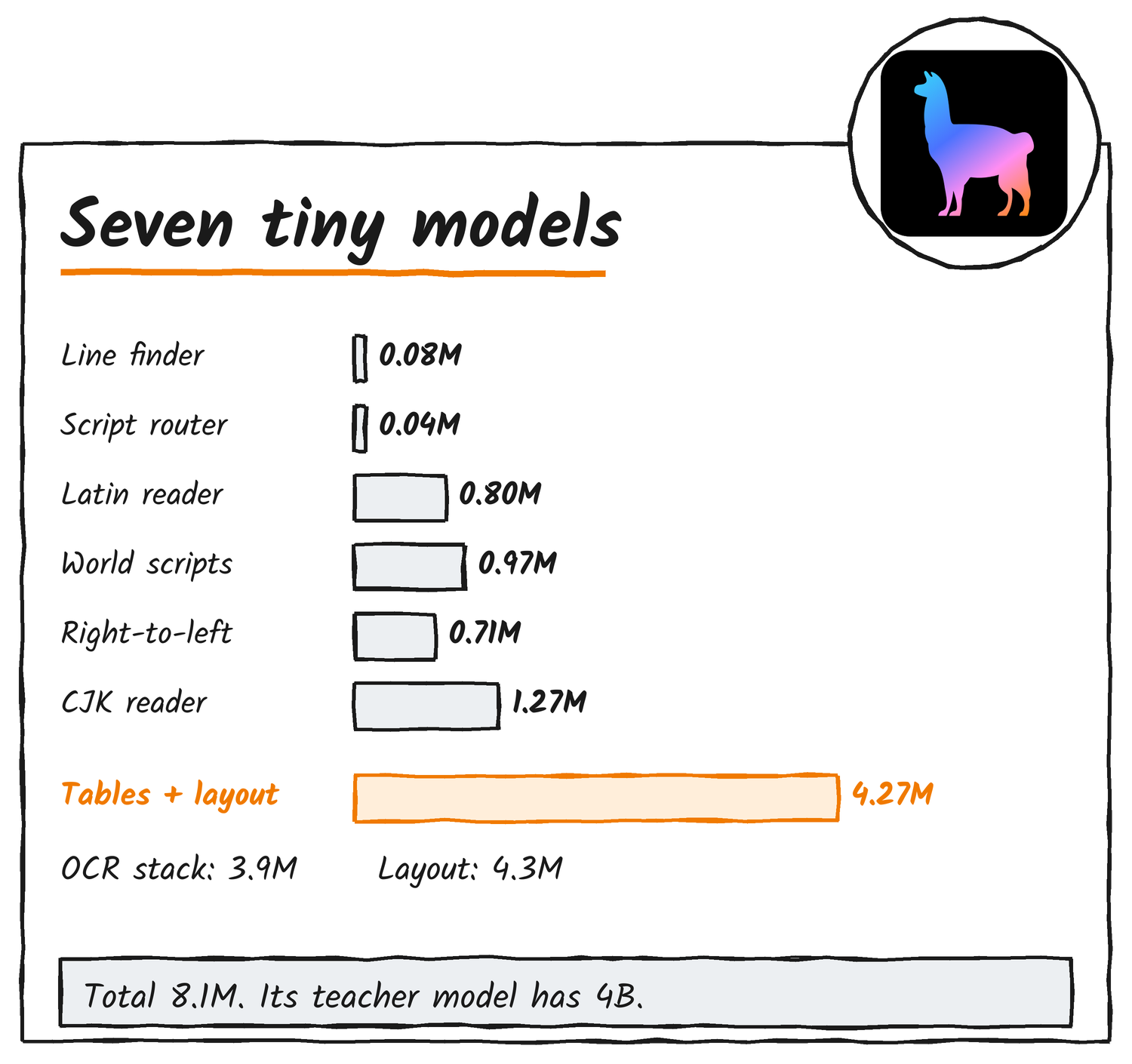
LlamaIndex has released the open weights for OCRia-nano-1, a document parser built from seven small models that add up to 8.1 million parameters and run on a CPU. The company reports 426 milliseconds a page on one core and 27.8 pages a second on 16 cores. On ParseBench-2, a benchmark LlamaIndex built, the pipeline scores 59.2, ahead of the CPU parsers Indra on 55.1 and Marker on 52.5.
Co-founder and CEO Jerry Liu announced it on X on 23 November, US time, “in celebration of Jensen Huang’s return and his commitment to open-source AI”. Nvidia reinstated Huang as CEO effective 22 November. Nano has no tie to Nvidia hardware. It needs no GPU at all, and that’s the pitch.
8.1M
parameters across seven models
426 ms
a page on one CPU core, on average
27.8
pages a second on 16 cores
59.2
ParseBench-2 overall score
What LlamaIndex shipped
The release is three things: a blog post, a technical report by Logan Markewich, and the weights on Hugging Face. Nano isn’t a standalone model. It plugs into LiteParse, LlamaIndex’s open-source local parser, as its OCR backend and its table and layout engine. Once you pull the models, Nano becomes LiteParse’s default OCR in place of Tesseract, which stays selectable.
LiteParse starts with the text a PDF already carries. Nano’s OCR models read only what that text layer is missing, such as scans and images embedded in a file. A line detector (0.08M parameters) finds the text lines. A script router (0.04M) sends each line to one of four recognisers: Latin, Chinese, Japanese and Korean, right-to-left scripts such as Arabic and Hebrew, and a world-script model that covers about 17 more. Then LayoutNet, a 4.27M-parameter transformer, takes the text, its position on the page and image features, and rebuilds the tables (rows, columns, spanning headers, cells) and sorts the page into 13 layout classes.
Output comes as Markdown, plain text or JSON. Markdown carries headings, lists and rebuilt tables, with HTML colspan and rowspan for spanning cells. JSON carries text with bounding boxes and OCR confidence.
Running it
pip install liteparse
lit models pull ocria-nano
lit parse doc.pdf --format markdown
Those are the commands from LlamaIndex’s post. The model download is 60 to 75 MB including ONNX Runtime, and the installed package is 59.9 MB on Linux and 75.3 MB on macOS. LiteParse also installs through npm and cargo, and it runs in the browser through WebAssembly, where the models use one thread and take about 1 to 4 seconds a scanned page on a laptop. A Latin-only build without layout is 1.5 MB.
The numbers
LlamaIndex ran every local system on the same 16-vCPU machine, on 300 random ParseBench pages with one worker per core.
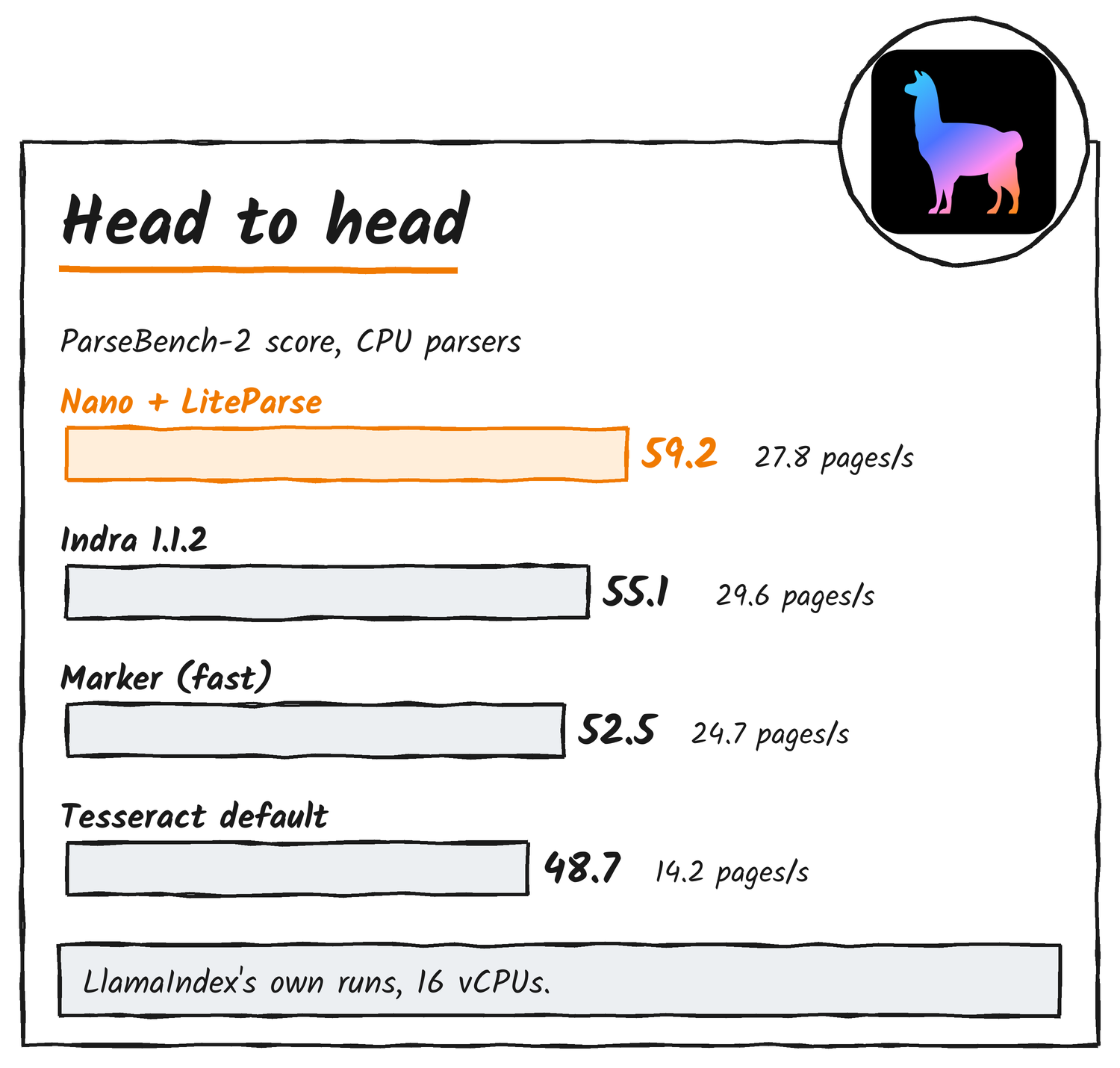
| System | ParseBench-2 | Tables | Layout | Pages a second | ms a page, one core |
|---|---|---|---|---|---|
| LiteParse + OCRia-nano-1 | 59.2 | 59.5 | 72.4 | 27.8 | 426 |
| Indra 1.1.2 | 55.1 | 47.6 | 65.2 | 29.6 | 440 |
| Marker 2.2.0 (fast) | 52.5 | 43.6 | 61.0 | 24.7 | 578 |
| LiteParse (Tesseract) | 48.7 | 36.2 | 49.4 | 14.2 | 751 |
| LiteParse + PP-OCRv6 tiny | 58.9 | – | – | 14.7 | 773 |
| LiteParse + PP-OCRv6 small | 59.9 | – | – | 5.7 | 1,963 |
Nano leads Indra and Marker on three other benchmarks and ties them on a fourth. On OmniParseBench it scores 74.8 against 70.9 for Indra and 69.8 for Marker. On ParseBench-1 it scores 52.7 against 42.6 and 40.4. On the BHL IMPACT historical print set its character error rate is 0.048, against 0.062 for Indra and 0.067 for Marker, and lower is better. On olmOCR-bench Nano scores 60.9 against 60.8 for both.
Most of the lead comes from tables (59.5 against 47.6 for Indra), layout grounding (72.4 against 65.2) and formatting (82.2 against 76.1). The report’s ablations show each stage earns its place. The PDF text layer alone scores 46.3 on ParseBench-2, OCR added on its own gets 51.2 and LayoutNet on its own gets 53.7. Together they reach 59.2.
Checking the post’s claims
Liu’s post says Nano is more accurate than Marker, PP-OCRv6 and Tesseract, and up to 2 to 5 times faster. LlamaIndex’s own tables back part of that and not all of it.
- Against Tesseract, throughput is 2.0 times higher and per-page latency 1.8 times lower (426 ms against 751 ms).
- Against PP-OCRv6, throughput is 1.9 times higher than the tiny version and 4.8 times higher than the small one. The top of the 2 to 5 times range is the small version.
- On accuracy, Nano is ahead of Tesseract, Marker and PP-OCRv6 tiny (59.2 against 58.9). It sits 0.7 points behind PP-OCRv6 small on 59.9, which runs at about a fifth of Nano’s throughput.
- Indra is the exception on speed. It does 29.6 pages a second against Nano’s 27.8, about 6% faster by my arithmetic, though Nano’s one-core latency is a touch lower.
The blog post is narrower than the tweet. It names the tiny PP-OCRv6 and limits the accuracy claim to tables and layouts.
Where it stops
LlamaIndex states the limits itself. Nano has no chart model, so charts stay as images and the Charts dimension scores 3.1 on ParseBench-2, level with Indra and Marker. Layout grounding at 72.4 trails the vision-language parsers, which score 80 to 89. Equations on scanned pages aren’t recovered at all, and handwriting and scripts with little training data are the weakest areas.
The report also finds where more size would help. The Latin recogniser is capacity-bound: a 9.6M-parameter version cut character error and added 2.4 text points in testing. LayoutNet isn’t. Growing it to 11.6M parameters left the overall score at 59.2.
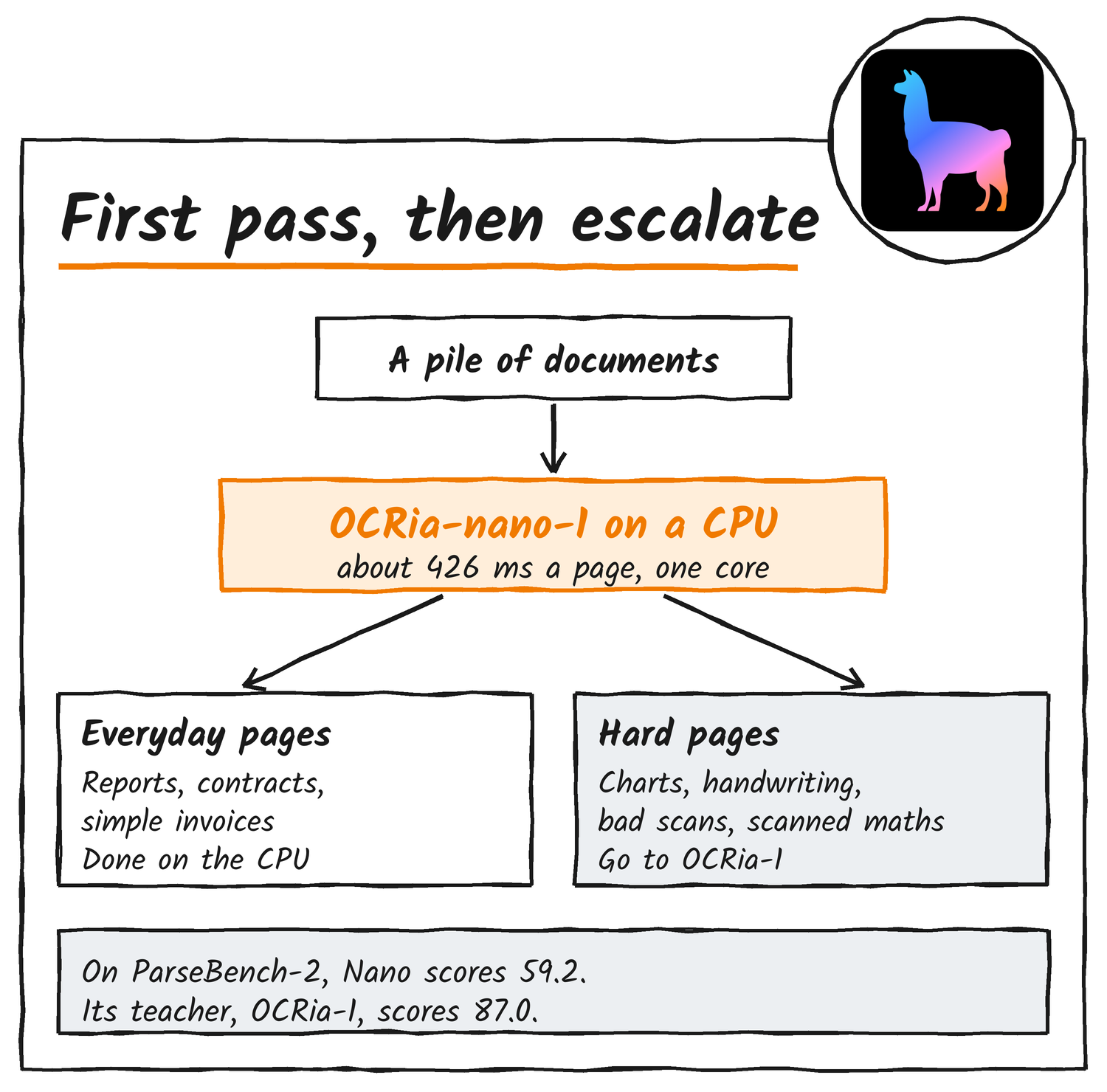
Choose OCRia-1 for demanding documents where accuracy takes priority over speed, including complex tables, handwriting, heavily degraded scans, and scanned mathematical notation.
LlamaIndex, introducing OCRia-nano-1
How a 4B model became an 8.1M one
Nano is distilled from OCRia-1, LlamaIndex’s 4-billion-parameter document model, which the report describes as a fine-tune of Qwen3.5-4B. Nano has about a five-hundredth of the parameters and, inside LiteParse, two-thirds of the teacher’s ParseBench-2 score (59.2 against 87.0). The report puts OCRia-1 at 2 to 10 pages a second on one B200 GPU, depending on concurrency. Nano does 27.8 on 16 CPU cores.
LlamaIndex says it hand-labelled none of the training data. Each text line comes from the teacher or a PDF’s text layer, and it’s kept only when a second reader (the text layer or PP-OCRv6) agrees to within a character error rate of 0.15. That filter dropped 3% of Latin lines but 63% of right-to-left lines and 53% of world-script lines, where off-the-shelf OCR is weak. Scripts with little real data, including Ethiopic, Armenian, Lao and most Indic scripts, lean mostly on synthetic pages built from Wikipedia sentences in 47 languages. Datasets under non-commercial or no-derivatives licences were left out.
The licence
The weights are open to download, but they aren’t under an Apache or MIT licence. LlamaIndex uses a modified Open RAIL-M licence:
- Free for research, teaching, evaluation and benchmarking by anyone, including publishing the results, and for internal R&D that doesn’t reach a product.
- Free for personal use, and for commercial use by organisations under US$2M in annual revenue and under US$2M in total funding.
- A commercial licence is needed above those thresholds, and for any document parsing, OCR or extraction product or service that competes with LlamaParse or LlamaCloud, at any size.
- You own your outputs.
LiteParse itself is Apache 2.0, and ONNX Runtime keeps its MIT licence. For commercial use above the thresholds, Liu’s post tells readers to “come talk to us”.
Where it sits in the market
Cheap local parsing is getting crowded. Tesseract was the long-time default, and PaddleOCR’s PP-OCR models are the usual upgrade. Datalab released Indra OCR on 13 October, built around a 1M-parameter recognition model, and says it reads about 49 pages a second on 32 CPU cores with roughly 230 ms for a single page. LlamaIndex’s report calls Indra the pipeline most like Nano.
Above those sit the vision-language parsers that need a GPU. The report names Chandra 2, LightOnOCR-3, Infinity-Parser2-Pro, dots.ocr and Nemotron 3.5 Parse. Above them are the cloud services. In the ParseBench-2 ranking LlamaIndex published on 12 November, the 13 document parsers it listed score from 66.1 (Azure Document Intelligence) to 89.8 (LlamaParse Agentic Plus). Reducto’s agentic mode is on 83.9, Extend Parse 2 on 83.2 and Datalab Accurate on 81.3. Nano’s 59.2 is below all of them.
It isn’t aimed at that fight. LlamaIndex’s OCRia-1.5 models sit in its cloud tiers at 3 credits a page (Cost Effective, the 2B model) and 10 credits a page (Agentic, the 4B model). Nano runs on hardware you already own. The company wants it as the default first pass over every document collection, with the larger models taking the pages it can’t read well.
One fact about the scoreboard: LlamaIndex builds and maintains ParseBench, runs its own systems and its rivals’ on it, and publishes the datasets and scoring code. Rival and teacher rows are re-scored from published outputs. The Nano row reproduces with parse-bench run liteparse_ocria_nano.
The release also caps a fast run. In the seven weeks to 23 November LlamaIndex put out OpenDocRouter (7 October), OCRia-1 (22 October), the Document Parsing Protocol (28 October), ParseBench-2 (12 November), OCRia-1.5 (18 November) and now Nano.
What to do with it
- Run it on your own documents before you trust the scores. They’re LlamaIndex’s, and your mix of scans and tables decides what you’ll see.
- Read the licence before you build it into a product. Above US$2M in revenue or funding, or if you compete with LlamaParse, you need LlamaIndex’s permission.
- Keep a fallback for charts, handwriting, bad scans and scanned maths. LlamaIndex points those pages at OCRia-1.
- For bulk ingestion, use Nano as the first pass and send only the failures up the ladder.
Sources
- Jerry Liu on X: OCRia-nano-1
- LlamaIndex: Introducing OCRia-nano-1
- Technical report: OCRia-nano-1
- Hugging Face model card and licence
- LiteParse on GitHub
- LlamaIndex: Introducing ParseBench-2
- Datalab: Indra OCR
Discover more from Sulat AI & Tech News
Subscribe to get the latest posts sent to your email.