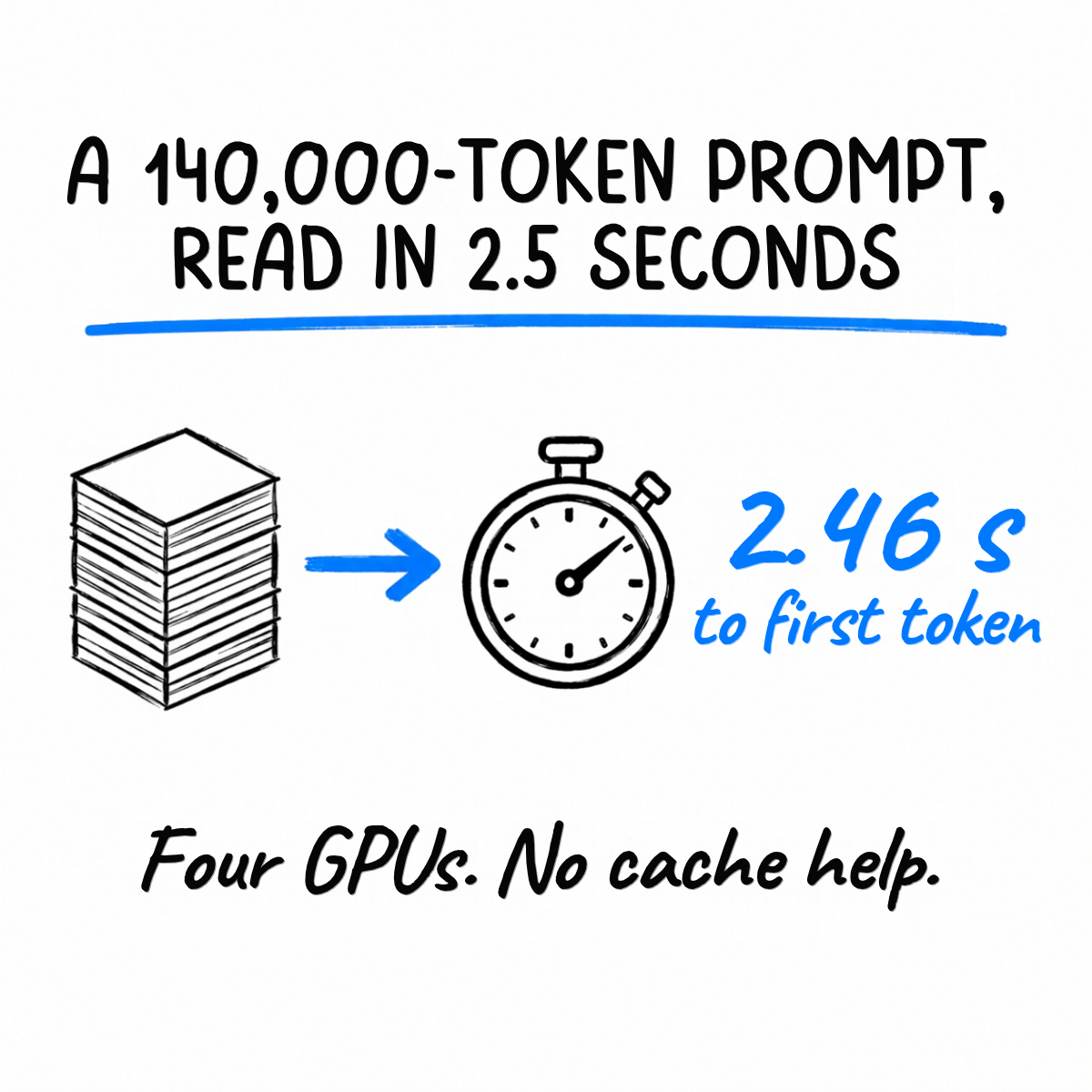
Local Inference Lab, Inc. updated its DeepSeek V4.1 Flash package for four NVIDIA RTX PRO 6000 Blackwell GPUs on 25 November (UTC), and its model card lists a cold prefill of 59,051 tokens a second. A 71,212-token prompt reaches its first token in 1.205 seconds, and a 142,508-token prompt in 2.46 seconds. The card says that is 43% to 82% faster than the previous build on the same GPUs.
Prefill is the model reading your prompt before it writes a word. Cold means nothing in the prompt was cached, and the card says each run was checked against Prometheus counters for 0% prefix-cache reuse. The number you feel is time to first token, which matters most for a coding agent reading a big repository, and the card lists it for every prompt size.
The numbers
| Prompt (tokens) | Prefill (tokens/s) | Time to first token |
|---|---|---|
| 8,700 | 44,712 | 0.194 s |
| 17,379 | 51,264 | 0.340 s |
| 35,540 | 56,997 | 0.624 s |
| 71,212 | 59,051 | 1.205 s |
| 142,508 | 57,944 | 2.460 s |
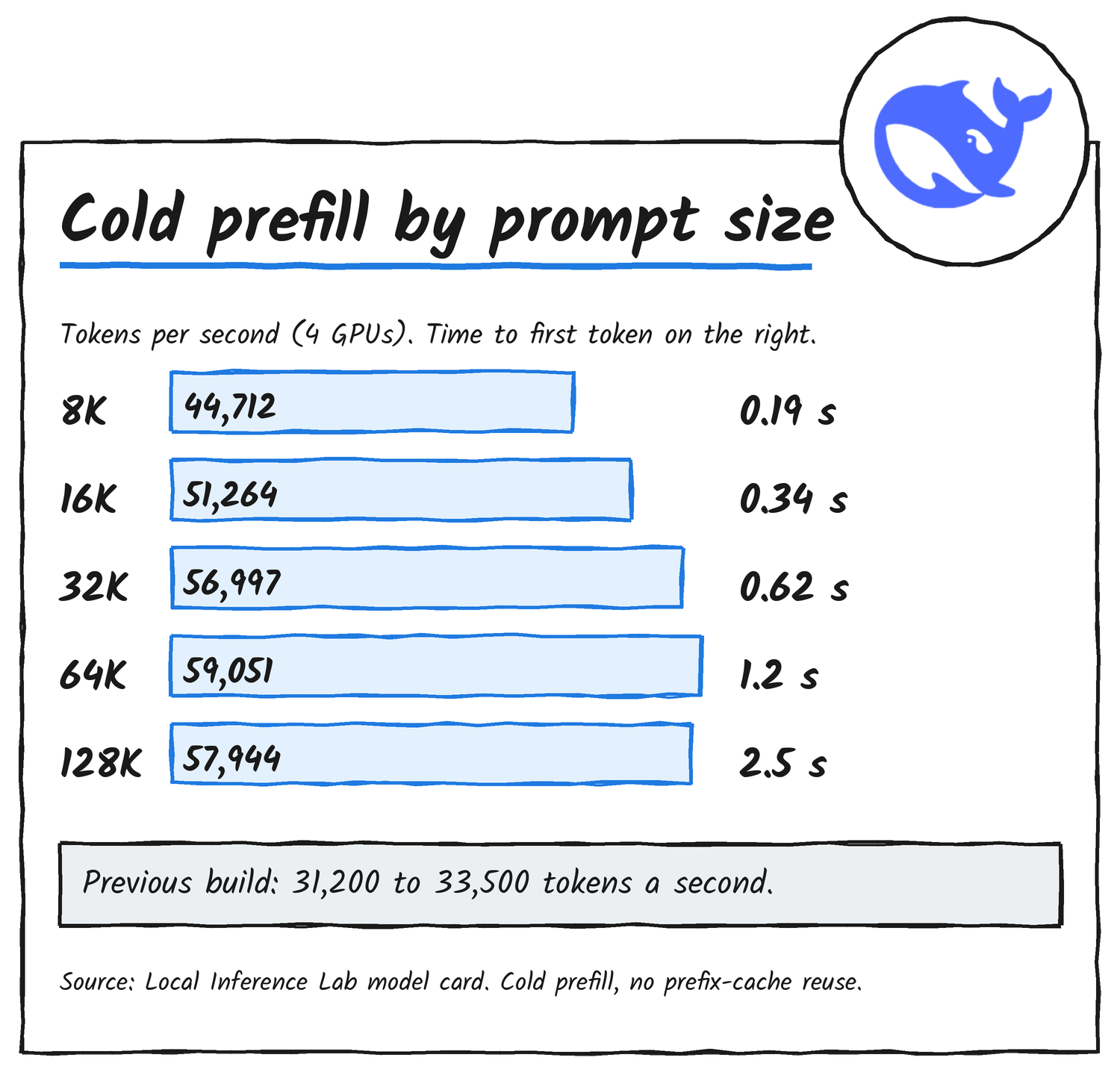
The card’s size labels are loose: its “8k” prompt is 8,700 tokens and its “64k” prompt is 71,212. It lists the previous build at 31,200 to 33,500 tokens a second, so the gain depends on prompt size. The 82% is the best case. The 8K prompt’s 44,712 is 43% above the 31,200 low end of the old range.
Decode, the model writing its reply, is the smaller part of this release. With 32 requests running at once the card lists 1,743.4 tokens a second in total, or 54.5 per user, and up to 2,635 or more on synthetic repetitive prompts. A single 16,000-token coding session, a Tetris game, ran at 612.4 tokens a second. The previous build’s card listed 2,640 tokens a second at 32 requests on its own decode test.
Where the gain comes from
The card credits three changes, each traceable to a pull request.
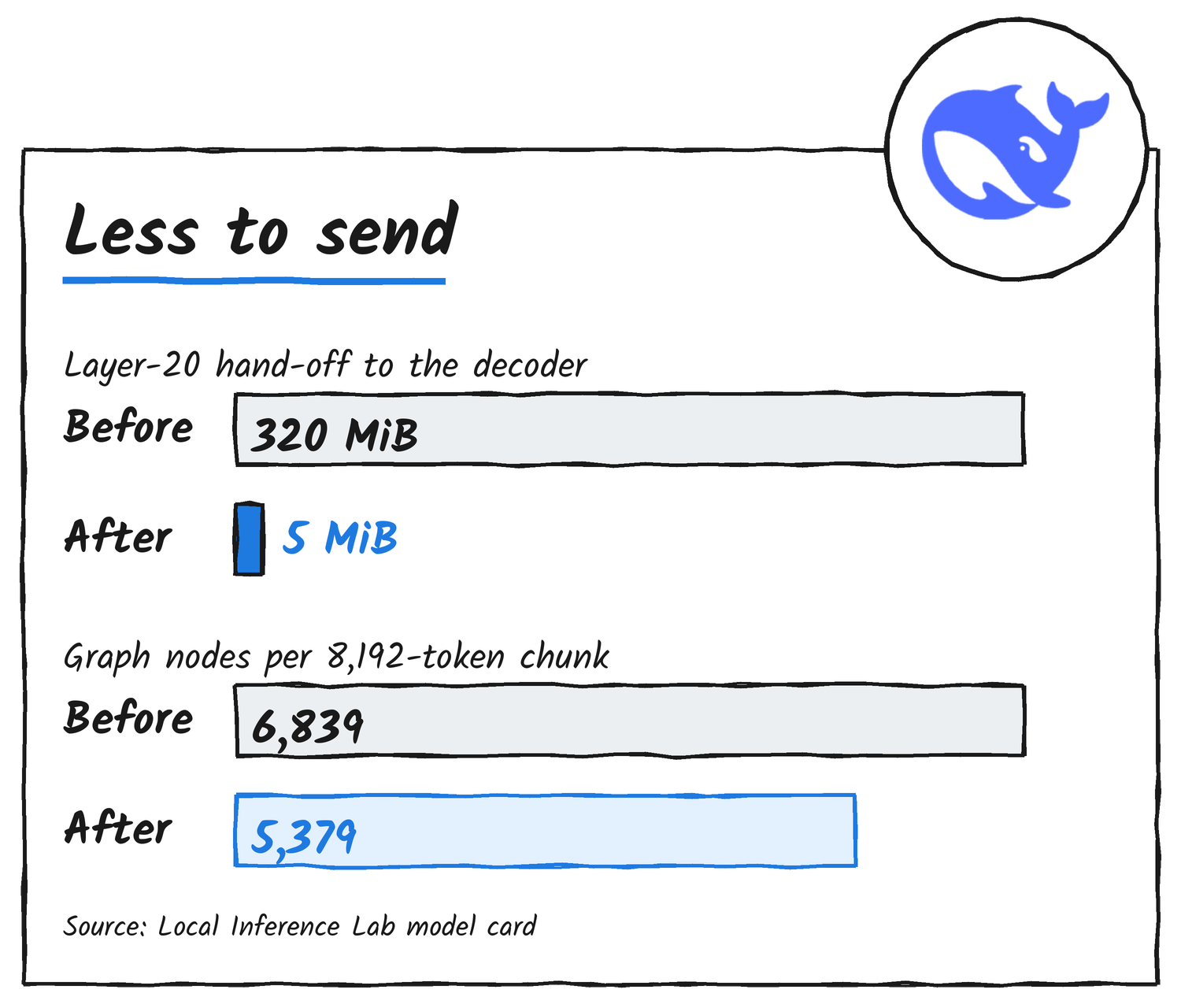
- Less traffic between GPUs. Attention for all 20 encoder layers now runs row-sharded, with each GPU handling a quarter of the prompt rows, instead of head-sharded with full-chunk exchanges over PCIe. The hand-off between layer 20 and the decoder shrinks from 320 MiB to 5 MiB. The cost is 2.32 GiB of replicated attention weights on each GPU.
- Transfers hidden behind compute. Key-value gathers move over peer-to-peer transfers that overlap with other work, and the Engram gathers sit inside the feed-forward compute window. The captured prefill graph drops from 6,839 to 5,379 nodes.
- A faster attention kernel. A rewritten BF16 prefill attention kernel for these GPUs runs 2.27 times faster on an RTX 5090 in isolation and 2.63 times faster on the PRO 6000 against a profiled 49.54 ms per-chunk baseline, and its outputs match the old kernel bit for bit.
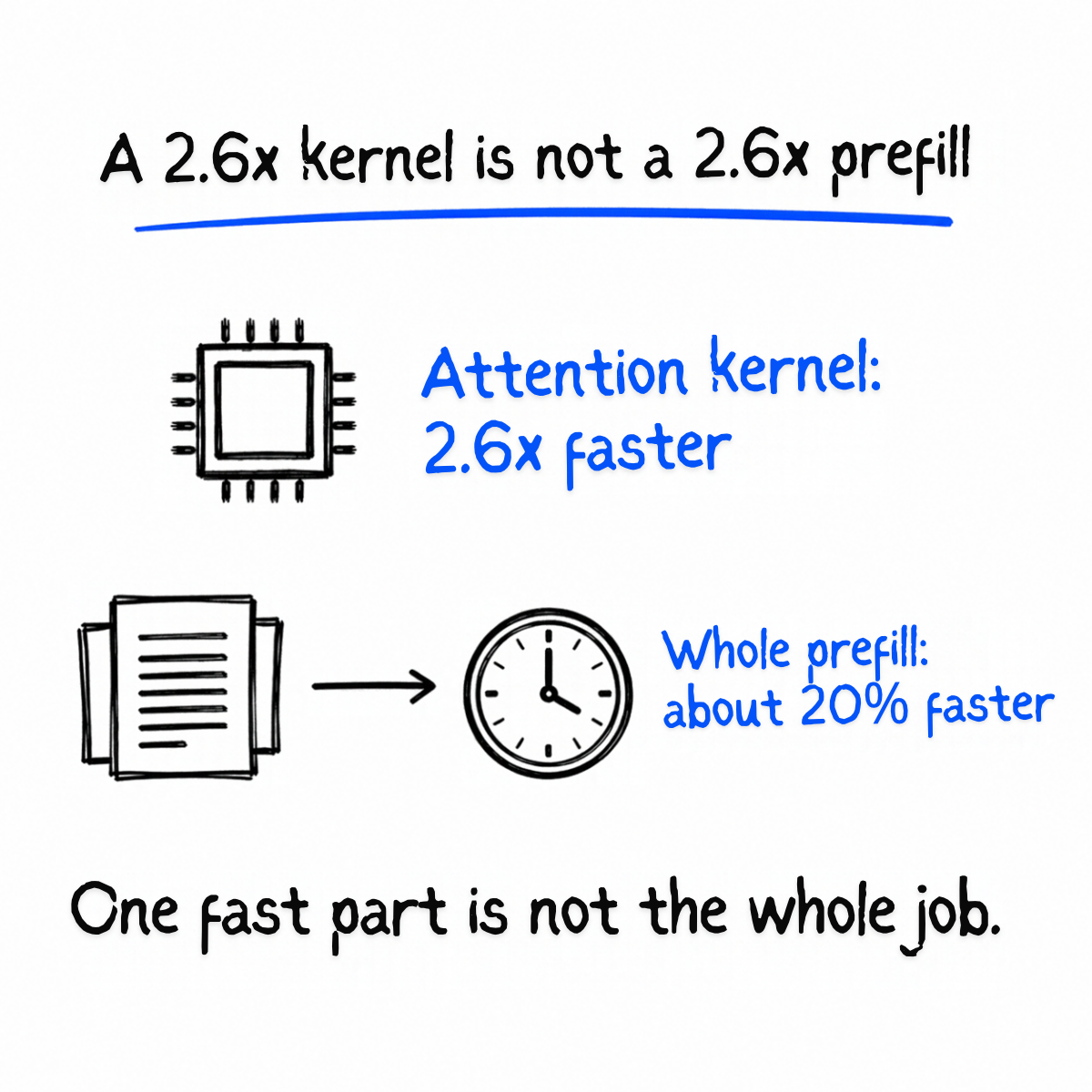
A faster kernel isn’t a faster prefill. In the kernel pull request’s own end-to-end test on the same four GPUs, swapping only the kernel lifted the mean across five prompt sizes from 44,007 to 52,712 tokens a second, a 19.8% gain. The earlier communication changes alone had taken the mean from 39,128 to 44,007, or 12.5%. The author ran these at a 600 W power limit with locked clocks, one or two runs per cell. The card’s final figures are higher than either test (59,051 against 56,416 at the 64K mark), and the card doesn’t say what accounts for the difference.
What it takes to run
- Four GPUs with 96 GB each on one Linux x86-64 host, with working CUDA peer access between them. The card prefers GPUs behind the same PCIe switch and a PCIe relaxed-ordering setting.
- About 527 GB downloaded on first start, which the card says belongs on fast local NVMe. The Engram tables take 188.8 GiB and are read from disk through a RAM cache by default, using about 77 GiB of host memory.
- At least 320 GiB of RAM to hold those tables in memory, which is faster. The benchmark figures above were measured in that RAM mode, and the card lists no prefill figures for the default disk mode.
- The Flare runtime. The package is a prepared Rust runtime format that Transformers, vLLM, SGLang and llama.cpp can’t load. It serves 32 concurrent requests, text and images, with a 1,048,576-token limit per request and about 17.02 million tokens of shared KV cache across the four GPUs.
Who built it, and where it sits
The publisher is Local Inference Lab, Inc., according to the package’s publisher file. The three pull requests I read come from two contributors: voipmonitor, whose scheduler change was merged into NVIDIA’s hyperflare-inference repository on 25 November, and FujitsuPolycom, who wrote the kernel and the communication changes. Both of FujitsuPolycom’s pull requests say they were “authored and verified with Antigravity (Gemini Carbon)”.
Flare is NVIDIA’s open-source local inference server for its SM120 and SM121 GPUs, an Apache-2.0 project created on 20 October. Its README says it is not, and will never be, a replacement for production engines such as vLLM. The same model card also carries a revision for four DGX Spark machines, where a commenter on the kernel pull request reported 8,174 tokens a second cold at 128K, against the 57,944 listed here for the RTX PRO 6000s.
Datacentre hardware is a different class. Baseten’s Rust and CUDA engine for the same model reports a 1,000,000-token prefill in 11.7 seconds on eight B300 GPUs, about 85,000 tokens a second, plus 2,060 tokens a second of decode on one prompt, as I reported in Baseten’s DeepSeek Ultrafast piece. The tests differ, so the two sets of figures can’t be lined up. On the rental side, hosted prices for the model have been falling this month, as Nous Portal’s 80% cut and OpenCode’s 60% cut showed.
The card says comprehensive model-accuracy evaluation hasn’t been run. What it lists is a greedy sanity check (17 × 23 = 391), four needle-in-a-haystack recalls at up to 32,471 tokens, and the 16,000-token Tetris run.
What I checked
I read the model card, its previous revision and the three pull requests behind it, and checked the card’s figures against them. I didn’t run the package: it needs four RTX PRO 6000 cards and a 527 GB download. Every figure above is the publisher’s own.
Discover more from Sulat AI & Tech News
Subscribe to get the latest posts sent to your email.