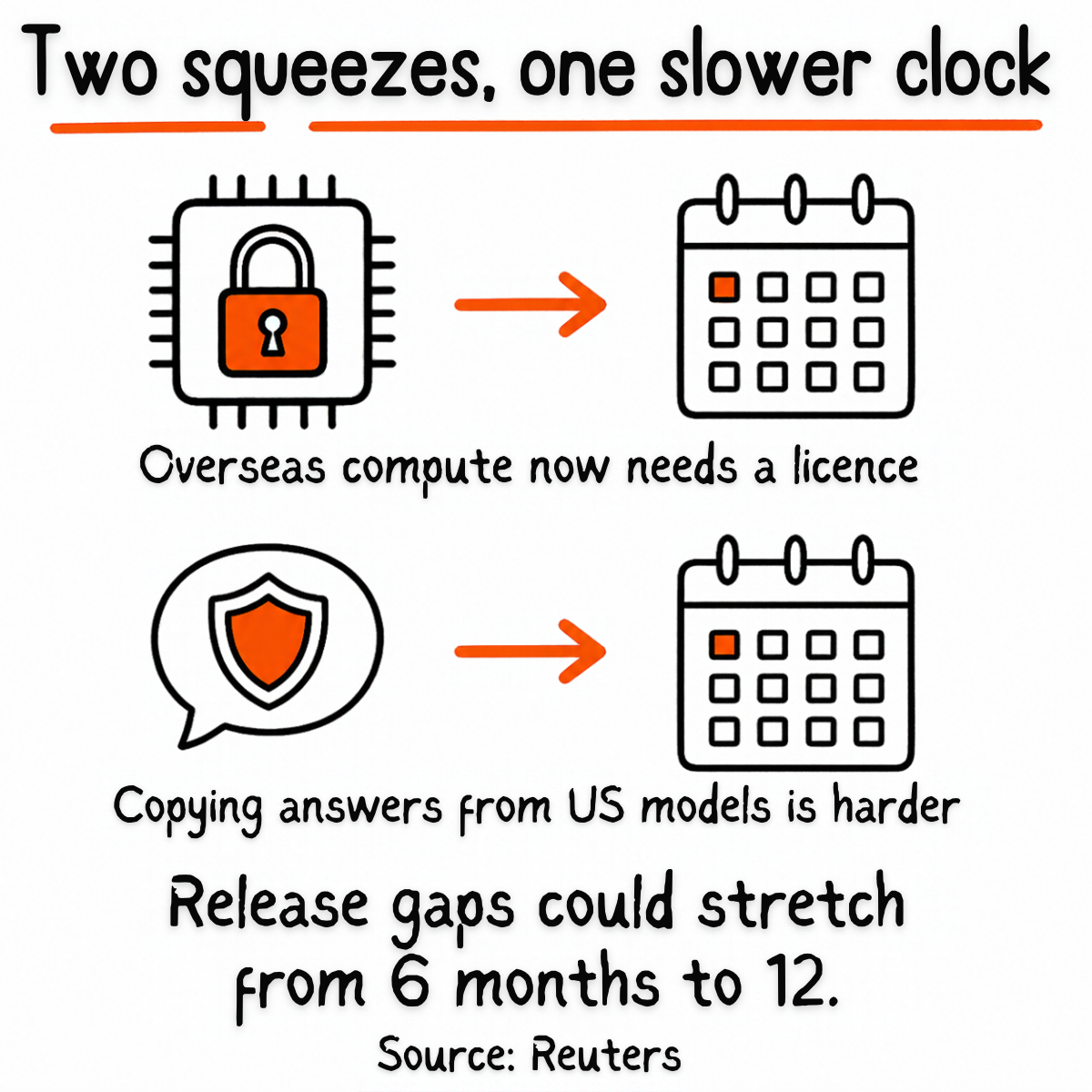
China’s Z.AI has missed its own November target for GLM-5.5, and Moonshot AI expects the gap between its major releases could double from six months to a year or longer if it loses overseas computing power. Reuters reported both details on 26 November, citing people familiar with the matter.
The report ties the delays to two US pressures at once. One is tougher safeguards against distillation at OpenAI and Anthropic. The other is a Commerce Department rule on overseas computing that took effect on 19 November. Together, Reuters says, they threaten the advantage that let Chinese labs challenge American rivals through years of export controls: building competitive models at much lower cost. I attribute every plan and timeline below to Reuters’s sources.
What Reuters reports
Z.AI, also known as Zhipu AI, had planned to release GLM-5.5 this month, according to two people who spoke on condition of anonymity. The model is designed with roughly 3 trillion parameters. One of them said it has been held up partly by increasingly effective safeguards against distillation. Z.AI had hoped to finish training and release it by the end of the year, but the new US computing restrictions could push the launch into the first quarter of 2027 or later, that person said.
On Monday 23 November Z.AI shipped GLM-5.4 instead. It is built on an existing 750 billion parameter model, and Z.AI says a new design lets it match models with 2 trillion to 3 trillion parameters. I covered the GLM-5.4 launch and Pawel Huryn’s bug-hunting benchmark of it.
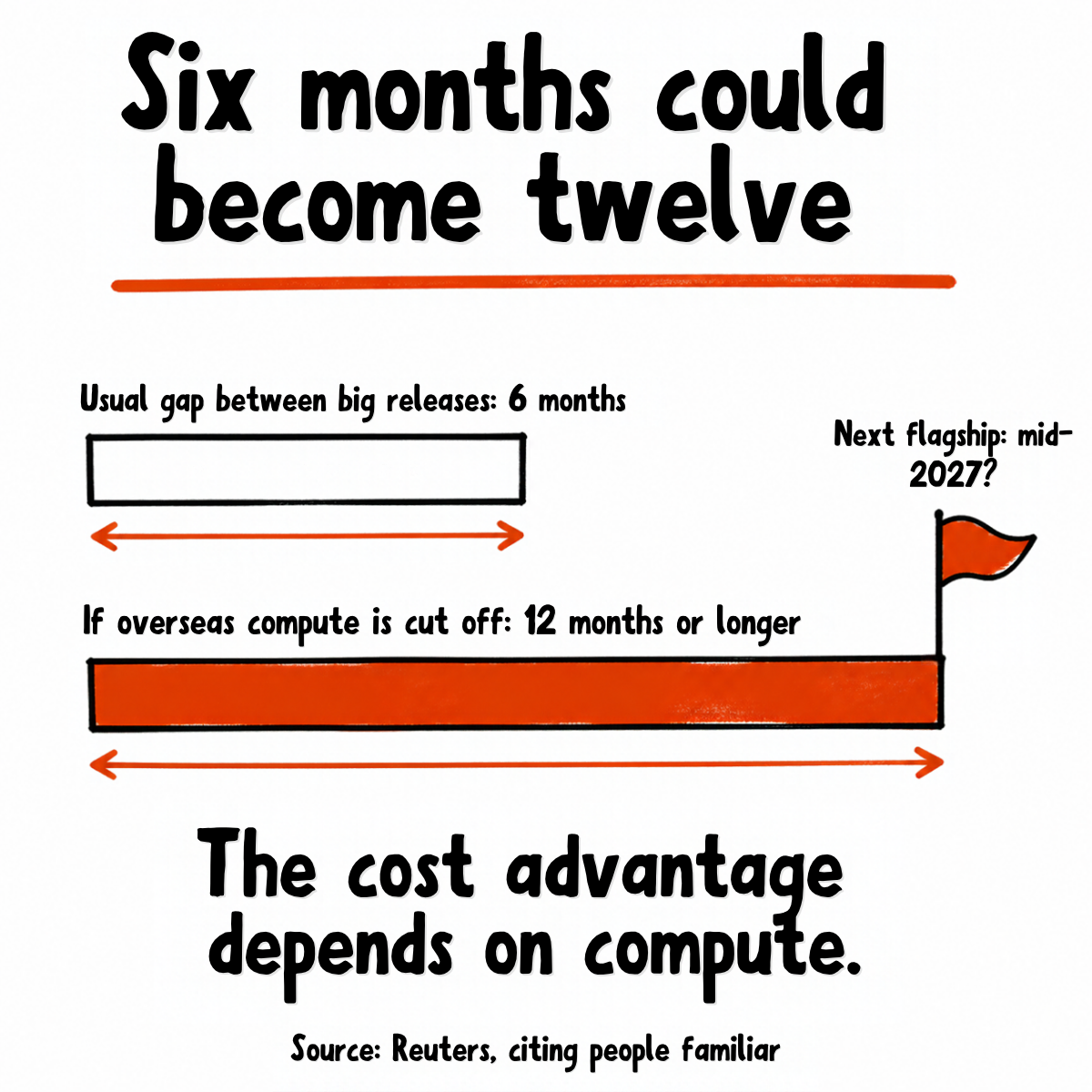
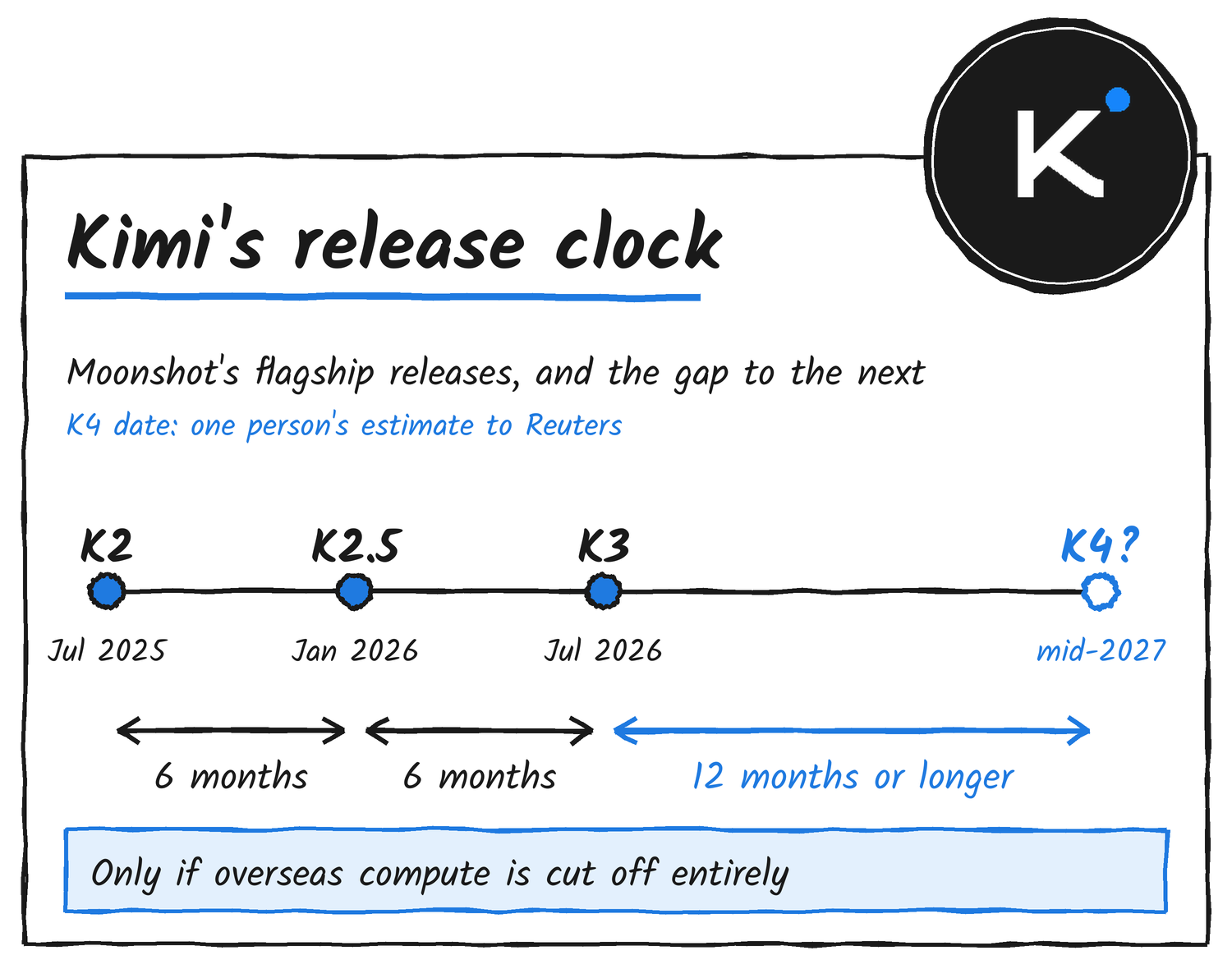
Moonshot is the more exposed of the two, Reuters says, because the Beijing company rents computing power to train its models and prioritises overseas providers. A person with knowledge of its operations said it internally expects its usual six months between major releases could stretch to 12 months or longer if overseas access is cut off entirely, and that capacity inside China could not make up the shortfall. The same person estimated Kimi K4 could be delayed until around the middle of 2027. Moonshot released Kimi K2 in July 2025, K2.5 in January 2026 and K3 in July 2026.
6 months
Moonshot’s usual gap between major releases
12+ months
The gap Moonshot expects if overseas compute is cut off entirely
Q1 2027
Where GLM-5.5 could land now, or later, per a Z.AI source
The compute lever
The Commerce rule imposes licensing requirements aimed at limiting Chinese companies’ access to large amounts of computing power from advanced US chips in overseas data centres. Reuters describes it as targeting a way of reaching Nvidia processors without importing them. That is the route Chinese labs had been using through Southeast Asian facilities, which I covered in the WSJ report on those data centres and in Bloomberg’s account of the squeeze on the region’s cloud business.
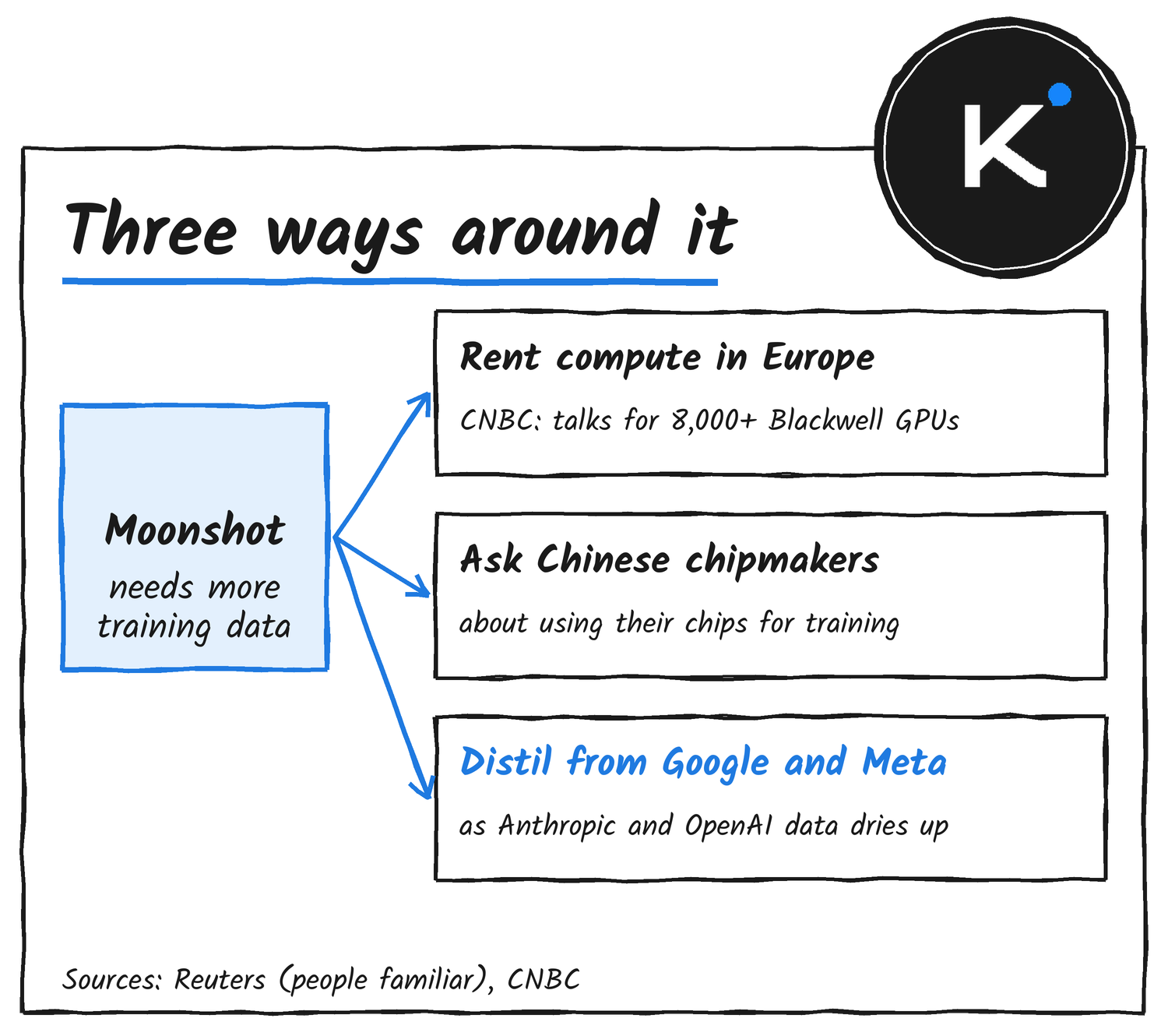
CNBC reported on 5 November that Moonshot had held talks to rent clusters of 8,000 or more Nvidia Blackwell GPUs hosted in Europe, and that a source described the lab as “very aggressive” in chasing more computing power. A separate person told Reuters that Moonshot has stepped up efforts to rent computing power in Europe, confirming the CNBC report, and plans to approach Chinese chipmakers about using their processors for training.
The rule is also reshaping other labs’ plans, which I come back to below. For the wider chip story, see my reports on Commerce adding Megaspeed and six related firms to the Entity List and on Nvidia reinstating Jensen Huang.
The distillation lever
Distillation trains a model on answers generated by a more capable one. Reuters says the safeguards US labs have built against it slowed Moonshot as well as Z.AI. As obtaining training data from Anthropic’s and OpenAI’s models has become harder, the person said, Moonshot has begun distilling from models developed by Google and Meta, whose latest releases have made them attractive sources.
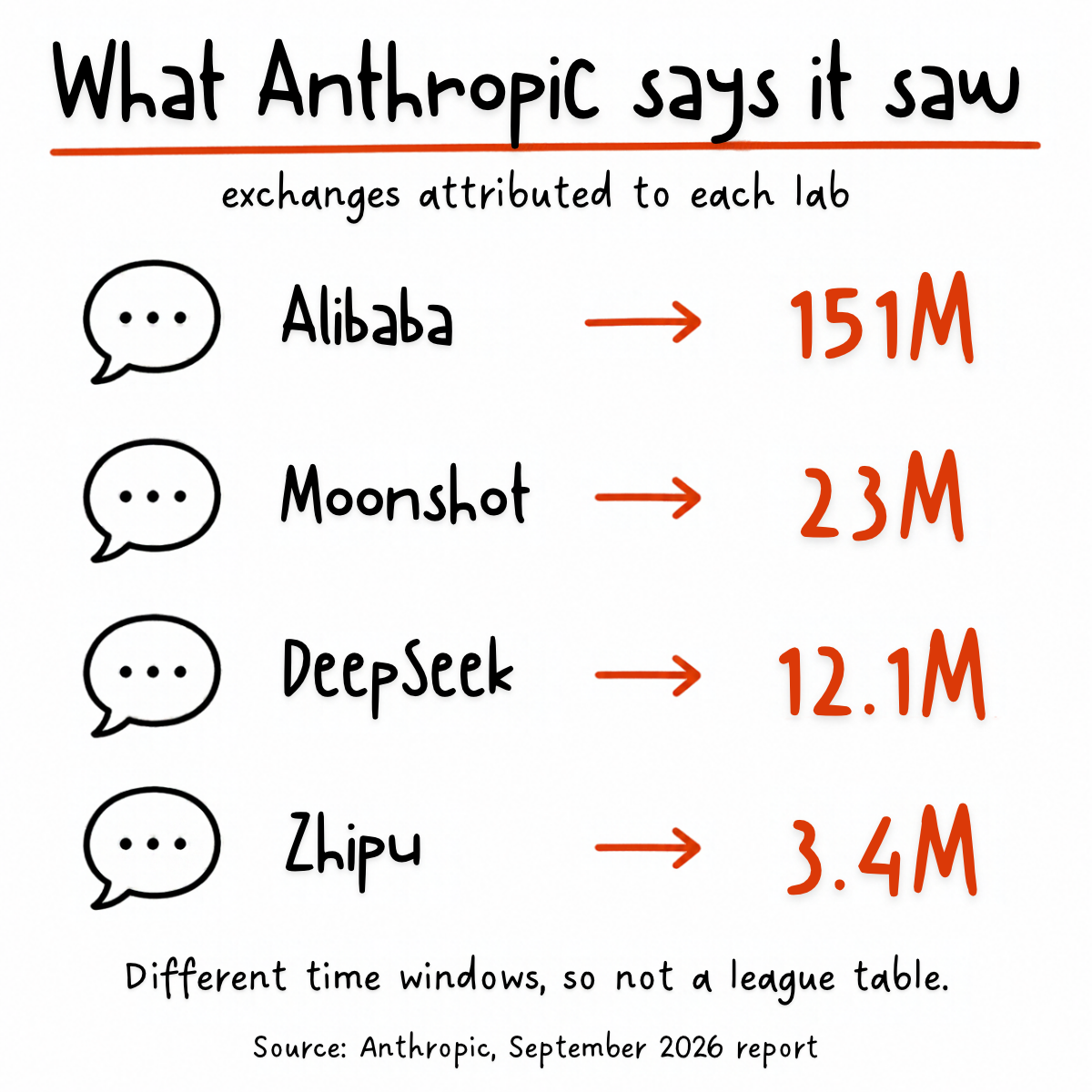
Anthropic’s September report is the most detailed public account of the other side. Reuters notes Anthropic said it had observed nearly 200 million exchanges with Claude linked to suspected distillation campaigns, attributed to Chinese developers including Alibaba, Moonshot and Z.AI. The report’s own figures are below. OpenAI has made similar accusations against individuals associated with Moonshot, Reuters says, and has reported its own efforts to disrupt such activity; I covered OpenAI’s research post on those safeguards.
What Anthropic says about Zhipu and Moonshot
On Zhipu, branded Z.ai outside China, Anthropic says it counted 770,609 exchanges passing through a chain-of-thought extraction pipeline over 10 days in June, using 273 fraudulent accounts, and attributed more than 3.4 million exchanges to the lab over 17 days across June and July. On Moonshot, it says the company relayed almost 300,000 customer requests to Anthropic over a ten-day stretch through a network of 5,380 fraudulent accounts, and attributes more than 23 million exchanges between May and July. These are Anthropic’s findings. Moonshot told China’s National Business Daily in July that its Kimi K3 gains came from original changes to the underlying architecture, Reuters notes.
What the peers said in the same fortnight
Z.AI and Moonshot are not alone. Two of China’s largest tech groups said similar things on earnings calls days earlier, and Anthropic’s report names DeepSeek and Xiaomi too.
“It sets everyone back in China.”
Martin Lau, Tencent president, on a post-earnings call on 18 November 2026, as quoted by Bloomberg
| Lab | What was reported | Source and date |
|---|---|---|
| Z.AI | GLM-5.5 behind schedule; could slip to Q1 2027 or later | Reuters, anonymous sources, 26 Nov |
| Moonshot | Release gap could double to 12 months or longer; K4 around mid-2027 | Reuters, anonymous sources, 26 Nov |
| Alibaba | Cloud growth to slow to 30% to 45% next year from 53%; 20 gigawatt capacity target may be lowered; next Qwen training on its own T-Head chips | Earnings call, via Bloomberg and Reuters, 19 Nov |
| Tencent | Next-generation model development to slow in the near term; cloud business largely unaffected because its AI services rely mainly on inference that can run on domestic chips | Earnings call, via Reuters and Bloomberg, 18 Nov |
| DeepSeek | 12.1 million exchanges over 14 days in July attributed to it by Anthropic | Anthropic report, September |
Tencent’s Lau also predicted that US controls would speed up development of China’s domestic chip industry in the long run, and Alibaba said it is already training its next Qwen model on its own semiconductors. The pressure is real, but the response is already under way.
Why the cost advantage is the stake
Reuters calls low-cost development the advantage Chinese labs have leaned on. Its report describes two things that cost money now getting harder at once: renting Nvidia capacity abroad, and borrowing capability from US models. A person at Moonshot’s end says compute inside China cannot fully cover the first.
Releases have not stopped. Z.AI shipped GLM-5.4 this week, and Moonshot released the weights for Kimi K3.1 Pro on 5 November. The delays Reuters describes are for the next flagships, the largest training runs.
What to watch
- Whether GLM-5.5 appears before the end of 2026, which was Z.AI’s original hope, or slips into 2027.
- Whether Moonshot’s talks to rent Blackwell capacity in Europe close, and whether any Chinese chipmaker agrees to supply training hardware.
- Whether Kimi K4 lands around mid-2027, as one person estimated, or on the old six-month rhythm.
Moonshot’s last three flagships arrived in July 2025, January 2026 and July 2026. On one person’s estimate, the next arrives in mid-2027.
Sources: Reuters, 26 November 2026; CNBC, 5 November 2026; Anthropic threat intelligence report, September 2026; Bloomberg, 18 November 2026; Bloomberg, 19 November 2026.
Disclosure: I’m an OpenAI, Firecrawl and Devin ambassador.
Discover more from Sulat AI & Tech News
Subscribe to get the latest posts sent to your email.