Switzerland’s National Cyber Security Centre (NCSC, known in German as the BACS) has confirmed the country’s first cyberattacks carried out with AI agents. Its director now puts the count at five, three of them against critical infrastructure operators. In an on-the-record reply to my questions, the NCSC says that when it published it knew of four attacks, two on critical infrastructure operators, and had since received a report of a fifth that failed. What the agency has not said matters as much as what it has, so I separate the two below.
5
confirmed cases, per the NCSC director
2 to 3
critical infrastructure operators, per the NCSC’s spokesperson and its director
2+
sectors affected, per the release
~2x
internet-reachable AI attack tools since October
What the NCSC announced
The release is dated 24 November 2026. It says the NCSC received its first reports “in recent days” of attacks on Swiss organisations that were carried out with the assistance of an AI agent, and that “various organisations and operators of critical infrastructure across at least two sectors” were affected. The agency calls it “a shift in the cyber threat landscape”.
The attackers used what the NCSC calls “Agentic Offensive Frameworks”: AI agents that search for vulnerabilities on their own, choose attack tools, judge the results and plan the next step. The same software is sold and used for penetration testing, which is why the NCSC describes it as dual-use. It adds that the agents exploit default or easily guessed passwords and known flaws in internet-facing systems, and that they “often require only a fraction of the time a human would need”.
Five cases, and a gap between two accounts
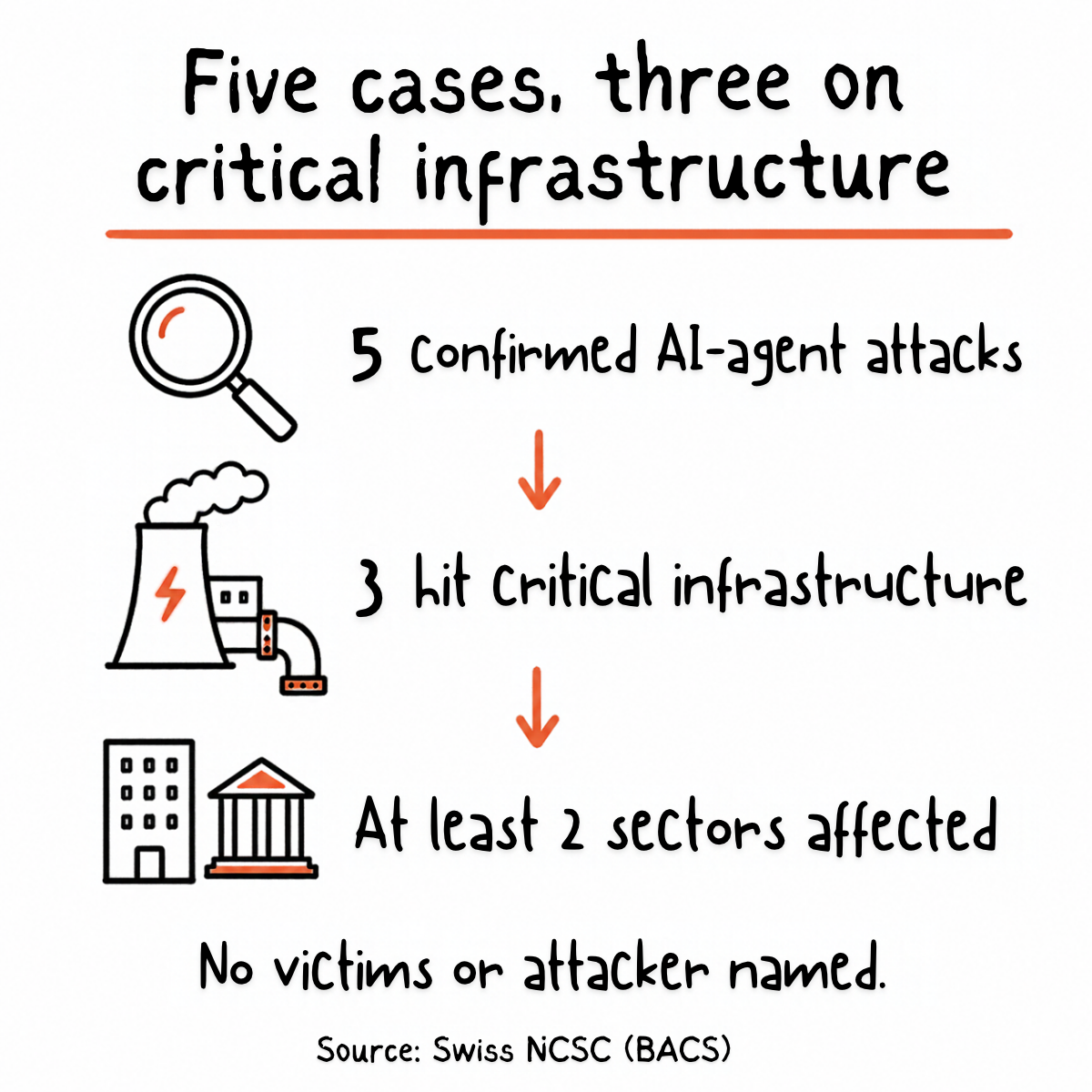
The release gives no count. Two days later, on 26 November, public broadcaster SRF quoted NCSC director Florian Schütz: “We currently have five confirmed cases of attacks with AI agents” (my translation from German). Per SRF, three of the five are critical infrastructure operators, such as power, water or telecom providers, and small and medium businesses that reported voluntarily were also hit. All five were reported in the past few days.
Here the two accounts part. The release says that in all attacks known to the NCSC, “the use of AI agents led to the successful compromise of the victim’s IT systems”. SRF reports Schütz saying systems were successfully hacked in four of five cases. I put the difference to the NCSC, and Manuela Sonderegger, its head of information and media, answered on the record: “At the time of publication, the NCSC was aware of four attacks, two of which affected critical infrastructure operators. The NCSC received a report of a further attack, which was not successful. This brings the number of confirmed cases to five.” That settles the success gap: four attacks had succeeded when the release went out, and a fifth report, which failed, came after. It leaves a smaller gap on infrastructure. Sonderegger counts two operators among the first four, while SRF quotes Schütz saying three of the five were operators. The two fit together only if the unsuccessful fifth attack also targeted an operator, which is my inference and not something the NCSC has said. SRF also reports there have been no larger outages, and that it is still unclear who is behind the attacks. Le Temps asked the NCSC on 26 November and got the same answer on victims: the agency will not name the critical infrastructure operators or the consequences, only that operators in at least two sectors were affected.
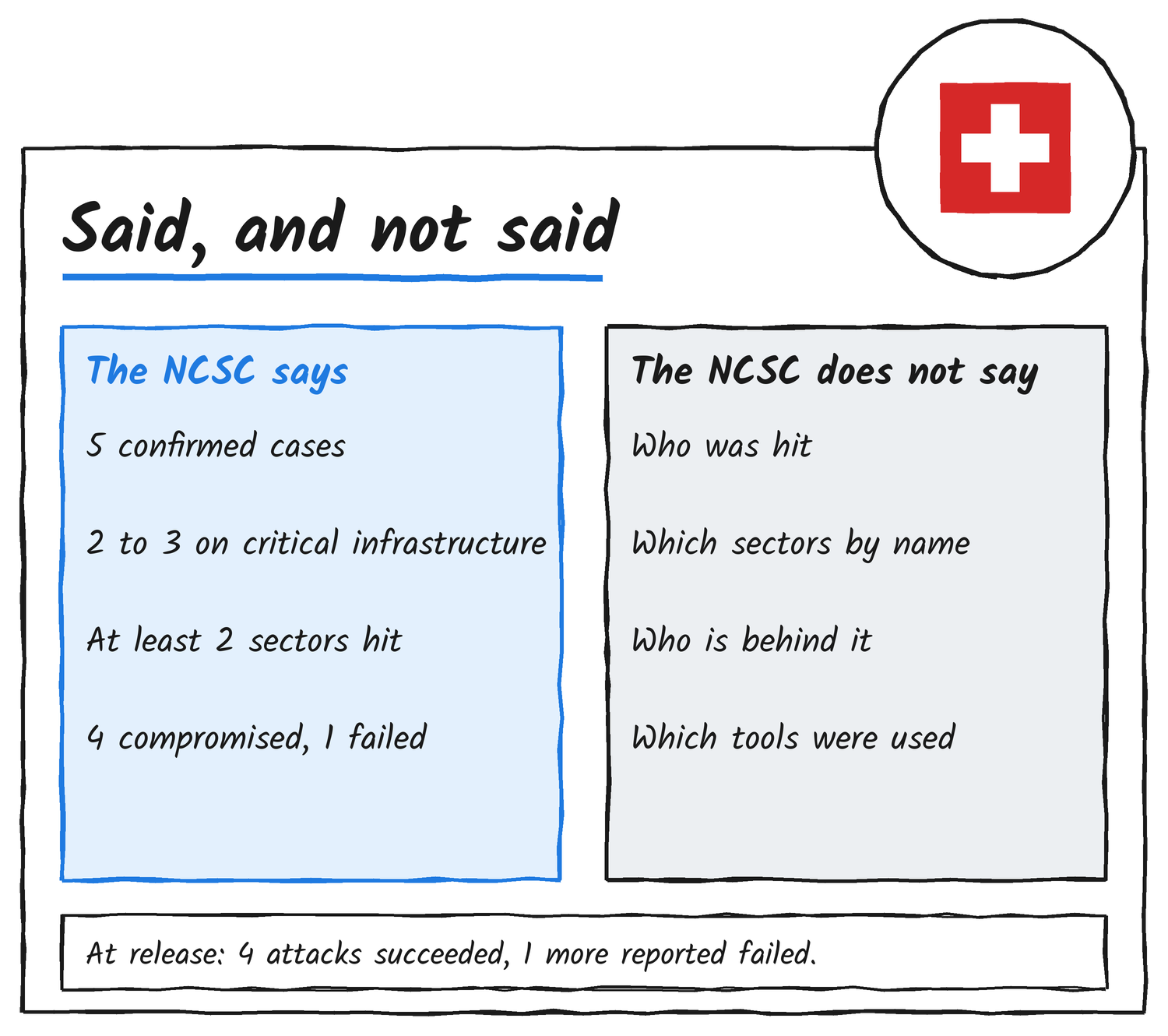
Two cautions on the numbers. First, “five confirmed cases” counts what organisations reported. Critical infrastructure operators must report, but the SMEs in the SRF account did so voluntarily, so the real total is probably higher than any figure the agency can publish. Second, the NCSC has not said which tools were used in the Swiss cases. It does name ARTEX and CyberStrikeAI, but as examples of freely available agents whose number it says has almost doubled since October 2026. The release does not say ARTEX or any other named tool was used in the Swiss cases, so I don’t either.
How these tools work, and who else is seeing them
ARTEX is the name that keeps coming up. The FBI’s 13 November FLASH said it had automated intrusions since August, some reaching privileged access in under three hours, as I reported in our ARTEX piece. Canada’s Cyber Centre now puts numbers on the wider family: of the AI-enabled offensive tool infrastructure it has observed worldwide, about 46% was linked to ARTEX, 28% to CyberStrikeAI and 14% to PentAGI. It says ARTEX’s developer made the project closed source on 8 October 2026, by which point it had been copied more than 12,000 times, and that activity from ARTEX servers has been hitting Canadian organisations for months without being attributed to a specific actor.
The Italian national CSIRT describes the mechanics most closely. In one campaign using DeepSeek Harness, an open-source agent framework with a “Red Team Mode” plugin, a coordinator handed tasks to five agents covering the stages from reconnaissance to persistence. The framework ships a prompt that frames the work as a team exercise with scores, to talk the model past its safety limits. Italy says agents chained low-impact flaws into longer attack paths and, in places, wrote malicious code in real time to get past endpoint defences. Italy also warns that each step on its own, such as an API call or a database read, looks like normal use, so detection has to look at the pattern.
The UK’s NCSC, in a blog post the same day as Switzerland’s release, is the most deflating of the lot, on purpose. Since September it has seen a marked rise in AI-assisted attacks across sectors, and it stresses that none of the weaknesses being exploited are new, and that the agents use common tools. What changed is speed and persistence at low cost. It lists the old favourites: credentials committed to code repositories and misconfigured infrastructure as code. It also says today’s frameworks are noisy, which makes them easier to spot, and warns that may not last if future ones favour stealth. Google’s threat group described a related case of agents moving fast on known flaws, an agent that turns patches into exploits, in our earlier piece.
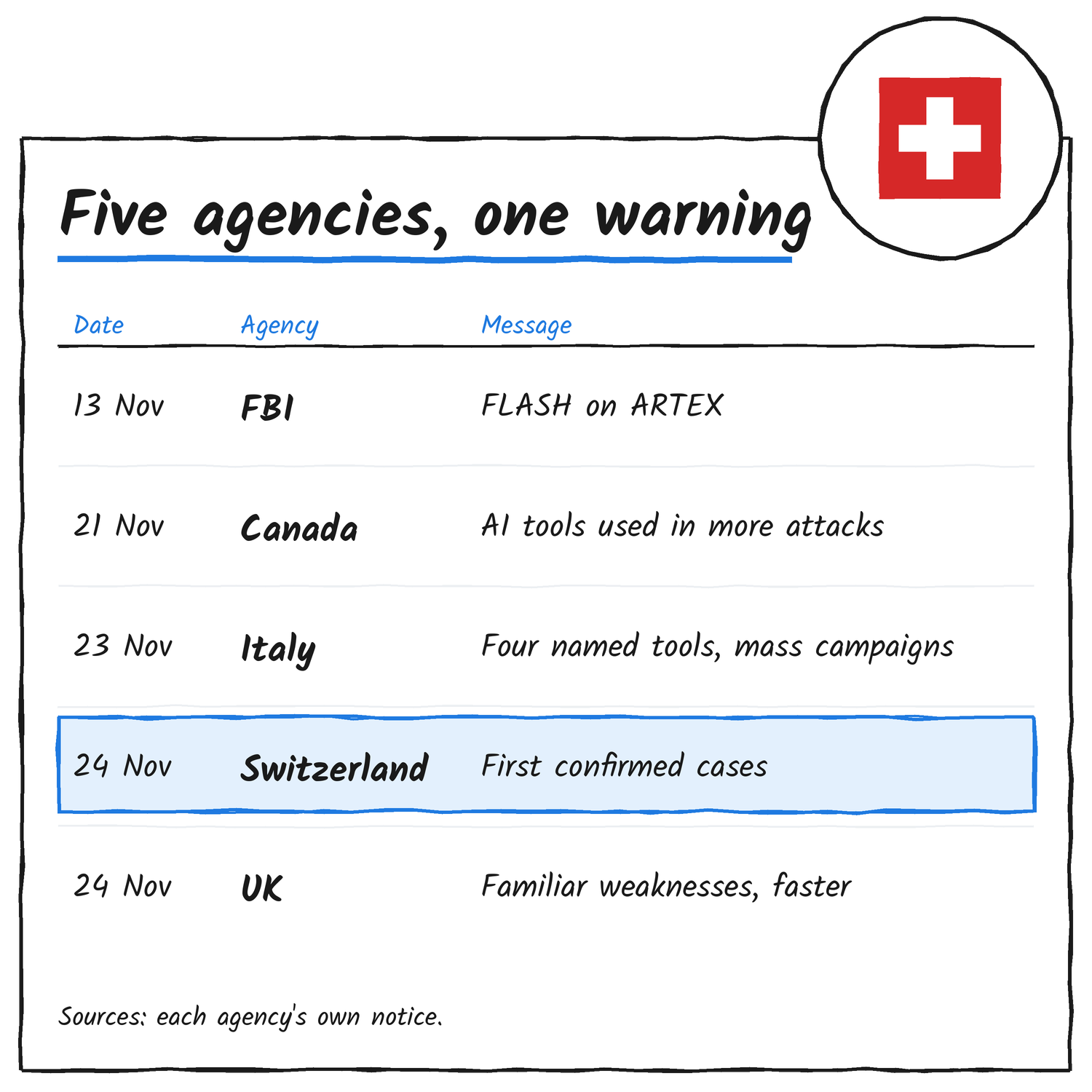
| Agency | Date | What it says | Tools named |
|---|---|---|---|
| FBI | 13 Nov | FLASH alert on an AI hacking tool in global attacks | ARTEX |
| Canada, Cyber Centre | 21 Nov | Threat actors increasingly use automated and AI-enabled tools; ARTEX servers have targeted Canadian organisations for months | ARTEX, CyberStrikeAI, PentAGI |
| Italy, CSIRT Italia | 23 Nov | Mass compromise campaigns run by autonomous agents | ARTEX, CyberStrikeAI, DeepSeek Harness (Red Team Mode), PentAGI |
| Switzerland, NCSC | 24 Nov | First confirmed cases; count of such tools almost doubled since October | ARTEX and CyberStrikeAI cited as examples |
| UK, NCSC | 24 Nov | Marked rise since September; familiar weaknesses, exploited faster | ARTEX, plus Cairn, PentAGI, RedAmon, Xalgorix, Darkmoon |
Germany’s BSI has moved its assessment of the national situation this autumn to “tense to critical”, partly because of fast AI development, according to SRF. In Japan, JPCERT/CC has logged AI attack tools in attack attempts, though Trend Micro had not tied AI to the breaches themselves, as I reported in our Japan piece. That many agencies reaching for the same warning within two weeks is a signal in itself, though they may be watching the same tools rather than independent waves.
Berne changes its mind in writing
The more telling Swiss document may be one that predates the NCSC release. In December 2025 the Federal Council published a report on AI in cybersecurity which, as described in a parliamentary question, judged that autonomous attacks were not to be expected within three to five years and that AI was mainly a catalyst for existing trends. In September 2026 Green Liberal MP Matthias Jauslin asked whether that still held. The Federal Council’s answer, dated 18 November, six days before the NCSC release, is blunt.
The capabilities of AI systems have developed significantly faster and on a larger scale than originally assumed. The cases that have become known show that AI systems are already able to carry out cyberattacks independently. The assessment in the report therefore no longer applies.
Federal Council reply to interpellation 26.4364, 18 November 2026 (my translation from German)
That answer refers to cases abroad, not the Swiss ones. It also holds a line the NCSC repeats: known protective measures still work if they are kept current. The Federal Council adds that the NCSC and the Cyber Command already use AI-assisted defence on their own infrastructure, and that supervisory authorities are checking whether critical infrastructure rules need changing. It calls those rules technology-neutral.
The 24-hour clock
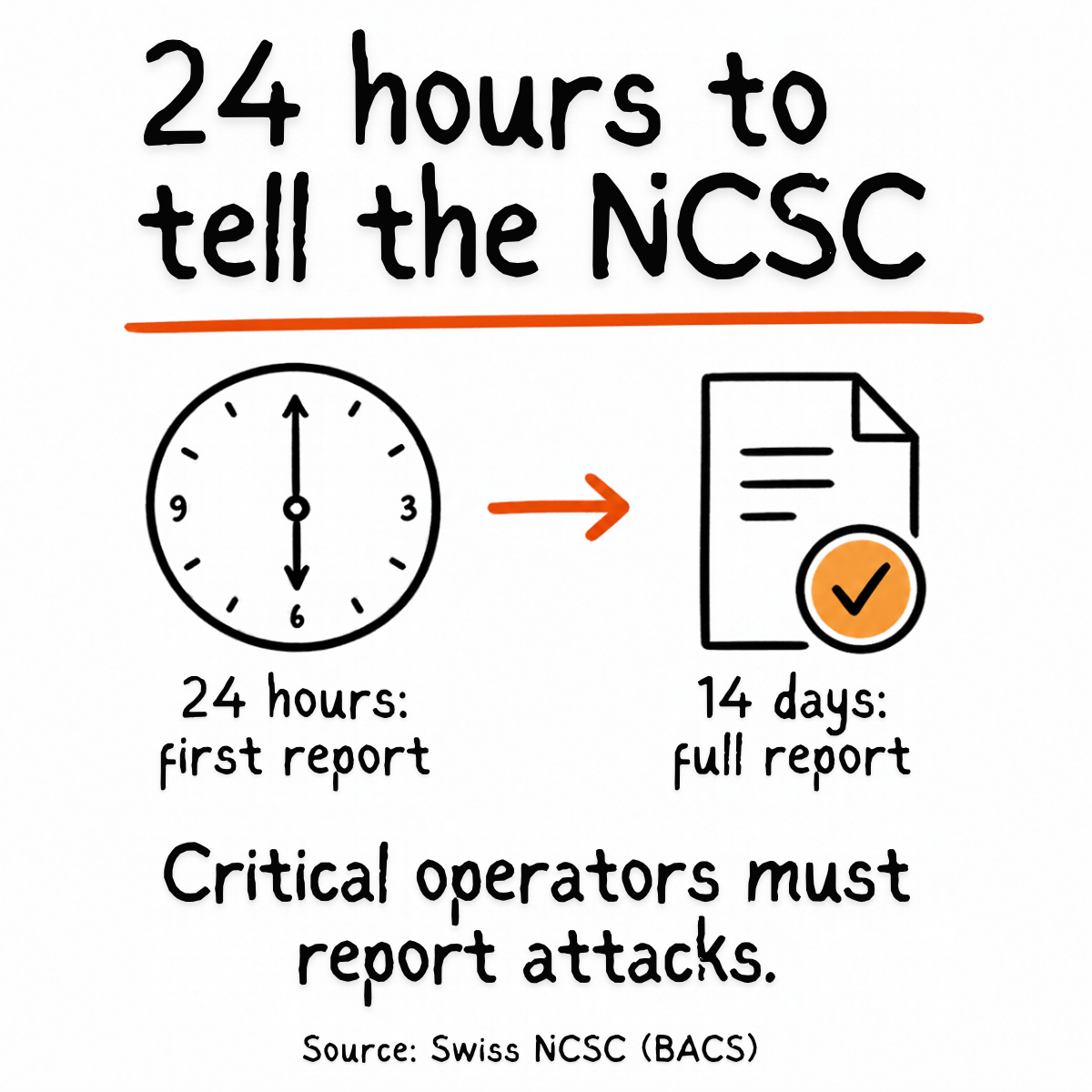
Why does Switzerland know about these cases within days? Because operators of critical infrastructure, including energy and drinking water suppliers, transport companies and cantonal and communal administrations, must report cyberattacks to the NCSC within 24 hours of discovery, and have 14 days to complete the report. Operators who fail to report can be fined. That rule is the reason the NCSC can see a cluster at all, and also the reason the count is partial: attacks on companies outside the obligation reach the agency only if they choose to tell it.
What defenders should do
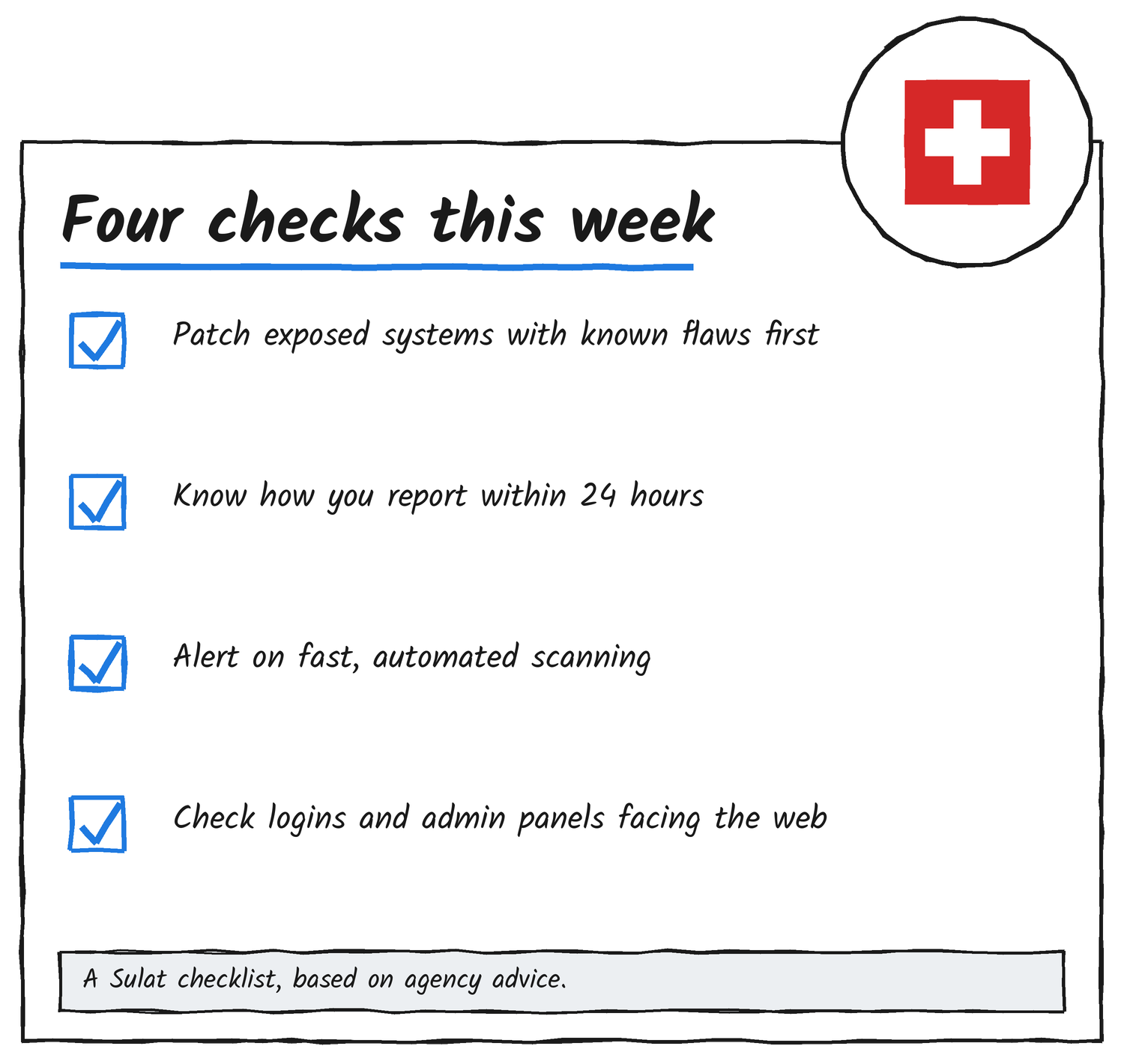
The advice from the agencies is dull, and that is the point. The Swiss NCSC asks companies to act “without delay” on three things I could read in full:
- Limit exposed systems, using geo-blocking or an allow list of IP addresses where possible.
- Install critical updates on internet-facing systems as soon as possible, and no later than 24 hours after release.
- Protect internal resources reachable from the internet, such as webmail and VPN, with multi-factor authentication or passkeys.
The release has further recommendations that the page cut off on my fetch, so read the full list before acting. Italy adds disabling remote management interfaces that are not needed and watching authentication sources and outbound server traffic. The UK points at secrets in code repositories and infrastructure-as-code mistakes. The drawing below is my condensed checklist, not an agency list.
What is still unknown
Four gaps stand out. Nobody has said who is behind the Swiss attacks or whether one actor is responsible for all five. The tools are unconfirmed. The sectors and victims are withheld, and the NCSC says affected organisations are entitled to speak for themselves. And the infrastructure count is stated two ways. Raphael Reischuk, co-founder of the National Test Institute for Cybersecurity, told SRF he expects a bigger wave of attacks and that too many Swiss companies feel safe. His warning is a forecast, not a count. The NCSC’s own is similar: it “anticipates an increase” in rapid, successful attacks. The NCSC’s reply to me adds that it “does not comment on individual incidents” and, not being a law enforcement authority, “does not attribute attacks to specific perpetrators”, so don’t expect a name from it. It did not answer my questions on which frameworks were used. Apart from that reply, every Swiss fact above comes from its published material and the press reports linked.
Sources
- Swiss NCSC (BACS), “Cyberattacks involving AI agents: First confirmed cases in Switzerland”, 24 November 2026
- SRF, “Fünf bestätigte Fälle”, 26 November 2026
- Swiss Parliament, interpellation 26.4364 and Federal Council reply, 18 November 2026
- Canadian Centre for Cyber Security advisory, 21 November 2026
- CSIRT Italia bulletin BL01/261123, 23 November 2026
- UK NCSC, “Familiar weaknesses, exploited faster”, 24 November 2026
- Swiss NCSC, reporting obligation
Discover more from Sulat AI & Tech News
Subscribe to get the latest posts sent to your email.