
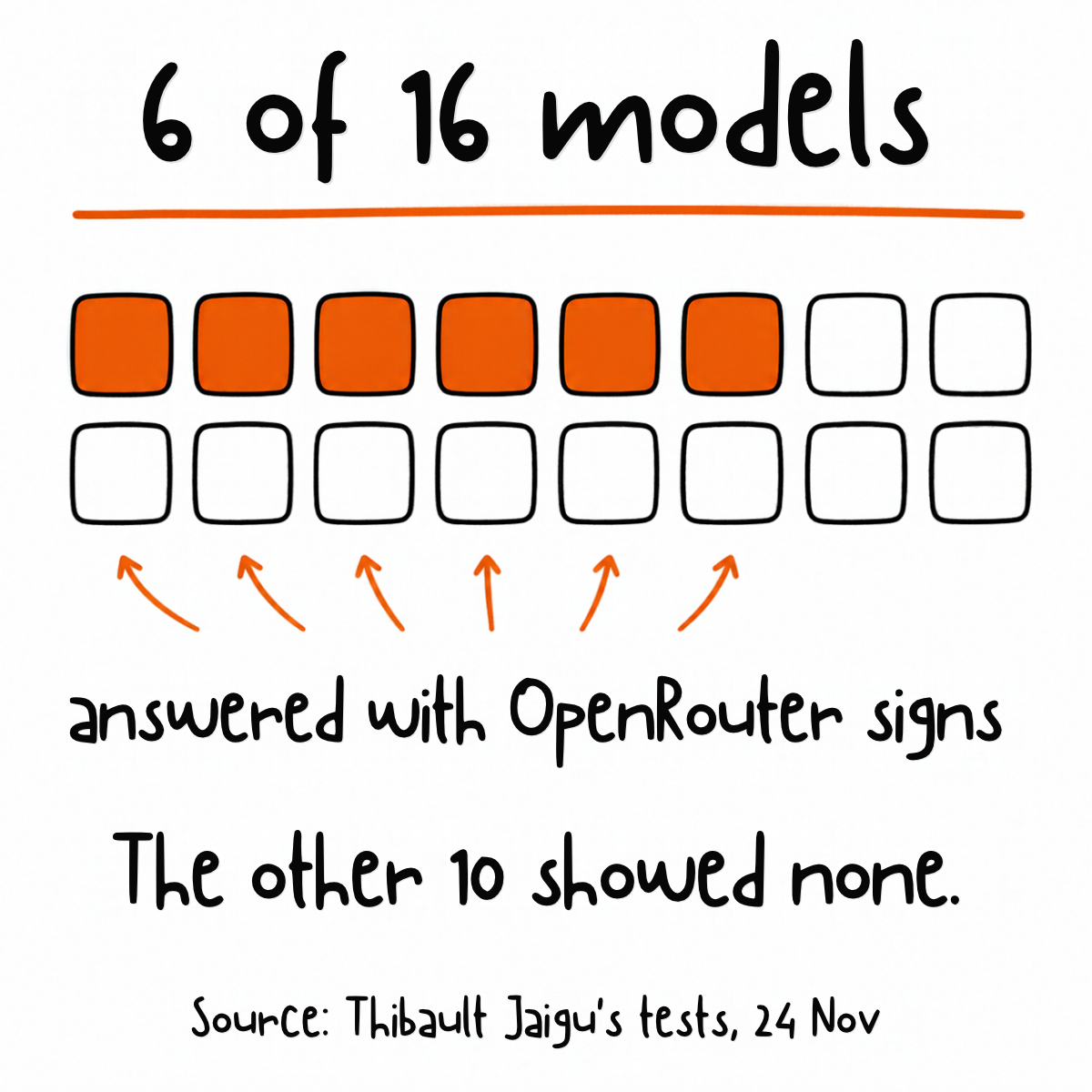
Thibault Jaigu, a cofounder of the LLM router Requesty, says six of the 16 chat models offered by Blackfuel, a Paris inference company, are routed through OpenRouter. He quotes Blackfuel’s Trust Center as saying “Zero data retention applies to every model, regional or global”, and says nothing Blackfuel publishes names OpenRouter. Requesty competes with OpenRouter, so Jaigu has a commercial interest in the finding.
I haven’t re-run his tests, because I don’t have a Blackfuel key. I checked what I could from public pages, OpenRouter’s docs and OpenRouter’s public API, and some of it supports him while some of it doesn’t. Blackfuel and OpenRouter haven’t commented publicly that I can find, and I’ll add whatever they say.
- Jaigu says one Kimi-K3 request returned a cookie scoped to openrouter.ai, and that six models show OpenRouter headers, generation IDs or error messages.
- The six are exactly the six models in Blackfuel’s live model list that have no
:euvariant. Blackfuel’s docs say an untagged model ID carries no data-residency guarantee. - Blackfuel’s privacy policy and the docs pages I read don’t name OpenRouter, but the policy allows sub-processors. I couldn’t load the Trust Center page where its sub-processors are listed.
- Jaigu’s own screenshots show the cookie on five models and an OpenRouter-style ID on three, so I can’t rebuild his count of six from them.
- Nobody has shown that a prompt was stored. The open question is whether the extra hop was disclosed.
What Jaigu found
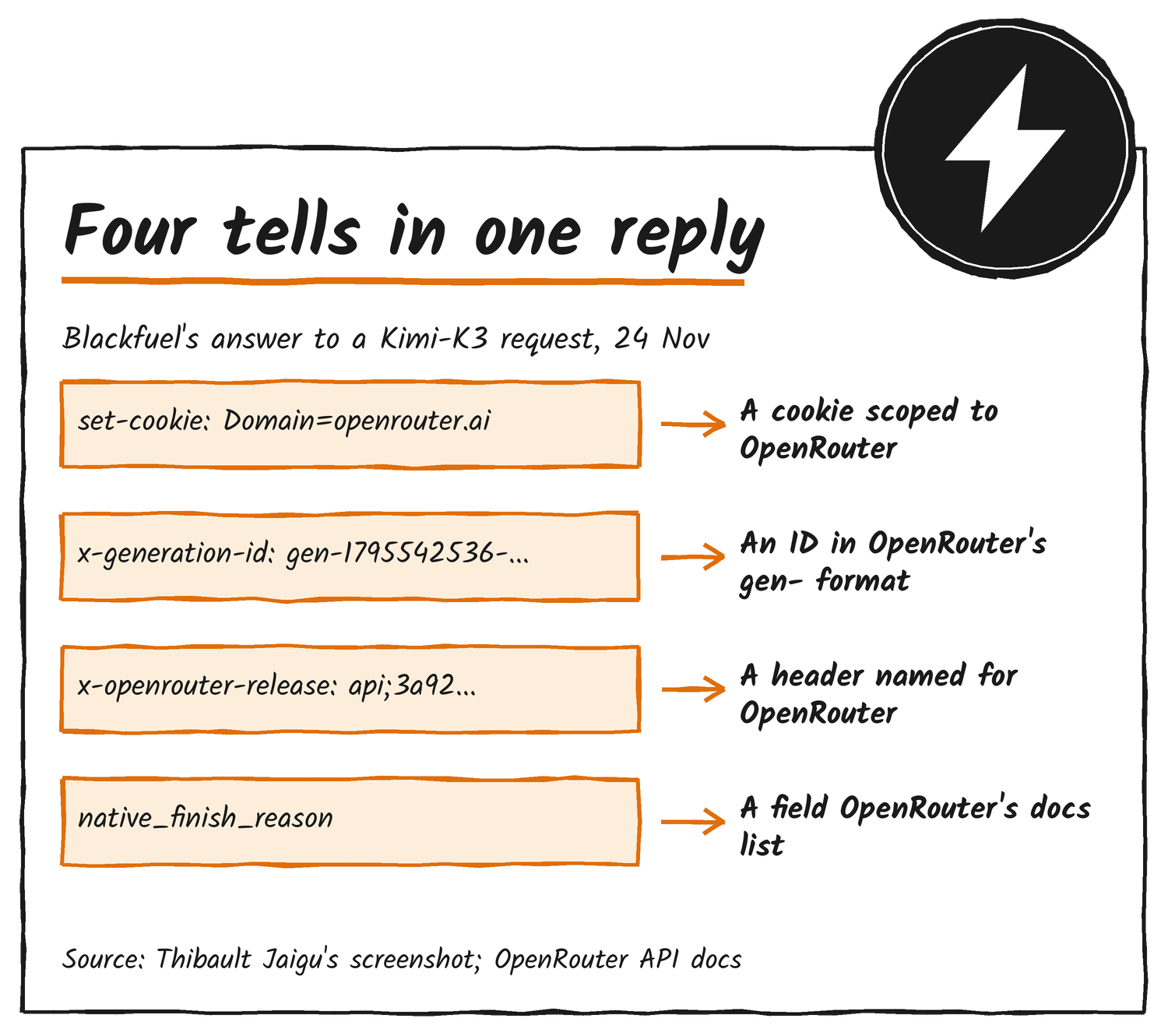
Jaigu posted a four-part thread on 25 November (UTC). He says his team was onboarding Blackfuel, which came out of stealth on 30 September and said in its launch release that it had “more than $250 million in contracted revenue”. He sent one request for Kimi-K3 to Blackfuel’s API and the response set a cookie for OpenRouter.
His screenshot of the response shows four things that point at OpenRouter: a set-cookie header for the domain openrouter.ai, an x-generation-id beginning gen-, an x-openrouter-release header, and a native_finish_reason field. OpenRouter’s API docs describe generation IDs, the X-Generation-Id header and native_finish_reason. Other gateways can copy a response format, so those three alone wouldn’t settle it. The cookie is harder to explain away, because a server can’t normally set a cookie for another company’s domain unless that company’s response is being passed through. That reading is mine, not Jaigu’s.
One detail I checked: the ID in his screenshot, gen-1795542536, decodes as a Unix time of 17:48:56 UTC on 24 November, which matches the response’s own date header.
The third screenshot is the most telling. A request for MiniMax-M3 came back with an error that reads like OpenRouter’s, not Blackfuel’s: “0 endpoints out of 5 requested are available matching your guardrail restrictions and data policy”, with lines for “Provider not allowed by guardrail” and “ZDR violation (guardrail)” and a link to openrouter.ai/workspaces/default/guardrails. A guardrail is an account-level OpenRouter setting. So whoever holds that OpenRouter workspace had limited which providers it could use and had a zero-retention filter on.
The six models, and the pattern in the list
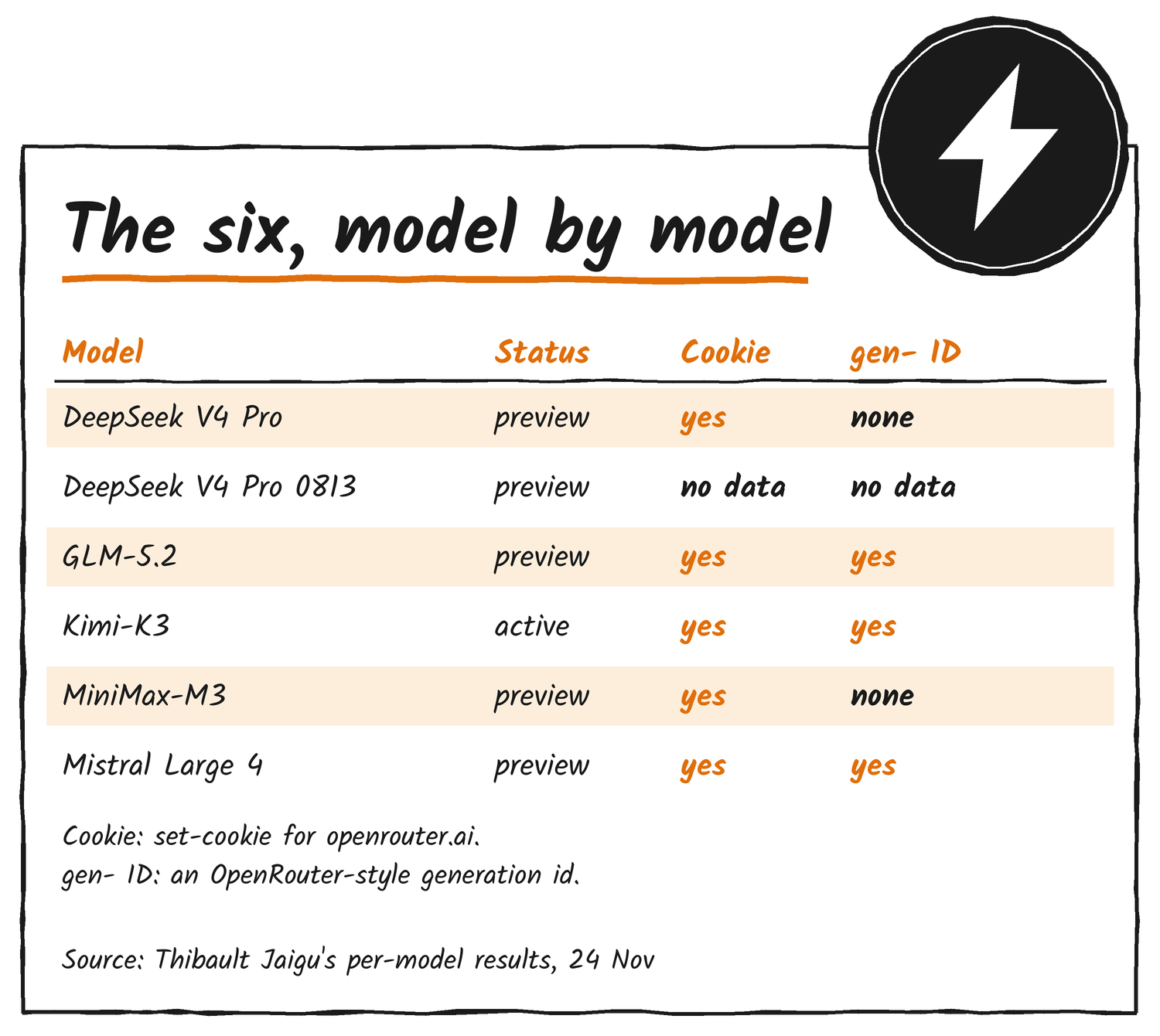
Jaigu also posted a call to Blackfuel’s /v1/models endpoint. It lists 16 chat models, all with owned_by set to “blackfuel”, and he highlighted six: DeepSeek V4 Pro, DeepSeek V4 Pro 0813, GLM-5.2, Kimi-K3, MiniMax-M3 and Mistral Large 4. Five of those are marked preview and Kimi-K3 is active.
Count the rest of the list and a pattern appears. Ten of the 16 are five models that each appear twice, once plain and once with an :eu suffix. The other six have no EU twin, and they’re the six he flagged. Blackfuel’s docs say :eu variants are “processed exclusively in the EU” and that an untagged ID “delegates the routing decision to Blackfuel, and no data-residency guarantee applies”. Jaigu says the :eu models “look natively hosted, with no OpenRouter signs”.
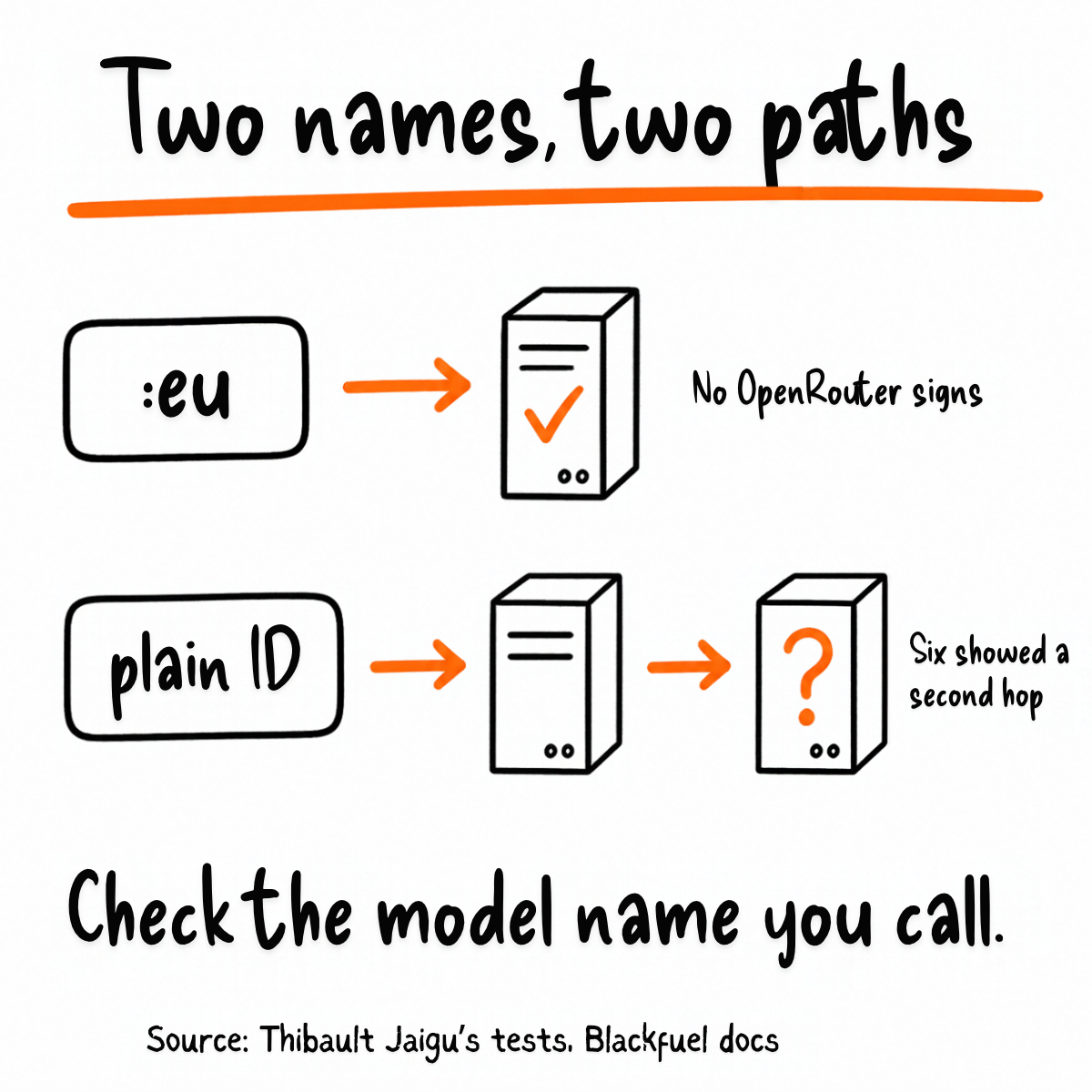
My inference is that Blackfuel runs the models it has finished deploying itself, and offers newer or larger ones it doesn’t host yet through someone else. Blackfuel’s launch release said its first cluster, in Barcelona, was still being delivered, and that its inference pool would launch with “selected models” from several labs. That’s a plausible reason and nothing more. Blackfuel hasn’t said it.
Where his count and his screenshots disagree
His post says six models show OpenRouter headers, IDs and error messages. His per-model screenshot shows a cookie on five, an OpenRouter-style ID on three, and no data at all for DeepSeek V4 Pro 0813. The sixth could be counted through the MiniMax-M3 error text or through the list pattern, but I can’t reconcile it from what he’s posted. The gap doesn’t undo the finding, since five models with a cookie is still a lot, and it does mean the headline number is his reading, not something a reader can check line by line.
16
chat models on Blackfuel’s live list
6
flagged by Jaigu, all without an :eu twin
5
with an OpenRouter cookie in his per-model screenshot
3
with an OpenRouter-style generation ID
What Blackfuel promises, in its own words
Three documents matter, and they don’t say quite the same thing.
- The docs. Blackfuel’s security page lists a “zero retention” commitment: “prompts and responses are processed in memory and never written to persistent storage or logs.” It keeps request metadata such as token counts and timestamps.
- The privacy policy, last updated 20 September. It says Blackfuel doesn’t “sell, rent, or share your Corporate Data with any third parties, except as required by law or as necessary to provide the Service (e.g., to a cloud infrastructure provider acting as our sub-processor, who is also bound by confidentiality)”.
- The Trust Center. Jaigu quotes it as saying zero data retention “applies to every model, regional or global”. I couldn’t load the FAQ it comes from, so I’m relying on his screenshot. The docs point to the Trust Center for the sub-processor list.
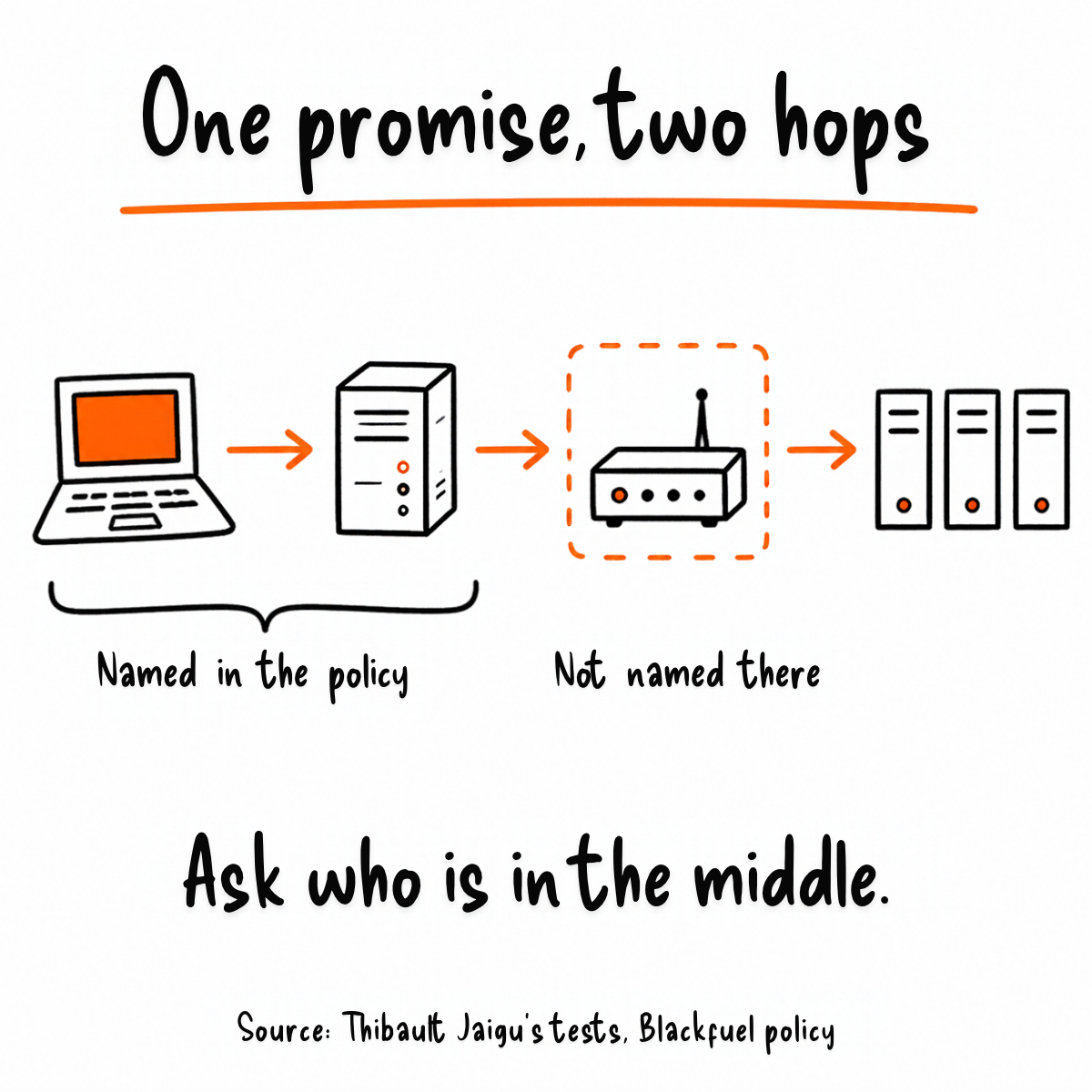
On the wording I can read, this isn’t a plain contradiction. The policy lets Blackfuel use sub-processors, and the docs promise that Blackfuel itself writes nothing to storage. Neither says what happens after the request leaves Blackfuel. The Trust Center sentence, as Jaigu quotes it, is the sharper claim, because “every model” is a statement about the whole path. The privacy policy and the docs pages I read (security, model catalogue and model lifecycle) don’t name OpenRouter, which is Jaigu’s point.
Blackfuel’s docs also say a preview model commits to “nothing about availability, latency, or uptime”, while being “served, billed, and shown exactly like a generally available model”. Preview is described as the status a model gets when it is “listed on day zero”. Five of Jaigu’s six are in that bucket.
What OpenRouter’s side shows
I pulled OpenRouter’s public API on 26 November. Blackfuel isn’t among its 124 listed providers, and none of the 950 endpoints on its zero-retention list is Blackfuel’s, which is what you’d expect if Blackfuel is a customer and not a host. Kimi-K3 on OpenRouter has 28 endpoints from 19 hosts. Blackfuel’s price for it, $3 per million input tokens and $15 per million output, sits inside OpenRouter’s range of $0.15 to $4.50 in and $9 to $22.50 out, so the price alone shows no obvious markup.
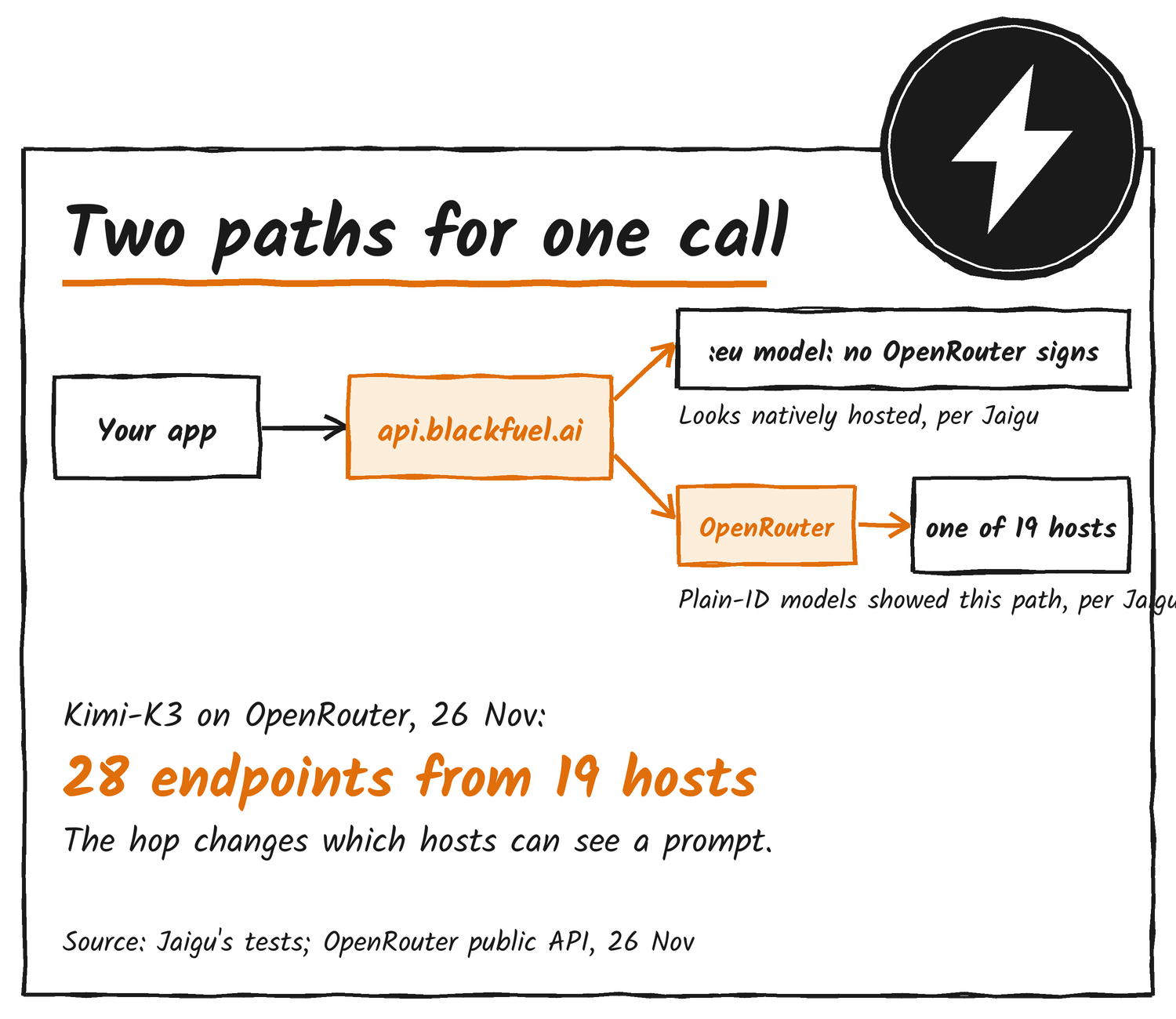
That fan-out is why the hop matters. A request that goes through OpenRouter can land on any host that OpenRouter’s filters allow, so the company that holds your data isn’t the one you signed with. OpenRouter’s self-serve terms, last updated 31 August, bar users from accessing the service “for purposes of reselling API access to Models or otherwise developing a competing service”. Whether that applies to Blackfuel depends on any separate agreement the two have, which I haven’t seen. OpenRouter is now part of Stripe, as I reported earlier this month.
What cuts the other way
- The error text points to a filter. The “ZDR violation (guardrail)” line suggests Blackfuel’s OpenRouter account asks for zero-retention endpoints only. A hop through a filtered route isn’t the same as an open one.
- That filter has its own weak spot. OpenRouter’s chief executive, Alex Atallah, told me on 23 November that providers’ data-handling commitments “have relied mostly on self-attestation, and that isn’t sufficient”. The label Blackfuel appears to lean on is one OpenRouter says it is tightening. I covered that earlier.
- The source competes. Jaigu’s company sells routing. That doesn’t make his screenshots wrong, but it’s why I’ve kept to what the documents and the API show.
- The evidence is partial. It comes from a thread of screenshots and one account. I haven’t seen the raw responses, and I can’t call Blackfuel’s API.
Where it sits next to the other “private AI” findings
It’s the third story this week about a privacy label and the plumbing behind it. Dragos’s canary study, which I covered on 20 November, found prompts read even where requests were marked zero retention. Earlier today I reported that Venice’s pages describe “private” AI three ways, and that KTibow’s probe found other hosts behind 14 of 18 of its image models. The thread running through all three is that a zero-retention label is a statement by whoever applies it, and every router in the middle adds a party the label has to cover.
Routers are also becoming ordinary plumbing. Hugging Face moved its Inference Providers to OpenRouter’s router for language models on 17 November. Using one isn’t a scandal. Not saying so, when your trust page says “every model”, is the part that draws attention.
What I make of it
This section is analysis, not reporting.
First, the cookie and the error text are strong evidence that at least some Blackfuel responses pass through OpenRouter. The exact count is softer. Second, the likelier story is a young company filling its catalogue fast, not a deliberate cover-up, and Blackfuel’s docs partly say so by calling untagged IDs a routing decision it makes. Third, the fix is cheap: name every sub-processor, mark which models are hosted where, and make “every model” true or change it. Until Blackfuel does one of those, a buyer who needs EU residency or verified zero retention should use the :eu names and ask for the sub-processor list in writing.
How to check your own provider
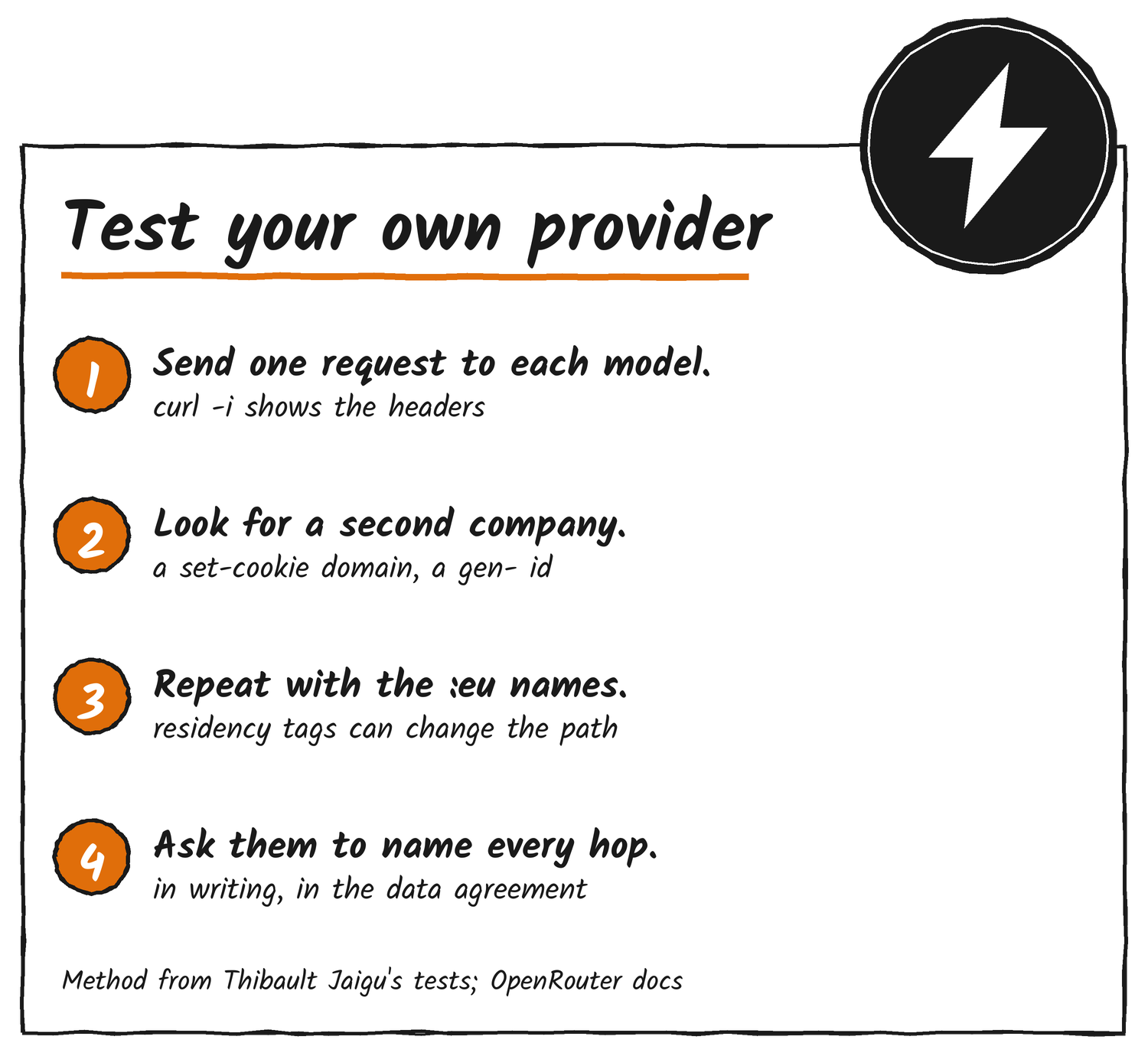
You don’t need much to repeat Jaigu’s test on any gateway. One request per model costs a fraction of a cent.
curl -si https://api.example.com/v1/chat/completions \
  -H "Authorization: Bearer $KEY" \
  -H "Content-Type: application/json" \
  -d '{"model":"MODEL_ID","messages":[{"role":"user","content":"hi"}],"max_tokens":5}' \
  | grep -iE '^(set-cookie|x-generation-id|x-openrouter)'
A hit shows a second company’s plumbing. It doesn’t show where your data ended up, and a clean result doesn’t prove there’s no hop. Treat it as a reason to ask, not a verdict.
- Zero data retention (ZDR)
- A promise that prompts and responses aren’t stored after a request is processed. It’s a label the provider or router applies.
- Generation ID
- A unique ID OpenRouter attaches to each request. Its IDs begin
gen-. - Guardrail
- An OpenRouter account setting that restricts which providers or data policies a request may use.
What hasn’t been published
Blackfuel hasn’t said whether the six models are routed through OpenRouter, whether its sub-processor list names OpenRouter, or how it squares its Trust Center wording with the routing. OpenRouter hasn’t commented on Blackfuel. Jaigu hasn’t published the raw responses, only screenshots, and I haven’t seen the Trust Center FAQ he quotes. If either company replies, I’ll add its answer here, at the top.
Sources
- Thibault Jaigu’s thread on X, 25 November 2026 (UTC)
- Blackfuel docs: Security & Privacy
- Blackfuel docs: Available Models
- Blackfuel docs: Model Lifecycle
- Blackfuel service privacy policy, updated 20 September 2026
- Blackfuel launch announcement, 30 September 2026
- OpenRouter Terms of Service, updated 31 August 2026
- OpenRouter’s public provider, zero-retention endpoint and Kimi-K3 endpoint APIs, read on 26 November 2026
Discover more from Sulat AI & Tech News
Subscribe to get the latest posts sent to your email.