Venice AI sells “private” AI, and its own pages define that word three different ways. The homepage says private means zero data retention on self-hosted open-source models. The privacy page says it means Venice’s own GPUs or zero-data-retention partner infrastructure. The docs page for Claude Opus 4.5 says the provider of that model may retain prompt data.
A researcher who goes by KTibow says there is more. Their attested probe, run on 21 November, saw Baseten, DeepInfra, Fireworks or Parasail download the images for 14 of the 18 image models Venice listed on OpenRouter. A model-swap test on 25 November found that three Venice model names did not behave like the models they named. I haven’t re-run those tests, so I attribute each one to KTibow throughout. I couldn’t find any public reply from Venice.
I read Venice’s homepage, llms.txt, privacy page, privacy policy and model docs on 26 November 2026 (NZDT), pulled OpenRouter’s public zero-data-retention list, and loaded venice.ai in a fresh headless browser to see which hosts it contacts. I haven’t paid for a Venice account or sent a prompt through it. What I could verify, I state plainly. What rests on KTibow’s probe is attributed to them and labelled.
- What Venice promises
- Where Venice’s own pages disagree
- What I checked myself
- What KTibow reports
- Venice is not the first name on this list
- What Venice hasn’t answered
- What to do if you use it
- What I make of it
What Venice promises
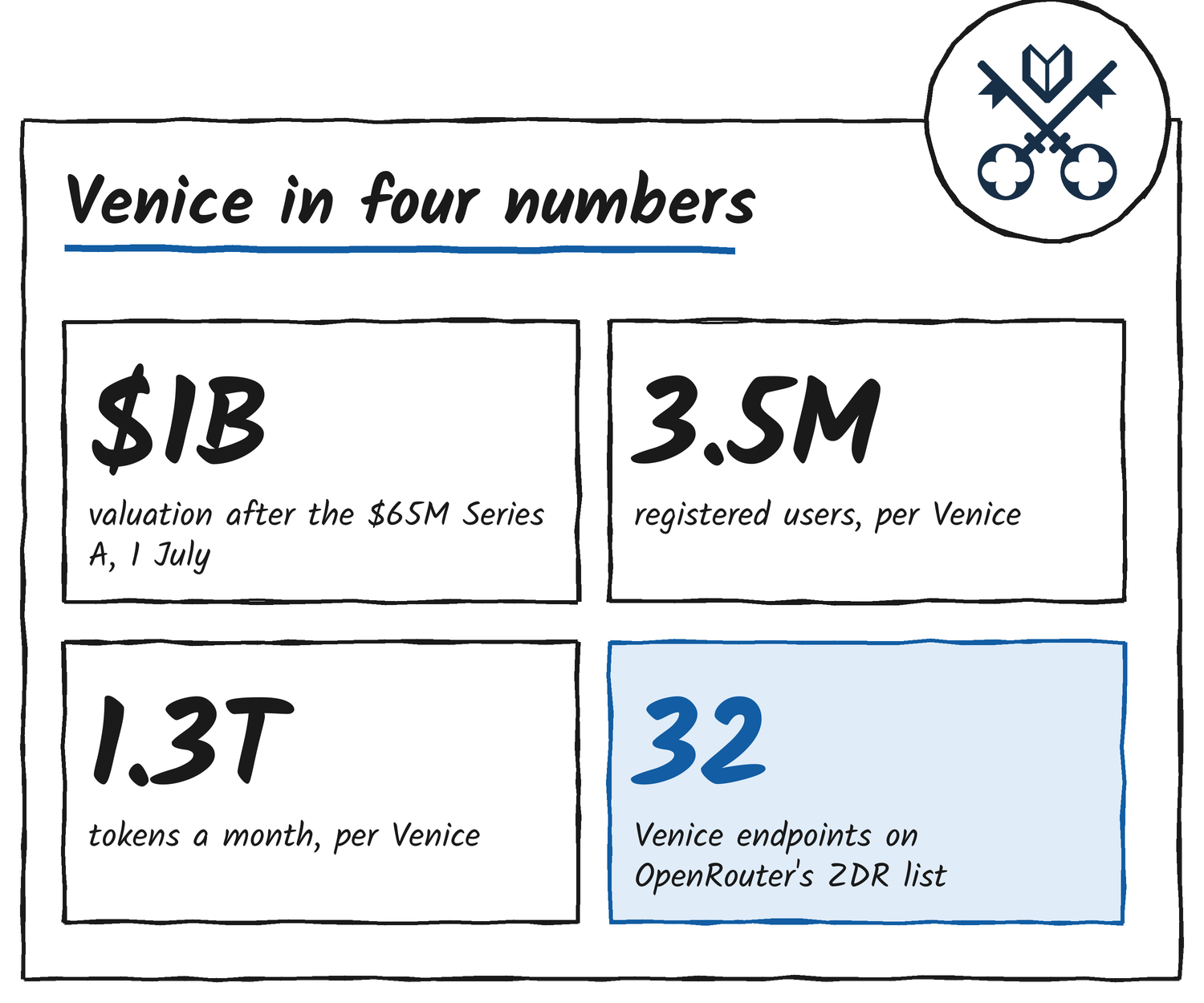
Venice is a privacy-branded chat, image and API service built around open models and a crypto token economy, with its own VVV and DIEM tokens. It raised a $65 million Series A led by Dragonfly at a $1 billion valuation, announced on 1 July 2026, with Coinbase Ventures, F-Prime and North Island Ventures also backing it. Venice says it has 3.5 million registered users, serves 1.3 trillion tokens a month and handles about 2 million API calls a day. Those are Venice’s own figures and I haven’t audited them.
The pitch is privacy. Venice’s homepage and llms.txt both say “Private (zero data retention on self-hosted open-source models)”. The founder, Erik Voorhees, was firmer when Venice launched.
We’re not a wrapper for centralized services, we are a way to access open-source models explicitly and only.
Erik Voorhees, Venice founder, to Decrypt, 11 May 2024
In the same interview he said Venice would “never provide Claude LLM and never provide OpenAI’s service”. Venice’s docs now carry a page for Claude Opus 4.5. Companies change course, and that is not a contradiction on its own. It does mean the 2024 promise can’t be the basis for a 2026 privacy decision.
Where Venice’s own pages disagree
This part needs no outside evidence. Four Venice pages, read on 26 November, say four different things about where a “private” prompt goes.
| Venice page | What it says |
|---|---|
| Homepage and llms.txt | “Private (zero data retention on self-hosted open-source models)” |
| Privacy page, Private tier | “Inference runs on Venice-controlled GPUs or zero-data-retention partner infrastructure. Privacy is enforced by contractual commitments” |
| Privacy page, Anonymous tier | Users should “assume the provider is storing your content” |
| Docs, Claude Opus 4.5 | “The provider of this model may retain prompt data (though it is anonymized by Venice)” |
| Privacy policy, effective 2 June 2026 | Model providers are “prohibited from storing, retaining, or using any of your Prompts or Outputs” |
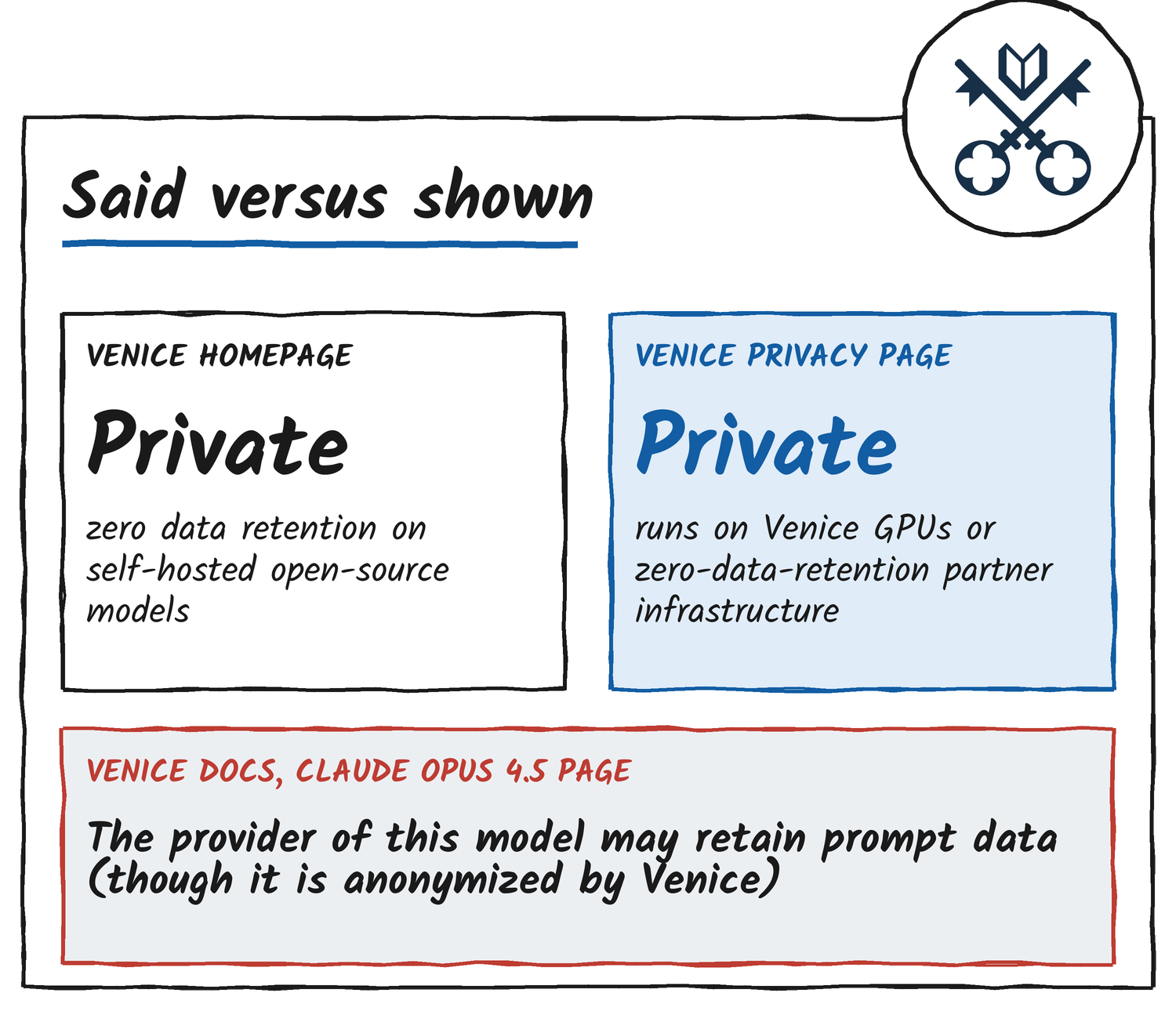
Read in order, the wording widens. “Self-hosted” on the homepage becomes “Venice-controlled GPUs or zero-data-retention partner infrastructure” on the privacy page. That wording admits partner infrastructure, so by Venice’s own definition “private” doesn’t mean Venice runs the hardware. The Claude page then says the provider may retain prompts, while the privacy policy says every model provider is prohibited from doing so. Both can’t describe the same request. Venice’s privacy page also names NEAR AI Cloud and Phala Network as its trusted-execution partners.
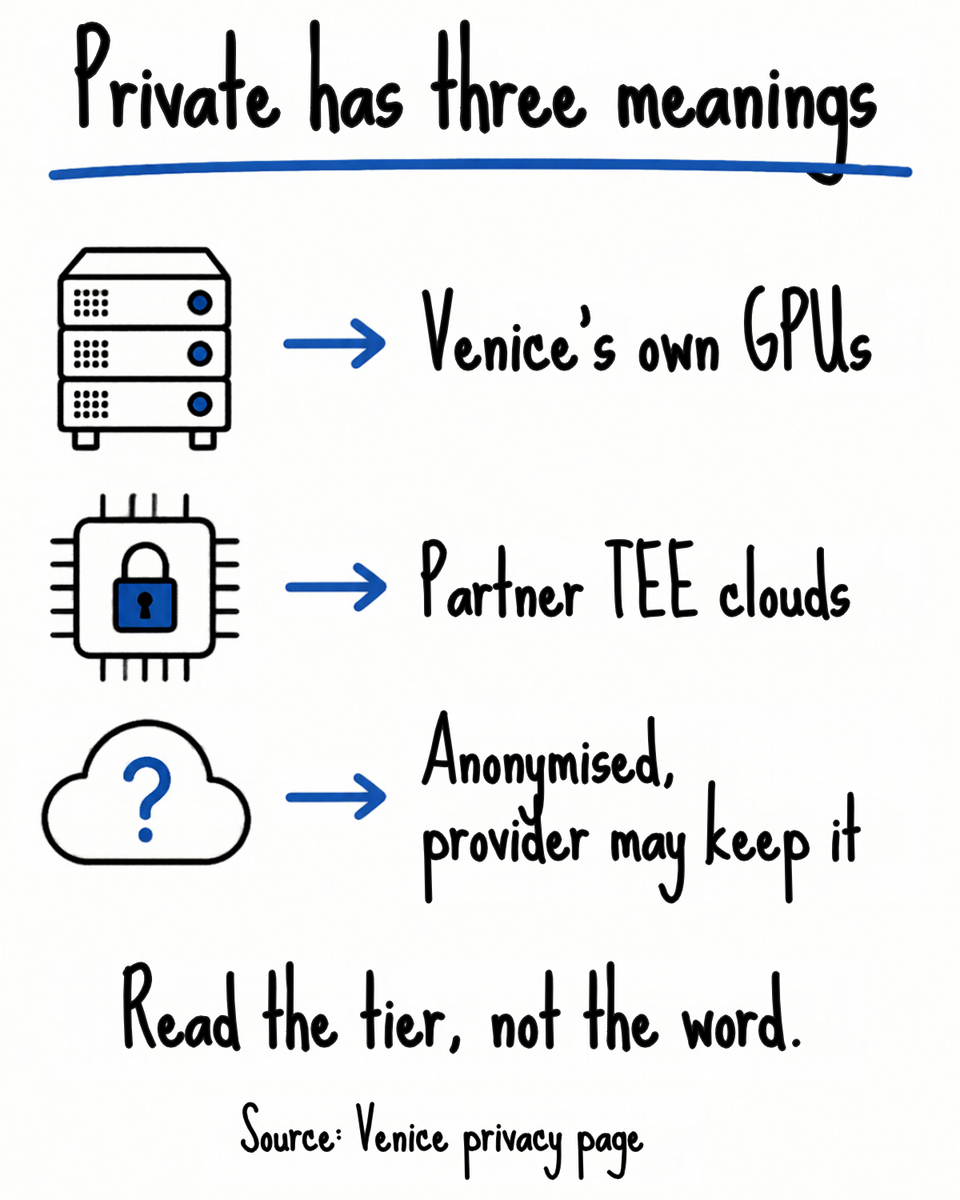
Venice’s tier labels, in plain terms
- Private
- Venice says inference runs on its own GPUs or on partner infrastructure that has agreed to zero data retention. The protection is a contract, not a technical guarantee.
- Anonymous
- Venice strips your identity before forwarding a request to a third-party model provider, and tells you to assume that provider stores the content.
- TEE
- The model runs inside a trusted execution environment, a hardware-isolated enclave, operated by a partner. Venice names NEAR AI Cloud and Phala Network.
- E2EE
- Prompts are encrypted on your device before they leave it. Venice launched this on 18 March 2026 using the same two partners.
What I checked myself
OpenRouter lists Venice as a provider. Venice’s own blog says OpenRouter carries it with 36 models, and OpenRouter’s public provider page shows the list. OpenRouter’s public zero-data-retention list held 949 endpoints when I pulled it at about 5:14pm NZDT on 26 November, and 32 of them were Venice’s.1 That matters because OpenRouter’s zero-data-retention label is a self-attestation by the provider, and OpenRouter is currently re-testing it. You can repeat the count yourself.
curl -s https://openrouter.ai/api/v1/endpoints/zdr \
  | jq '[.data[] | select(.provider_name=="Venice")] | length'
# 32 when I ran it, out of 949 endpoints
The homepage contacts advertising and tracking hosts on load. I opened venice.ai in a fresh headless browser, clicked nothing, and logged every host it contacted. I found no consent banner text on the page.2 A request to a host shows that the page loaded that host’s script or pixel. It doesn’t show what data was sent, and I didn’t inspect payloads.
| Operator | Hosts venice.ai contacted on load |
|---|---|
| TikTok | analytics.tiktok.com (7 requests), analytics-ipv6.tiktokw.us |
| Snap | tr.snapchat.com (6 requests), tr6.snapchat.com, sc-static.net |
| alb.reddit.com, pixel-config.reddit.com, www.redditstatic.com | |
| Meta | connect.facebook.net (2 requests) |
| Google Ads | googleads.g.doubleclick.net, ad.doubleclick.net, www.googleadservices.com |
| X | static.ads-twitter.com, analytics.twitter.com, t.co |
| Microsoft Advertising | bat.bing.com (3 requests) |
That is ordinary for a consumer growth site. It sits oddly next to a privacy brand, and a marketing page isn’t the chat product. KTibow goes further and says these pixels fire before consent and that Venice ignores Global Privacy Control. I didn’t test the second claim.
What KTibow reports
Everything in this section is KTibow’s finding, taken from their write-up and the public probe repository. KTibow discloses three interests. They run Surplus Intelligence, a competing marketplace. OpenRouter has given them credits. And they say they may trade Venice’s VVV token. None of that makes the findings wrong. It is why I haven’t treated them as established.
The method. If you send a model a prompt containing an image address, whoever actually runs the model has to download the image. KTibow served a test image from their own server and recorded who fetched it. The probe runs in GitHub Actions, and the results carry a build attestation, so the files can be tied to a specific commit and run. The run in question is 44936721959, commit 85554d8, dated 21 November.
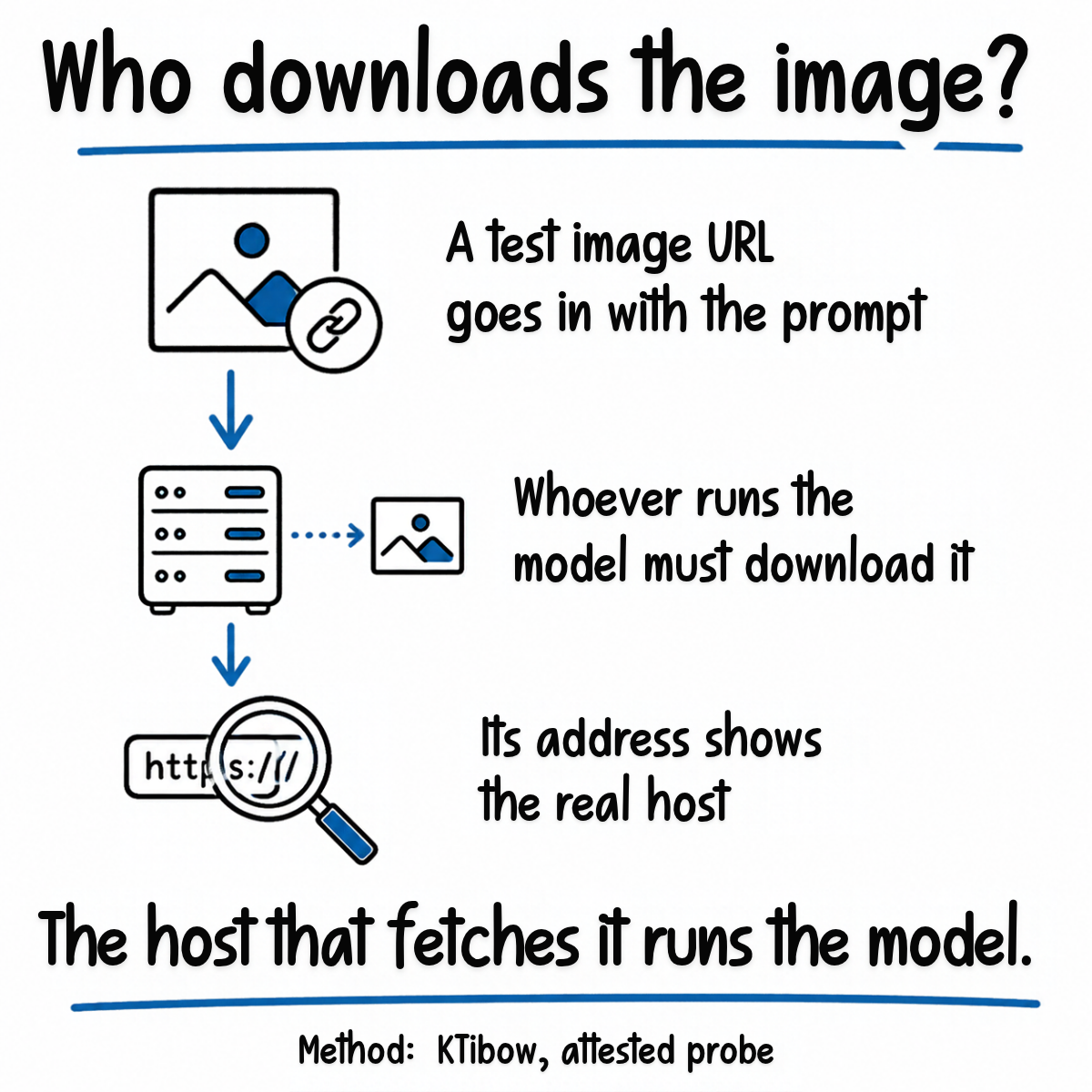
14 of 18
Venice image models whose test image was downloaded by Baseten, DeepInfra, Fireworks or Parasail
32 of 40
qwen3.5-397b requests that looped back through OpenRouter
7 of 21
tables in Venice’s app database left unencrypted, with the key in plain text
3
Venice model names that behaved like a different model on 25 November
Where requests went. KTibow says 14 of the 18 image models Venice listed on OpenRouter on 21 November were downloaded by Baseten, DeepInfra, Fireworks or Parasail. They say Hunyuan Image 3.0 runs on fal, citing Venice’s own app configuration. They say qwen3.5-397b looped back into OpenRouter for 32 of 40 requests, then moved to DeepInfra between 22 and 24 November. Venice’s privacy page allows “zero-data-retention partner infrastructure”, so third-party hosts alone don’t contradict it. They contradict the homepage’s word “self-hosted”, and they matter if those hosts haven’t signed the zero-retention terms Venice promises.
Model swaps. On 25 November KTibow tested three Venice model names and found these behaviours.
| Venice model name | What KTibow says it did |
|---|---|
| qwen3-235b-a22b-thinking-2507 | Behaved as the Instruct model, for about four times the price |
| llama-3.2-3b | Was Gemma 4 31B |
| minimax-m27 | Said it was MiniMax-M3 |
Encryption. KTibow reports that 7 of the 21 tables in Venice’s app database are unencrypted, with the key stored in plain text, and that a store named venice-rx-db-encrypted encrypts none of its 31 collections. They also say the end-to-end encrypted protocol lets Venice or Phala read or inject messages. These are claims about client code, and Venice hasn’t responded to them in public.
The report to Venice. KTibow says they told a Venice developer on 17 November and pinged twice more, and that the image-model routing was unchanged on 25 November. They also report other items I haven’t checked, including that 13-year-olds can sign up, tests of the image editor’s “nudification” guardrails, claims about Minnesota and Texas law, and an Apple EU App Store “trader” listing. I’m leaving those out of this piece, because I can’t corroborate them.
How strong is a probe like this?
The image-download test is a good fingerprint when it works: whoever downloads the file is running the model, or sitting in front of whoever is. It can’t show what happens to the prompt afterwards, and it only covers models that accept an image address. A host that fetches an image through a proxy would hide itself. Model-swap tests are weaker, because models misdescribe themselves, though a price gap is harder to explain away. Zoan’s public LLM-verification case studies describe similar fingerprinting of hosted models.
Venice is not the first name on this list
KTibow has run the same kind of test on other providers, and the pattern is familiar. In September they reported that CrofAI, a cheap inference seller, accepted an OpenRouter-only tool, and published attested results. The owner has told KTibow some traffic reached OpenRouter. In November KTibow wrote up Phala, whose own API they say admits many models run on Chutes, NEAR AI, Tinfoil and others, and GMI Cloud, where OpenRouter disabled all endpoints on 20 November. They also wrote up Novita, StreamLake and Ant Digital routing DeepSeek on to ByteDance’s Ark service.
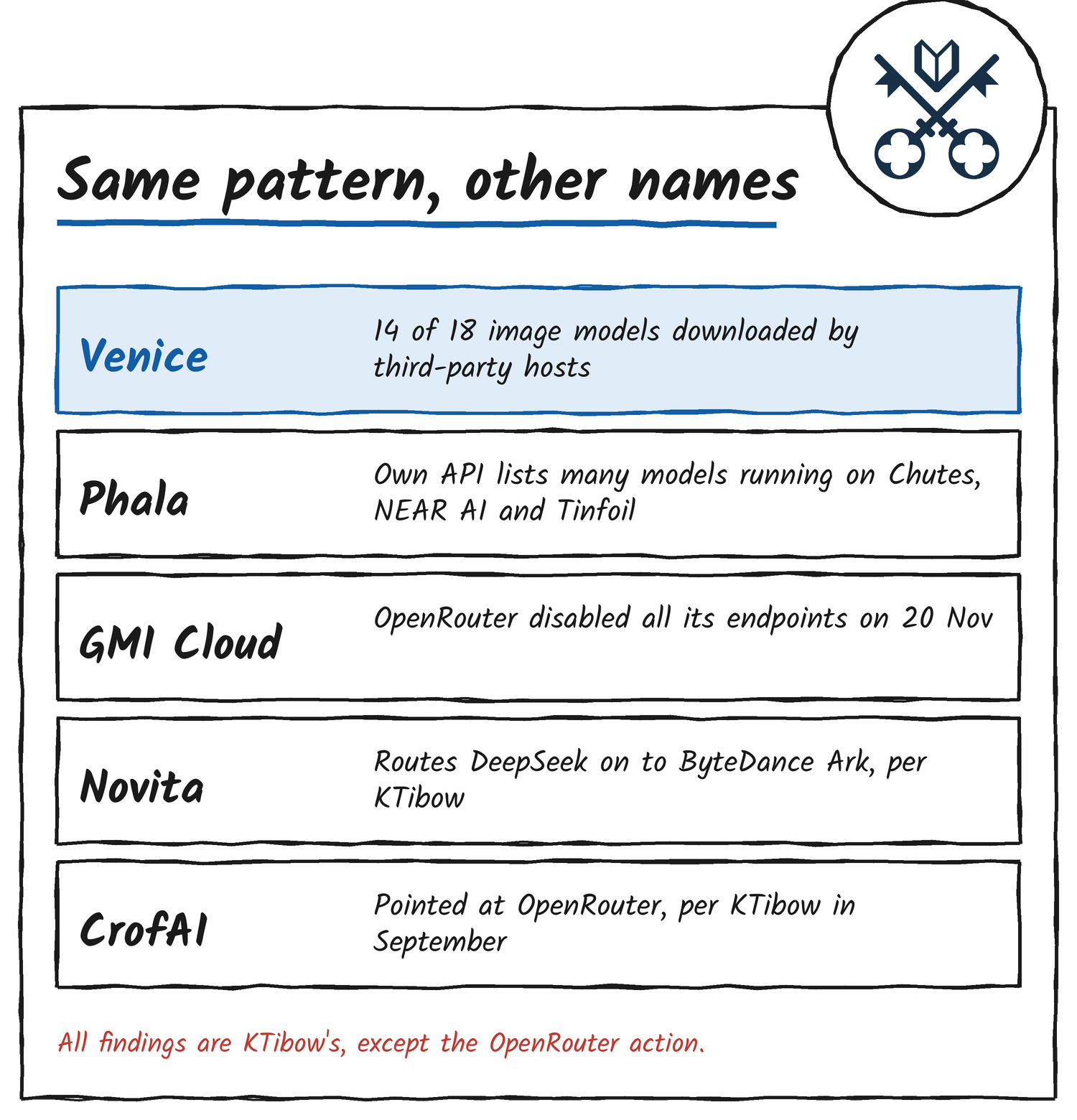
One of those steps is verified and public. OpenRouter said on 22 November that it had off-boarded three providers and removed 125 endpoints from zero-data-retention eligibility after researchers reported that some providers’ data policies weren’t being upheld, and it is adapting the researchers’ tests to run continuously. It named Dragos in its thanks. It didn’t name Venice, and Venice’s 32 endpoints were still on the list when I checked. We covered the earlier chapters.
Vercel took a different route and had its zero-data-retention claims audited, which is the kind of check Venice’s label hasn’t had.
OpenRouter itself now belongs to Stripe, which closed its purchase on 10 November. That matters here because OpenRouter is both Venice’s distribution channel and the party that decides who stays on its zero-data-retention list. Our report on the acquisition has the detail.
What Venice hasn’t answered
Venice hasn’t commented publicly on KTibow’s findings. Crypto news sites, among them PANews, Phemex and Gate, covered a separate allegation on 26 November and note that Venice hasn’t commented either. I’m sending Venice a comment request with this piece and will add any reply, with the time it arrived.
These are the questions I put to Venice.
- Which models on the Private tier run on hardware Venice controls, and which run on a partner’s?
- Have Baseten, DeepInfra, Fireworks, Parasail and fal signed zero-data-retention terms with Venice, and can you publish them?
- Does the Claude Opus 4.5 docs line, which says the provider may retain prompts, override the privacy policy’s “prohibited from storing” promise?
- Is the Erik Voorhees statement from 2024, “never provide Claude”, withdrawn?
- Did the model names KTibow tested on 25 November serve the models they name?
- What does the E2EE design let Venice or Phala read?
What to do if you use it
Venice hasn’t been shown to have leaked anything. The risk is a gap between a label and what runs behind it, and you can manage that gap yourself.
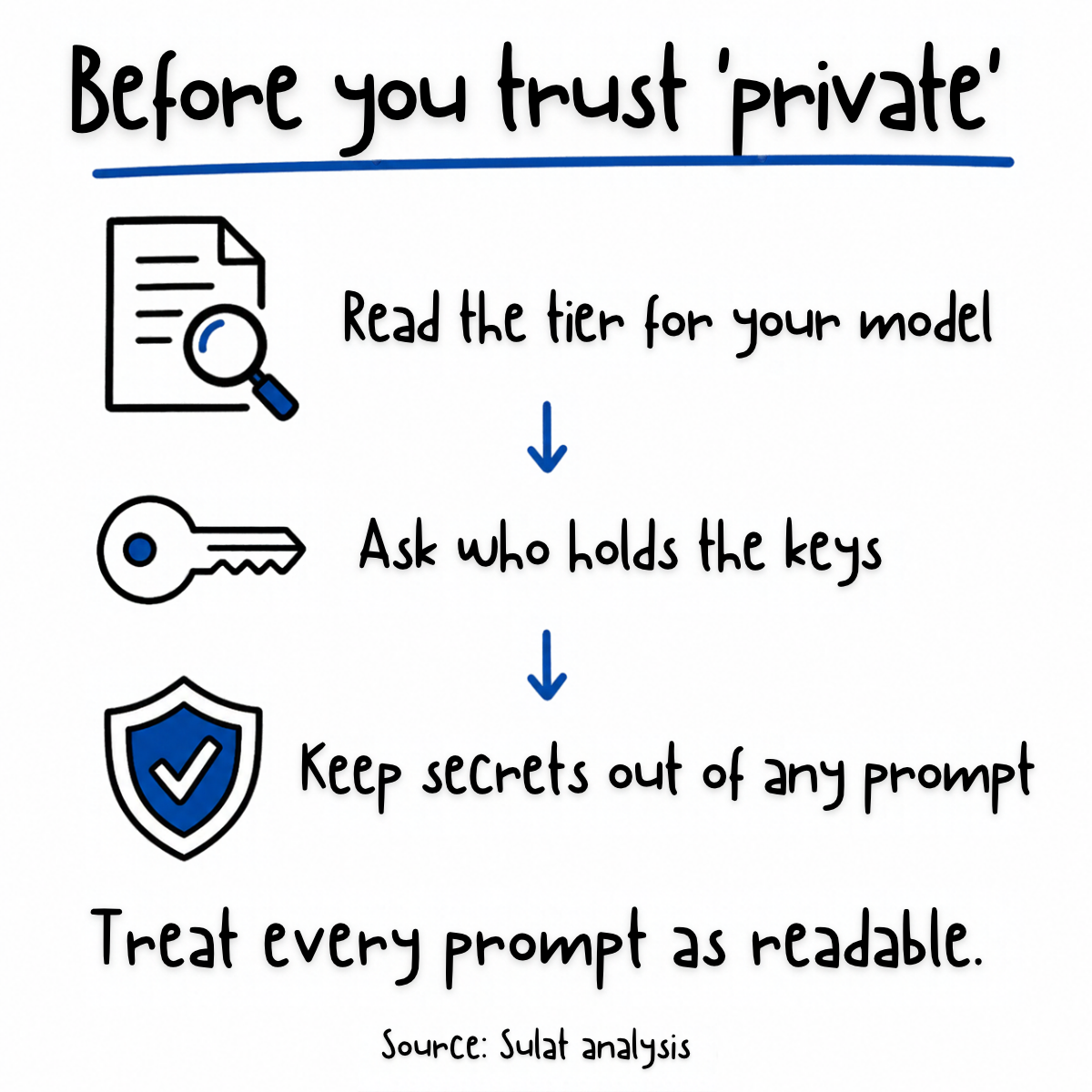
- Find the tier for the specific model you use. The tier is shown per model, and the word “Private” covers more than one arrangement.
- Treat anything outside the TEE and E2EE tiers as readable by a third party. Don’t send secrets, client files or credentials.
- If you use Venice through the API or OpenRouter, check which endpoint answers your requests, and set your own provider allow-list rather than relying on a zero-retention filter alone.
- If you need a guarantee, ask Venice for it in writing for your model and keep the reply.
What I make of it
This section is analysis, not reporting.
First, Venice’s problem is already visible without KTibow. A company whose brand is privacy has four pages that describe where a prompt goes in four ways, and one of them tells you the provider may keep it. A careful reader can work out the tiers. A hurried one reads “Private” and stops.
Second, KTibow’s results are serious and worth testing, but not yet established. They come from one researcher with a stake in the market, and the strongest items rest on a probe I haven’t re-run. The image-download method is sound, and the attested runs make it checkable, which is more than most accusations offer. If Venice or an independent party repeats it, the question gets settled quickly.
Third, the pattern is the story. CrofAI, Phala, GMI Cloud, Novita and now Venice have all been questioned over what sits behind a model name, and OpenRouter has begun to act. A resold model can be honest, so reselling isn’t the offence. The offence is the label. Providers that call something “self-hosted” or “private” should publish who runs the hardware, and buyers should expect that page before they pay.
Sources
- KTibow’s post on X, 26 November 2026
- KTibow’s write-ups on Phala, GMI Cloud, Ark routing, verifiable inference and CrofAI
- Venice: llms.txt, privacy policy, Claude Opus 4.5 docs and the Series A announcement, read 26 November 2026
- Decrypt’s May 2024 interview with Erik Voorhees
- OpenRouter’s Venice provider page and its public zero-data-retention endpoint list, read 26 November 2026
- Our earlier reporting on OpenRouter, Vercel and OpenRouter’s acquisition by Stripe, linked above
- I fetched OpenRouter’s public endpoint list at about 5:14pm NZDT on 26 November 2026 and counted provider_name equal to Venice. I re-ran the count later that evening and got the same 949 and 32. OpenRouter’s eligibility changes, so your count may differ. ↩︎
- A fresh Chromium session with a German locale, no cookies and no clicks, loading https://venice.ai/ and waiting a few seconds after the load event. I logged request hosts and found no cookie or consent wording in the page text. A different region or browser could show a banner. ↩︎
Discover more from Sulat AI & Tech News
Subscribe to get the latest posts sent to your email.