
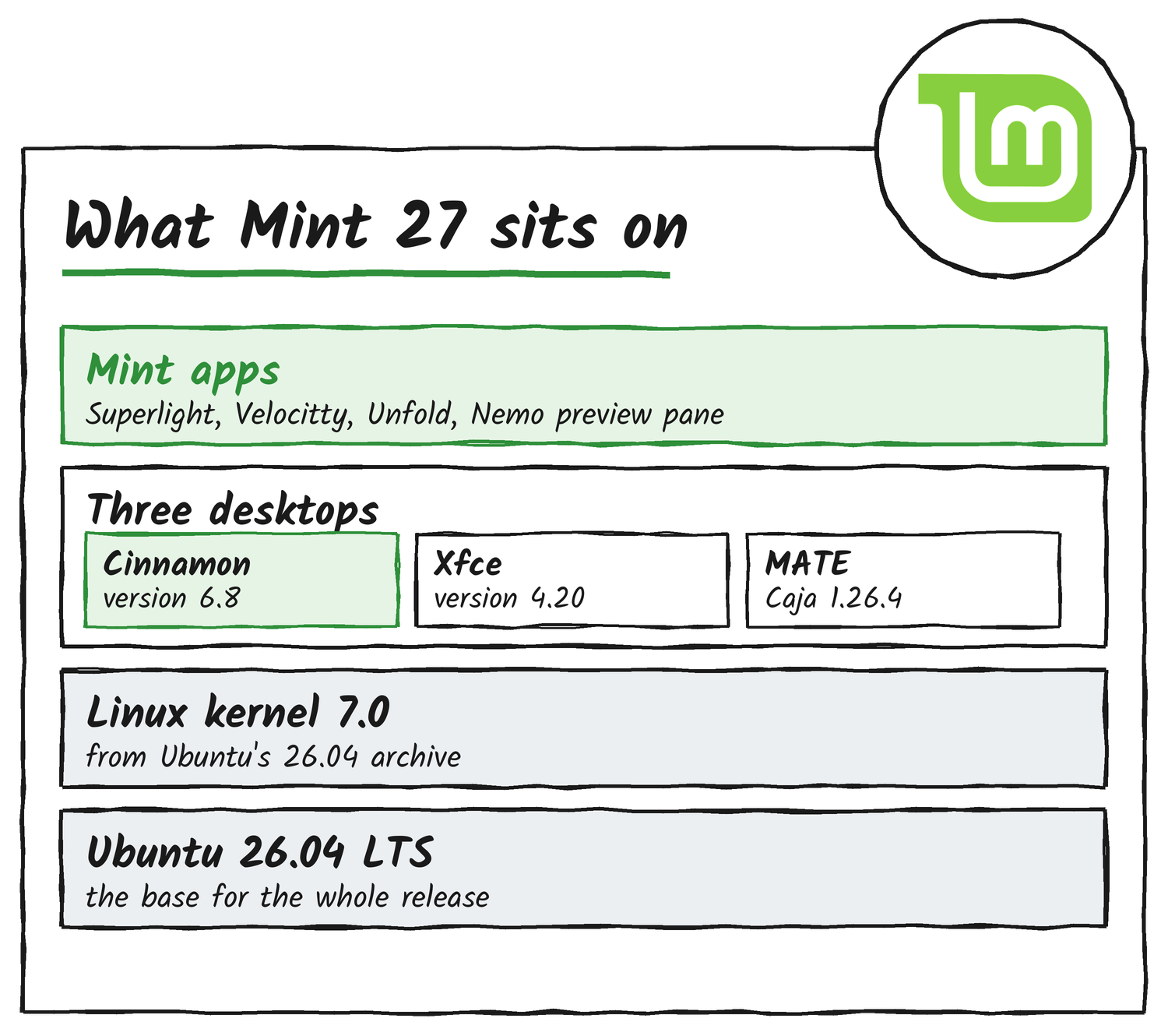
Linux Mint 27 “Adrien” is now in beta. The Cinnamon, Xfce and MATE editions all sit on Ubuntu 26.04 LTS and Linux kernel 7.0, and Cinnamon is on version 6.8. Mint’s own ISO tracker shows the three beta builds were approved on 25 November, and the team still says the final release lands at Christmas.
When I checked at 4:40pm NZ time, Mint’s blog still showed its October news as the latest post. I’ve built this from Mint’s ISO tracker, its package repository and its monthly news posts, and I haven’t booted the ISOs. Where a detail comes from somewhere else, I say so.
What Mint approved
Mint approved one beta image per edition on 25 November: Cinnamon (build 2026.11.25-12.29), MATE (11.05) and Xfce (14.53). It threw out four builds on the way. All three editions were rejected on 19 November, and an earlier Xfce build was rejected on 25 November.
3
beta ISOs approved on 25 November
4
earlier builds rejected first
7.0
Linux kernel, from Ubuntu 26.04
6.8.4
Cinnamon in the beta repository
Mint 22.x sits on Ubuntu 24.04, so 27 jumps a full LTS generation. Ubuntu 26.04 arrived on 23 April 2026, and its 7.0 kernel is the linux-generic 7.0.0-42 package in Ubuntu’s archive. Every Mint edition inherits both.
| Edition | Desktop components | File manager |
|---|---|---|
| Cinnamon | Cinnamon 6.8.4, Muffin 6.8.6 | Nemo 6.8.5 |
| Xfce | Xfce 4.20 (xfdesktop 4.20.1) | Thunar 4.20.7 |
| MATE | mate-desktop 1.28.2, Caja 1.26.4 | Caja 1.26.4 |
9to5Linux’s report lists MATE 1.26. Mint’s repository agrees for Caja, which is at 1.26.4, but it lists the core mate-desktop package at 1.28.2. The MATE edition is a mix of 1.26 and 1.28 components, not a clean 1.26.
What’s new since 22.3
Cinnamon 6.8 shipped on 4 November. It adds one-to-one trackpad gestures on both Wayland and Xorg, groups WireGuard and VPN connections in the network applet, and spots WPA3 and OWE Wi-Fi networks more reliably. It also fixes a command-injection flaw, CWE-78, in the cin-debug-run helper, according to Linuxiac. The Register reports that Cinnamon’s Wayland session is no longer experimental, and the X11 session stays for anyone who wants it.
Mint’s September and October news posts preview the rest. The repository confirms the three new apps are in the beta archive: Superlight 1.0.4, Velocitty 1.1.1 and Unfold 1.0.5. Mint calls everything in those posts a preview, and I haven’t checked which features are switched on in the ISOs.
- Sleep Modes: a new page in the System Administration tool that sets up hibernation, Hybrid Sleep and Suspend-then-Hibernate.
- Nemo preview pane: toggled with F7, it shows audio, pictures and videos, plus details such as the camera a photo was taken with.
- Superlight: a system monitor with graphs for CPU, RAM, swap, GPU, network, disk I/O, temperature and fan speed. Its Storage page shows what’s using disk space, including Steam games and Flatpak apps.
- Velocitty: a terminal with a tab overview, themed palettes, tabs you can drag between windows, and colour-coded tabs for root, remote and busy sessions.
- Unfold: a small archive manager that uses 7zip and handles password-protected archives.
- Clocks and the calendar: an Android-style alarm app and a calendar from the Clockenstein project.
- A new installer: the live installer from Mint’s Debian edition replaces Ubiquity, with OEM, BIOS and EFI, Secure Boot, and LVM and LUKS support, per ZDNET.
Mint also rewrote its Community website without PHP after critical PHP vulnerabilities turned up. Sign-in now goes through GitHub, and the site no longer stores passwords.
Hibernation is the one Mint pushes hardest
Mint’s October post explains why. Suspend is fast and reliable but keeps drawing power, and a good laptop with a full battery lasts two or three days before the session is gone. Hibernation saves the session to disk and shuts the machine down completely. It’s slow, though, and Mint says it can take longer than a reboot. It also needs a large swap space, and Ubuntu removed it from the available sleep modes, so Mint users usually didn’t have it.
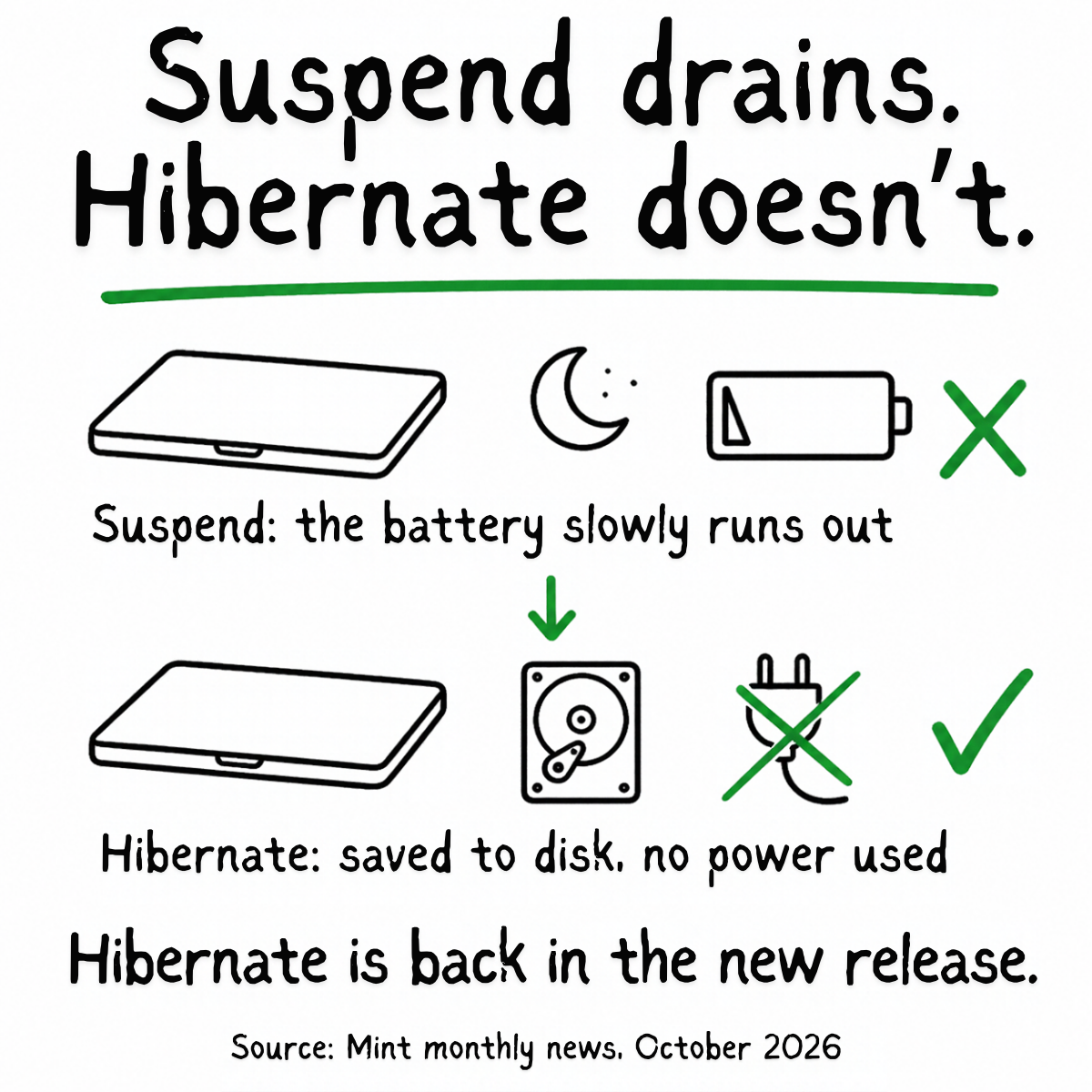
The Sleep Modes page is Mint’s answer. It sets hibernation up correctly, and it adds Hybrid Sleep, which suspends and saves the session to disk, and Suspend-then-Hibernate, which suspends first and hibernates once the battery goes critical.
Christmas, and the clock
Zena, Mint 22.3, is the closest precedent. Its beta post went up on 20 December 2025, and its first stable ISOs are dated 8 January 2026, 19 days later. Mint 27’s beta has about four weeks to Christmas, and Mint has given no day. It’s FOSS reports 24 December and a five-year support period, but neither figure appears in a Mint post. Ubuntu 26.04 itself is supported until April 2031. Mint 22.x is supported until April 2027, according to Mint’s download page. Mint’s earlier posts name no upgrade path from 22.3.
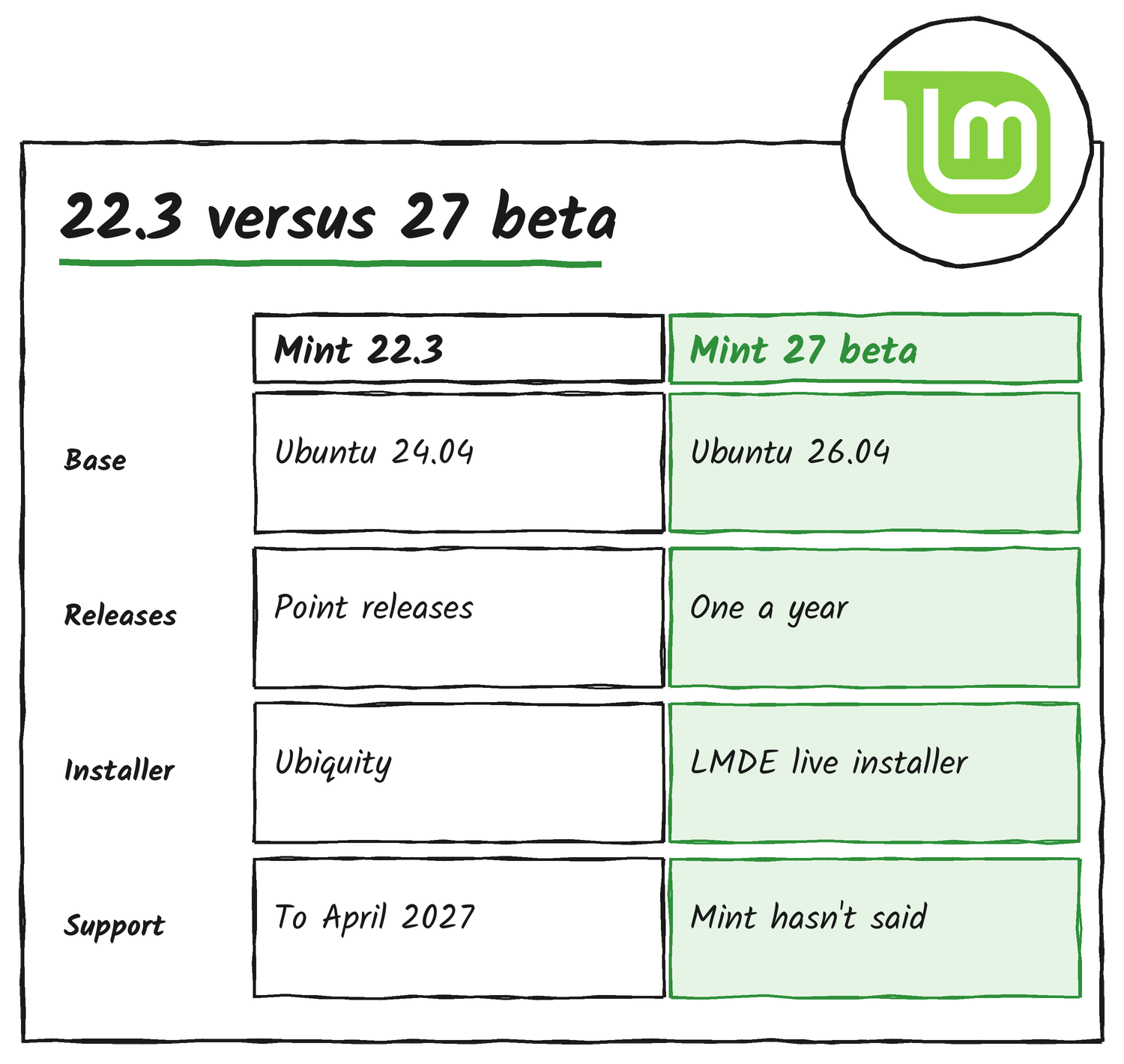
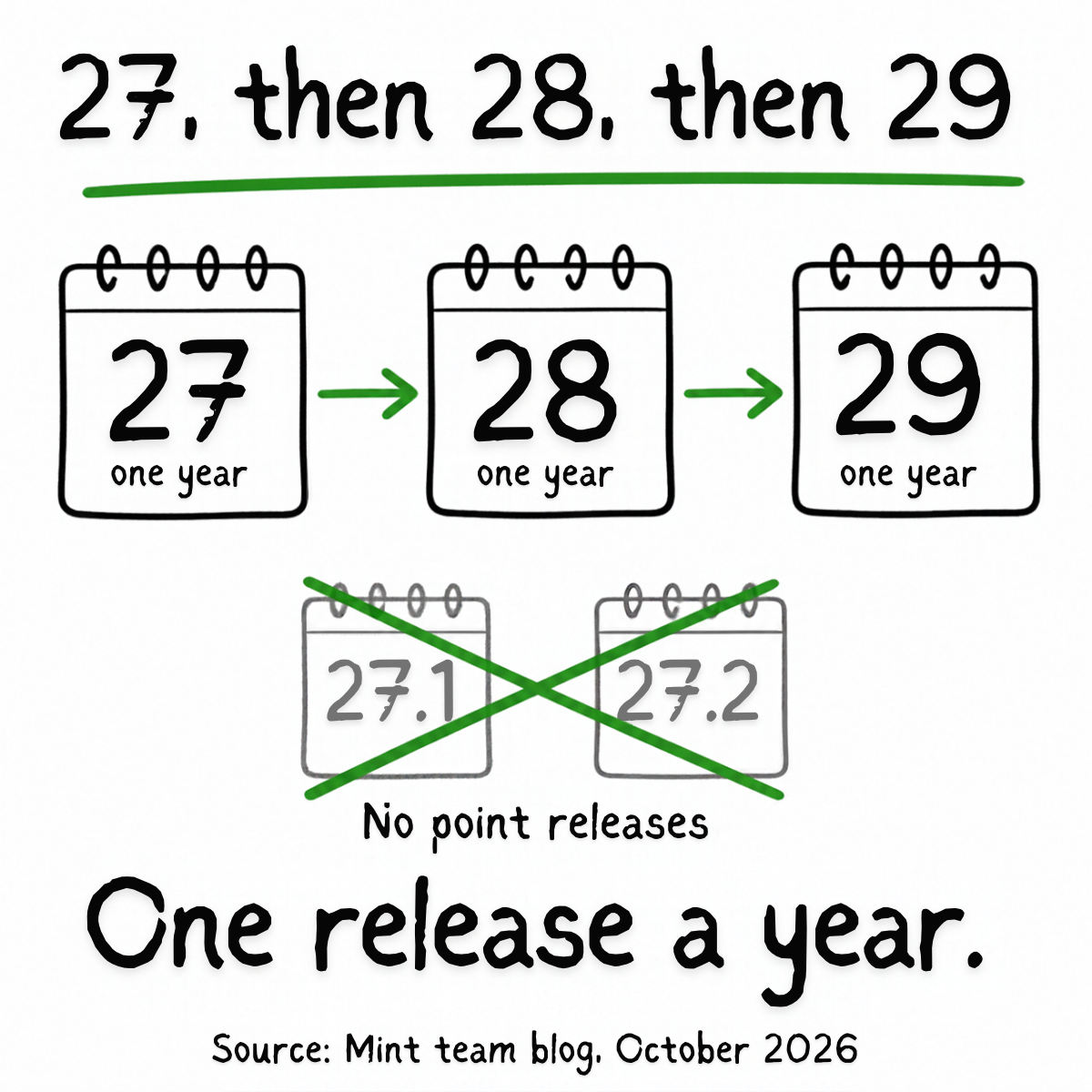
The beta also sets up the new numbering. Mint says it will no longer use point releases, so 27 is followed by 28 and 29, one a year. Names change too: the girls’ names that ran from Ada to Zena give way to boys’ names, starting with Adrien.
Where it sits among its peers
Ubuntu 26.04 is also the base for System76’s Pop!_OS 26.04 LTS, which has just reached download with the COSMIC desktop. Mint’s Debian-based sibling, LMDE 7, stays on the download page for people who want to avoid Ubuntu.
If you want to try it
Boot the ISO from a USB stick and stay in the live session. Don’t put a beta on a machine you rely on. Mint’s Community site has a Beta Testing section for bug reports. Hibernation is worth testing only on a spare laptop with a full backup, because it needs swap set up before it works.
Discover more from Sulat AI & Tech News
Subscribe to get the latest posts sent to your email.