
Addy Osmani, who works on Claude Code at Anthropic, has published a practical guide to shipping pull requests with Claude Code, the how-to for Claude Ship, Anthropic’s set of agents that review GitHub pull requests, push fixes and approve the ones a team’s policy allows. His advice is to start on your own pull requests with two commands, /code-review and /ship, and to involve admins only when the team wants agents doing the same work on everyone’s changes.
Osmani posted the guide on X on 25 November (NZ time) as a long-form article, opening with “We just launched Claude Ship”. By the time we checked, about 22 hours later, it showed roughly 104,000 views, 1,100 likes, 135 reposts and 86 replies. The product itself is covered in our report on the launch; this piece is about the advice, the caveats Osmani attaches to it and the man giving it.
7 days
the longest a /ship watch runs on one pull request
3
pushes Claude makes on one issue before it stops and reports
2
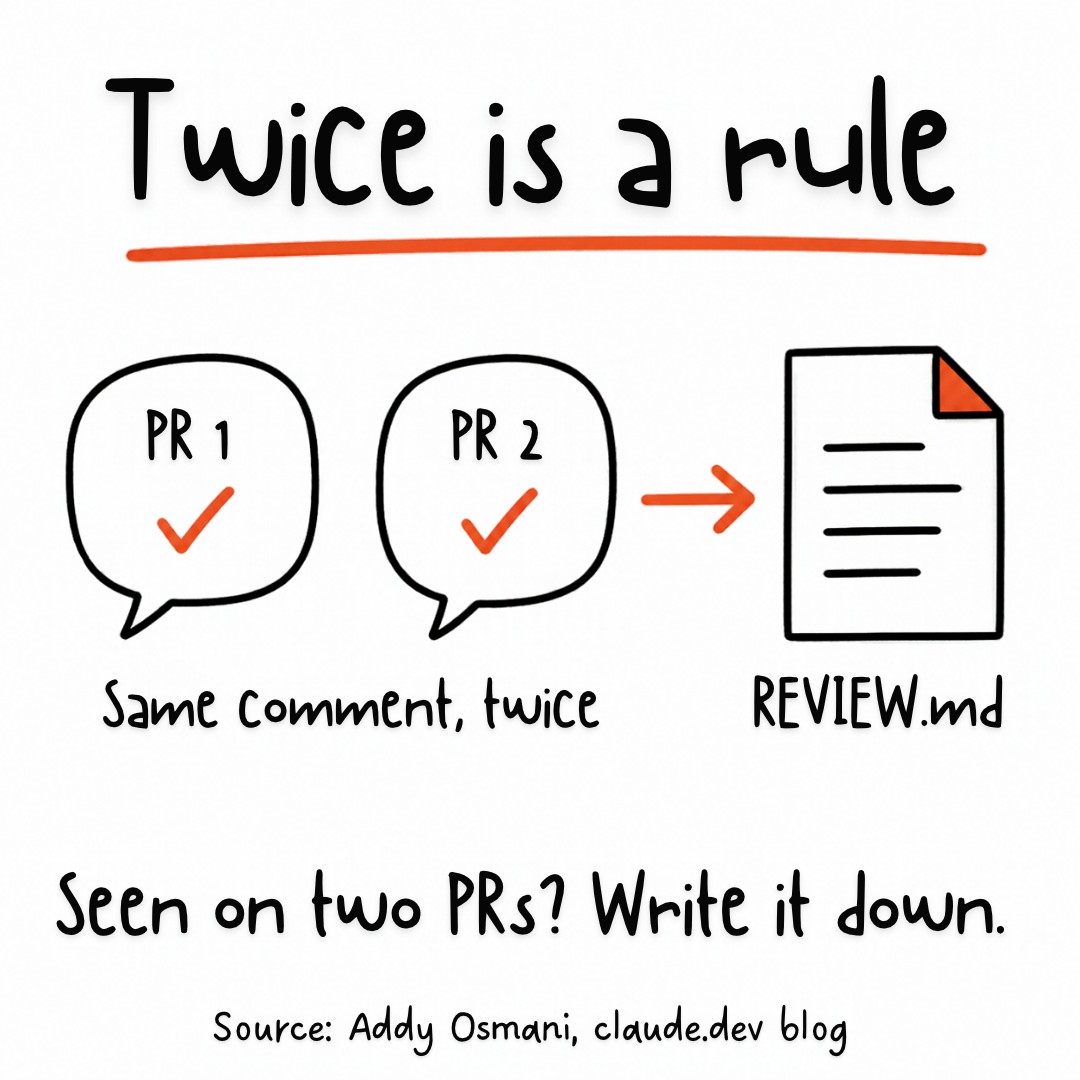
pull requests a comment has to repeat on before it becomes a written rule
14 years
Osmani spent at Google before joining Anthropic, mostly on Chrome
- Who Addy Osmani is
- Start with /code-review
- What /ship does
- The watch runs as you
- /steward, and when Claude hands back
- Turning repeats into rules
- Taking it to the team
- From observe mode to enforcement
- What the guide doesn’t show
- The three things he suggests this week
Who Addy Osmani is
Osmani is a Member of Technical Staff at Anthropic, working on Claude Code, according to his own bio. He joined in 2026 after more than 14 years at Google, which he joined in 2012 to work on Chrome. There he ran developer experience for the browser, including Chrome DevTools, and was among the founding team of Lighthouse, the open-source auditing tool launched in 2016 that many sites still use as a baseline for performance.
He is also one of the better-known voices in web development. He wrote Learning JavaScript Design Patterns for O’Reilly in 2012, created TodoMVC and co-founded Yeoman, and in 2025 published the O’Reilly title Beyond Vibe Coding. His bio says he has had more than 20 million developers read his content and counts over 400,000 followers on X, though that follower figure comes from a third-party page and may be out of date.
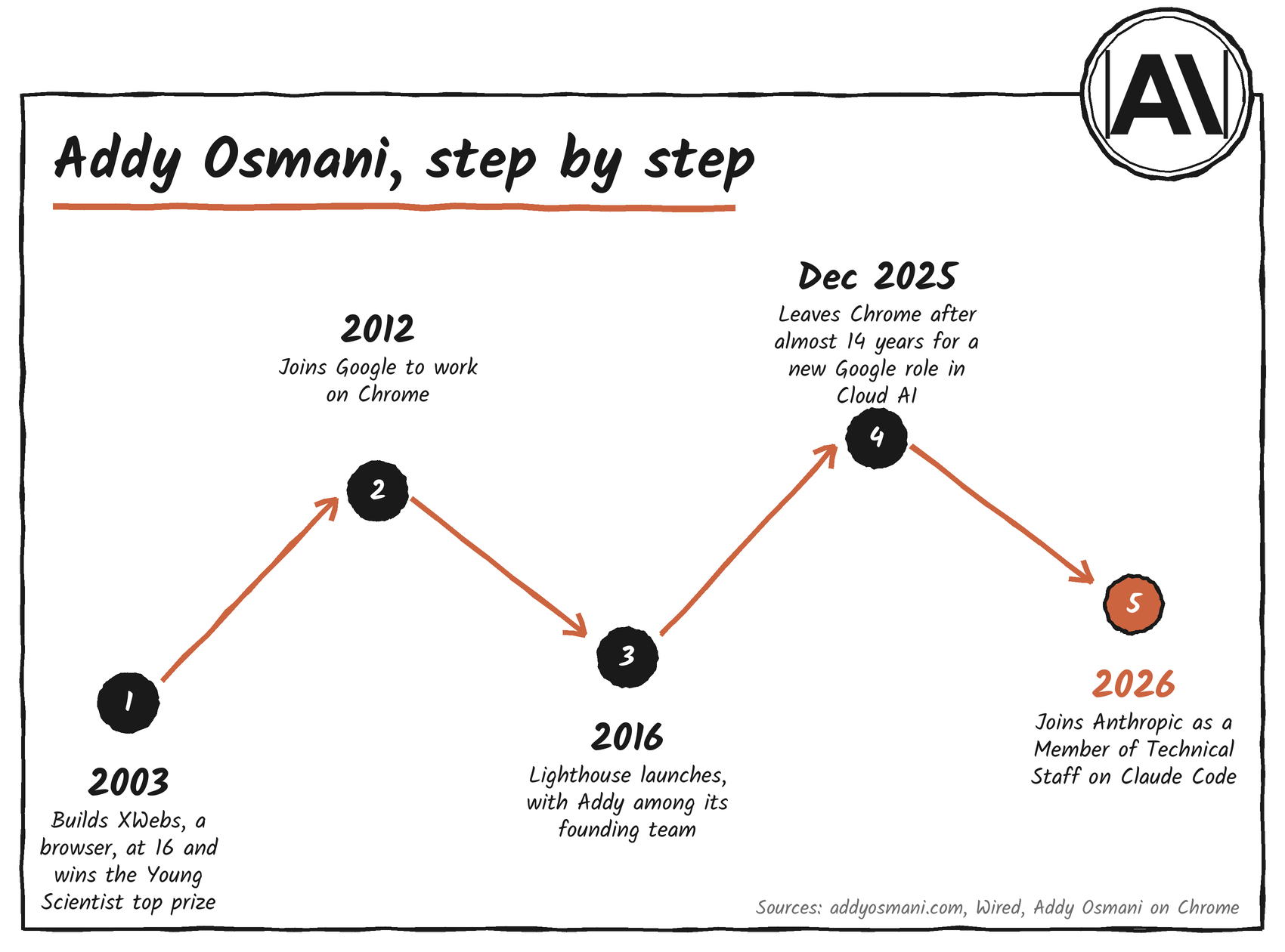
The career started early. At 16 he built a web browser called XWebs and won first prize at Ireland’s Esat BT Young Scientist competition in January 2003, Wired reported at the time. In late 2025 he left Chrome. His own farewell post, dated 30 November 2025, says his last day on the Chrome team was 1 December and that he was moving into a new Google role; his bio describes that role as Director at Google Cloud AI, leading developer experience and technical evangelism.
Osmani writes from inside the project. He co-wrote Anthropic’s October post on how the Claude Code team does code review with Morgan Westlee Lunt and Qing Wang, and the guide leans on that post and on a second one about verification.
Two things that are easy to mix up
A date doesn’t line up between sources. Osmani’s bio puts his move to Google Cloud AI in December 2024, while his own farewell-to-Chrome post is dated 30 November 2025 and describes leaving Chrome the next day. We’ve used the 2025 date, since it comes from a dated post by Osmani himself. The bio doesn’t give a month for his move to Anthropic.
The name also collides. Osmani maintains an open-source repository called agent-skills, a pack of 26 engineering skills for coding agents, and it has its own /ship command, mapped to shipping to production. That is a different thing from Anthropic’s /ship, which opens and watches a pull request. The repository is his personal project.
Start with /code-review
If you only do one thing from this post, review your branch before you push it.
Addy Osmani, A practical guide to shipping with Claude Code
The guide’s first instruction is the cheapest one. Type /code-review at the Claude Code prompt and it reviews the commits on your branch and your uncommitted changes for correctness bugs. A bug caught here, Osmani says, is less likely to come back later as a review comment or a failed check that pulls you off your next task. Four variations are listed:
/code-review high 1234       # review PR 1234 at high effort
/code-review --fix           # apply the findings to your working tree
/code-review --comment 1234  # post the findings on the PR
/code-review ultra           # run a deeper review in the cloud
Effort runs from low to max. Low returns only the findings the review is most sure about; higher levels give a broader set, including some it’s less sure of. The command remembers your last setting, so you need to change it when the risk changes.
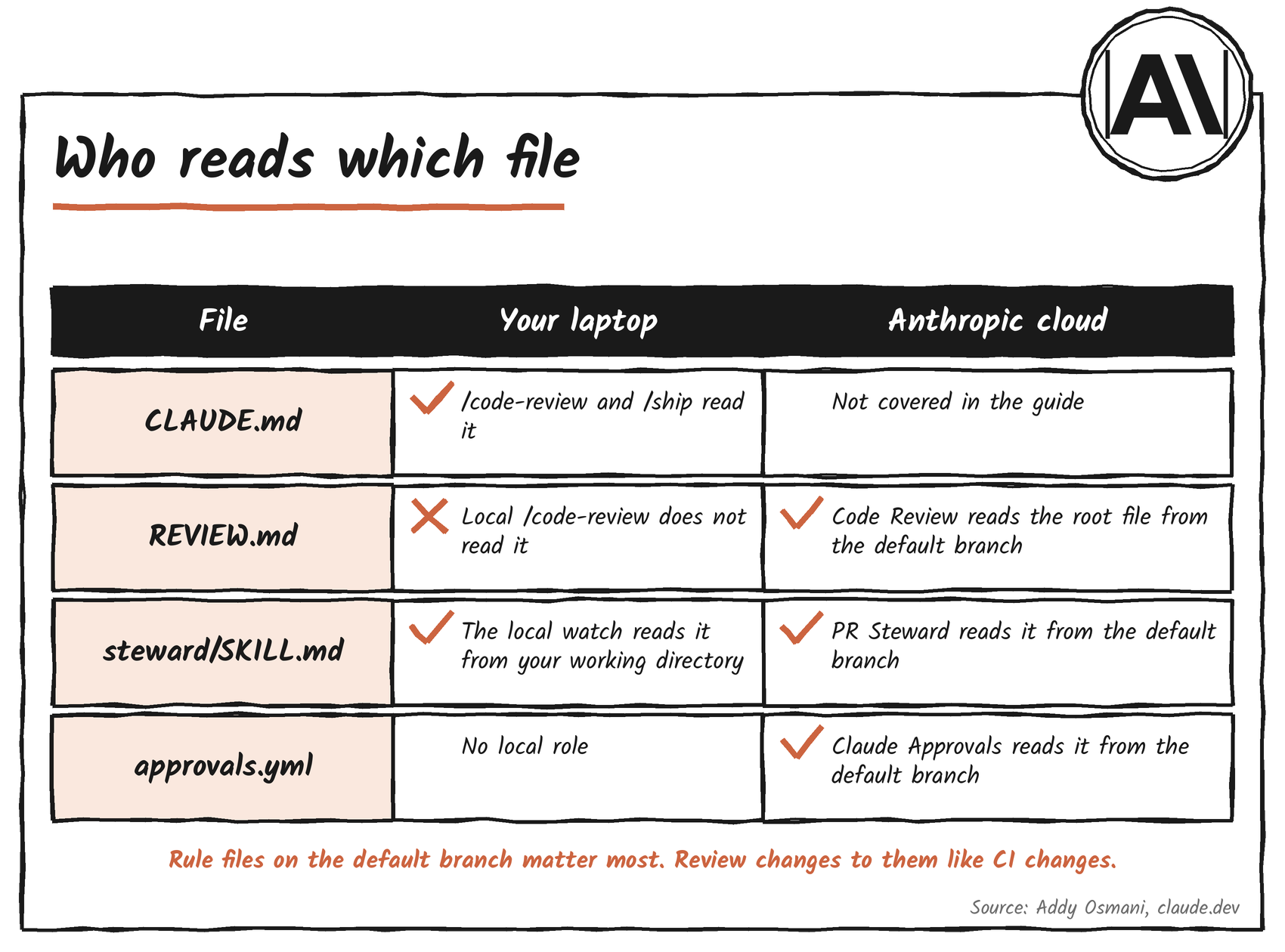
Osmani attaches three cautions. The ultra setting runs in the cloud, needs a claude.ai login and can be billed separately from your plan, so read the ultrareview documentation first. Edits made by --fix during a background review may not be caught by /rewind, so commit before you use it if you want an easy way back. And the local command reads your CLAUDE.md files but not REVIEW.md, which matters later. His own homework for this step is to run it a few times and note where it’s right and where it’s wrong.
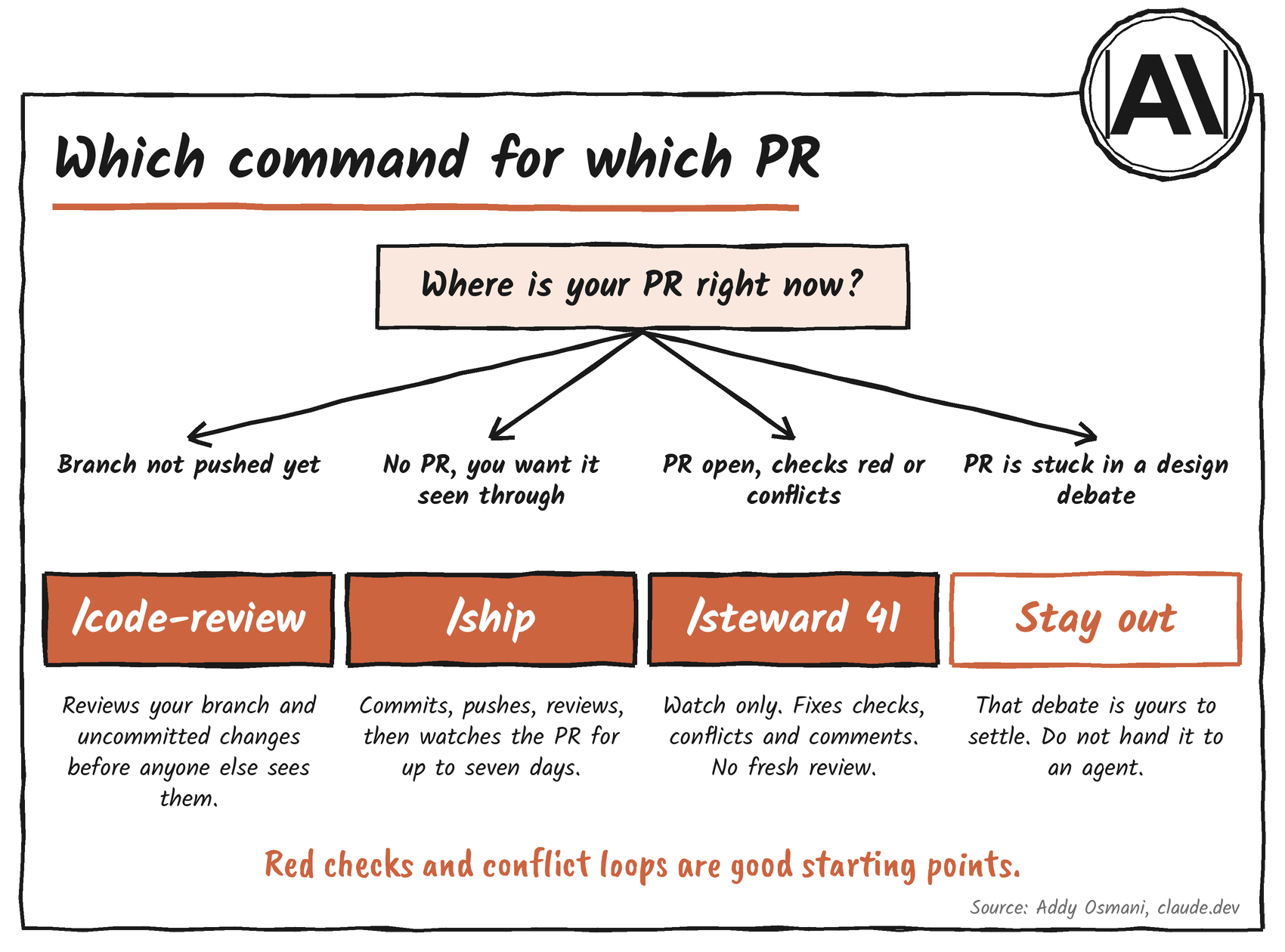
| Tool | Runs where | What it does | Who sets it up |
|---|---|---|---|
/code-review | Your Claude Code session | Reviews your branch and uncommitted changes | Nobody; it’s built in |
/ship | Your machine, as you | Commits, pushes, opens the PR, reviews it, then watches it | Nobody; it’s in the latest Claude Code |
/steward | Your machine, as you | Watch only, on a PR that already exists | Nobody |
| Code Review | Anthropic’s cloud | Reviews each PR, checks its own findings, posts them | An admin; generally available |
| PR Steward | Anthropic’s cloud, as claude[bot] | Fixes checks, conflicts and comments; designed not to approve or merge | An Owner of the Claude organisation; beta |
| Claude Approvals | Anthropic’s cloud | Applies an approval policy kept in the repository | Starts when a policy file reaches the default branch; beta |
What /ship does
Once you trust the review, /ship adds the rest. If your branch has no pull request yet, it does four things in order: it commits your pending work, pushes and opens the pull request as you, runs /code-review unless Code Review has already covered that commit, and then watches the pull request for up to seven days, working on failing checks, conflicts and review comments. It exits if the pull request is merged or closed.
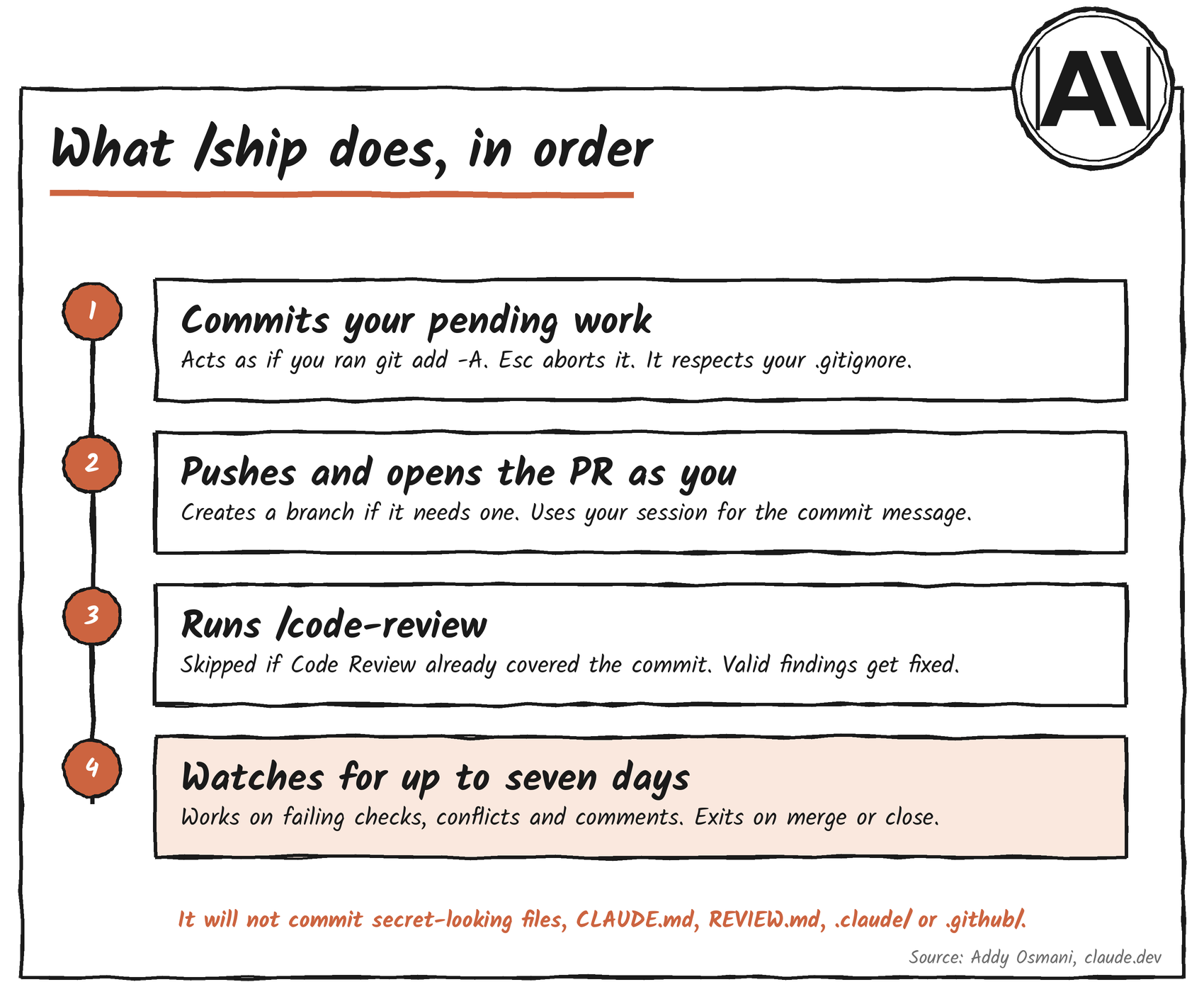
The first step catches people out. /ship commits as if you’d run git add -A, respecting your .gitignore, so Osmani says to run git status first. You’re told before the commit and can abort with Esc. It won’t commit files whose names look like secrets, or files that set rules: CLAUDE.md, REVIEW.md and anything under .claude/ or .github/. Those you commit yourself. In a public repository it won’t commit anything for you at all, and if the pull request already exists, your pending changes aren’t included.
/ship high            # run at high effort
/ship 41              # work on pull request #41
/ship +my-lint-bot    # also read comments from my-lint-bot
/ship stop            # end the watch
By default the command reads comments from you, from people with write access and from the Claude GitHub App. A bot you add with +name is treated as an assertion to check against the code, not an instruction to obey.
The watch runs as you
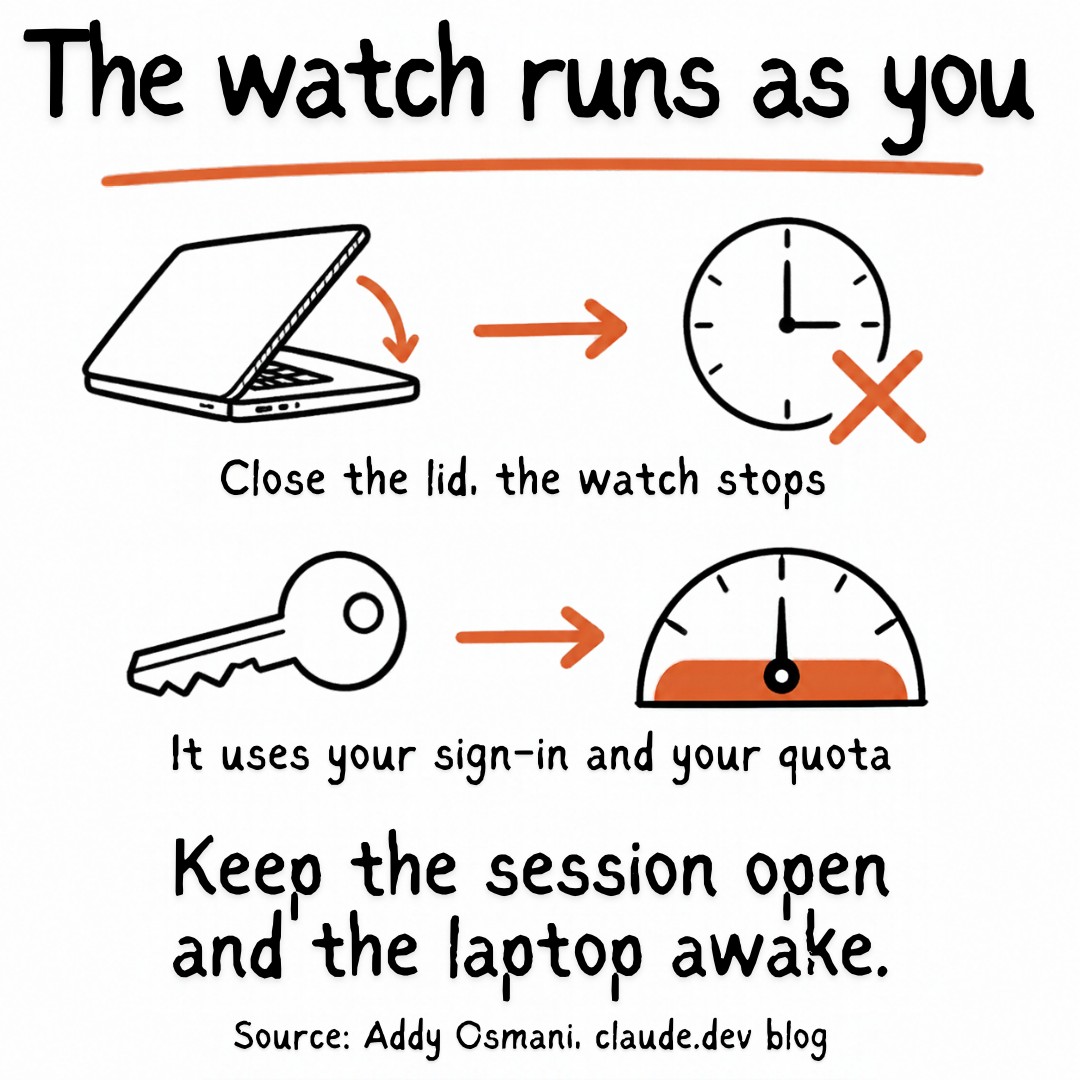
The watch carries most of the fine print. Claude watches as you, on your machine, using your quota. Closing the laptop stops it, so the session has to stay open and the machine awake. You need to be logged in to the GitHub CLI first, with gh auth login, and it only watches a pull request you opened. Because it burns model turns while you’re away, it counts against your plan or API bill, and Osmani suggests staying near the machine the first time to see what it uses.
The watch also merges the base branch into yours when needed and runs your tests, so anyone who can land changes on the base branch can, in effect, run commands on your machine during the watch. Osmani’s instruction is blunt: only run the watch locally on a repository where you trust everyone who can land changes on the base branch.
The guide lists the safeguards and where they stop. Claude is told never to merge, and Claude Code constrains the gh and git commands it can run in an unattended turn, which blocks direct merging and force-pushing. The watch’s own commits leave out rule files such as .github/, CODEOWNERS, CLAUDE.md and .claude/. But the test script still runs under your credentials, typing a message during a turn lifts the constraints for that turn, and if auto-merge is on, a fix from the watch could be what lets GitHub merge. The watch’s commits also bypass your repository’s git hooks, so any check that has to exist belongs in CI and branch rules.
When the watch won’t start
Outside auto mode, the watch stops at every permission prompt and waits for you. It won’t run in bypass-permissions mode. On Windows, /ship opens the pull request and reviews it, but the watch doesn’t start. A PreToolUse or PermissionRequest hook on Bash in the repository’s .claude/settings.json also prevents it. If the watch can’t start, Claude says why and still reviews the pull request. The watch needs its own checkout, so if you move straight to your next task, use a separate worktree for one of them. Osmani points readers to /ship terms in the product for the full terms before first use.
/steward, and when Claude hands back
Many pull requests don’t need another review, just someone to see them to merge. For those, /steward 41 runs only the watch half of /ship. Without a number it watches the pull request for the current branch. A session can run one watch at a time, so starting a new one ends the old one, and either /steward stop or /ship stop ends it. If a pull request already carries the Steward label, the local watch won’t run.
Osmani is careful to separate this from the cloud service. /steward runs as you, in your session. PR Steward is a team service that runs as claude[bot] once an admin enables it. His examples of good candidates are a pull request with red checks or one stuck in a conflict loop. A bad candidate is one in the middle of a design debate, “because that’s your debate to settle”.
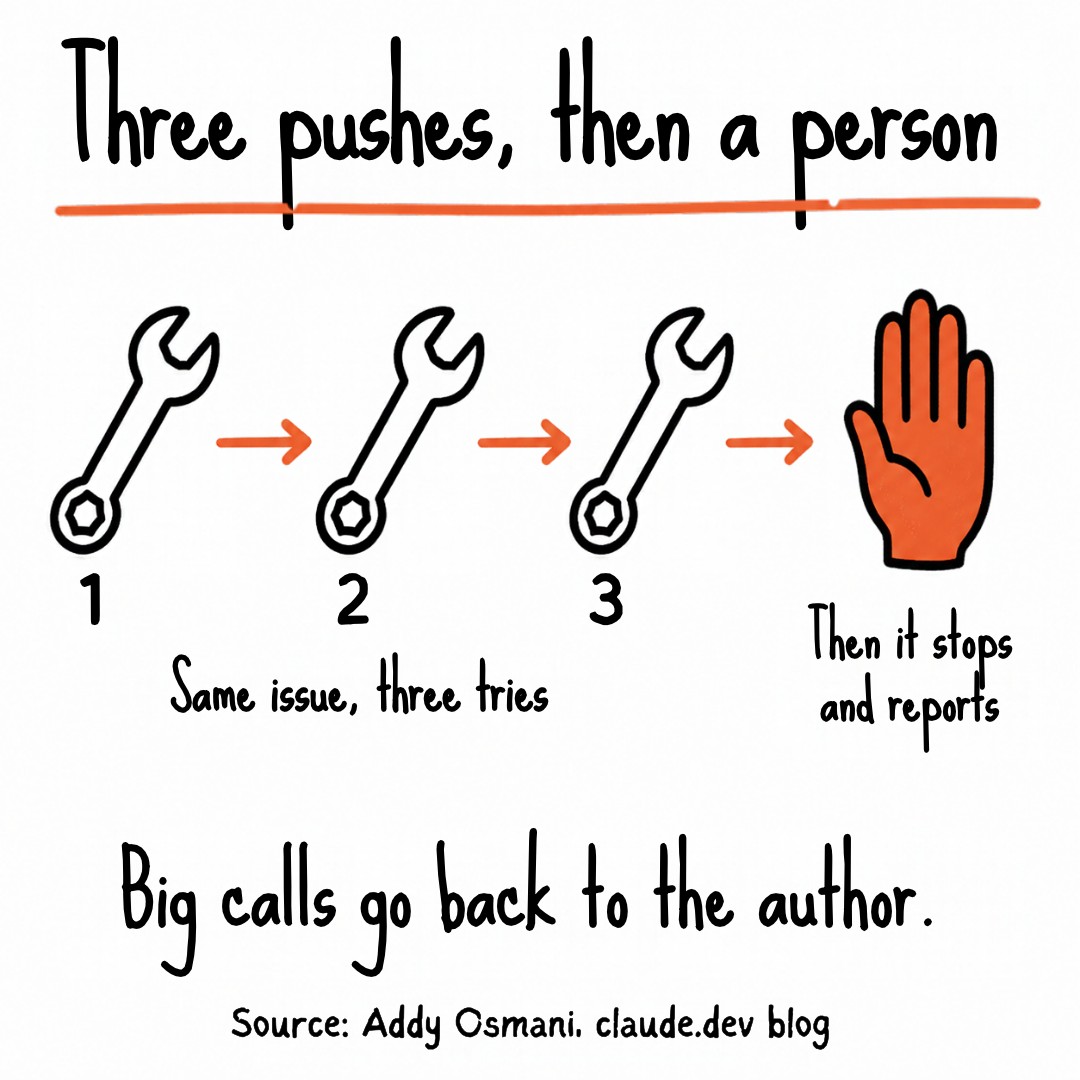
The watch is built to make small changes and pass the big ones up. A request to redesign an API or widen scope, or a security issue it couldn’t resolve, goes back to the author. It also pushes at most three times for one issue and then reports what it tried. That mirrors a rule in Anthropic’s verification post: if a check still fails after three rounds, the approach is probably wrong and a person should step in. The October code review post gives the reason it exists: one command-line pull request went through more than 50 rounds of review and fixes overnight before its author stopped it.
Turning repeats into rules
After a few pull requests, Osmani says, patterns appear: the same comment from the same reviewer, a setup step Claude has to work out each time, a flaky check. The guide’s answer is to write each one into the file that the right tool reads. The catch is that the tools read different files, in different places.
Repeat comments become review rules. If a peer has twice asked you to make sure a new query carries a tenant check, put it in CLAUDE.md for local review, and in a root REVIEW.md if you have Code Review on the repository. Osmani’s example:
# Review instructions

## What Important means here

Wrong results, leaked data or anything that blocks a rollback.
Style and naming are Nit at most.

## Always check
- Database queries are scoped to the caller's tenant.
- New API routes have an integration test.

## Keep it quiet
- Report at most five Nits.
- Skip generated files and lockfiles.
- Behavior claims need a file and line.
Code Review won’t read REVIEW.md from the pull request being reviewed, only from the default branch, and it honours some instructions, such as excluding paths and limiting nits, only when the default branch is protected. The bar for adding a rule is on Osmani’s own team: a pattern has to show up on at least two pull requests, and a person approves the pull request that adds the rule. He adds that rules should be deleted as needed.
Repeat setup becomes a verify skill. If you keep telling Claude how to start the app and reach a page, write it in .claude/skills/verify/SKILL.md: start the stack, wait for the health check to return 200, exercise the changed flow in a browser, take a screenshot and report the steps and what was seen, without claiming success otherwise. Run it a few times and fix any flakiness, he says, because “people ignore verification they don’t trust”.
Repeat maintenance becomes steward rules. The local watch reads .claude/skills/steward/SKILL.md from your working directory, while the cloud PR Steward reads it from the default branch. His example rules say to regenerate the lockfile rather than edit it by hand, re-run a known flaky nightly test once before hunting for a cause, run the tests and linter before pushing a fix, and leave API design comments to the author. The file can’t loosen the watch’s restrictions, but anyone who can merge can edit it, so changes to it deserve the same scrutiny as changes to CI.
Taking it to the team
The last third of the guide is written for the conversation with admins. Osmani says to ask for one repository, a few volunteers and a limited time, then follow five steps.
- Agree the budget first. Everything bills by tokens.
- Protect the default branch. A repository admin requires a pull request with an approval on the latest push and keeps the Claude GitHub App off the bypass list.
- Enable Code Review for the repository, which an Owner of the Claude organisation can do.
- Enable PR Steward in manual mode. It then starts when someone with write access comments
@claude steward, or when authors opt in.@claude stopends it. - Create an observe-mode approval policy. Merging the file switches Approvals on for the repository, so clear it with an Owner before you do.
Two warnings sit in that list. PR Steward is designed not to approve or merge, so branch protection has to require the approvals you want. And because it reads reviewers’ comments, it can be fooled by what people write; use it only with trusted collaborators and check what it changes in response to untrusted ones.
The starter policy lives in .claude/approvals.yml on the default branch. In it, seats is the number of people who must approve, and the author can fill one of those seats. When a rule’s verdict is claude: comments, Claude doesn’t approve, the strictest matching rule wins, and in observe mode the check prints its outcome without approving.
# .claude/approvals.yml
version: 1
mode: observe

rules:
  - purpose: "A change takes two people."
    paths: ["**"]
    verdict: { claude: comments, seats: 2 }
    advisory: [claude/code_review]

  - purpose: "A change to the review rules takes two people."
    paths: ["**/.claude/**", "**/REVIEW.md", "**/CLAUDE.md", "**/CODEOWNERS", ".github/**"]
    nested: inherit
    verdict: { claude: comments, seats: 2 }
That’s the guide’s example with the indentation restored; the original copy lost it in transit. Three details in the guide are easy to get wrong. After the watch has merged the base branch, the latest commit is a merge commit and nobody sits in the author’s seat for it, so the author should comment @claude approve. The advisory line has to stay: once the policy is on the default branch, Code Review starts automatically only on pull requests that match a rule naming it, so dropping the line stops your automatic reviews. And a policy that names Code Review starts billed reviews on every push, in observe mode too and whatever the repository’s Code Review setting says, so tell whoever owns the budget before merging.
To see where a passing review could lower what a path needs, Osmani suggests swapping the advisory line for an override that drops the rule to one seat plus Claude’s approval when claude/code_review = pass. He flags the cost himself: text in a pull request can sway Claude’s review, and when it does, the override lowers what that pull request needs. Paths that must always get a human belong in a rule with no override. Custom classifiers for questions such as “is this pull request related to a migration?” are possible too, but each run is billed, even in observe mode, so he says to begin with paths and the Code Review result.
From observe mode to enforcement
Observe mode only pays off if someone reads the output. Osmani says his team uses the same approach for its own internal commit gate: the gate logs the decision it would have made, so false positives can be studied before anything becomes mandatory. His advice is to wait a week or two, then go back over the merged pull requests and compare each decision with what the human reviewers did, paying most attention to the cases where Claude’s result would have let through something a person caught.
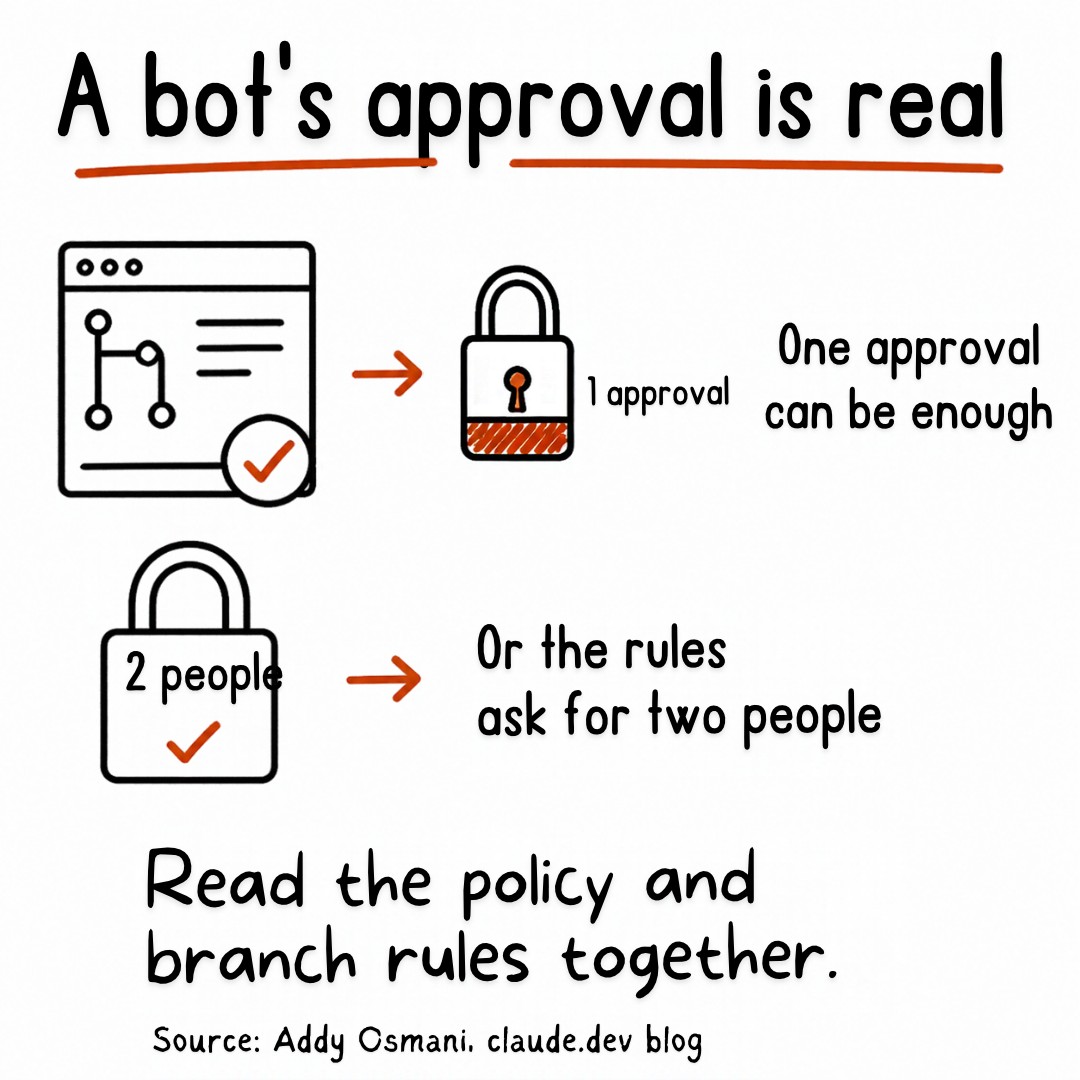
Claude’s approvals count as real approvals on GitHub, so if a ruleset needs only one, Claude’s can be enough by itself. With auto-merge on and a policy only the author can satisfy, pull requests can merge with nobody doing anything. Osmani’s instruction is to decide explicitly, path by path, whether that’s acceptable, and to write the decision down. Then he gives an order for locking down:
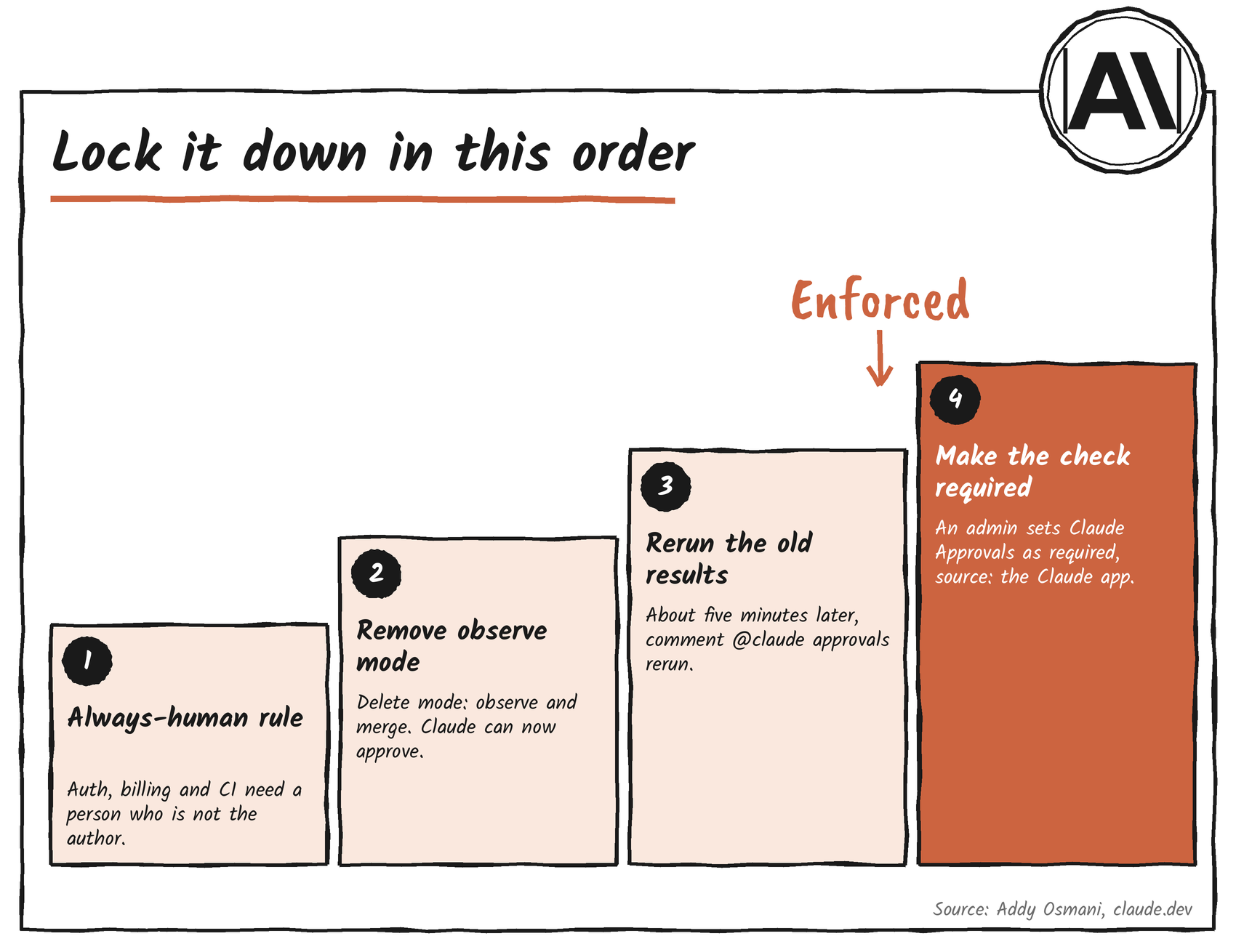
- Add a rule with no condition or override for paths that always need a second person, such as auth, billing and CI. No classifier result can override it, and
nested: inheritcarries it into subdirectories with their own policies. - Remove
mode: observeand merge, so Claude can approve wherever the rules say. - About five minutes later, comment
@claude approvals rerunon open pull requests to clear stale results. Reruns can charge for classifiers again. - Ask a repository admin to make the Claude Approvals check required, with the Claude app as its source. Until then, a pull request can merge whatever the check says.
What the guide doesn’t show
The case for the approach rests on Anthropic’s own repositories. In the October code review post, merged pull requests to Claude Code’s codebase more than doubled from June to September while the share reverted fell by more than 40%, and the share of internal pull requests with substantive review comments rose from 16% to 54% after Code Review’s preview. Those are Anthropic’s figures, and none has been independently checked. The guide itself adds no new numbers.
The guide doesn’t say how often Claude Approvals or Code Review miss a bug, how often an observe-mode decision turned out wrong on Anthropic’s own team, or what a typical review costs; Anthropic hasn’t published a per-review price. Osmani closes the section with a plain disclaimer that Claude Ship and the local commands use AI and “can miss bugs, security problems, and other issues”, so teams should keep their existing tests, scanners and reviewers. The guide also assumes GitHub and, for the team features, a Claude plan with admin controls, and our launch report covers who can’t use the product at all, including organisations with zero data retention.
Rivals are moving in the same direction, with their own limits on how far a model may approve code; the comparison of Copilot, Greptile, CodeRabbit and Cursor’s Bugbot is in the same launch report. The guide also states a responsibility rule. For the Claude Code team, Osmani writes, the person who called the agent is responsible for the change, as if they’d typed it themselves, and the team still owns the scope, design, evidence and merge rules.
The three things he suggests this week
- Today: run
/code-reviewon your current branch and note what it got wrong and what it missed. - Next pull request: in a repository where you trust everyone who can merge, try
/shipand stay nearby. Try/stewardon an existing one, from a different terminal and checkout. - By Friday: open a small pull request with the rule you repeated most, in CLAUDE.md, REVIEW.md or a skill, and commit it yourself, since
/shipwon’t commit rule files. Share it with your team along with the example observe-mode policy.
Osmani ends by asking readers to tell him which rule file ended up most useful and which tasks they chose to keep doing themselves. Anthropic hasn’t said when PR Steward and Claude Approvals leave beta.
Sources: Addy Osmani, A practical guide to shipping with Claude Code (X, 25 November 2026 NZ); Anthropic, How the Claude Code team does code review (15 October 2026) and How the Claude Code team thinks about verification; Claude Code documentation for /ship; addyosmani.com bio and farewell-to-Chrome post (30 November 2025); Wired, 2003; GitHub, addyosmani/agent-skills.
Discover more from Sulat AI & Tech News
Subscribe to get the latest posts sent to your email.