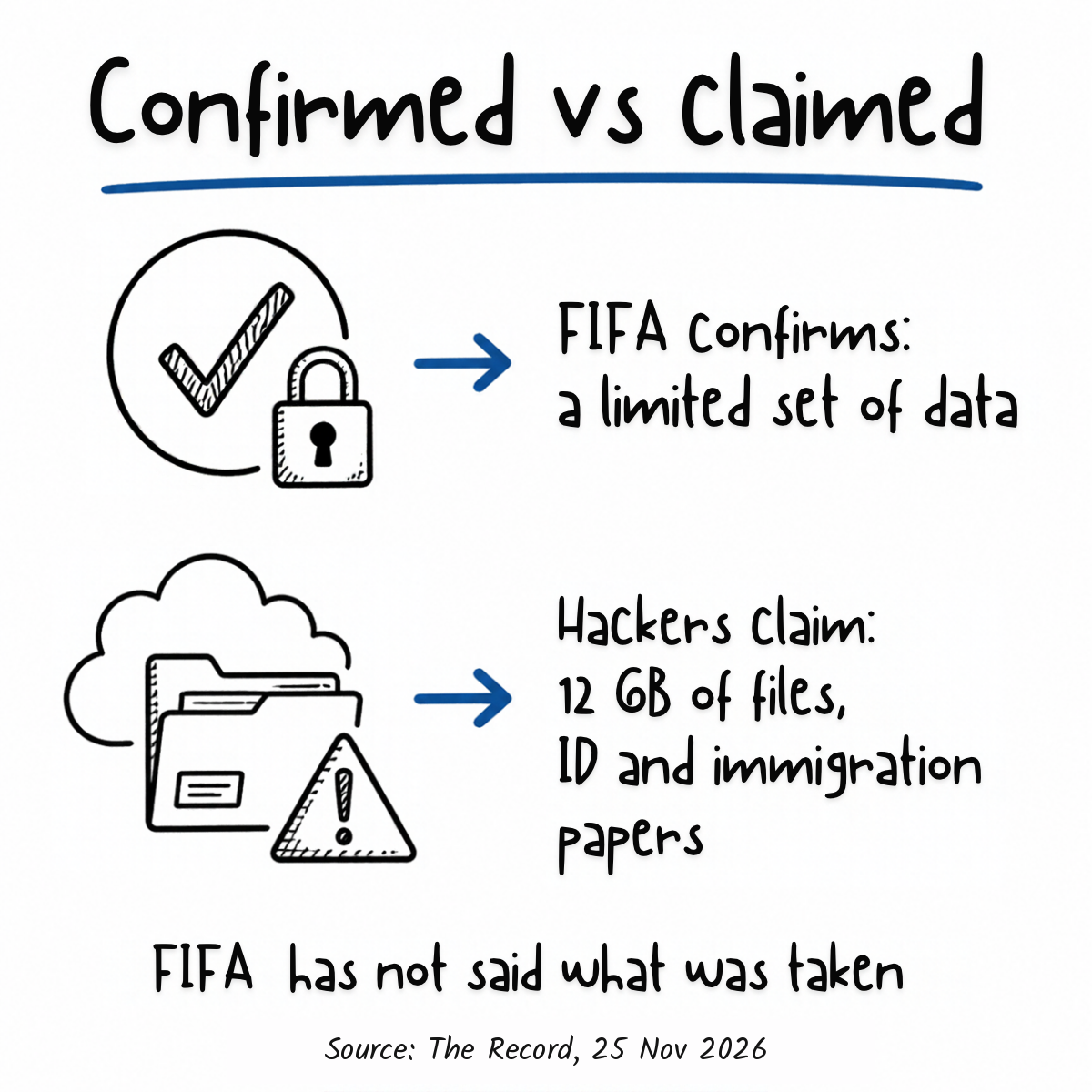
FIFA has confirmed that hackers got into its systems. A spokesperson told The Record on 25 November that someone had gained “unauthorised access to a limited set of personal and business information”, and that FIFA is working with the relevant authorities, including law enforcement.
A new group calling itself the Handsome Boy Hacking Club (HBHC) says the haul is bigger than that phrase suggests: more than 12 GB from FIFA’s Microsoft environment, including identity and immigration documents, posted on a cybercrime forum after FIFA refused to pay. FIFA hasn’t said what was taken, whose data it is, or whether the group’s claims are true.
I haven’t seen the files. The only outlet I found that has examined a copy is DarknetSearch, a company that sells dark web monitoring, so I attribute everything it found to it. Its review was written on 23 November, before FIFA said anything, and it still calls the breach unverified. FIFA’s statement has since settled that part.
- FIFA confirmed unauthorised access to a “limited set” of personal and business information, and condemned its publication.
- The group claims 12 GB, including identity and immigration documents, financial and legal records, and governance files.
- DarknetSearch says a copy holds 2,460 files, including 169 passport-titled and 116 visa-titled files. FIFA hasn’t confirmed any of that.
- FIFA hasn’t said who is affected, or whether it has notified Swiss or EU regulators.
What FIFA has said
FIFA’s statement is short. Beyond the sentence above, it said:
FIFA condemns in the strongest possible terms the unlawful acquisition and publication of information, particularly personal data. Such actions constitute a serious and unacceptable violation of privacy and can have significant consequences for the individuals concerned.
FIFA spokesperson, quoted by The Record, 25 November 2026
The word “publication” is the useful one. FIFA is acknowledging that the material is out, not just that someone got in. It didn’t answer The Record’s follow-up questions about the nature of the incident. FIFA is based in Zurich and has about 700 employees, so Swiss law is the first place to look for what it owes the people involved.
| Question | Where it stands |
|---|---|
| Was FIFA accessed without authorisation? | Yes. FIFA confirmed it. |
| Did FIFA say what was taken? | No. It said a “limited set” of personal and business information. |
| Did FIFA say whose data it is? | No. |
| Is the 12 GB figure confirmed? | No. It is the group’s claim. |
| Is it ransomware? | DarknetSearch saw no ransom note and no sign of encrypted match systems. |
| Are matches at risk? | DarknetSearch says nothing in the files shows that. |
What the group says, and when
The Record says HBHC claimed the theft last week, tried to extort FIFA and failed, then published the data on a cybercriminal forum, claiming it came from FIFA’s Microsoft environment. The group emerged only last week, and The Record says little is known about its members or associations. The dates below come from tracker listings, the forum post and the vendor’s review.
| When | What happened |
|---|---|
| 12 Nov | Thirty download-failure notices inside the archive carry this date, according to DarknetSearch. |
| 19 Nov | HBHC appears on leak-site trackers with three US targets. |
| 20 Nov | FIFA is listed, recorded by trackers at 01:22 UTC. |
| 21 Nov | A forum post at 06:14 offers a 12.2 GB archive, describing identity documents, immigration records, executive information, financial data and legal documents. |
| 23 Nov | DarknetSearch reviews a copy. LaLiga says fans’ data was stolen in a separate attack. |
| 25 Nov | FIFA’s statement to The Record. |
The forum post says the group is financially motivated and “not interested in the country of origin”, and it warns that some folders may be corrupted or duplicated. Early press coverage on 21 November saw no samples. A French outlet, FrenchBreaches, later saw screenshots of a file tree and listed what they couldn’t prove: that every file came from FIFA, that every file was authentic, or how many people were affected.
What a security vendor found in the files
DarknetSearch says it obtained a copy of the published collection and examined it. These are its findings, not mine, and FIFA hasn’t confirmed any of them.
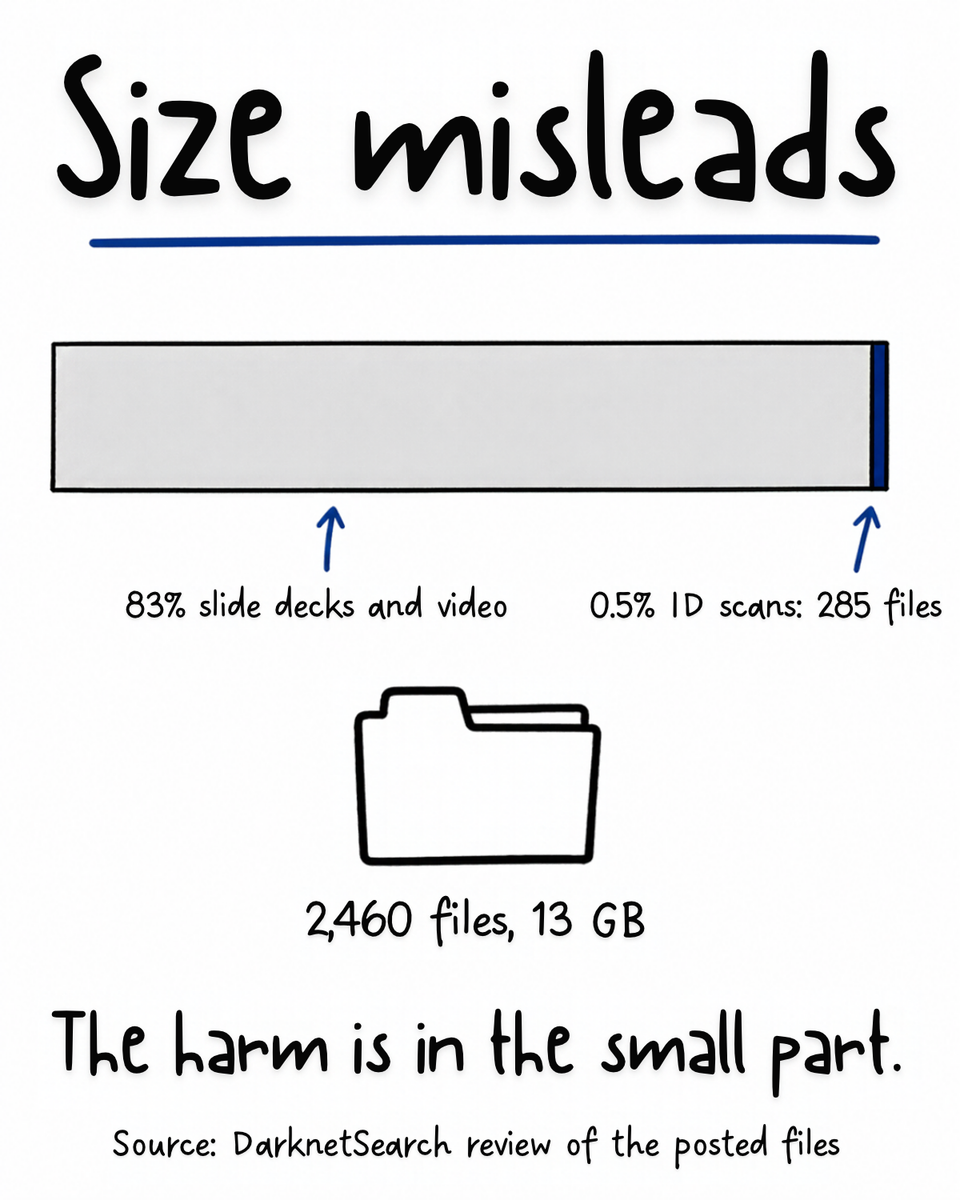
- Size. 2,460 files and 13.15 GB unpacked. About 83 percent of that is slide decks and training video.
- Identity documents. 69 MB, made up of 169 files titled as passports and 116 titled as visas. It says they opened as real document images, including material for senior officials and people travelling with them. It withheld names and images.
- Travel. Tickets, hotel bookings and three private-jet manifests, with council planning for November and December 2026 still being edited on 11 November.
- Commercial files. Negotiation notes, unpublished revenue workbooks and screenshots of an internal dashboard showing 106.0 million registered customers. It says the customer list behind that screen isn’t in the archive.
- Passwords. A workforce pack for the U-17 tournament in Qatar includes a venue wireless password, which the vendor withheld.
It concludes the files are genuine FIFA working documents copied from a Microsoft 365 environment, and rates the harm high for the people in the identity and travel files and high for FIFA’s commercial confidentiality. It rates the risk to match integrity low. Its limits are plain: it didn’t match the copy to a publisher checksum, it doesn’t know whether the files came from FIFA’s own tenant or a supplier, and it hasn’t identified the account that downloaded them.
The group’s other claims
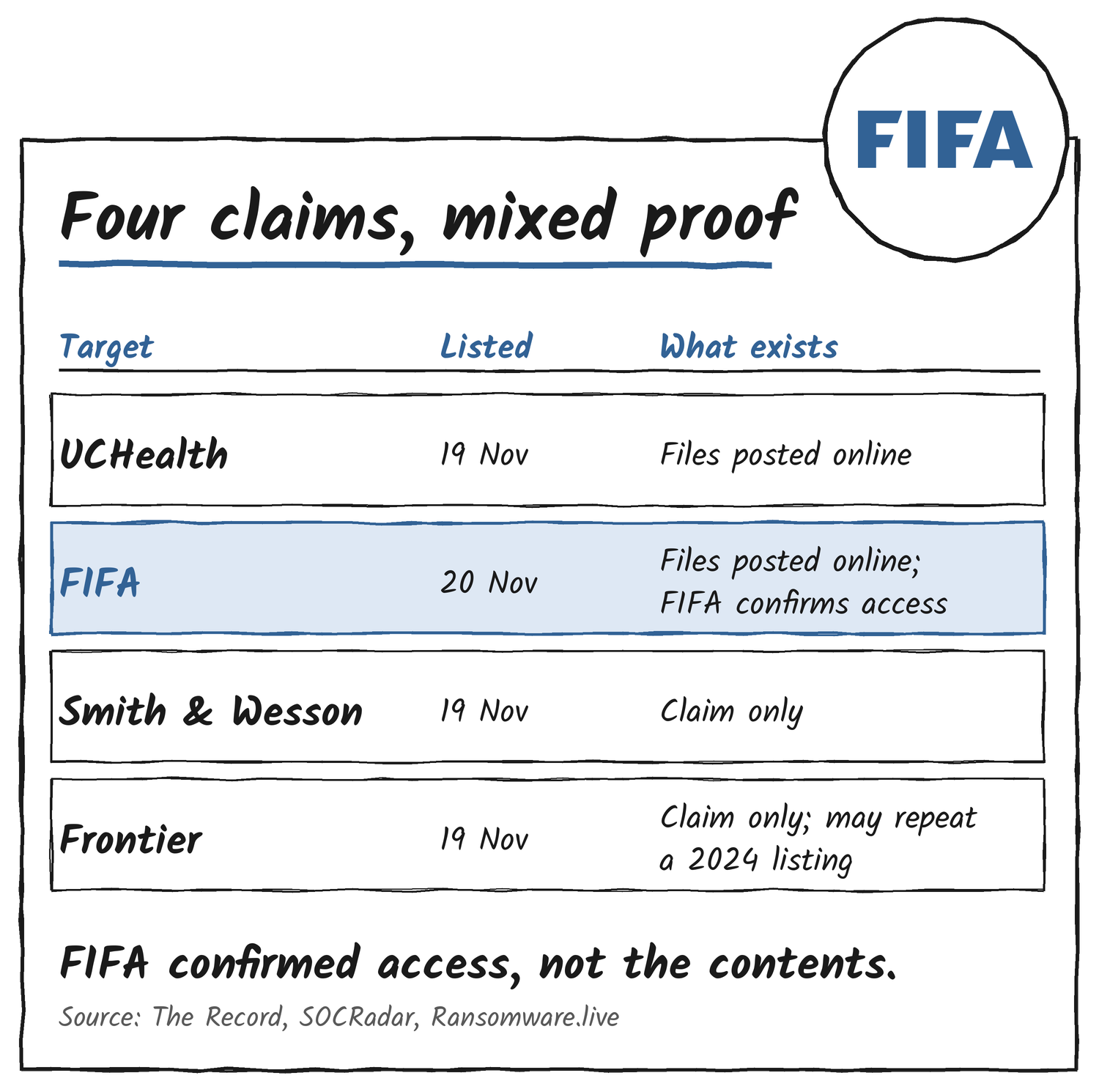
SOCRadar’s ransomware tracker lists four HBHC victims, all first seen in November 2026. FIFA and UCHealth are marked as data leaked. Frontier Communications and Smith & Wesson are marked as claimed. Ransomware.live flags the Frontier listing as a possible duplicate: Frontier said it detected a breach on 14 April 2024, which the RansomHub group claimed at the time, according to BleepingComputer. Ransomware.live calls HBHC an emerging group and says its claims should be treated with caution until independently verified.
UCHealth is a separate case. On 13 November it disclosed a July incident involving two employee accounts in its Microsoft cloud, with notification letters going to about 129,000 people and its medical-record system untouched. Nobody has tied that disclosure to HBHC’s listing.
Football has had a bad year
The Record places the FIFA incident among other recent attacks on European football. Spain’s LaLiga said on Monday that hackers stole fans’ personal information in an attack on its digital services and those of several Spanish clubs. In May, Dutch police arrested a 35-year-old man suspected of hacking Ajax. The French Football Federation disclosed a cyberattack in 2025.
FIFA had its own warning in June. A researcher known as BobDaHacker found that signing up as a prospective football agent put an account into FIFA’s Microsoft Entra tenant, and that backend checks didn’t enforce roles. iTnews and Dark Reading reported that it exposed World Cup stream keys, camera controls and match-management functions. DarknetSearch says the November collection doesn’t look like that event, and nothing public links the two.
What FIFA owes, and to whom
Under Article 24 of Switzerland’s Federal Act on Data Protection, a controller must notify the Federal Data Protection and Information Commissioner “as quickly as possible” of a breach likely to lead to a high risk to the people concerned. It must also tell those people if that is needed to protect them, or if the Commissioner asks. The Swiss act sets no hourly deadline. For people in the EU, the GDPR can apply at the same time, and Article 33 expects notification to the supervisory authority within 72 hours where feasible.
FIFA hasn’t said whether it has notified the Commissioner, an EU authority or any individual.
If you’ve sent FIFA a passport or visa
FIFA hasn’t said who is affected, so the safest assumption for anyone who has sent it identity documents, as staff, a freelancer, an agent or a travelling delegate, is that they might be.
- Treat unexpected messages that mention FIFA events, bookings or accreditation as suspect, even when they quote real details. Reply through a number or address you already hold.
- Ask FIFA directly whether your documents are in scope, and keep the reply.
- Ask your passport or visa issuer whether replacing an exposed document is possible, and watch for identity checks on your name where a credit freeze is available.
- If you’re a commercial partner, ask whether your contracts or negotiation papers sit in the affected systems.
What I make of it
This section is analysis, not reporting.
First, “limited” is a word, not a number. FIFA hasn’t backed it with a count of files or people. The vendor’s figures show how both descriptions can hold: 13.15 GB is mostly video and decks, and the identity scans are about half a percent of the volume. Size is the wrong yardstick here.
Second, the group deserves caution and the files deserve attention. An emerging group that lists victims in bursts has at least one listing that looks like a repeat. But FIFA’s own statement confirms acquisition and publication, and the only public look at the contents says they’re real working documents. I can’t verify that look, and FIFA hasn’t endorsed it.
Third, the useful signals to watch are FIFA naming the scope, a notification to the Swiss Commissioner, and letters to individuals. Until one of those arrives, the people in those passport and visa files are guessing.
Sources
- The Record: FIFA says hackers accessed ‘limited set of personal and business information’, 25 November 2026
- DarknetSearch: FIFA has not confirmed a breach. A published archive was obtained and reviewed., 24 November 2026 (a vendor review, prepared 23 November)
- SOCRadar: Handsome Boy Hacking Club ransomware group profile
- Ransomware.live, group page for Handsome Boy Hacking Club
- iTnews: Access control flaw left FIFA World Cup match streams wide-open, 17 June 2026
- Dark Reading: FIFA Bug Exposes World Cup Streams to Remote Takeover, 18 June 2026
- Fedlex: Federal Act on Data Protection (FADP), Article 24
Discover more from Sulat AI & Tech News
Subscribe to get the latest posts sent to your email.