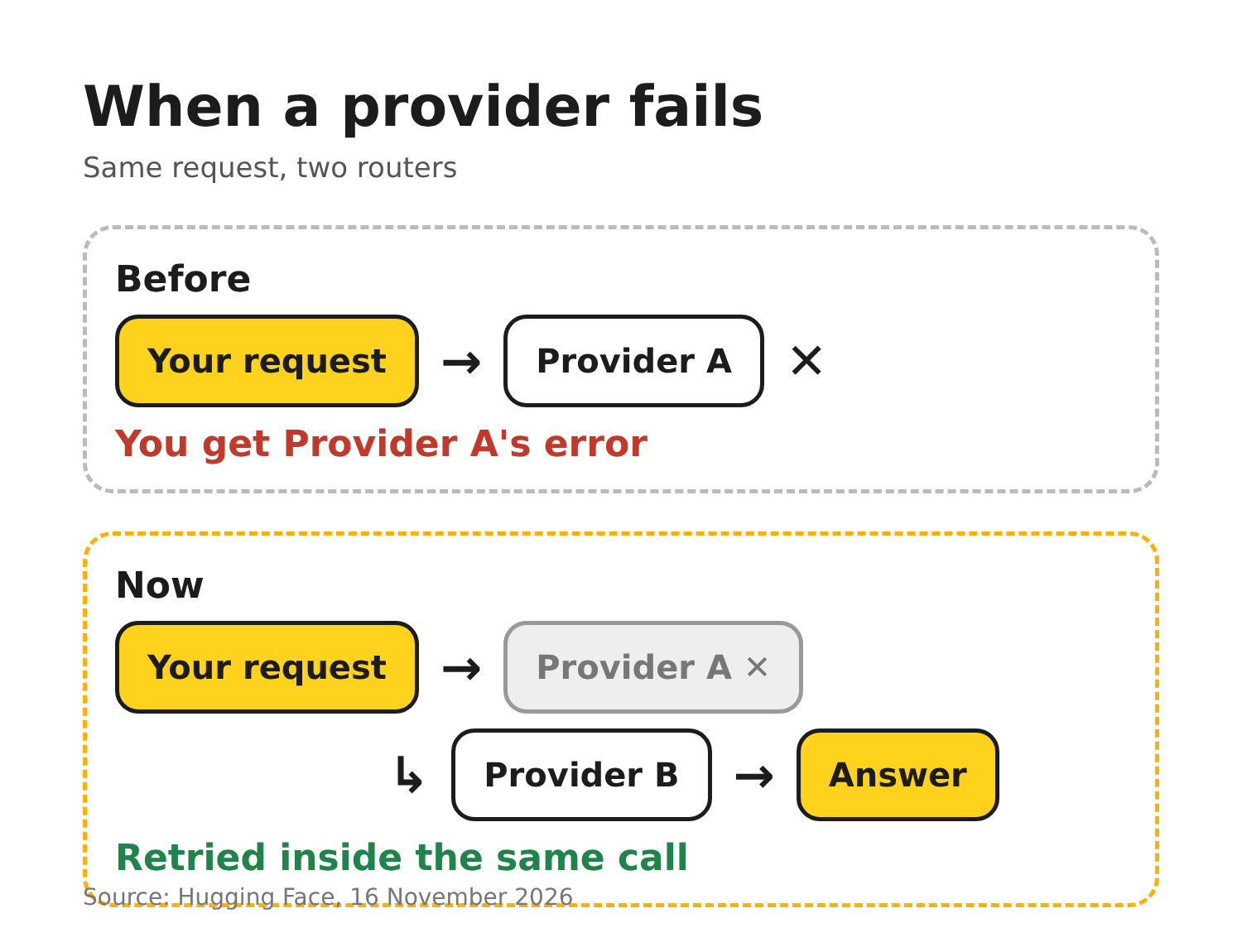
Hugging Face has switched its Inference Providers service to OpenRouter’s router for language models, so a Hugging Face token now reaches any open-weight model on the Hub that a provider serves. Hugging Face says OpenRouter picks the provider for each call from live price, speed and reliability, and retries on another provider if the first one fails.
Hugging Face announced the change on X on 16 November, saying OpenRouter is “integrated into Hugging Face directly” with the same token and endpoint, live model stats on the Hub and a redesigned inference widget.
We’re teaming up to accelerate open-source AI.
— Hugging Face (@huggingface) 16 November 2026
OpenRouter is now integrated into Hugging Face directly. Same token, same endpoint, plus live model stats on the Hub and an inference widget we redesigned together.
The best of open, in one place. huggingface.co/blog/openrouter
Inference Providers is Hugging Face’s pay-as-you-go service for calling hosted models through one API. Until now it picked a single provider for your request and returned that provider’s error if it failed. Now the request moves to the next provider inside the same call, according to Hugging Face’s blog post. Image, video and audio generation aren’t part of the switch and still run directly through Hugging Face.
How the routing works
OpenRouter is a router that sends requests to model providers. Hugging Face says OpenRouter serves more than 800 trillion tokens a month to over 10 million users, across 600-plus models from 80-plus providers. Its routing was rebuilt in October. OpenRouter’s own measurements, which Hugging Face repeats, put the gains at 46% fewer capacity errors, 16.9% faster time to first token and 16.3% higher throughput. OpenRouter’s post adds a cost: 6.0% higher cost per request in the live experiment.
The router accepts OpenAI’s Chat Completions and Responses APIs and Anthropic’s Messages API for every chat model, whatever provider sits behind it. Hugging Face has setup guides for Claude Code, Codex, OpenCode, Pi and Hermes Agent. Routing is also cache-aware: a conversation stays on the provider that holds its prompt cache, and you can pin that by sending a stable UUID per conversation in the X-HF-Session-Id header.
You can still steer the router with a suffix on the model ID. The default balances price, speed and reliability, :fastest picks the highest throughput, :cheapest the lowest price, and a provider name such as :novita restricts the call to that provider.
zai-org/GLM-5.3            # default: best mix of price, speed and reliability
zai-org/GLM-5.3:fastest    # highest throughput
zai-org/GLM-5.3:cheapest   # lowest price
zai-org/GLM-5.3:novita     # only Novita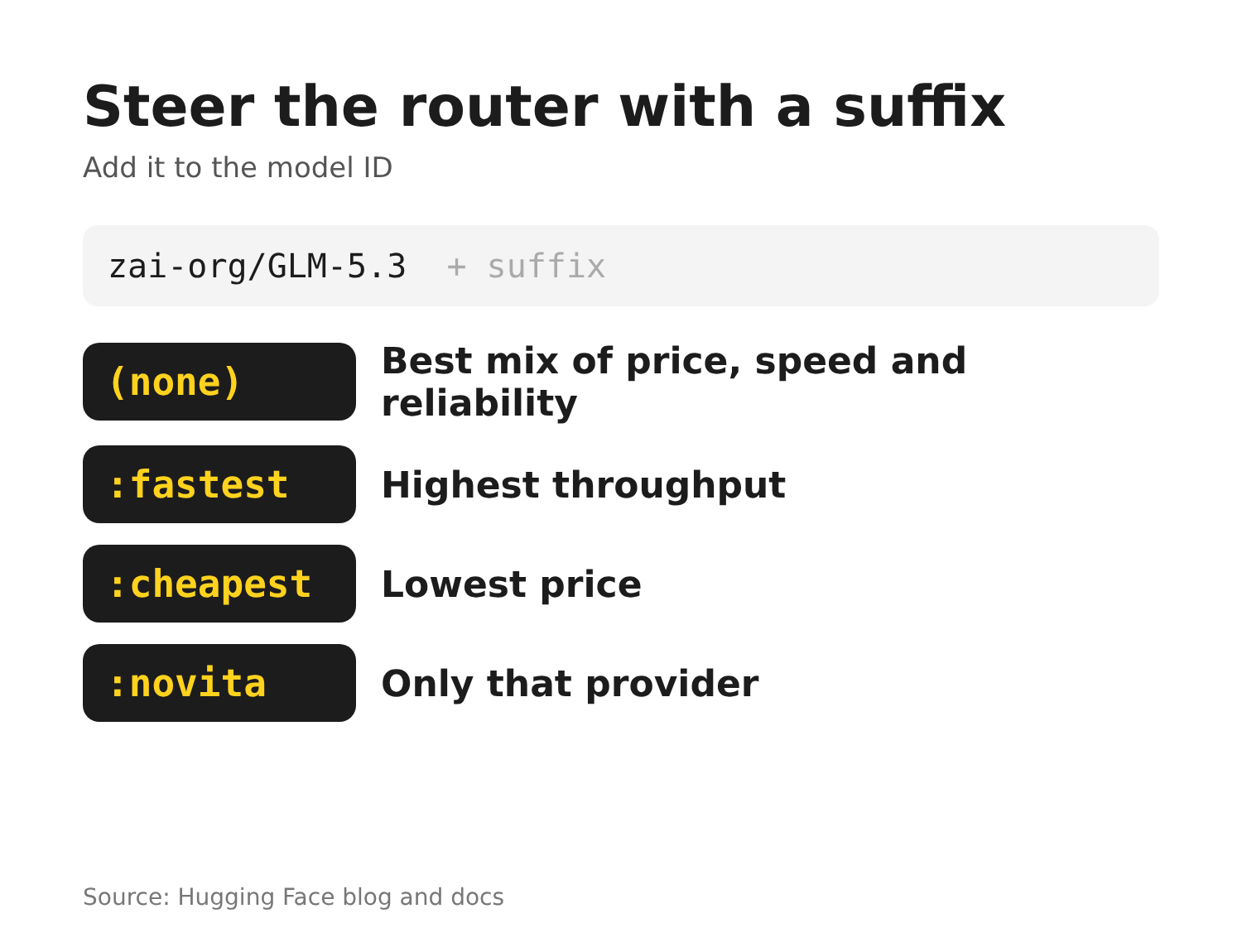
What shows up on the Hub
Each model page has two new tabs. Providers lists every provider OpenRouter can route the model to, with input and output prices, speed and uptime over the last 24 hours. Metrics shows the best price, throughput, time to first token, context length and uptime among them. Your usage overview now breaks spend down by the provider each request went to, and in your settings you can switch off any provider so the router never uses it. Organisations get the same controls, and they apply to every request billed to the organisation.
OpenRouter’s announcement says 160 models from 38 labs are available this way. That’s every model OpenRouter serves that also has a page on the Hub. It lists DeepSeek V4.1 Flash, Kimi K3.1 Pro and K3, GLM 5.3 and GLM 5.3 Flash, Qwen3.8 27B, MiniMax M3.1 Flash, MiMo-V2.6-Flash, NVIDIA Nemotron 3 Ultra and OpenAI gpt-oss-120b among them.
Traffic can flow back to the Hub too. In OpenRouter’s setup, you can have each request saved as a JSON file in a Storage Bucket you own: the input messages, the model’s output, token counts and cost, minus images and other media. OpenRouter lists the Broadcast destination as beta.
The case Hugging Face makes for open weights
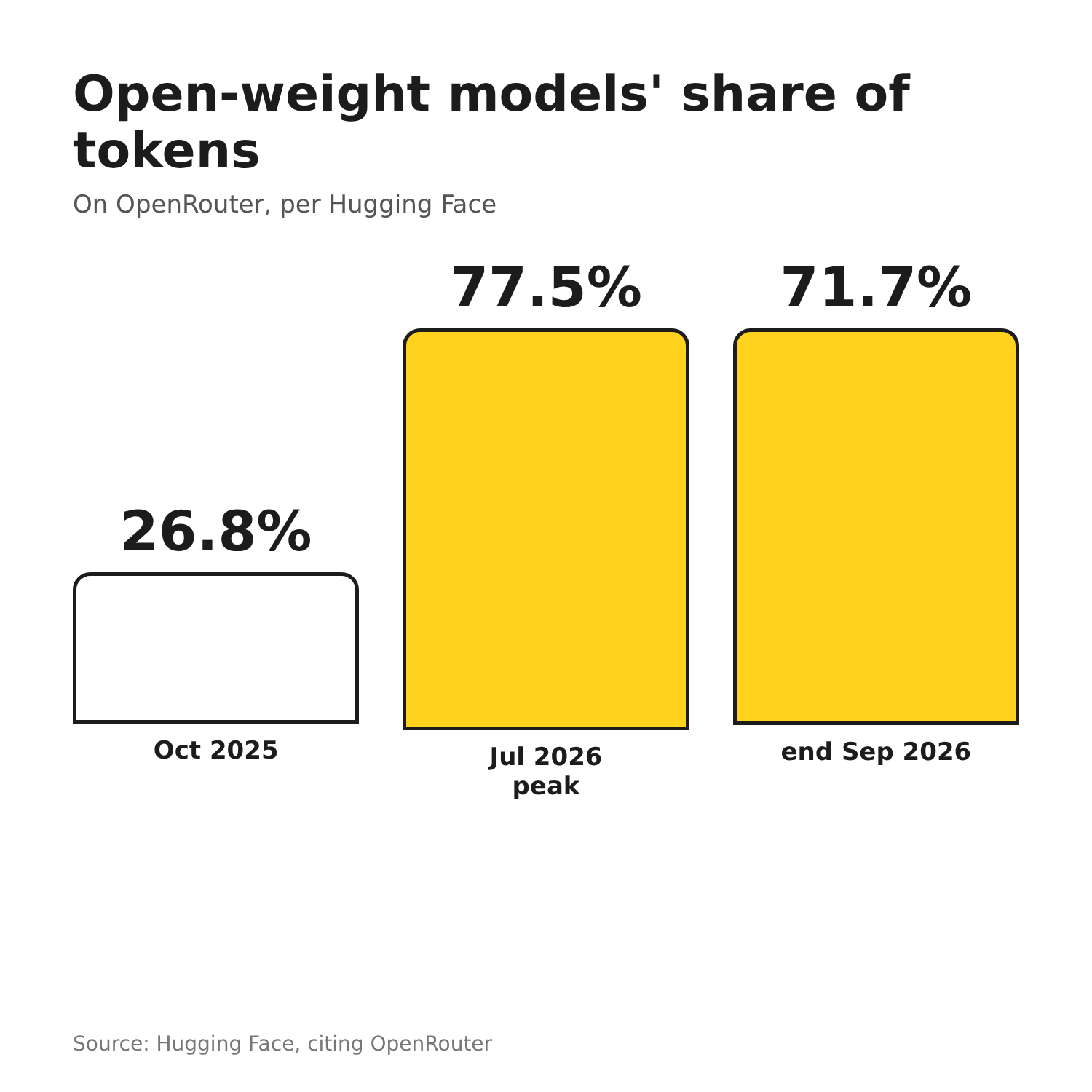
Hugging Face backs its pitch with OpenRouter’s numbers. In October 2025 open-weight models made up 26.8% of the tokens OpenRouter served; by the end of September 2026 that was 71.7%, down from a July high of 77.5%. Weekly open-weight volume grew more than 60-fold over the period, and closed-model volume almost tenfold. The most used model on OpenRouter this week is open-weight: DeepSeek V4.1 Flash 1017, at 59.2 trillion tokens.
Open-weight models are also cheaper, Hugging Face says. On average they cost US$0.28 per million input tokens and US$1.62 per million output tokens, where closed models average US$1.27 and US$6.36. They still trail on the hardest benchmarks. On the Artificial Analysis Intelligence Index, Kimi K3.1 Pro, the best open-weight model, scores 46 against 65 for Claude Fable 5.2, at about a seventh of the cost per task (US$3.68 against US$26.54).
Pricing and the breaking change
Hugging Face says pricing is unchanged. The bill carries the provider’s price with no markup from Hugging Face. PRO accounts get US$2 in credits a month, and Team and Enterprise organisations get US$2 per seat, per its pricing page.
One thing breaks. Language-model requests are now billed to your Hugging Face account or organisation, so a personal API key for a provider no longer works with these models. Provider suffixes and the settings switches still do, and custom keys for image and video providers carry on.
Hugging Face’s post lists two next steps: connecting your OpenRouter account to Hugging Face, and routing more tasks through OpenRouter. It hasn’t given dates for either.
Sources
- Hugging Face on X, 16 November 2026
- Hugging Face and OpenRouter join forces to make open-weight models easy to run, Hugging Face
- OpenRouter Now Powers Inference on Hugging Face, OpenRouter
- Inference Providers documentation, Hugging Face
Discover more from Sulat AI & Tech News
Subscribe to get the latest posts sent to your email.