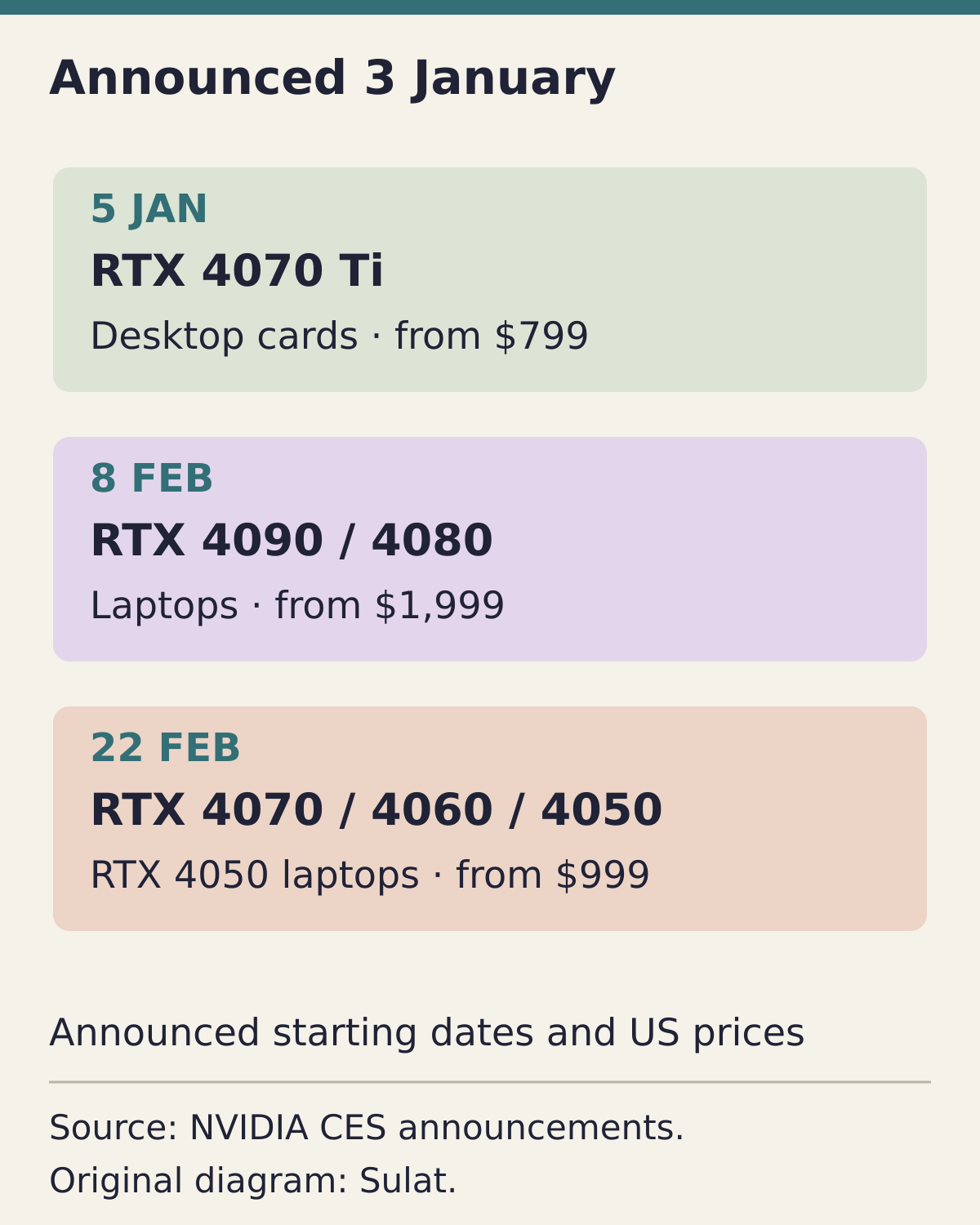
NVIDIA announced the GeForce RTX 4070 Ti on 3 January, extending its Ada Lovelace desktop lineup with a card due on 5 January from $799. It has 7,680 CUDA cores and 12GB of GDDR6X memory.
Sulat illustration; NVIDIA logo.
The company also announced RTX 40 Series laptop GPUs. RTX 4090 and 4080 systems are due on 8 February, starting at $1,999. RTX 4070, 4060 and 4050 laptops follow on 22 February; the entry RTX 4050 tier starts at $999.
AI fills in additional frames
The shared Ada architecture supports DLSS 3, introduced in September. The technology combines image reconstruction with AI-generated frames. An optical-flow accelerator examines consecutive images, while game-engine motion information helps a neural network synthesize an additional frame.
That distinction matters when comparing frame-rate claims. A generated frame is different from a fresh game-engine update. NVIDIA says the GPU-side process can lift displayed frame rates even when the CPU limits the game. Its launch comparisons therefore need to be read alongside their rendering settings and enabled features, rather than treated as a universal increase in raw computing speed.
Availability
The laptop range adds fifth-generation Max-Q efficiency features. These are planned starting dates; individual manufacturers set availability. Laptop names do not imply desktop-equivalent performance.
The desktop card will be sold through board partners and system builders. NVIDIA lists a 285W total graphics power rating. That specification is distinct from its workload-dependent average gaming-power measurements.
The lineup follows NVIDIA’s October withdrawal of the planned 12GB RTX 4080. The company said sharing the 4080 name between two GPUs was confusing, while keeping the 16GB model on its November schedule. That earlier naming decision is separate from January’s announced availability dates.
Discover more from Sulat AI & Tech News
Subscribe to get the latest posts sent to your email.