Google Quantum AI has demonstrated a small but important improvement in quantum error correction: a logical qubit built from 49 physical qubits made fewer errors than the average of smaller, 17-qubit versions. The result, published in Nature on February 22, tests whether adding hardware can make stored quantum information more reliable.
Photo: Anthony Quintano, “Google at the 2012 Democratic National Convention North Carolina”. CC BY 2.0. Resized and cropped.
The improvement is roughly 4% relative to the smaller codes. It’s a step toward a scalable quantum memory, with substantial work still needed before the approach can support useful, fault-tolerant computations.
What the researchers measured
The experiment used a 72-qubit superconducting Sycamore processor. Within it, the larger surface code combined 25 data qubits with 24 measurement qubits. Each smaller code used nine data qubits and eight measurement qubits. These arrangements are called distance-5 and distance-3 codes, respectively.
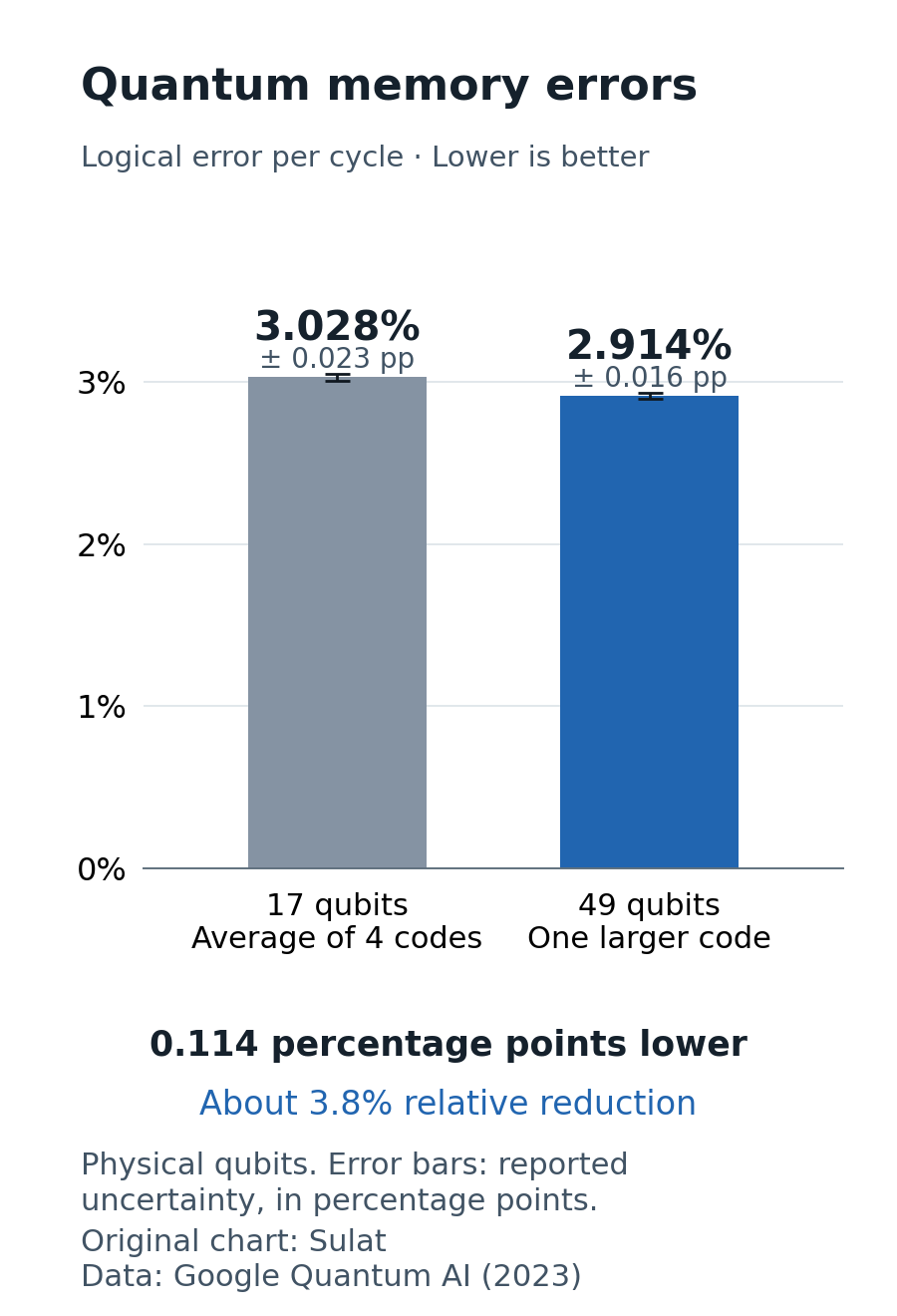
The researchers compared the larger arrangement with four smaller codes covering its quadrants. Using an approximate maximum-likelihood decoder to interpret the measurements, they obtained a logical error rate per error-correction cycle of 2.914%, against 3.028% for the smaller codes on average. The reported uncertainties were 0.016 and 0.023 percentage points.
That difference is 0.114 percentage points. Dividing it by the smaller codes’ 3.028% error rate gives a reduction of about 3.8%, rounded to 4%. Calling it a four-percentage-point improvement would substantially overstate the result.
The comparison covered experiments lasting up to 25 error-correction cycles. The larger code beat the average of the smaller codes, but two individual smaller codes had slightly lower per-cycle error rates than the larger one. Results also depended on the decoding method: a faster belief-matching decoder gave an improvement of about 2%.
Why more qubits can help
A physical qubit is an individual piece of quantum hardware. A logical qubit stores information across a group of physical qubits, so a local error need not destroy the information. The surface code protects against both bit-flip and phase-flip errors.
Measurement qubits repeatedly check relationships between neighbouring data qubits. Those checks can reveal evidence of errors without directly reading out the stored logical state. A classical decoder examines the measurement history and infers how errors have affected the information.
The difficulty is that the extra hardware and operations can introduce extra errors. Increasing the code’s size helps only when its added protection outweighs that added noise. Google’s experiment shows a modest benefit at the two sizes tested, making the quality of the physical components as important as the number of qubits.
What remains to be demonstrated
The paper focuses on preserving logical memory. It doesn’t demonstrate a general-purpose fault-tolerant computer or a commercially useful quantum calculation.
The authors also caution that the device appears to sit in a crossover regime. In that regime, increasing a code’s size can initially reduce errors, yet further increases can reverse the benefit. The result therefore doesn’t establish that errors will keep falling as the same hardware design grows indefinitely.
Their modelling suggests component performance needs to improve by at least 20% to move below the threshold for sustained improvement with scale, and substantially more for practical scaling. Those estimates use simplified models and need experimental validation with larger codes running for longer.
A separate repetition-code experiment reached much lower error rates, but it protected against bit flips alone. Because it didn’t also correct phase errors, those numbers can’t be treated as the performance of the full surface-code logical qubit.
Google describes the result as the second milestone on its quantum-computing roadmap. The immediate significance is a measurable answer to a basic engineering question: with sufficient control of errors, a larger protected qubit can outperform a smaller one on average. Turning that narrow advantage into reliable, large-scale computation remains the next challenge.
Sources: Google Quantum AI’s Nature paper and Google Research announcement, both published February 22, 2023. This explainer paraphrases research by Google Quantum AI, published in Nature 614, 676–681 under CC BY 4.0; the wording and structure have been changed.
Discover more from Sulat AI & Tech News
Subscribe to get the latest posts sent to your email.