The European Union’s Chips Act cleared its final legislative vote on 25 July, completing the approval process for a programme intended to expand chip research, manufacturing and supply-chain protection. Signature and publication are still required before the regulation takes effect.
File photo: European flags. © Håkan Dahlström, Spain, 2010. Original photograph, CC BY 2.0, via Wikimedia Commons. Resized and cropped. This isn’t the July 2023 announcement.
The Council puts the investment ambition at €43 billion in public and private funding, including €3.3 billion from the EU budget. Its manufacturing ambition is to raise the EU’s global semiconductor market share to at least 20% by 2030. The adoption documents also set out the budget steps and factory constraints that will shape delivery.
The request to complete the budget
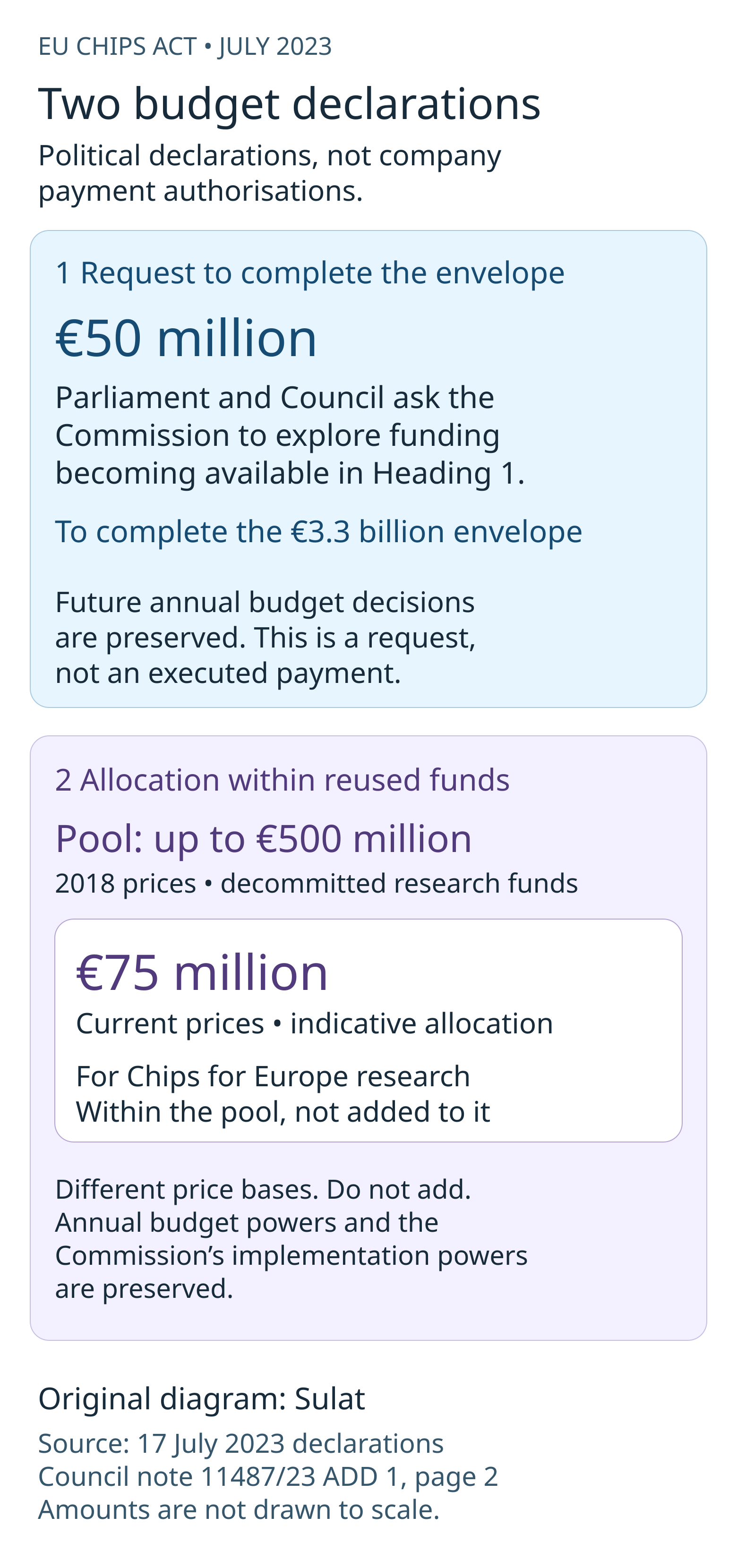
In a joint declaration circulated with the adoption documents, Parliament and Council ask the Commission to explore funding becoming available under the EU budget’s Heading 1 to provide €50 million to complete the €3.3 billion envelope. This is a request to explore budget reinforcement, with future annual budget decisions expressly preserved.
In a separate joint political statement, Parliament and Council agree an indicative €75 million allocation, in current prices, for Chips for Europe research from previously decommitted research funds. That pool is up to €500 million in 2018 prices. The two figures use different price bases, and the €75 million is an allocation within that pool, rather than a fresh addition to it. The statement preserves annual budget powers and the Commission’s role in implementing the budget.
These statements sit alongside Parliament’s 11 July announcement that it had secured €3.3 billion for chip research and innovation. The declarations record political commitments; they don’t themselves authorise payments to companies. Their practical significance is the distinction between agreeing the programme’s scale and completing its budget implementation.
Emergency powers have a technical limit
The text adopted by Parliament on 11 July also narrows what emergency intervention can accomplish. Article 23 requires serious supply-chain disruptions or obstacles to semiconductor trade within the EU, causing significant shortages. Those shortages must prevent the supply, repair or maintenance of essential products to an extent that would seriously harm critical sectors. The Commission needs concrete and reliable evidence and consultation with the European Semiconductor Board before proposing activation. The Council decides by qualified majority.
The initial crisis period can last no more than 12 months. Extensions require another Council decision, and the emergency measures stop when the crisis stage expires or ends early.
During a crisis, the Commission can require recognised integrated production facilities and open EU foundries to prioritise orders. Article 26 also covers certain other chip businesses, including firms that accepted such obligations when receiving public support. The orders are a last resort, with fair and reasonable prices and limits protecting affected businesses.
For orders to recognised facilities, the Commission must hear the producer on feasibility. It mustn’t issue an order that the company can’t fulfil because of inadequate capacity, capability or technical constraints, even with priority treatment. An unreasonable economic burden causing particular hardship, including substantial business-continuity risk, also rules it out.
That safeguard matters for shortages of specialised chips. A legal power to move an order up the queue can’t make a factory capable of producing a component it lacks the technology to manufacture. Priority orders can redirect available production, while investment and research address the separate problem of building capability. The safeguards make that distinction an explicit constraint on emergency intervention.
Common purchasing has its own conditions. Article 27 requires a request from at least two member states during an activated crisis, followed by a Commission assessment. Participating governments must agree the mandate and liabilities. The mechanism covers public procurement of crisis-relevant products for critical sectors. It can include financing production or development in exchange for priority access to the result.
What the approval changes
The vote completes the formal adoption left outstanding by the April political agreement. Parliament approved its position on 11 July by 587 votes to 10, with 38 abstentions.
The Council also approved the separate amendment needed to turn the Key Digital Technologies Joint Undertaking into the Chips Joint Undertaking. It says the two texts will be published together. The Chips Act will enter into force on the third day after its publication in the EU’s Official Journal.
The vote completes legislative approval. Publication and the budget implementation described in the accompanying declarations remain separate steps.
Discover more from Sulat AI & Tech News
Subscribe to get the latest posts sent to your email.